Air compressors come in all shapes and sizes, so knowing which is the best one for painting can be a challenge.
We turned over every stone to bring you our take on the best available air compressors for painting, whether it be for your car, house, furniture, or walls.
- 3,000 hour life cycle
- Fast refill time
- Dual-piston pump
- Oil-free pump
- 6-gallon tank
- Built-in auto thermal overload protection
- Comes in complete set
- Adjustable patterns
- Continuous operation cycle
- Highly satisfaction rating
- Weighs 32 lbs
- 13-piece accessory set
- 72 db running volume
- 8-gallon tank
- Hefty 54.9 lbs
- 100% duty cycle
- 2-stage model
- 30,000 hour runtime
- Complete set with attachments
- On-demand system
- 1.5 horsepower motor
Review Methodology: At Sensible Digs, we believe in providing thorough and reliable information to our readers. Our detailed analysis and careful assessment of the best air compressors for painting is based on hands-on experience, professional evaluations, and hard data. We don’t just compare products; we measure their performance, track their reliability, and score them based on key decision-making factors such as power, capacity, efficiency, and design. We understand that product features like adjustable pressure settings, noise level, and portability can significantly impact your painting experience. Therefore, we use these criteria, among others, to rank each air compressor. Our reviews are designed to help you understand what sets each product apart from its competitors, providing you with the necessary facts and evidence to make an informed decision. Trust in our findings and let Sensible Digs guide you to the right air compressor for your painting needs.
The Best Air Compressors For Painting of 2024
Here are seven excellent air compressors for painting.
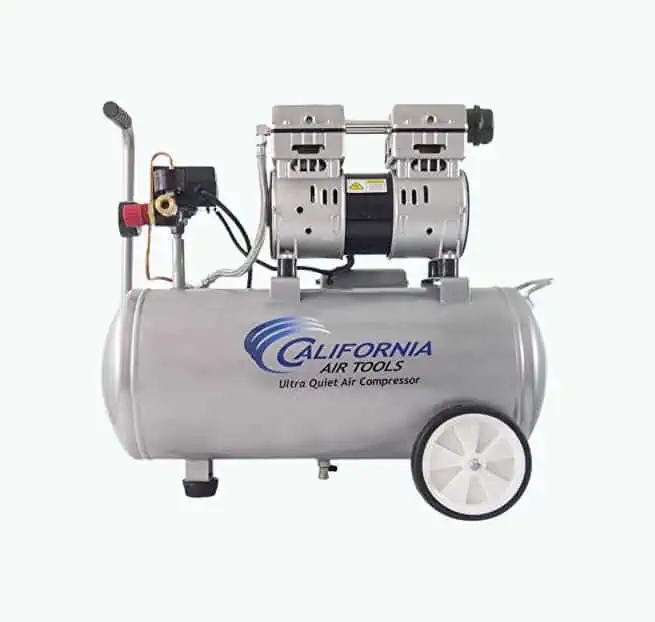
California Air Tools 8010A 8-Gallon Air Compressor
Best Quiet Air Compressor for Painting
This California Air Tools compressor is, without doubt, the obvious choice for our quiet award. Getting an air compressor to better this model for decibels is pretty tricky. It runs at 60 dB, which is impressive by anyone’s standards. It’s the equivalent of the volume of a normal conversation.
It has a maximum pressure of 120 PSI, so it is not the most powerful machine in the review, but it has a dual-piston pump with a life cycle of plus 3,000 hours. The pump is also oil-free, so you won’t need compressor oil or have to dispose of the old oil in the landfill. This is better for the environment and reduces your running costs.
It has an airflow of 2.2 CFM at 90 PSI and 3.1 CFM at 40 PSI, and produces cleaner air, and starts on cold mornings with minimum fuss.
What We Like
60 dB Running Volume
If you work in an environment where noise is a problem, this compressor will make things a little easier thanks to the 60-decibel running volume. That’s a difference of 20 decibels compared to some models.
Fast Refill Time
When the tank runs low, you won’t have to wait long for it to refill. This compressor recharges from empty to full in just over 2 minutes. It means more time making money and less downtime.
Oil-Free
Oil-free pumps require almost zero maintenance and produce cleaner air because there is no oil residue to contaminate. Also, they are cheaper to run thanks to not needing fresh compressor oil.
What We Don't Like
1 Horsepower Motor
You might want to save this compressor for lighter duties. It only has a 1 horsepower motor and produces 2.2 CFM at 90 PSI. That is low compared to some of the other compressors to feature.
Product Specs
| Weight (pounds) | 48 |
| Dimensions (inches) | 26 x 14 x 23 |
| Max PSI | 120 |
| CFM | 2.2 at 90 PSI |
| Capacity (gallons) | 8 |
| Accessories | N/A |
| Oil/Oil-free | Oil-free |
| Price | $$ |
| Warranty | 1-year limited |
Our Ratings
User Experience
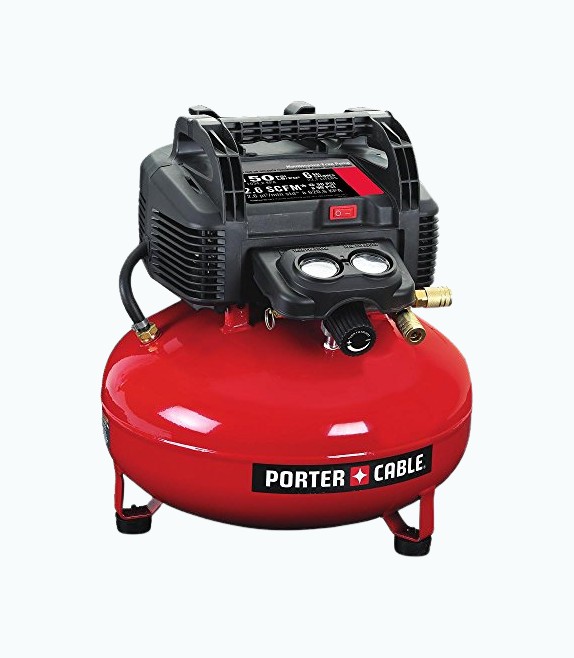
Porter-cable C2002 6-Gallon Air Compressor
Best Portable Air Compressor for Painting
Porter-Cable has ensured that this compressor is stable with the addition of rubber feet, and the drain valve lets you clean moisture out of the tank to prevent corrosion.
This pancake compressor generates a maximum PSI of 150, with 2.6 CFM at 90 PSI. The 6-gallon tank stores more air for tool running time, and the low-amp, 120-volt motor starts quickly in cold conditions and with an extension cord.
It has a shroud to protect vital components from damage and the elements, and a large carry handle makes lifting this 30-pound device a breeze. And for safety, it has built-in automatic thermal overload protection.
What We Like
Oil-Free Pump
Oil-free pumps are easy to maintain, last longer, and are better for the environment because you never have to dispose of old oil. If you want the convenience of a small air compressor without the hassle of maintenance, this is the type to get.
6-Gallon Tank
The capacity gives you the freedom to tackle larger jobs, and the CFM rate means there is a faster recharge when it empties. 6-gallons is about the maximum you should expect from a pancake compressor.
Affordable Price
Porter-Cable has managed to produce a powerful and affordable compact compressor. Compared to some on the list, it is cheap.
What We Don't Like
No Accessories
If you want the extra kit, you have to buy it. Hose attachments and nozzles aren’t cheap, so they could increase your spend considerably.
Noisy
This compressor is louder than the competition. It produces 82 dB, which puts it at the top of the noise charts as things stand. 82 decibels is noisier than a domestic vacuum cleaner.
Product Specs
| Weight (pounds) | 30 |
| Dimensions (inches) | 19 x 19 x 18 |
| Max PSI | 150 |
| CFM | 2.6 at 90 PSI |
| Capacity (gallons) | 6 |
| Accessories | N/A |
| Oil/Oil-free | Oil-free |
| Price | $ |
| Warranty | 1-year limited (compressor parts only) |
Our Ratings
Personal Perspective
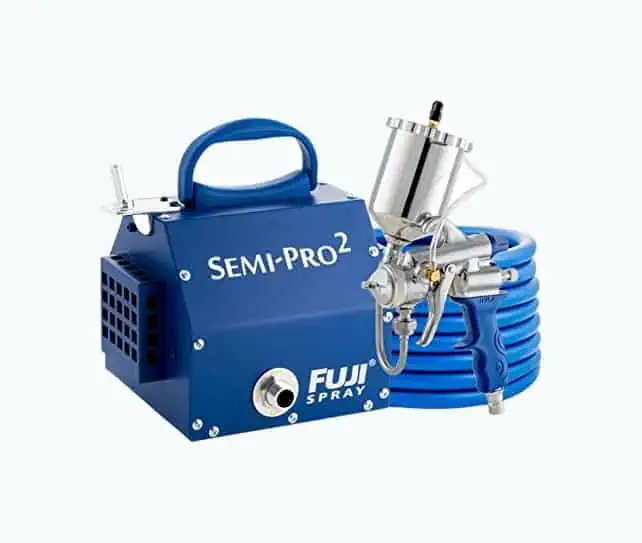
Fuji 2203G Semi-Pro 2 Gravity HVLP Spray System
Best Air Compressor for HVLP Painting
This Fuji Spray compressor comes complete with a professional, non-bleed HVLP gun. It has a 400cc gravity cup, a metal turbine case with a gun holder, and a 25 ft hose with control valves to reduce overspray and bounce back.
This compact compressor has a 1,400-watt 2-stage motor and a dedicated fan pattern control to deliver increased precision and less waste. The steel fluid passages are ideal for preventing wear on the needle tip and perfect for water and solvent-based paints.
What makes this the ideal HVLP compressor is the continuous flow of air, meaning you don’t have to stop to wait while the tank recharges.
What We Like
Complete Set
This compressor has everything you need to get started straight out of the box. The 25 ft hose gives you the scope to move freely, while the gravity-feed HVLP gun delivers a smooth layer of paint.
Adjustable Patterns
Paint wastage can be expensive, so adjusting the spray pattern is invaluable to reducing waste. It also helps you adjust your gun to cater to different shapes and surfaces.
Continuous Cycle
When you have large-scale projects to get done, having a continuous cycle is ideal. It means you won’t be stopping to wait for the tank to recharge, decreasing your downtime and increasing your profitability.
What We Don't Like
Limited Uses
Unlike traditional compressors with their multitude of uses, this Fuji Spray really only has one use, and that’s to power an HVLP gun.
Super Expensive
For such a small air compressor, this model is super-expensive. It costs over 4 times the price of some on the list yet it has limited uses.
Product Specs
| Weight (pounds) | 25.1 |
| Dimensions (inches) | 16 x 9.5 x 12.5 |
| Max PSI | 5 |
| CFM | Turbine system so the CFM is not stated |
| Capacity (gallons) | N/A |
| Accessories | Hose, gun, and nozzles |
| Oil/Oil-free | Not stated |
| Price | $$$$$ |
| Warranty | 2-year limited |
Our Ratings
Community Feedback
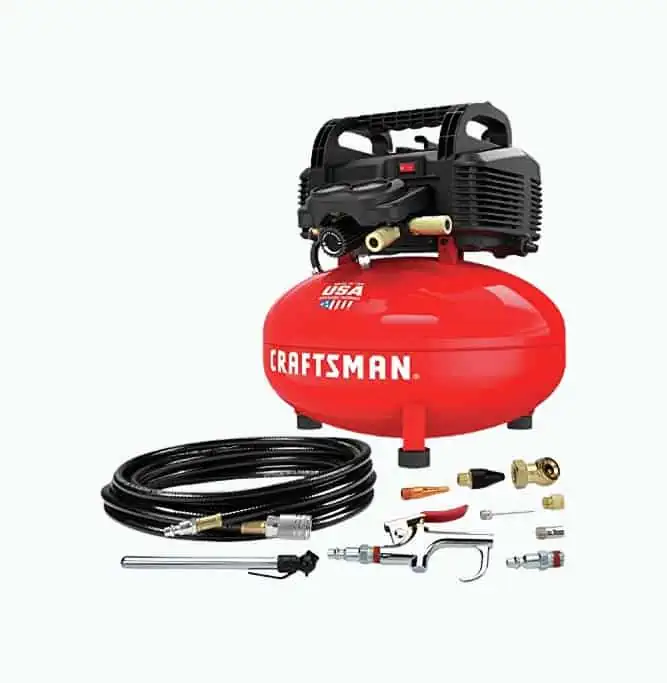
Craftsman 6-Gallon Oil-Free Air Compressor
Best Air Compressor for Painting Furniture
This model has a 6-gallon capacity and a maximum PSI of 150, so it hits the spot when it comes to power. It also has an oil-free pump, so maintenance should be a breeze, and there are fewer running costs than an oil-lubricated model.
The first thing you notice about this Craftsman pancake-style air compressor is the volume of sales it has notched up. And then you see the satisfaction rating, which is exceptionally high.
It comes with a 13-piece accessory set that includes a PVC air compressor hose, coupler, plug assembly, tire chuck, blow gun with an OSHA safety nozzle, and 3 inflator adapters. It also has 2.6 standard cubic feet per minute (SCFM) at 90 PSI, which allows for a quick compressor recovery time.
The voltage is 120, it has a large carry handle, and it weighs just over 32 pounds, making it pretty lightweight.
What We Like
Highly Rated
This compressor is extremely popular, both in sales numbers and the satisfaction rating. Customer feedback is one of the best ways to gauge the truth about a product.
Air Pressure
While this may be the perfect small air compressor, it packs a punch. You can connect nail guns, air wrenches, and just about any other air tool you want, and it will cope.
Accessory Set
It even comes with 13 accessories to get you started straight out of the box. Whether you want to paint or inflate tires, this pancake compressor has the adaptor or attachment to do it.
What We Don't Like
Quality Control Issues
Many have reported issues with the quality of the build. Tanks leak, attachments snap, and some have even struggled to get it to work after a few weeks. This is only a small minority, but one dissatisfied customer is one too many.
Product Specs
| Weight (pounds) | 32.5 |
| Dimensions (inches) | 16.5 x 16.5 x 17.88 |
| Max PSI | 150 |
| CFM | 2.6 at 90 PSI |
| Capacity (gallons) | 6 |
| Accessories | 13-piece set |
| Oil/Oil-free | Oil-free |
| Price | $$ |
| Warranty | 1-year limited |
Our Ratings
First-Hand Impression
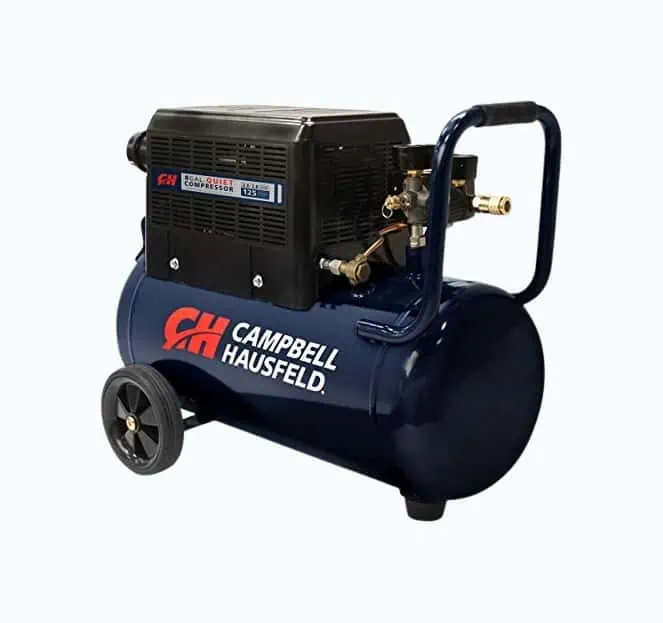
Campbell Hausfeld 8-Gallon Compressor
Best Air Compressor for Painting Walls
Like the California Air Tools model, this Campbell Hausfeld is an 8-gallon compressor. It has a large carry handle and two pneumatic wheels to increase its maneuverability. The motor is enclosed in a shroud, and it produces a maximum PSI of 125.
This compressor also delivers 2.2 CFM at 90 PSI and 3.2 at 40 PSI. It also has an oil-free pump that increases the compressor’s longevity, reduces the burden on the environment, and leaves you with a virtually maintenance-free device.
It almost gives the California compressor a run for its money in the noise stakes too. This one operates at 72 decibels.
What We Like
72 dB Running Volume
This is a quiet air compressor. 72 dB is impressive, although not enough to beat the California Air Tools model. That said, it is a quiet compressor compared to the other competition.
Great Price
This model comes in at fewer dollars than the California Air Tools compressor. For the price, it is a lot of kit, so you know you are getting value for money, especially when compared to the Fuji Spray model with limited uses.
Highly Portable
It weighs a hefty 54.9 pounds, but that is off-set by the large handle and pneumatic wheels. It makes this a portable air compressor, easy to transport from location to location.
What We Don't Like
Lacks Power
This compressor lacks in the PSI and CFM stakes. It has a PSI rating of 125 and a maximum CFM value of 3.2 at 40 PSI. This drops to 2.2 at 90 PSI.
Product Specs
| Weight (pounds) | 32.5 |
| Dimensions (inches) | 16.5 x 16.5 x 17.88 |
| Max PSI | 150 |
| CFM | 2.6 at 90 PSI |
| Capacity (gallons) | 6 |
| Accessories | 13-piece set |
| Oil/Oil-free | Oil-free |
| Price | $$ |
| Warranty | 1-year limited |
Our Ratings
User Experience
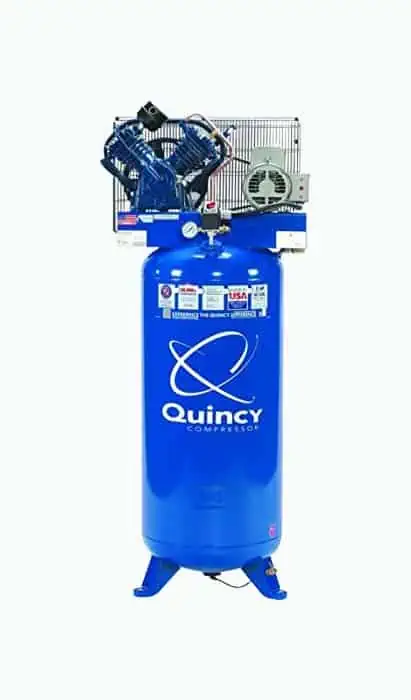
Quincy QT-54 Reciprocating 60-Gallon Air Compressor
Best Air Compressor for Painting Cars
When it comes to car resprays, you need a high-capacity compressor that delivers enough air supply to keep you working for longer. Say hello to the Quincy QT-54. This compressor runs at a lower RPM to reduce heat build-up and preserve the life of the motor.
And speaking of the motor, it is a US-made Baldor that produces 5 horsepower, and it operates on a 230-volt electrical system. This compressor is a 2-stage model, so it generates more power than a single-stage version, and it is more efficient.
They also boast that this compressor will give you 30,000 hours of service, so it’s built to last.
It also has a working PSI of between 145 and 175, so it can handle pretty much all you can throw at it, and the pump runs at 1,310 RPM. It has a CFM of 15.2 at 175 PSI, so you will never have airflow problems.
The only downside is this is a stationary compressor. Given that it weighs 475 pounds, once it’s in position, we doubt you could move it anyway.
What We Like
100 Percent Duty Cycle
The 100 percent duty cycle means that you can continually use this compressor without rest stops for the motor to cool down. It speeds up your work rate and increases the scope of projects you can undertake.
Impressive Airflow
When working with spray paint guns, airflow is king. CFM is crucial, and air volume makes the difference between a smooth outcome and a poor final result.
30,000 Hours of Runtime
Quincy is so confident that this compressor will last the distance they have given it a specific lifespan of 30,000 hours. That equates to 1,250 days of dependable use.
What We Don't Like
Poor Customer Service
Quincy makes quality compressors, but their customer service department fails to make the grade when there is an issue.
Product Specs
| Weight (pounds) | 475 |
| Dimensions (inches) | 29 x 21 x 64 |
| Max PSI | 175 |
| CFM | 15.2 at 175 PSI |
| Capacity (gallons) | 60 |
| Accessories | N/A |
| Oil/Oil-free | Oil |
| Price | $$ |
| Warranty | 1-year |
Our Ratings
Personal Perspective
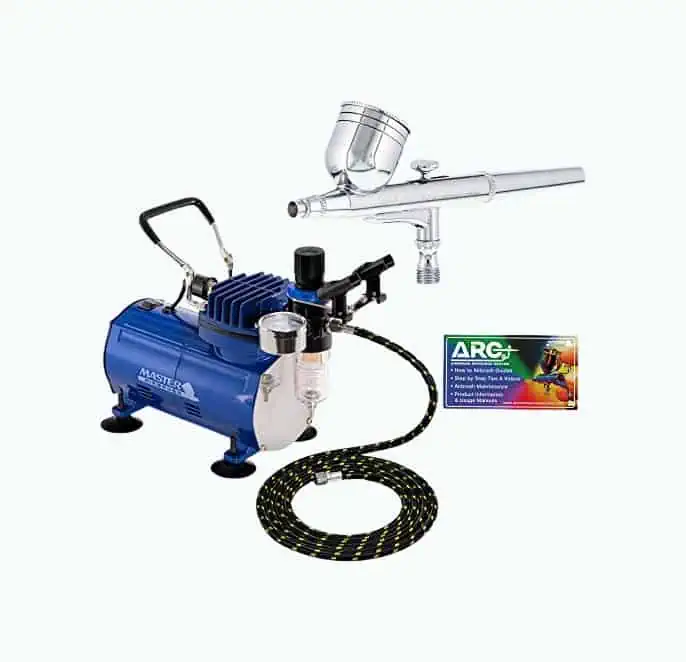
Master Airbrush Multi-Purpose Airbrush Compressor
Best Air Compressor for Painting Miniatures
This model is portable, lightweight, and stores away easily. It has a 1.5 horsepower motor and a single-piston and oil-free pump. It even has thermal protection to stop it from overheating. It is the perfect tool to use in a studio or home garage.
Not all air compressors require power and impact. Some need delicacy to increase your deftness of touch. The Master Airbrush compressor comes complete with everything you need to get you started on that miniature. Whether you are a hobbyist, artist, or professional, this dedicated airbrush compressor will see the task through.
It comes with a 6 ft hose attachment and an airbrush set. It creates a maximum of 57 PSI and has a CFM value of 0.7. You can’t use this compressor for any other air tools other than an airbrush.
What We Like
Complete Set
This set is complete, meaning you can get started straight out of the box. It also saves you money buying attachments and hoses at great expense.
On-Demand System
It has a unique on-demand system that shuts off when not in use. It saves energy and costs. It also gives you peak capacity air on demand, increasing the motor’s life as it reduces wear and tear.
Lightweight and Portable
It only weighs 9.7 pounds, making it one of the lightest compressors available. It has a large carry handle and 4 wide padded feet for increased stability.
What We Don't Like
Specialized Tool
If you love airbrushes and painting, this is the perfect combination, but for anyone else, look elsewhere for your compressor as this one only has one use. It won’t power your nail gun and air wrench.
Product Specs
| Weight (pounds) | 9.7 |
| Dimensions (inches) | 14.8 x 12.5 x 6.8 |
| Max PSI | 57 |
| CFM | 0.7 |
| Capacity (gallons) | Not stated |
| Accessories | Airbrush and hose |
| Oil/Oil-free | Oil-free |
| Price | $$ |
| Warranty | 2-year money-back guarantee |
Our Ratings
Community Feedback
| Product | Best | Weight | Dimensions | Max PSI | CFM | Capacity | Oil/Oil-free | Warranty |
|---|---|---|---|---|---|---|---|---|
| California Air Tools Air Compressor | Quiet | 48 lbs | 26 x 14 x 23″ | 120 | 2.2 at 90 PSI | 8 gal | Oil-free | 1-year limited |
| Porter-cable Air Compressor | Portable | 30 lbs | 19 x 19 x 18″ | 150 | 2.6 at 90 PSI | 6 gal | Oil-free | 1-year limited |
| Fuji Semi-Pro 2 Gravity Spray | HVLP | 25.1 lbs | 16 x 9.5 x 12.5″ | 5 | N/A | N/A | N/A | 2-year limited |
| Craftsman Oil-Free Air Compressor | Furniture | 33 lbs | 16.5 x 16.5 x 17.88″ | 150 | 2.6 at 90 PSI | 6 gal | Oil-free | 1-year limited |
| Campbell Hausfeld Compressor | Walls | 32.5 lbs | 16.5 x 16.5 x 17.88″ | 150 | 2.6 at 90 PSI | 6 gal | Oil-free | 1-year limited |
| Quincy Reciprocating Compressor | Cars | 475 lbs | 29 x 21 x 64″ | 175 | 15.2 at 175 PSI | 60 gal | Oil | 1-year |
| Master Airbrush Multi-Purpose | Miniatures | 9.7 lbs | 14.8 x 12.5 x 6.8″ | 57 | 0.7 | N/A | Oil-free | 2-year |
Types of Air Compressors For Painting
There are different types of air compressors, but which is best for spray painting your car?
Pancake Air Compressors
Pancake air compressors are aptly named, thanks to their squashed, “pancake” shape. These compressors are probably the most user-friendly in that they are lightweight, affordable and easy to use. They are a firm favorite with home users and hobbyists, as well as professionals alike.
Pancake compressors typically have 6-gallon tanks, a maximum pressure rating between 135 and 150 PSI (Pounds per Square Inch), and produce an airflow of between 2 and 3 CFM (Cubic Feet per Minute).
Hot Dog Compressors
Hot dog compressors get their name from their elongated tanks which resemble a hot dog. They typically have a 1 to 3-gallon capacity and, like pancake compressors, they are preferred by casual users and hobbyists.
Hot dog air compressors often have more powerful motors, so they can recharge the tanks faster, and they also have large handles and wheels to maneuver them easily.
Pontoon Compressors
Unlike hot dog compressors with one elongated tank, pontoon compressors have twin-tanks, straddling either side of a centrally-mounted motor. They look a bit like wheelbarrow compressors, only not all of them have a central wheel.
Often, these compressors are gas-powered, so they deliver more power, PSI, and CFM. They are also more portable because gas-powered models don’t need to plug into an electricity supply.
What Size Air Compressor Do I Need for Painting?
Sizing your air compressor is vital if you want to carry out different painting tasks. Respraying a car is more demanding on the compressor than creating artwork using an airbrush.
Car
If you are spray painting a car, it is recommended that you look at air tank capacity and horsepower for faster recharges. A 60-gallon air compressor should see the job through, with a typical horsepower of between 4 and 6.
You also need considerable CFM, so try and get a compressor in the range of 14 to 18 CFM at 90 PSI. You might notice that we haven’t mentioned the compressor’s air pressure, and that’s because spray painting is about volume rather than PSI.
House
You might get away with a slightly smaller compressor for this. Something with a 20 or 30-gallon tank should suffice. Look for a CFM of between 5 and 10. Most 20-gallon air compressors have motors that produce between 2 and 5 horsepower.
Horsepower is important because you want to refill the tank quickly to reduce downtime.
Spray
Typical spray guns have a working PSI of between 15 and 50, so the compressor you need should have a minimum of 70 PSI to operate your tools successfully. You can buy artist spray brushes that use minimal pressure, and for these, you would need a 1 or 2-gallon compressor.
For larger projects, think about the volume again, and scale up the air compressor size to compensate. 10 or 15-gallon compressors work best for larger tasks.
HVLP (High Volume Low Pressure)
You can carry out DIY tasks and professional work using an HVLP spray gun. To get that flawless finish, choose an air compressor with the pressure and CFM to match the gun.
However, focus on the airflow, as the name suggests. These guns require a high volume of air and a decreased pressure level to deliver the goods. CFM ratings are judged by comparing them against an average of 90 PSI, but the CFM increases when you drop the pressure, so you get higher values at 40 PSI.
HVLP guns need between 10 and 15 CFM to operate properly.
How To Choose the Best Air Compressor for Painting
When choosing the right compressor, there are many elements to consider. Doing the legwork is crucial if you want to get the best compressor for your money.
Here are a few pointers to help you along.

Motor
The motor is what drives the efficiency of your compressor. When the tank discharges, you need it to fill quickly, and your engine does this. Most air compressors have a horsepower rating between 1 and 5.
The higher the horsepower, the more efficient the compressor is and the greater capacity tank it has. It gives you longer usage between recharges, but it significantly increases the amount of money you need to spend.

Air Pressure
Air pressure is measured in units of PSI, or pounds per square inch. Most modern air compressors have a PSI value of around 125, which is ample to deliver the power that drives your spray gun.
As with the motor, the larger and more expensive air compressors have a higher PSI rating, meaning you can scale up the projects, increase your runtime and keep working more efficiently.

Airflow
CFM measures the rate of airflow. When using a spray gun, airflow, or volume of air, is one of the vital factors in how well the tool performs. Small air compressors have smaller motors and less tank capacity. They also have lower PSI ratings.
It affects the CFM because there isn’t enough air to deliver a smooth and efficient finish.
You should look for a compressor with a CFM between 10 and 15 at 90 PSI. This is a reliable way of telling whether your air compressor will work with your spray gun.
Tank Capacity
Spray painting requires a continuous stream of air to achieve the smoothest results. Stopping and starting will hamper the finish and slow you down. Larger tanks hold more air and give you an extended runtime between tank refills.
The downside is that larger tank compressors are more expensive, harder to store, and noisy.
Noise Levels
Most compressors operate at about 80 to 90 decibels. The general rule of thumb is the larger the compressor, the louder it gets. You can make the air compressor quieter, but in the main, ear defenders are a great idea.
Some air compressors run at a reduced volume, like the California Air Tools model, but don’t expect your air compressor to be super-quiet.
Air Compressor For Painting FAQs

What PSI Is Good for Painting?
If you plan on spray painting anytime soon, you need around 20 to 40 PSI. Of course, the specific application is essential because the PSI requirements for painting a car differ from those for spray painting a house.

Is a 20 Gallon Compressor Good for Painting?
A 20-gallon compressor is more than enough for painting stuff around the house, as some of the best portable units have 8-gallon tanks. For reference, an 8-gallon compressor is enough if you plan on painting the walls at home by yourself.

Do You Need to Ventilate When Painting?
You should always ventilate when painting because paint releases toxic fumes that can be dangerous when inhaled. If you plan on painting the walls inside your home or want to give your car a new coat of paint, leave it for a sunny day.
When painting indoors, it’s best to leave as many windows and doors open as possible. You may have heard of VOCs.
They are volatile organic compounds that are detrimental to your health if you inhale them. While some paints are VOC-free, most of them are still filled with them, leading to problems such as nausea or dizziness.
Even if you paint in a well-ventilated area, you should wear a respiratory mask and protective eyewear. Spray paint can just as easily get in your eyes.

Which Air Compressor Is Best for Painting?
The Fuji Spray 2203G Semi-PRO air compressor is perfect for painting because it offers adjustable spray patterns and a continuous cycle, allowing for more accessible applications of paints.
Unlike other HVLP compressors, this model has adjustable patterns, so you can play around and experiment with painting different surfaces.
This means you can customize each job to match the specific needs of a particular project. The flexible patterns allow you to achieve a consistent finish on uneven surfaces. That makes it a great air compressor for beginners.
Also, the continuous cycle feature makes this product ideal for sustaining heavy workloads as it runs uninterrupted for extended periods, ensuring decisive spray action even on thicker coats of paint.
Let’s Paint
Respraying a car or freshening up some old wooden furniture is not only satisfying, but it also saves you money because it stops you from replacing your old stuff with new stuff. However, getting the best results requires the right tools, and that’s where your air compressor comes in.
Air compressors make many things possible, and when it comes to picking the best one for painting, you have to consider the tank volume and the airflow as the most important features.