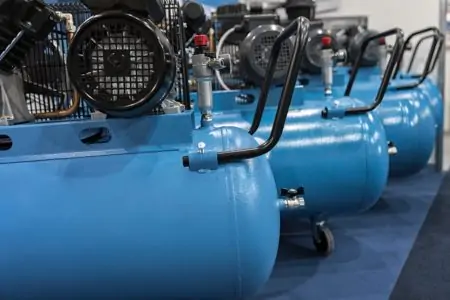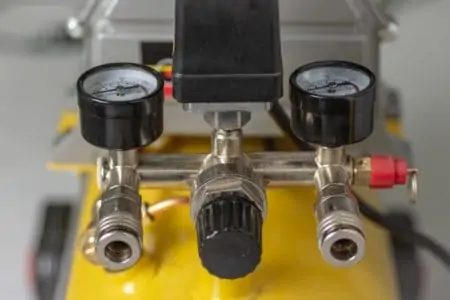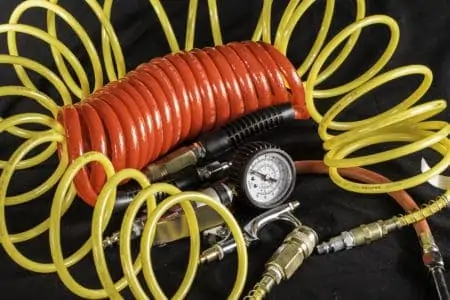
If you want the most from your air compressor, you need the best quality air hose. It helps you direct the air where it is required and should be reliable and hard-wearing.
Air compressor hoses come in 4 different materials and varying lengths, so choosing the correct one can be challenging.
We’ve made it easier by doing thorough research and brining you this selection of the 5 best air hoses currently on the market.
- All-weather capable
- Hybrid material
- Max 300 psi
- Cold weather-resistant
- Max 300 psi
- Oil & chemical-resistant
- Quick-release connectors
- Retractable
- PVC material
- Heavy-duty rubber hose
- 12-position gear lock
- Robust casing & mount arm
- Crush & oil-resistant
- High-quality brass NPT
- Max 300 psi
Review Methodology: At Sensible Digs, we bring you comprehensive assessments of the best air compressor hoses. Our professional team conducts rigorous checks and comparisons, using a well-defined criteria and hands-on experience. We rank each product based on key decision-making factors such as durability, flexibility, length, and material. We also evaluate the design choices and their effect on user experience. Our reviews are based on solid facts, a culmination of careful research, and quantitative data. By providing you with our findings and scores, we aim to guide you in choosing a product that truly stands apart from its competitors.
- Our Top Picks
- Product Reviews & Ratings
- Product Comparison Chart
- Are All Air Compressor Hoses Universal?
- Types of Air Compressor Hoses
- What Size Hose Should I Use for My Air Compressors?
- How To Choose the Best Air Compressor Hose
- How To Connect an Air Compressor Hose
- How To Soften a Stiff Air Hose
- Air Compressor Hose FAQs
- Let’s Hear It for the Hose
The Best Air Compressor Hoses of 2024
Here are five great air compressor hoses to consider.
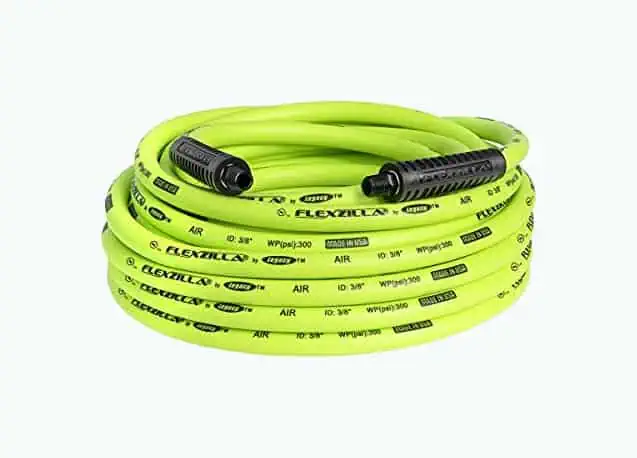
Flexzilla 50 Ft Hybrid Air Hose
Best Hybrid Air Compressor Hose
This lightweight and durable hybrid hose is suitable for the auto industry as well as the home market. It copes well in extreme weather conditions, thanks to the hybrid material, and it lies flat without recoiling, making it a joy to use.
It has a working pressure rating of 300 PSI, and it only weighs 5 pounds. This air hose is abrasion and bend-resistant, so you should avoid those annoying kinks that beset other hoses, and each end of the hose is reinforced with aircraft-grade aluminum.
You don’t need to worry about extreme weather conditions either because this hose works in temperatures ranging from -40 to +140 degrees Fahrenheit.
Pros
- All-weather capable.
- Hybrid material.
- Lightweight and durable.
- Max 300 PSI.
Cons
- Too lightweight.
- Won’t flex under pressure.
- Difficult to coil.
Product Specs
| Weight (pounds) | 5 |
| Min diameter (inches) | 0.25 |
| Max diameter (inches) | 0.50 |
| Size ranges (feet) | 25 to 100 |
| Temperature range | -40 to +140 F |
| Material | Hybrid polymer |
| Type of connectors | MNPT |
| Price | $$ |
| Warranty | 30-day |
Our Ratings
User Experience
Plews and Edelmann Amflo Polyurethane Air Hose
Best Air Compressor Hose for Cold Weather
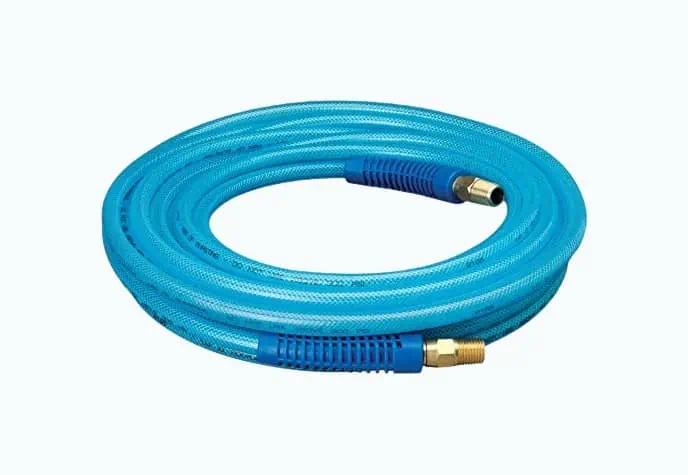
This Plews and Edelmann air hose is incredible value for money and costs a fraction of other models. It is lightweight, weighing just 1 pound, making applications a lot easier without having to drag a heavy hose around.
The polyurethane material is perfect for conditions like the extreme cold because it doesn’t crack or mar. It is also oil and chemical-resistant, so it won’t suffer in the harsh environment of the auto repair shop.
This air hose has a working PSI of 300, but the burst pressure leaps to 1,200 PSI giving it a safety factor of 4 to 1. It varies in size from 25 ft to 100 ft, with diameters stretching from 0.25 inches to 0.50 inches.
Pros
- Amazing price.
- Cold weather-resistant.
- Max 300 PSI.
- Super-lightweight.
Cons
- Too light.
- Prone to leaking.
Product Specs
| Weight (pounds) | 1 |
| Min diameter (inches) | 0.25 |
| Max diameter (inches) | 0.50 |
| Size ranges (feet) | 25 to 100 |
| Temperature range | -30 to +150 F |
| Material | Polyurethane |
| Type of connectors | NPT |
| Price | $ |
| Warranty | 4-year |
Our Ratings
Personal Perspective
Campbell Hausfeld Retractable Air Hose
Best Retractable Air Compressor Hose Reel
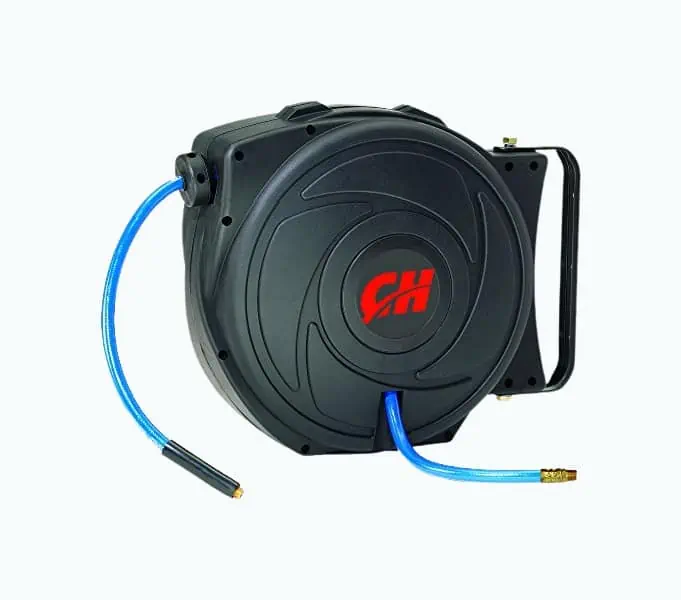
If you are a fan of neat and tidy air hoses, this retractable model by Campbell Hausfeld is a great buy. It is 50 ft in length, so reaching your project will be a breeze. You can lock the hose in place at the desired length without all the hassle of changing to a different size hose.
It handles temperatures of -35 to +250 degrees Fahrenheit, thanks to the PVC material, and the swivel-mounted bracket means you can secure the hose to a wall. It has a crack-resistant case, an internal diameter of 0.375 inches, and the quick-release connectors ensure you can swap tools with ease.
Pros
- Quick-release connectors.
- Retractable.
- Mounting bracket.
- PVC material.
Cons
- Heavy.
- 0.375-inch diameter.
Product Specs
| Weight (pounds) | 15.72 |
| Min diameter (inches) | 0.375 |
| Max diameter (inches) | 0.375 |
| Size ranges (feet) | 50 |
| Temperature range | -35 to +250 F |
| Material | PVC |
| Type of connectors | NPT plus quick-release |
| Price | $$$ |
| Warranty | 1-year limited |
Our Ratings
Community Feedback
DeWALT DXCM024-0343 Double Arm Hose Reel
Best Professional Grade Air Compressor Hose
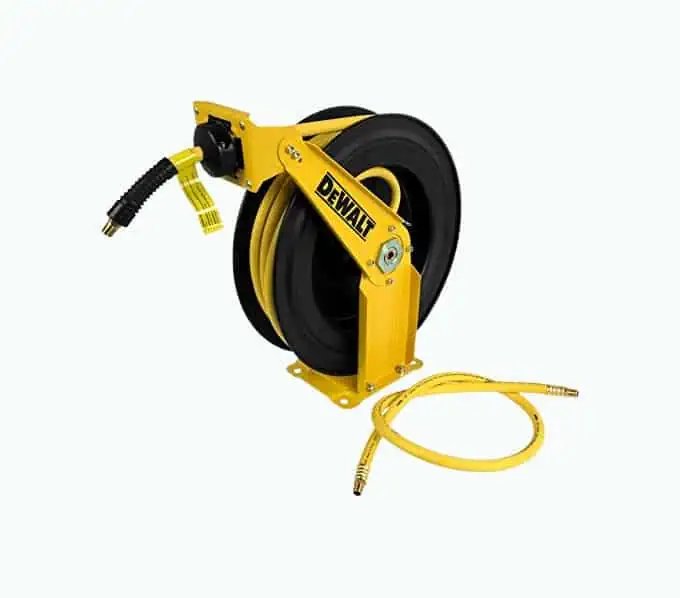
When it comes to heavy-duty punishment, you can’t get an air hose much tougher than a rubber one. This DeWALT is super-durable and perfect for industrial applications that ask a lot of the air hose.
The hose is retractable thanks to the all-steel reel and mounting arm and the 4-roller hose guide that evenly winds the hose. The hose can be extended to any length because it has a 12-position gear lock, so you need never trip over a trailing air hose again.
It also has a class-leading safety factor of 4 to 1, meaning that the burst pressure is 4 times the working PSI. That equates to a burst PSI of 1,200!
Pros
- Heavy-duty rubber.
- 12-position gear lock.
- Retractable.
- Robust casing and mount arm.
Cons
- Expensive.
- Heavy.
Product Specs
| Weight (pounds) | 28 |
| Min diameter (inches) | 0.375 |
| Max diameter (inches) | 0.375 |
| Size ranges (feet) | 50 |
| Temperature range | -40 to +150 F |
| Material | Rubber |
| Type of connectors | MNPT |
| Price | $$$$ |
| Warranty | 1-year limited |
Our Ratings
First-Hand Impression
Campbell Hausfeld 25 Ft Air Hose
Best PVC Air Compressor Hose
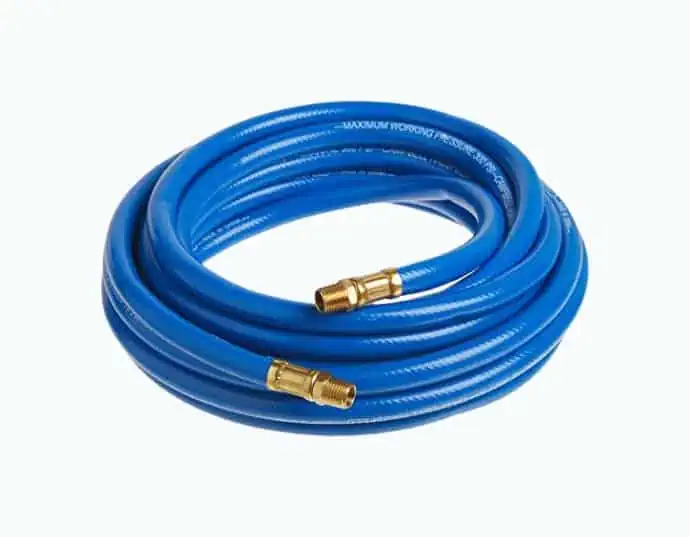
This is the second Campbell Hausfeld to feature in the review. It is a 25 ft hose constructed from PVC, so it is non-marring, abrasion-resistant and long-lasting. It is also very cheap to buy, costing almost 8 times less than the DeWALT retractable reel.
It has a maximum PSI of 300, so it will power your heavy-duty tools with ease, and the temperature range is zero degrees to 130 degrees Fahrenheit. So, it doesn’t have the cold weather resistance of some on the list.
The fittings are high-quality brass NPT at each hose end, and the hose is oil and crush-resistant.
Pros
- Amazing value.
- Crush and oil-resistant.
- High-quality brass NPT.
- Max 300 PSI.
Cons
- Too lightweight.
- Lacks temperature range.
Product Specs
| Weight (pounds) | 8 ounces |
| Min diameter (inches) | 0.375 |
| Max diameter (inches) | 0.375 |
| Size ranges (feet) | 25 |
| Temperature range | 0 to +130 F |
| Material | PVC |
| Type of connectors | NPT |
| Price | $ |
| Warranty | 1-year |
Our Ratings
User Experience
| Product | Best | Weight | Min diameter | Max diameter | Size ranges | Temperature range | Material | Type of connector | Warranty |
|---|---|---|---|---|---|---|---|---|---|
| Flexzilla 50 Ft Hybrid Air Hose | Hybrid | 5 lbs | 0.25″ | 0.5″ | 25 to 100 ft | -40 to +140 F | Hybrid polymer | MNPT | 30-day |
| Plews and Edelmann Amflo | Cold Weather | 1 lb | 0.25″ | 0.5″ | 25 to 100 ft | -30 to +150 F | Polyurethane | NPT | 4-year |
| Campbell Hausfeld Hose | Retractable Hose Reel | 15.72 lbs | 0.375″ | 0.375″ | 50 ft | -35 to +250 F | PVC | NPT | 1-year limited |
| DeWALT Double Arm Hose Reel | Professional Grade | 28 lbs | 0.375″ | 0.375″ | 50 ft | -40 to +150 F | Rubber | MNPT | 1-year limited |
| Campbell Hausfeld Air Hose | PVC | 8 oz lbs | 0.375″ | 0.375″ | 25 ft | 0 to +130 F | PVC | NPT | 1-year |
Are All Air Compressor Hoses Universal?
In the main, air compressor hoses are universal, but some pneumatic tools require specific hoses and couplings. Different applications and tools may require certain types of air compressor hoses.
Quick connectors are ideal for most tool applications, while NPT (National Pipe Tapering) connectors have a smaller hose hole size for lower pressure tasks.
Types of Air Compressor Hoses
As with everything, variety and choice are welcome, but it can make choosing the correct hose confusing. Here is a brief rundown of the different types available.
Rubber
Rubber is the most common type of hose, frequently used in commercial and domestic settings. It is weatherproof, abrasion-free, and can tolerate extreme cold and hot temperatures. Withstanding -20 and +150 degrees Fahrenheit is not uncommon.
The downside is rubber weighs more than other types and can suffer bubbling in high heat.
Hybrid
Hybrid hoses are a mixture of PVC, polyurethane, and rubber. They beat rubber hoses for flexibility and durability and work well in the most extreme conditions. They are also lighter and easier to manage than rubber hoses, although they start to kink after prolonged use.
PVC
PVC is a budget-friendly option. It is also durable and abrasion-free. These hoses lack the flexibility of other varieties, but they are effective in warm weather. PVC hoses are great in tight spots when you need to reach awkward angles, but over time they kink and lose performance, especially in the colder weather.
Polyurethane
If lightweight is your preference, polyurethane hoses are the ideal choice. They work well in cold weather and have a fantastic recoil capability. However, they are more expensive and kink more easily than other types of hoses.
What Size Hose Should I Use for My Air Compressors?
It all comes down to cubic feet per minute (CFM) when choosing the hose size. If you have a smaller compressor with a weaker airflow, then a hose with a smaller diameter will suffice. Hoses are measured by their internal diameter with standard sizes ranging from 0.25 inches to 0.50 inches.
A higher internal diameter correlates to increased airflow, so the larger the compressor’s CFM, the wider the hose.
Does the Length of the Hose Affect Pressure?
Air hoses come in lengths ranging from 6 to 50 feet, but if you want a longer hose, remember that this reduces the air pressure. If you want a hose to give you more freedom, and don’t care about air pressure, go for a longer option.
If you need the maximum available airflow, choose a shorter length, and move the compressor closer to the action.
How To Choose the Best Air Compressor Hose
Once you’ve decided it’s time to upgrade your air compressor hose, which type do you choose? Here are some pointers.

What Type of Hose?
You can make your choice based on the available budget and pick a rubber or PVC variety, or you can splash the cash on a polyurethane or hybrid version. As with all things, the budget is king when it comes to making your choice, but keep in mind that cheaper may be a false economy.
It might be better to spend more now to get the best quality, so you get an increased lifespan.

What Brand?
There are some great brands available. Household names like DeWALT feature prominently in the world of air compressor hoses. Other brands, like Flexzilla and Campbell Hausfeld, are also respected names in the industry.

What Budget?
We’ve touched on the types you can get and their varying quality depending on the price, but how much should you pay?
If you are spending less than $30, it will probably be a shorter hose made from rubber or PVC, as these are the most price-friendly types. If you are spending over $30, expect the hose to vary in length and the quality to improve. Polyurethane and Hybrid hoses fall into this category.

What Length?
If you are working in cramped conditions, a smaller length of hose is fine. 6 ft is standard, with others ranging from 8 or 10 ft. The size you choose will depend on the type of task you are undertaking.
You should be wary of extra long lengths as this causes the pressure to drop, which affects the tasks you do.

What Diameter?
Air hoses are measured internally for their diameter. The diameter you require depends on the CFM values of your compressor. A lower airflow means you can have a smaller diameter air hose. The reverse is true if you have a powerful compressor with a high CFM value.
The most common sizes are 0.25 and 0.50 inches. Getting the diameter right will reduce the risk of leakage and the hose splitting under increased pressure.

Coiling Capability
You get two choices when it comes to coiling. You can get a standard hose or a recoil hose. Standard hoses lay flat and can be looped easily for better storage, whereas recoil hoses have a memory function that shrinks the hose when you let go.

Pressure Rating
Your compressor pressure rating needs to be compatible with the air hose, or you will suffer air leakage, which reduces the pressure and affects how efficient your pneumatic tool is. It could also lead to splits in the hose, which will cost you more money in the long run.
Hoses with a higher PSI rating last longer and cope better in extreme weather.

Kink Resistance
Prolonged use increases the chances of your hose kinking. This causes pinch-points that reduce the flow of the pressurized air, causing a drop in performance. You can buy kink-resistant hoses, and the best material is rubber.
The next best material for kink-resistance is the hybrid hose, but this is more expensive to buy.
How To Connect an Air Compressor Hose
Hose connectors come in a variety of styles. Quick connectors help switch between different air tools by using a spring clip that attaches to the air port. To release, pull the clip and remove the device.
NPT (National Pipe Tapering) connectors are suited to low and high-pressure applications. Threaded connectors are typically made of corrosion-resistant brass or aluminum and are widely used in the auto sector, thanks to their airflow capacity and secure fastening.
How To Soften a Stiff Air Hose
The easiest way to soften a stiff air hose is to submerge it in warm water. The heat loosens up the hose and makes it more pliable. Be careful not to pour boiling water over the hose because when the hose hardens, the material becomes brittle. Any temperature changes could cause it to crack and split.
Air Compressor Hose FAQs

Does Hose Diameter Affect PSI?
The hose diameter can affect PSI because it’s closely related to how much air said hose can deliver. Think of it as trying to blow a lot of air through a straw. It’s difficult, isn’t it? The same concept applies to air compressor hoses.
It needs more velocity to travel that distance when pushing a lot of air through a small hole.

Do You Lose Air Pressure with a Longer Hose?
Long hoses tend to lose more air pressure. You will find air compressor hoses varying between 6 and 50 feet in length.
Only choose a longer hose if you have to work in conditions where the distance between you and the air compressor is significant (for example, if you’re working on the roof).
A shorter hose is a better option when you need as much pressure as possible from your air compressor. For instance, it would take a long time to inflate a truck tire with low pressure from a long hose.

Is Rubber or PVC Air Hose Better?
Rubber hoses are considered better when compared to PVC ones. Rubber hoses are reinforced with different materials and are a real game-changer regarding durability.
You want to invest in a rubber hose because it’s easy to work. It won’t coil and kink, so you don’t have to waste time adjusting it. You won’t like its price point and the fact that it gets dirty fast if you drag it across the garage floor/outside.
PVC hoses are a better option for those looking to save money. They are affordable and won’t break the bank, but they can be annoying because they always coil. You will have difficulty keeping a PVC hose lying flat.
Note that your air compressor likely comes with a PVC hose and many people upgrade to a better-quality hose.

Which Is Better: Rubber or Polyurethane Air Hose?
Think of polyurethane hoses as an upgrade to the PVC hose. They’re flexible and much easier to work with. Plus, they’re easier to carry around with you because they’re so lightweight.
The external coating of the hose means you can easily drag it across the floor without getting it stuck in the slightest bumps. While they lack the flexibility of rubber hoses and tend to kink sometimes, they’re the second most expensive type.
Let’s Hear It for the Hose
A good quality air compressor is a useful tool to own, but it is only as effective as the air hose attached. Making sure you do your compressor justice with a decent-quality air hose, which is crucial if you want to maintain flexibility and tackle as many tasks as possible.
Whether you want a budget hose or a lightweight and durable hybrid version, making the correct choice is vital.