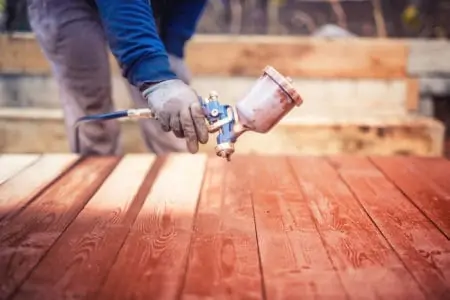
Fed up with drips, brush hairs, and uneven coats? Take the pain out of painting and give yourself a chance to get the job done in double-quick time. Using a paint sprayer gives you an even finish, and it covers more surface area than brushes and rollers.
We rundown the 7 best paint sprayers, judging them on ease of use, features, and price, to make your choice a lot easier.
- Sucks paint straight from the tin
- Requires no paint thinner
- Reversible nozzle for continuous spraying
- No-bleed gun and adjustable fan pattern
- Stay-cool, ergonomic handle for increased comfort
- Professional quality paint sprayer
- Perfect for low-pressure painting
- Easy to clean and control
- Comes with additional tips and adjustable flow switch
- Lightweight and affordable
- Sealed leak-free paint cup
- Adjustable fan
- Flow adjuster and pressure control dial
- Works with latex paints and stains with the right thinner
- 3 spray patterns
- Flexible with 5 size nozzles
- Easy to assemble, use, & clean
- Has 6.6-foot power cord for maneuverability
- Precise adjustable flow control knob
- 1,000mL paint cup
- Amazing price makes it ideal for beginners
Review Methodology: At Sensible Digs, we understand that choosing the best paint sprayers can be a daunting task. Therefore, we have conducted in-depth analysis, rigorous tests, and hands-on evaluations to provide you with the objective data and facts you need to make an informed decision. Our professional team uses a set of criteria to compare, measure, and rank each product’s performance, efficiency, and design choices. These findings are supported by first-hand evidence, ensuring the authenticity of our reviews. We assess key decision-making factors like ease of use, cleaning, and the overall finish quality, to help you understand what sets a product apart from its competitors in the market. Our goal is to provide you with a trustworthy and sensible guide to making your next painting project a success.
The Best Paint Sprayers of 2024
We left no stone unturned looking for our shortlist of the top 7 paint sprayers. We gauged public opinion, performance, and price to narrow the field down.
Graco Magnum 262800 X5 Stand Airless Paint Sprayer
Best Airless Paint Sprayer
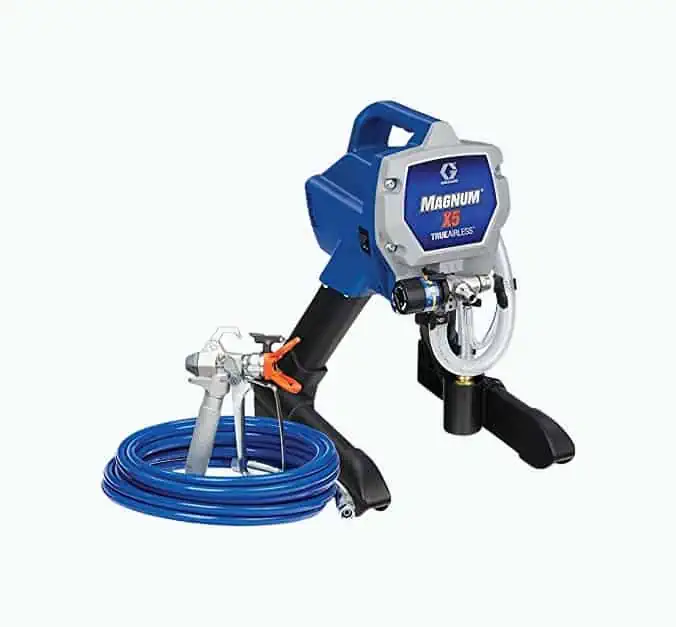
This Graco could so easily have won the professional category. It has adjustable pressure to give you total control over the paint flow to help you tackle different size tasks, and the piston pump allows you to spray the paint without any thinners.
You don’t even need to pour the paint in because this model is equipped with a flexible hose that allows you to suck the paint straight from the can or bucket. And the flow rate hits 0.27 GPM, even with sucking paint straight from the tin.
This sprayer loves to work hard. Graco recommends that it should spray at least 125 gallons every year, so once again, if you are a professional, it fits the bill. And once you are done, it connects to a garden hose for easy cleaning.
If your project is extensive, you can increase the sprayer’s reach with up to 75 feet of additional hose. It’s lightweight, compact, and gives you continuous runtime, thanks to the reversible 0.15-inch tip that allows you to swap it around when clogging occurs.
While this is not the most expensive paint sprayer you can buy, it is still costly. If you are looking for a sprayer for a one-off job, avoid this model. Plus, the largest recommended nozzle size is 0.15 inches.
Pros
- Sucks paint straight from the tin.
- Requires no paint thinner, thanks to the powerful piston.
- Adjustable pressure to cater to different tasks.
- Reversible nozzle for continuous spraying.
Cons
- The price will deter some people.
- Can’t use nozzles larger than 0.15 inches.
Product Specs
| Weight | 19 pounds |
| Dimensions | 14.5 x 12.75 x 19 |
| GPM | 0.27 |
| Power source | 110 V |
| Price | $$$$ |
| Warranty | 1-year |
Our Ratings
User Experience
Fuji 2203G Semi-Pro 2 Gravity HVLP Spray System
Best Professional Paint Sprayer
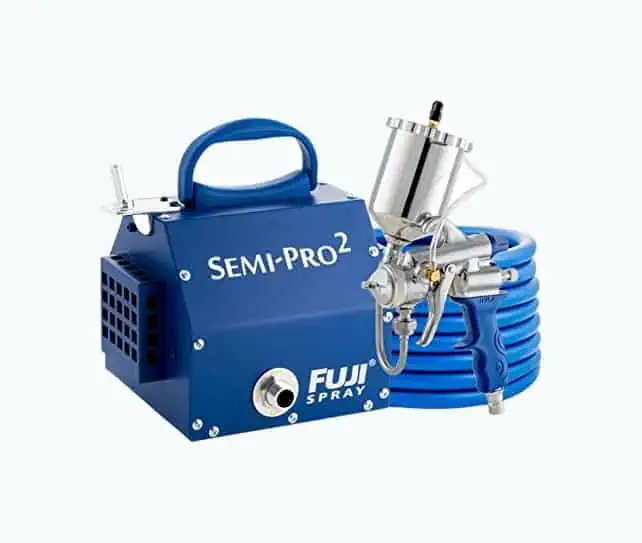
This Fuji paint sprayer is a step up in performance and quality, but they certainly make you pay for the privilege. You get a no-bleed gun with an adjustable fan pattern for increased control, as well as a 400cc gravity cup.
Fan pattern control allows you to decrease the paint waste and lets you paint vertically, horizontally, and in circular motions. You can also adjust 1-inch circular to 12-inch oval patterns in the blink of an eye.
You also get a powerful 1,400-watt 2-stage motor and a 25-foot Hi-Flex hose. It disassembles easily for efficient maintenance and cleaning, and it has stainless steel fluid passages to keep wear and tear to a minimum, especially solvent and waterborne paints.
The stay-cool handle is ergonomically designed to reduce stress on your hands and wrists, and the guns are convertible from gravity-fed to bottom-fed to cater to different tasks.
The major sticking point with this paint sprayer is the cost. It costs multiple times the price of other models. It’s also a heavy machine, weighing over 25 pounds, so maneuverability might be an issue.
Pros
- No-bleed gun and adjustable fan pattern.
- 25-foot Hi-Flex hose for extended reach.
- Stay-cool, ergonomic handle for increased comfort.
- Professional quality paint sprayer.
Cons
- Priced for professionals only.
- Weighs over 25 pounds, which might affect maneuverability.
Product Specs
| Weight | 25.1 pounds |
| Dimensions | 16 x 9.5 x 12.5 |
| GPM | HVLP system so not stated |
| Power | 120 V |
| Price | $$$$$ |
| Warranty | 2-year parts and labor |
Our Ratings
Personal Perspective
HomeRight C800971
Best HVLP Paint Sprayer
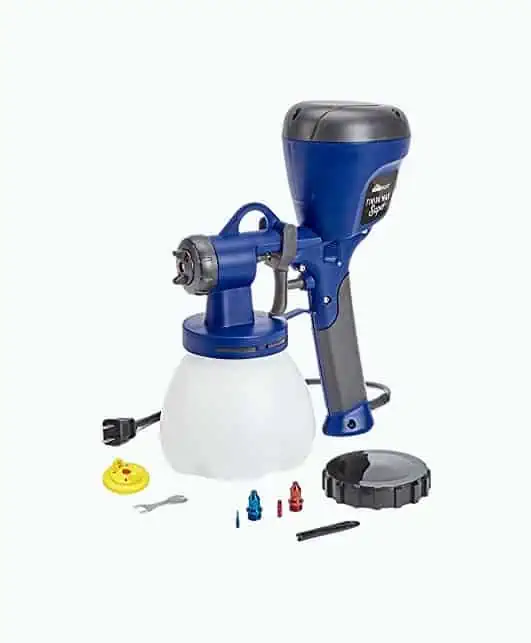
This is the paint sprayer for every task you can think of. It’s a high-volume, low-pressure system, so it lends itself to smaller jobs like painting kitchen cabinets and table-tops, but you can still use it to respray fencing and other applications.
You get 3 different tips for various applications, a material flow controller and round, horizontal and vertical spray patterns. As you would expect for a DIY paint sprayer, it has a weaker motor with 450 watts of power, but that’s plenty for smaller projects.
You get between 20 and 50 GPM depending on the applications, and when you are done painting, it cleans easily using soap and water for water-based paints and mineral spirits for oil-based materials.
The only downside with this paint sprayer is the reservoir size. At 39 fluid ounces, you will have to stop every couple of meters to refill the chamber. It also struggles to spray unthinned paints, thanks to the low wattage.
That said, this spray gun is the perfect all-around tool. It is lightweight and easy to master.
Pros
- Perfect for low-pressure painting like cabinets and furniture.
- Easy to clean using water or mineral spirits.
- Comes with additional tips and an adjustable flow switch.
- Lightweight and easy to control.
Cons
- Low wattage motor restricts application size.
- A small paint reservoir means constant refill interruptions.
Product Specs
| Weight | 3.3 pounds |
| Dimensions | 9.5 x 6 x 12.5 |
| GPM | 20 to 50 depending on application |
| Power | 120 V |
| Price | $$$ |
| Warranty | 2-year limited |
Our Ratings
Community Feedback
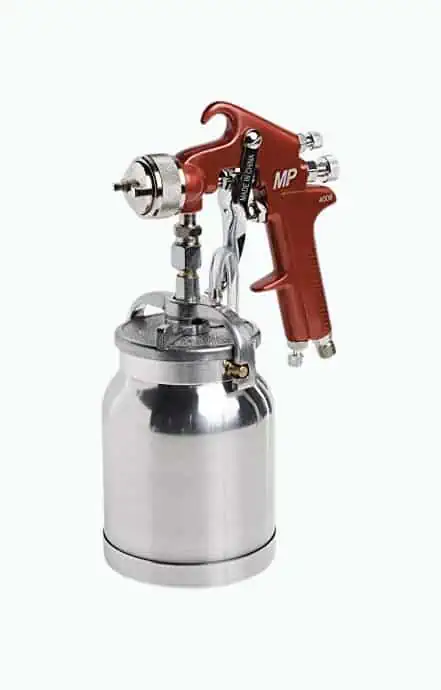
Astro Pneumatic 4008 Spray Gun and Cup
Best Pneumatic Paint Sprayer
This is the only pneumatic spray gun to feature on the list. The great thing about this spray gun is it comes with an instruction manual for beginners, telling you how to set up the air supply, dial the adjustable fan size and flow rate, and a host of other useful things.
The fan adjusts up to 11 inches in size from an 8-inch distance, speeding up tasks, and thanks to the metal sealed paint cup, you can hold the gun at any angle without fear it will leak.
The downside with air tools is they need an air compressor, which adds to your costs. This one requires a 7 to 12 cubic feet per minute (CFM), 3 horsepower compressor. However, because it’s an air tool, it’s lightweight and inexpensive compared to others in its class.
Using this sprayer is noisy, thanks to the compressor, and you are also restricted because the air compressor anchors you, making everything less maneuverable.
Pros
- Lightweight and affordable.
- Sealed leak-free paint cup ensures painting at any angle.
- Adjustable fan to 11 inches maximum from an 8-inch distance.
- High-power gun, ideal for fences and decks.
Cons
- Noisy with the air compressor.
- Requires an air compressor at additional cost.
Product Specs
| Weight | 2.5 |
| Dimensions | 12 x 7.25 x 4.25 |
| GPM | 30 |
| Power | 7 to 12 CFM |
| Price | $$ |
| Warranty | 1-year |
Our Ratings
First-Hand Impression
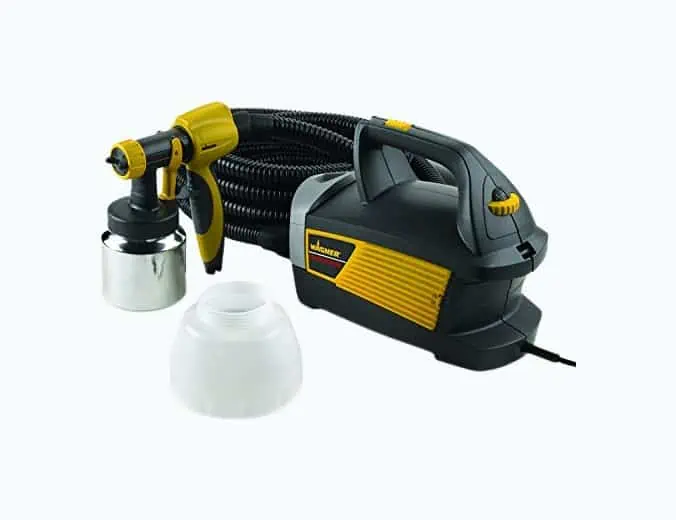
Wagner Spraytech 0518080 Control Paint Sprayer
Best Paint Sprayer for Decks
This Wagner Spraytech uses high volume and low pressure to atomize paint, so it spreads using fine particles to cover more evenly to give a smoother finish. The powerful 2-stage turbine makes it possible to use this sprayer with latex paints and stains as long as thinner is used.
You can customize your settings using the flow adjuster and the pressure control dial to cater to different applications, making it incredibly versatile. It covers furniture, table-tops, decks, and anything else you can think of.
The base connects with a 20-foot hose, giving you the freedom to move about unrestricted, which is great when working outdoors on garden projects.
You get 3 spray patterns: round, vertical and horizontal, plus you can opt between a gravity-fed 1.5-quart cup and a metal 1-quart bottom-fed cup. The flow rate is 13 ounces per minute, which is less than some models, and you will spend quite a lot of time stopping to refill the cups.
Pros
- Flow adjuster and pressure control dial.
- Works with latex paints and stains with the right thinner.
- 3 spray patterns from horizontal, vertical, and round.
- 20-foot hose for longer reach.
Cons
- Small cup capacity means frequent refills.
- Slower flow rate at 13 ounces per minute.
Product Specs
| Weight | 11.18 |
| Dimensions | 18.5 x 12 x 12 |
| GPM | 13 ounces per minute |
| Power | 110 V |
| Price | $$$ |
| Warranty | 1-year |
Our Ratings
User Experience
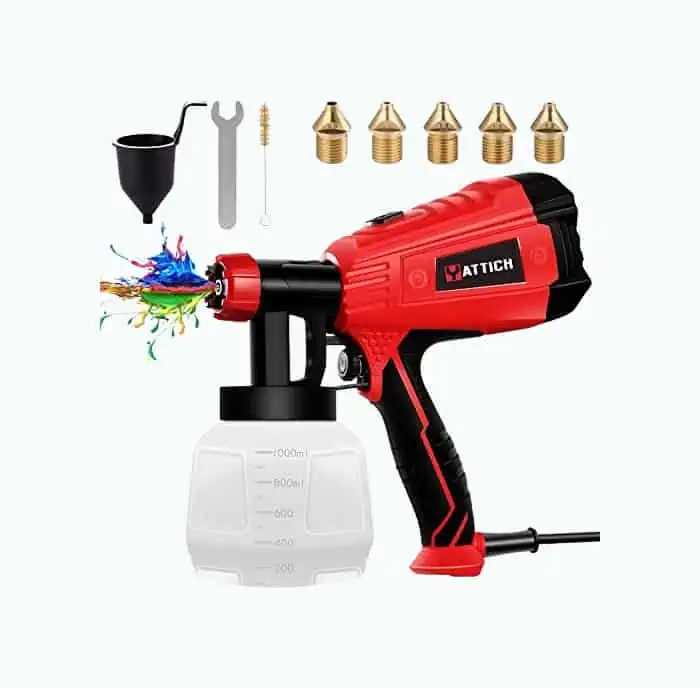
Yattich HVLP Paint Sprayer
Best Paint Sprayer for Furniture
When you need a flexible paint sprayer to cope with painting furniture, having five different nozzles is a real bonus. This one comes equipped with tips ranging from 1.2mm to 3.0mm, to give you the versatility you need.
It has vertical, horizontal, and round spray settings, a 500-watt motor, and a 1,000ml paint container. You can regulate the paint flow by adjusting the control knob to get different outputs, suitable for large and intricate applications.
This sprayer is easy to assemble, easy to use, and simple to clean. It’s also lightweight and comes with a 6.6-foot power cord for increased maneuverability.
The HVLP technology produces a finer paint mist that coats more evenly and is better for working at close quarters to achieve greater detail.
However, some customers complain that they struggle to get an even coating, and the nozzle blocks after a couple of seconds.
Pros
- Comes with 5 different size nozzles for flexibility.
- Easy to assemble, use, and clean.
- Comes with a 6.6-foot power cord for maneuverability.
- HVLP technology is perfect for detailed painting.
Cons
- Some customers complain the nozzle easily blocks.
- According to some, it may take a lot of learning curve using the machine.
Product Specs
| Weight | 3.83 pounds |
| Dimensions | 11.22 x 9.41 x 5.67 |
| GPM | Not stated |
| Power | 110 V |
| Price | $ |
| Warranty | 2-year |
Our Ratings
Personal Perspective
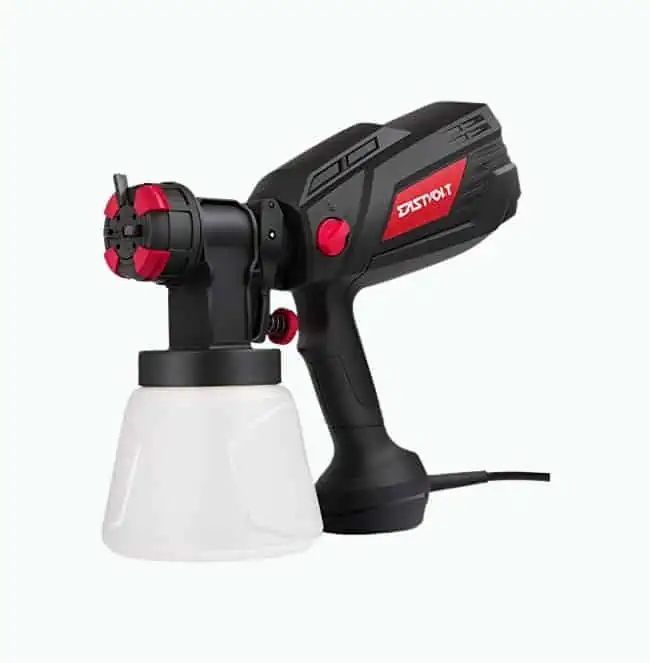
EastVolt 600-Watt HVLP Paint Sprayer
Best Budget Paint Sprayer
This 600-watt HVLP paint sprayer has an adjustable flow control knob for precise output, so you can work on many different projects and surfaces. You also get 3 spray patterns and 4 nozzles ranging from 1.5mm to 2.6mm.
You also get a 1,000ml paint cup and a 6.6-foot power cord. The viscosity measuring cup means you can control the pigment to get an effective and smooth finish.
The paint needs a thinner to help it flow, or the gun will clog, and it is intended for home and DIY applications rather than professional use. The price tag means this paint sprayer is the perfect model for beginners to learn their craft.
It’s also the ideal model when you only have one job to complete and don’t want to spend a fortune on a top-end paint sprayer. Think respraying the garden fence once every 3 or 4 years, and you get the idea.
Not surprisingly, it feels cheaply made and contains many plastic elements, and some customers have reported that after a short amount of use, the gun clogs and stops working.
That said, it is the budget model, and it only costs a fraction of other featured paint sprayers.
Pros
- Adjustable flow control knob for extra precision.
- 1,000ml paint cup.
- Amazing price makes it ideal for beginners.
- Perfect for one-off applications.
Cons
- Feels cheaply made with lots of plastic elements.
- Clogs all too easily, causing the gun to fail, according to some.
Product Specs
| Weight | 3.79 pounds |
| Dimensions | 13.18 x 5.7 x 11.61 |
| GPM | Not stated |
| Power | 110 V |
| Price | $ |
| Warranty | Not stated |
Our Ratings
Community Feedback
| Product | Best | Weight | Dimensions | GPM | Power source | Price | Warranty |
|---|---|---|---|---|---|---|---|
| Graco Magnum 262800 X5 Paint Sprayer | Best Airless | 19 lbs | 14.5″ x 12.75″ x 19″ | 0.27 | 110 V | $$$$ | 1-year |
| Fuji 2203G Semi-Pro 2 Gravity HVLP Spray System | Best Professional | 25.1 lbs | 16″ x 9.5″ x 12.5″ | HVLP system so not stated | 120 V | $$$$$ | 2-year parts & labor |
| HomeRight C800971 HVLP Paint Sprayer | Best HVLP | 3.3 lbs | 9.5″ x 6″ x 12.5″ | 20 – 50 depending on application | 120 V | $$$ | 2-year limited |
| Astro Pneumatic 4008 Spray Gun and Cup | Best Pneumatic | 2.5 lbs | 12″ x 7.25″ x 4.25″ | 30 | 7 – 12 CFM | $$ | 1-year |
| Wagner Spraytech 0518080 Control Paint Sprayer | Best for Decks | 11.18 lbs | 18.5″ x 12″ x 12″ | 13 ounces p/m | 110 V | $$$ | 1-year |
| Yattich Paint Sprayer | Best for Furniture | 3.83 lbs | 11.22″ x 9.41″ x 5.67″ | Not stated | 110 V | $ | 2-year |
| EastVolt 600-Watt HVLP Paint Sprayer | Best Budget | 3.79 lbs | 13.18″ x 5.7″ x 11.61″ | Not stated | 110 V | $ | Not stated |
Types of Paint Sprayers
Essentially, there are 4 types of paint sprayers, but which is the best?
Pump-Action Sprayer
These are handy paint sprayers when painting garden furniture, decks, and fencing because they are less accurate than other paint sprayers. Simply pour the paint into the chamber, pump the handle to increase pressure, and press the trigger.
The nozzle is typically attached to a hose to give you a lot of freedom to move around. The advantage of this type of sprayer is you don’t need any power source, which means you can take them anywhere.
The disadvantage is you have to pump the handle manually to generate pressure.
Airless Sprayer
If you want accuracy, airless is the way to go. These high-pressure devices force air through a small nozzle, ensuring that almost every drop of paint ends up where it should, on your project.
The advantage is you don’t mix air with the paint, which could cause air bubbles. They are lightweight, easy to use, and make swift work of your project.
Just bear in mind that airless paint sprayers are more expensive, but you do get an efficient tool.
High-Volume Low-Pressure (HVLP) Sprayers
When you tackle intricate tasks or smaller objects and surfaces, you want to reach for an HVLP sprayer. The jet of paint is narrower and easier to control.
The lower pressure ensures you get greater volume, helping to apply more color on the surface rather than on the carpet. The advantage is they are easy to use, giving almost anyone with limited experience the chance to get a professional finish.
The disadvantage is this type of sprayer would struggle to coat larger projects like room redecoration.
Pneumatic/Compressed Air Paint Sprayers
Pneumatic air sprayers are the most widely used and the type you are likely to find in garages up and down the country. They are fast, efficient, and reliable. They are sometimes called high-pressure paint sprayers due to the power of the air compressor.
These sprayers are noisy, thanks to the compressor, and you lack basic accuracy because the extreme levels of pressure throw the paint everywhere. If you are respraying fencing or the patio, pneumatic is a great choice. If you are painting a tabletop, go for an HVLP model.
How To Choose the Best Paint Sprayer
That’s the 60-million dollar question. What should you be looking for when choosing a new paint sprayer? Here are some pointers.

Type of Job
Okay, so this isn’t about the actual paint sprayer, but the type of task you undertake matters when choosing the right sprayer. If you are working in the garden, painting fences, patios, decking, and other objects, you should select a hand-held or pump-action sprayer.
They are less precise, but they get the task done. For more intricate projects, go for an HVLP sprayer or an airless model.

Horsepower and Pressure
A common theme when reading about paint sprayers is horsepower. The more HP you have, the more pressure you can create. You need to match the tool to the compressor, making sure that the sprayer can handle the pressure limits of your compressor.
If you want decent coverage, coupled with a thicker layer of paint, look for the tool with the most HP. However, not all jobs call for extreme power. Sometimes, the project is more intricate and needs a steady hand with lower pressure.

Gallons Per Minute
When we talk about GPM, we are referring to the amount of paint coming through the nozzle in any given minute of usage. GPM is as important to paint sprayers as MPG is to cars. It’s the measure of the speed the paint transfers from the container to the project.
The greater the GPM, the faster you will complete the task. This is reassuring to know when you need to paint substantial amounts of fencing or walls.

Types of Tips
The tips on your paint sprayer have a crucial role to play, especially if you are swapping between different paints. Paint sprayers are versatile, and you can change the paint product to suit the task. To do this, you might require a variety of nozzles.
Tips are rated in size, typically listed as 0.10-inch, which is the size of the opening for the paint to escape. Other examples might say 515. The 5 refers to the fan size of the sprayer, and the 15 indicates the nozzle size.

Value for Money
There is so much choice when selecting a paint sprayer. You can always pick up a budget model for one-off tasks, but if using a paint sprayer is a long-term aim, try and spend a few more dollars and get the best model you can.
After all, it will be with you for years, so the price you pay will pale into insignificance 10 years from now when it’s still going strong. However, don’t go too mad and spend money on a professional-grade sprayer unless you really want or need to.
FAQs

Does Spraying Use More Paint Than Rolling?
Paint sprayers use approximately 33 percent more paint than rolling. The general consensus is that the time you save spraying rather than rolling on the paint is worth the extra cost of more paint.

Is Spraying Paint Better Than Rolling?
Spraying paint is smoother and coats better than any other type of application. It gets into all the gaps and corners that you might otherwise miss. It’s also the best method for painting rougher surfaces like fences because it really soaks in.

Are Airless Paint Sprayers Worth It?
It depends on what you are painting. Because airless sprayers are so efficient, you get almost zero paint wastage, which means the paint goes where it’s supposed to; on the wall. Airless sprayers speed up the task, getting you to the end in double-quick time.

Can You Paint Cabinets With an Airless Sprayer?
You can use an airless sprayer to paint your cabinets because they are great for large and small applications. The way the paint flows, you get less air in the mix, which creates a smoother and more detailed coating.

What Is a Good Spray Gun for a Beginner?
When you start out with a spray gun, using an HVLP gun is one of the easiest ways to learn. They are easy to load, easy to handle, and simple to control. Plus, you get excellent coverage and superior detail.

Should You Thin Paint When Using a Sprayer?
The general answer is yes. You should use a thinner like water or mineral spirits to aid the flow of the paint. Adding thinner reduces clogging and makes it easier to clean the sprayer after use.
However, some powerful models will suck paint straight out of the tin without any thinner. The Graco Magnum is the perfect example. It has a powerful piston that draws the paint through the sprayer and a reversible nozzle to keep you spraying for longer.