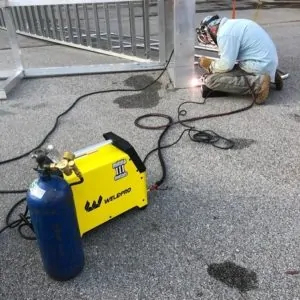
110-volt welders are less common than you might think. They are excellent for basic jobs and welding light to medium-gauge material. Getting the best 110-volt welder is crucial because they can be a bit of a hit and miss when it comes to performance.
We review 7 of the best 110-volt welders to bring you the definitive guide.
- Dual capabilities
- Only weighs 57 pounds
- Easy to use
- Stick & TIG capabilities
- 200-Amp welder
- 40 & 60 percent duty cycles
- Weighs 25 pounds
- Simple to operate
- Multi-process
- Easily adjustable controls
- Cold contractor safety
- Entry-level model
- Dual voltage
- Maximum of 200 amps
- High-frequency starts
- Compact welder
- Weighs only 37 pounds
- No gas needed
- Flexible & versatile
- Inverter technology
- 1 year warranty
Review Methodology: At Sensible Digs, we understand the importance of making an informed decision when choosing the best 110-volt welder. Our professional team has hands-on experience with each product, conducting thorough analysis and performance tests, to provide you with factual and unbiased reviews. We measure each welder against a set of key criteria, such as power output, duty cycle, and ease of use, to rank and compare products. Our evaluations also delve into design choices and their effects on user experience. We share these findings and provide quantitative measurements of a product’s performance so you can understand what sets the top welders apart from their competitors. Trust in our research, as we guide you towards the best 110-volt welder for your needs.
The Best 110-Volt Welders of 2024
Finding 110-volt welders wasn’t easy. We included some dual voltage welders because the majority can switch between 110 and 220 volts. Here is our pick of the best 110-volt welders available to buy.
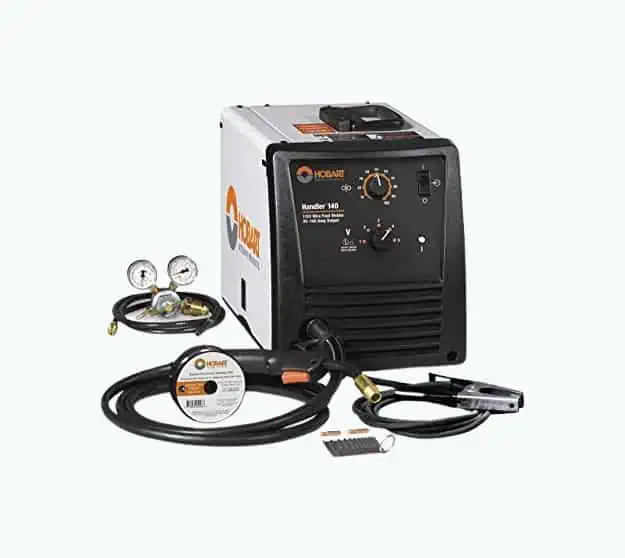
Hobart Handler 140 MIG/ Flux-Cored Welder
Best 110-Volt Flux Core Welder
This is a welder at home that welds thicker and thinner material, thanks to its MIG and flux-cored dual capabilities. The flux-cored electrode removes the need for shielding gas, meaning you reduce your operating and set-up costs, and it adds to the convenience.
It can weld up to 24-gauge material and mild steel up to 0.25 inches in thickness. It has 5 voltage positions to give you smoother control, and it has an amperage range between 25 and 140 amps.
At 90 amps, the duty cycle is 20 percent, so you will need to rest the torch every 8 minutes, and it is light and portable, making it the ideal candidate for taking on the road. This might not be the biggest hitter when it comes to power, and it is restricted to smaller tasks, but it still packs a punch when you need to make on the spot repairs to farm machinery, work art and the car.
What We Like
Dual Capabilities
Having a machine that can switch between a MIG and flux-core welder is a real asset. It gives you greater scope on what you can weld and it gives you the freedom to go gasless.
Only Weighs 57 Pounds
This welder has a large handle that folds neatly away. It also weighs just 57 pounds, making it the ideal welder to pack into your car and take on the road. It also means you can store it away easily in the garage or workshop.
Easy To Use
If you want a welder that is simple to operate, this could be a perfect choice. It has two dials on the front, one for voltage and the other for amperage. Find the setting you want, and you are ready to go.
What We Don't Like
It’s Not Cheap
It isn’t the most expensive welder available, but it is certainly not a budget option. If you are a beginner, it may be beyond your price range. It is a quality welder, but there are others in the same class that are cheaper.
Build Quality Issues
For a welder that costs so much, it does feel like it’s been made on a budget. This may not be an issue now, but if you want a welder that will last the distance, it could become a problem later.
20 Percent Duty Cycle
This welder only has a 20 percent duty cycle. It means that for every 2 minutes spent welding; you will need to rest this welder for 8 minutes to let it cool down.
Product Specs
| Weight (pounds) | 57 |
| Dimensions (inches) | 19 x 11 x 13 |
| Multi-process | MIG, flux-cored |
| Voltage | 115 |
| Max amps | 140 |
| Duty cycle | 20 percent |
| Price | $$$ |
| Warranty | 5-year |
Our Ratings
User Experience
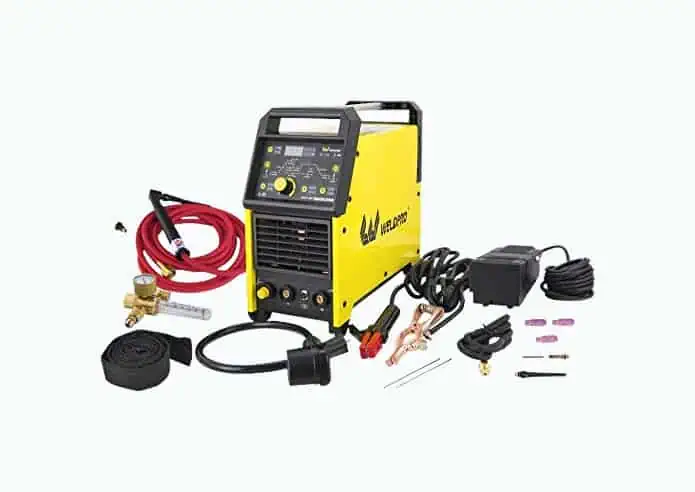
Weldpro Digital 200GD 110V TIG/Stick Welder
Best 110-Volt Stick Welder
Strictly speaking, this Weldpro is a dual voltage welder, meaning it has 110 and 220-volts. It operates perfectly well at both voltages, but it does give you the option of scaling up your welding if you want to.
If you want the most out of your 110-volt welder, this has the highest amperage of any on the list. This is a TIG and stick welder, so you can switch between the two, just be aware that TIG welders struggle at 110 volts.
It welds stainless steel and aluminum at 110 volts. It comes with an excellent foot pedal that is great when you want to TIG weld. However, for stick welding, the results are not so good, so you might want to switch to the welder’s manual controls if you need to make adjustments.
What We Like
Stick and TIG Capabilities
This welder comes with a foot pedal in case you want to use it as a TIG welder. It also has stick welding capabilities, making it incredibly versatile.
200-Amp Welder
This Weldpro has an amperage of 200. It increases the welder’s penetration levels, so it is better suited to a wider variety of material.
40 and 60 Percent Duty Cycles
This welder has twice the duty cycle of the Hobart, at 40 percent in DC. It keeps you welding for longer and increases your work rate. This is crucial if you are against the clock. In AC, that cycle increases to 60 percent.
What We Don't Like
Very Expensive
This is very expensive. It is Weldpro’s flagship welder, but even so, it will set you back a lot compared to some welders on the market. It is not a budget option, and it is unlikely to appeal to the beginners out there.
Product Specs
| Weight (pounds) | 31.3 |
| Dimensions (inches) | 17.6 x 7.9 x 16 |
| Multi-process | Stick, TIG |
| Voltage | 110/220 |
| Max amps | 200 |
| Duty cycle | 40 percent |
| Price | $$$$ |
| Warranty | 2-year |
Our Ratings
Personal Perspective
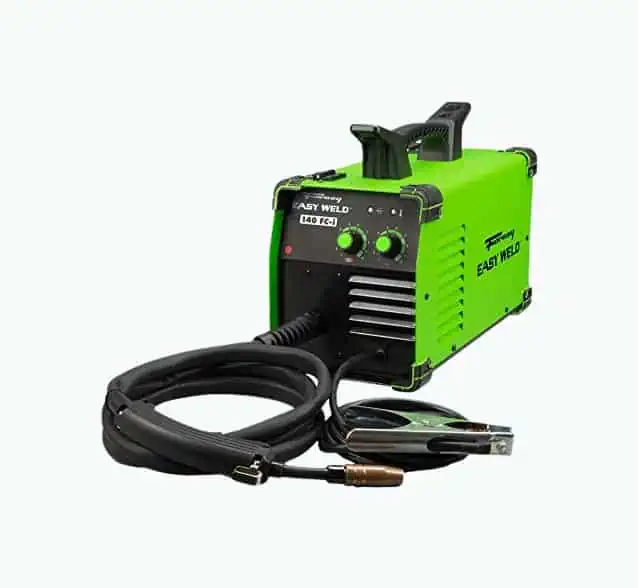
Forney Easy Weld 261, 140 FC-i MIG Welder
Best 110-Volt MIG Welder
This Forney Easy Weld could so easily have won the multi-process welder award. It handles MIG, TIG and stick welding. It puts out a maximum of 140 amps and is a dependable light-gauge welder.
While it has multi-process capabilities, it works best as a MIG welder, which is why we chose it. It is easy to operate and robust, thanks to the hard metal shell, and you can use it as a gas shielded welder or go gasless if you prefer.
This unit is also super-lightweight, making it a contender for the portable category. It weighs just over 25 pounds, putting it at half the weight of the Hobart.
What We Like
Weighs 25 Pounds
At just over 25 pounds, carting this welder to the job-site is child’s play. You could lift this with one arm. Being so light makes it ideal for storing away in the garage or workshop, and given its diminutive size, it fits into the smallest of car trunks.
Easy To Use
The controls are simple to operate, making it another welder suited to beginners. It has two dials and a switch to select different welding methods. The dials control the amperage and the voltage.
Multi-Process
While this welder is primarily geared towards MIG welding, it can switch easily between stick and TIG if you so desire. It makes it a 3-in-1 welder and the perfect machine to cover all your welding bases.
What We Don't Like
Quality Costs
If you want the best quality, you have to pay for it. It isn’t the most expensive welder available, but it also isn’t the cheapest. Forney has opted for the middle ground, where they hope their superior quality shines through.
Short 12-Month Guarantee
Compared to some models that have 3 and 5-year warranties, this model has a meager 12-month guarantee. So, if something malfunctions after the first year, you have no way of addressing the problem with the manufacturer.
Product Specs
| Weight (pounds) | 25.8 |
| Dimensions (inches) | 14.19 x 19.31 x 11.61 |
| Multi-process | Stick, TIG, MIG |
| Voltage | 120 |
| Max amps | 140 |
| Duty cycle | Not stated |
| Price | $$$ |
| Warranty | 1-year |
Our Ratings
Community Feedback
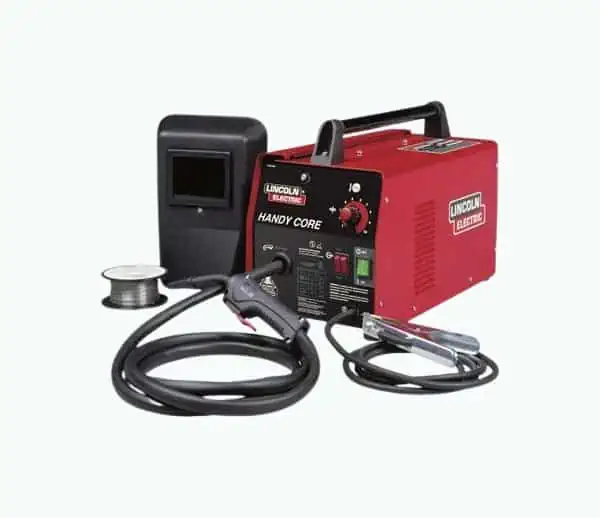
Lincoln Electric K2278-1 Handy Core Power Welder
Best 110-Volt Beginner Welder
If you are looking for a 110-volt welder to learn the ropes, this is the model you should consider. Lincoln Electric is a respected name in the industry, and this Handy Core Power Welder will set you off in the right direction.
It can weld to a depth of 0.125 inches on mild steel, and it has really simple controls. It has a high and low power switch and a dial that controls the voltage. It’s lightweight and portable, so it should satisfy most home or hobby users, and it is the perfect welder to use for a beginner.
It plugs straight into the electrics and delivers a maximum 88 amps output. It also has a cold contractor safety feature that keeps the torch electrically cold until you depress the trigger. This stops instant arcing the moment you plug in the unit and protects your eyes.
What We Like
Ideal for Beginners
When you first learn a new skill, it takes all your concentration to get it right. Why would you want to over-complicate matters with a welder that is so difficult to use? What you want are easily adjustable controls.
Cold Contractor Safety
Welding is dangerous, so keeping the electrode electrically cold until you are ready to use it is a useful safety feature. It stops arc eye and retinal damage because it cannot form an arc until you depress the trigger.
Amazing Price
This is a beginner welder, priced to be an entry-level model that most novices can afford. It is a fraction of the price of the Weldpro, making it one of the cheapest welders to make the list.
What We Don't Like
Lacks Real Power
With a maximum output of 88 amps, you will struggle to weld anything other than small projects and lighter tasks. This is a welder aimed at the home-user market, so it isn’t going to cope with heavy usage.
10-20 Minutes Cooling Time
Don’t expect a fast work rate when using this welder. It takes between 10 and 20 minutes to cool down between uses, making the task painfully slow.
Product Specs
| Weight (pounds) | 45 |
| Dimensions (inches) | 8.82 x 17.99 x 12.88 |
| Multi-process | MIG |
| Voltage | 115 |
| Max amps | 88 |
| Duty cycle | 20 percent |
| Price | $$ |
| Warranty | 1-year |
Our Ratings
First-Hand Impression
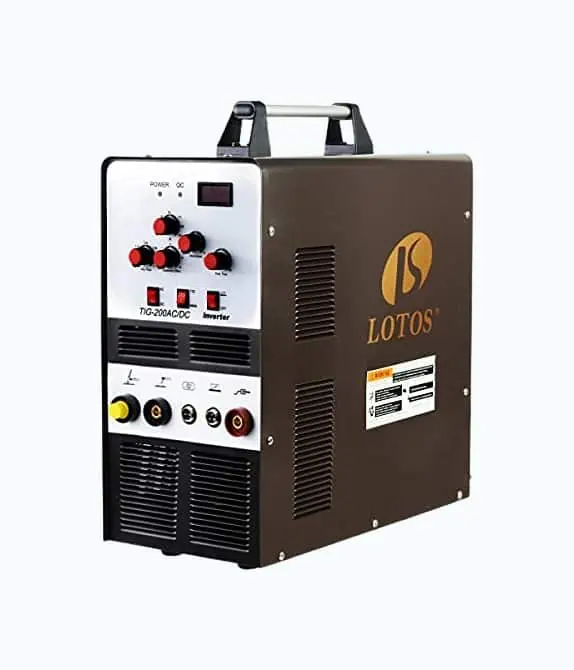
Lotos TIG 200A TIG Welder
Best 110-Volt TIG Welder
This Lotos welder utilizes a square wave inverter for accurate aluminum welding. It is a dual voltage 110/220 welder, so it can tackle heavy-duty tasks if you want to. It has a power efficiency of 80 percent, and it has a 200 amp output.
It is the ideal welder for the professional or the weekend enthusiast, although a TIG welder is pretty hard to master, so you will need some experience to use this machine.
This welder is ideal for tackling home repairs and hobby projects, but you know that you have all the power you need should you feel like tackling larger tasks.
What We Like
Dual Voltage
Home electrical sockets are 110 volts, so this welder is compatible with domestic garage and workshop use. However, because it is dual voltage, it has the punch to tackle large-scale projects and heavy-duty industrial tasks.
Maximum of 200 Amps
A maximum of 200 amps means that you get deeper penetration of the weld, which is great for taking on thicker materials or metals that require a stronger bond. You can weld cast iron, stainless steel, and aluminum using this welder.
High-Frequency Starts
Unlike scratch starts, high-frequency starts are easier to perform, and you get a more stable arc. Touch the base metal with the lightest of pressure, and the arc starts.
What We Don't Like
High Price Tag
We talk about the price of welders a lot in this review, and this TIG welder is no exception. It costs many times more than the Lincoln Electric model, so it is unlikely to appeal to beginner welders. At this price, Lotos is aiming for the professional market.
Product Specs
| Weight (pounds) | 58.7 |
| Dimensions (inches) | 28 x 13 x 17 |
| Multi-process | TIG, stick |
| Voltage | 110/220 |
| Max amps | 200 |
| Duty cycle | 60 percent |
| Price | $$$$ |
| Warranty | 1-year |
Our Ratings
User Experience
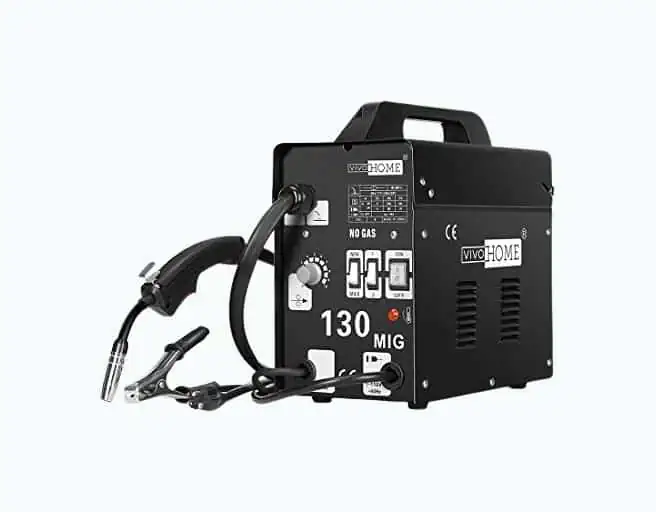
VivoHome Portable MIG 130 Welder
Best Small 110-Volt Welder
Okay, so now we are firmly back in entry-level territory again. This VivoHome welder costs a fraction of the Lotos model’s price, which puts it within the range of beginner’s budgets. So, how good is this welder, and just how compact is it?
Unsurprisingly, it is a MIG welder, as so many seem to be. It weighs 37.2 pounds, so it is certainly light, and thanks to the large carry handle on the top, it is easy to pick up. The dimensions are 20.47 x 15.2 x 12.44 inches, so it is compact, making it easy to maneuver and store away.
It’s a no-reaction welder, so you don’t need shielding gas, and it has a maximum output of 120 amps, so while it will tackle lighter tasks, you won’t be repairing the iron girders on the Washington Bridge just yet.
What We Like
Super-Affordable
You could buy 3 units at this price and still have change from the cost of a high-end model. If you are starting on a welding journey for the first time, this might be a great option.
Weighs Only 37 Pounds
At 37 pounds, it is a lot lighter than some of the high-end models. This could be down to the materials used in the construction (more plastic than metal), but if you want a compact welder, this unit is easy to store and maneuver.
No Gas Needed
This welder has an electrode with a flux-cored wire that produces shielding gasses during the welding process. It means that you don’t need to worry about the integrity of your welds; the flux-cored wire sorts that out.
What We Don't Like
Build Quality Issues
For such a well-priced welder, you won’t be surprised to learn that the quality of the components is not as high as the expensive models. You really do get what you pay for!
Low Duty Cycle
This welder has a very low duty cycle. For every 1.5 minutes of welding, you need to rest the welder for 8.5 minutes. That is going to hamper your work rate. You’ll spend most of your time sipping coffee while you wait to go again.
Product Specs
| Weight (pounds) | 37.2 |
| Dimensions (inches) | 20.47 x 15.2 x 12.44 |
| Multi-process | MIG |
| Voltage | 115 |
| Max amps | 120 |
| Duty cycle | 15 percent |
| Price | $ |
| Warranty | 1-year |
Our Ratings
Personal Perspective
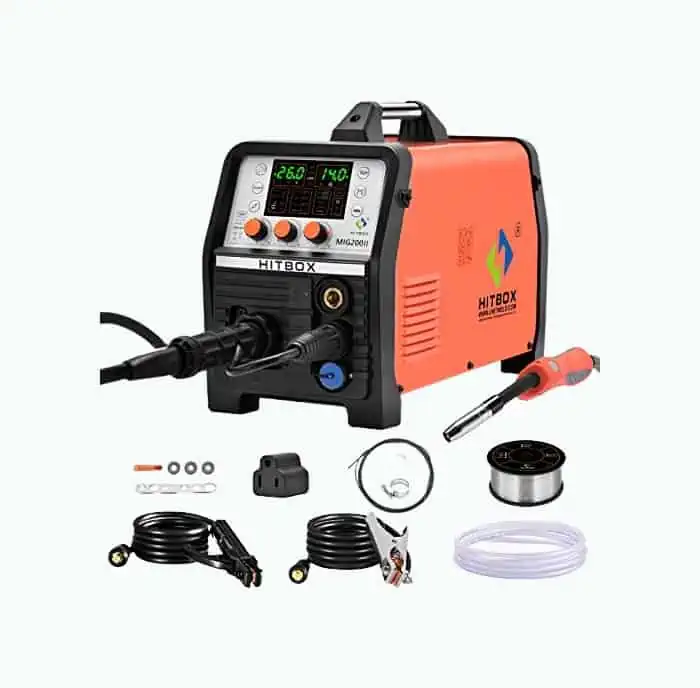
HitBox MIG200II Welding Machine
Best 110-Volt Multi-Process Welder
This is another dual voltage welder. We chose it for the multi-process award because of the sheer array of welding techniques this machine can handle. It MIGs, it arcs, it sticks! What more could you want from a welder?
This model utilizes inverter technology to create a more efficient controlling process and makes the unit lighter. You don’t need transformers to get the same result, and the inverter responds faster to adjustments.
You can repair outdoors, on rusty and dirty metal, and it welds stainless steel, aluminum, carbon steel and copper. It’s also priced sensibly, somewhere in the middle of the pack, so it won’t put off experienced and starter welders.
What We Like
Multi-Process Heaven
MIG is the most popular form of welding, but once you’ve mastered that, you might want to try your hand at stick welding or other techniques. This welder lets you do that. It is flexible and versatile.
Inverter Technology
Inverters are the very latest in technological advancements in welder control. They use circuitry instead of outdated transformers to regulate the arc, voltage and temperature. And when we say transformer, we don’t mean Optimus Prime.
Optional Gas
Going gasless is more convenient because you have no gas to regulate or the added costs. It also means that you can weld in most outdoor conditions without worrying about the weld becoming contaminated. But if you are someone who prefers to use gas, you can also do so with this unit as well.
What We Don't Like
Poor Wire Feed
So many people have reported that this welder’s wire feed was a bit of a problem. It seems there isn’t any wire feed control for this unit.
Product Specs
| Weight (pounds) | 19.4 |
| Dimensions (inches) | 20.08 x 16.14 x 13.39 |
| Multi-process | MIG, stick, arc |
| Voltage | 110/220 |
| Max amps | 200 |
| Duty cycle | 60 percent |
| Price | $$ |
| Warranty | 1-year |
Our Ratings
Community Feedback
| Product | Best | Weight | Dimensions | Multi-process | Voltage | Max amps | Duty cycle | Warranty |
|---|---|---|---|---|---|---|---|---|
| Hobart Handler MIG/Flux-Core | Flux Core | 57 lbs | 19 x 11 x 13″ | MIG, flux-cored | 115 | 140 | 20% | 5-year |
| Weldpro Digital TIG/Stick | Stick | 31 lbs | 17.6 x 7.9 x 16″ | Stick, TIG | 110/220 | 200 | 40% | 2-year |
| Forney Easy Weld MIG Welder | MIG | 25.8 lbs | 14.19 x 19.31 x 11.61″ | Stick, TIG, MIG | 120 | 140 | N/A | 1-year |
| Lincoln Electric Handy Core Power Welder | Beginner | 45 lbs | 8.82 x 17.99 x 12.88″ | MIG | 115 | 88 | 20% | 1-year |
| Lotos TIG 200A TIG Welder | TIG | 58.7 lbs | 28 x 13 x 17″ | TIG, stick | 110/220 | 200 | 60% | 1-year |
| VivoHome Portable MIG 130 Welder | Small Welder | 37 lbs | 20.47 x 15.2 x 12.44″ | MIG | 115 | 120 | 15% | 1-year |
| HitBox Dual Voltage Welder | Multi-Process | 19.4 lbs | 20.08 x 16.14 x 13.39″ | MIG, stick, arc | 110/220 | 200 | 60% | 1-year |
Are 110-Volt Welders Any Good?
If you plan on welding light to medium-gauge metal and want a welder that covers the basics, yes, they are excellent machines. The key is to know the limitations of your 110-volt welder. It won’t compete with 220-volt varieties because it lacks the power and welding range, but 110 volts should be ample for small projects.
Pros
- Lighter.
- More portable.
- Inverter technology.
- Ideal for light to medium-gauge metal.
- More affordable.
Cons
- Reduced welding range.
- Only suitable for lighter duties.
- Light to medium-gauge metal.
- Less robust.
How To Choose the Best 110-Volt Welder
Making the right choice is crucial when it comes to a new 110-volt welder. Research is the key to getting the best machine for your dollars. Here is our guide to choosing the best 110-volt welder.

How Portable Is It?
Consider where and when you intend to use your welder. Is it likely to be carted from place to place? Do you have limited storage space in your garage, workshop or car? If the answer is yes, you should opt for a compact and lightweight welder.
Luckily, almost all 110-volt welders are easy to transport and are compact, making them the perfect option. They also come with large carry handles and small footprints, making them easy to stow away when not in use.

How Much?
Price is always an important consideration when buying something new. You wouldn’t expect a welder that costs a lot of money to have the same features as a budget option, just like you wouldn’t be happy if your new, expensive welder got outperformed by that same budget model.
The price you pay is dictated by the brand, the quality of the components, and the features it comes with. If you want whistles and bells, be prepared to pay big bucks.

Think Safety
Welding is a lot of fun and very rewarding, but it is also hazardous. A welder in the wrong hands can cause untold damage to your health, your property and those around you. To avoid this danger, get a welder with safety features like overheating sensors and automatic shut-off.
The safer the welder, the safer you are. Luckily, 110-volt welders are safer than other types of welders, and they come packed with safety features.

Go for Multi-Amp
Multi-amp gives you the ability to switch heat and power when performing tasks that require less intensity. This is great money and energy-saving feature because you don’t always need the maximum heat and power. You wouldn’t drive your car at 100 MPH all the time, so why should you need to max out your welder.

Think Material Thickness
Consider what you will be cutting. Do you intend to cut thicker material? If you do, then choose a welder that has higher capabilities for welding thickness. It may not seem important, but not all welding machines are created equal.
The bare minimum thickness you should search for is 0.125 inches.

Is It Easy To Use
You are more likely to enjoy your welding experience if you have a welder that is easy to use. Controlling the welding process can be a challenge, especially if you are stick or TIG welding, so make your life easier and get a welder that performs well.
110-volt welders are ideal for beginners because they generate less heat and tend to be suited to lighter duties, making them easier to manipulate.

Type of Welder
The 3 main ways to weld are MIG, TIG and stick. MIG is, by far, the most popular choice, making it an ideal welding technique for beginners, thanks to its simplicity and cheaper set-up costs. MIG welding is the easiest to master, again, a reason why more MIG welders are sold than other types of welders.
TIG welding is the most difficult to learn, with the most expensive set-up costs, while stick welding is challenging, but again, it is a popular choice after MIG welding.

You Have the Power?
110-volt welders are geared towards home use because most homes have 110-volt outlets. If you are using a 220-volt welder, you need an adaptor or a dedicated power socket to handle the extra demand.

What’s the Duty Cycle?
The duty cycle is how long you can use the welder continuously before it needs to cool down. The duty cycle is measured in units of 10 minutes, so if your chosen welder has a cycle of 30 percent, it means you can use the welder for 3 minutes out of every 10 minutes. It takes the other 7 minutes to cool down.
110-Volt Welder FAQs

How Many Amps Does a 110-Volt Welder Use?
Typically, they use 80 to 100 amps, limiting your penetration rate and the types of electrodes you can use.

Can a Generator Run a 110-Volt Welder?
You can run a generator to power your 110-volt welder, but you need to check the manufacturer’s specifications before you do. Some welder generators are rated at 120 volts while your welder is rated at 110 or 115 volts.

How Thick Can a 110-Volt Welder Weld?
It depends on the material. A 110-volt welder could weld 0.25-inch mild steel, but only 0.125 inches for other materials. These welders are limited because they don’t have the amperage to increase the penetration rate.

Can I Plug a 110v welder Into a Regular Outlet?
Welders with lower voltage are designed to function correctly when plugged into a standard household outlet. In contrast, welders with higher voltage require plugs with a higher capacity, such as those used for electric dryers.

How Thick of Metal Can a 110 Volt Welder Weld?
You can use a 110-volt welder for welds up to 1/8 inches. Of course, there are always exceptions. With some 110-volt welders, like flux-core models, it’s possible to weld up to 3/8-inch-thick steel.
But, these machines require an experienced operator to achieve good results.

How Many Watt Generators Do I Need to Run a 110 Welder?
For a 110 welder, you need a generator that can provide up to 6,000 watts of output. When selecting a generator, it is crucial to consider any other items you may be running simultaneously with the welder, such as lights and fans.
Be sure to size the generator accordingly to prevent overloading the unit, which can cause damage both to your equipment and could potentially be dangerous for people nearby.

Which Is Cheaper to Run, 110v or 220v?
A supply that operates at 220 volts can transport power more affordably since it requires a lower current.
If you’re running a device that draws a lot of energy, it’s more economical to use a higher voltage appliance because they draw less current at the same wattage compared to their 110-volt counterparts.

Can You Weld Aluminum With a 110v MIG Welder?
You can weld aluminum with a 110-volt MIG welder, albeit at a lower power output and with more difficulty than if you used a 220-volt model. To make the job easier, use an aluminum welding wire specifically designed for use in a 110-volt welder.
Using an argon/CO2 (gas) mix will help to provide better arc stability and cleaner welds. Ensure that your machine is running the correct voltage and amperage settings.
It’s All About the Volts
Not everyone needs more power. Home welders are powerful enough for everyday tasks like home repairs and hobby activities. They are not going to work on the heavy-duty applications better suited to 220-volt welders.
110-volt welding machines fill a niche. The next time you think about a home welder, save some money and go with a 110-volt machine.