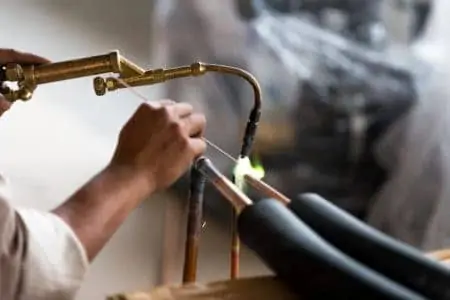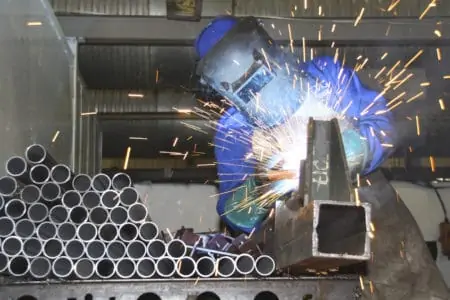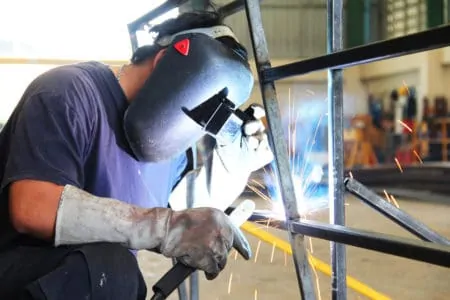
Welding aluminum is a lot trickier than welding steel or other metals. It has a higher conductivity and lower melting point, increasing your chances of burn through. Choosing the best welder for aluminum is a delicate and detailed process.
We bring you the best aluminum welders to help you decide.
- Efficient IGBT inverter
- TIG & Stick welder
- Dual voltage
- Top quality casing
- Superior voltage control
- Easy to use
- Lightweight inverter technology
- Value for money
- Simple controls
- Lightweight & portable
- Gasless capabilities
- Flux-cored
- Comes with several accesories
- Equipped with safety features
- 10 welding speed options
Review Methodology: At Sensible Digs, we dedicate ourselves to offering a thorough analysis and fair assessment of the best aluminum welders on the market. Our experienced professionals conduct hands-on tests and use carefully selected criteria to score and rank each product. We evaluate each welder from a user’s perspective, tracking performance and comparing data to set industry benchmarks. We provide factual evidence, detailing design choices, and their impact on the user experience. Our evaluations focus on key decision-making factors like power, durability, ease-of-use, and value for money. After rigorous review and research, we recommend the best performing welders, providing you with reliable results you can trust.
The Best Aluminum Welders of 2024
Finding the right welder to work with aluminum is a challenge, especially with the choices available. We scoured the internet to bring you the 5 best examples money can buy.
AlphaTig 200X AC/DC Welder
Best Aluminum TIG Welder
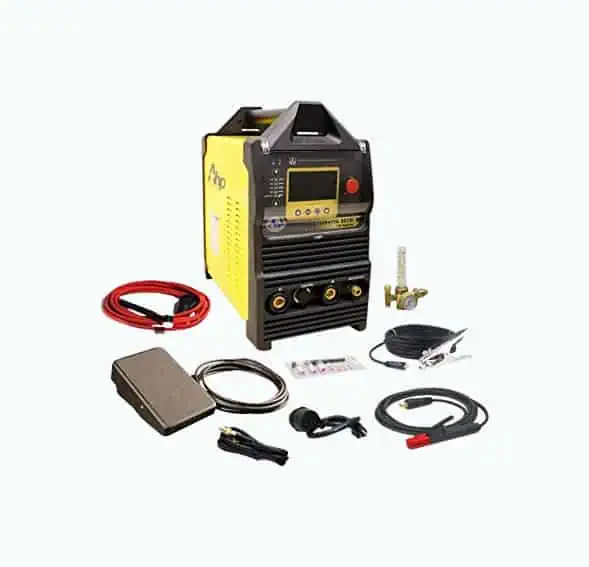
This AlphaTig is a great machine because it uses the latest inverter technology to give users the very best heat and output control, making it a more efficient and effective TIG welder for aluminum. The IGBT inverter is sharper and more precise compared to regular inverters.
This machine is equally at home welding sheet aluminum as it is working with 0.25-inch stock. The unit features a high-frequency start, which makes starting an arc easier and maintains stability throughout. It is also dual voltage, so it is at home in a domestic setting as well as in professional environments like construction sites.
What We Like
Efficient IGBT Inverter
These inverters are more efficient than transformers and more responsive, giving you complete control. This makes working with aluminum a lot less challenging and increases your chances of a better outcome.
TIG and Stick Welder
TIG is neater and more precise, and stick allows you to work in harsher conditions outdoors. Stick and TIG have good penetration levels, which helps when you are welding thicker material.
Dual Voltage
Switching between 110 volts and 220 volts is ideal if you want to maximize your usage of this welder. It is equally at home in the garage and the professional workspace.
What We Don't Like
High-End Price
There is no escaping from the fact that this is a high-end welding machine. Compare it to some on the list, and you’ll see what we mean. The price tag might put some non-professional welders off purchasing one.
Less Robust
Inverters are no match for the durability of a transformer. They can’t take the punishment. This inverter technology welder is susceptible to the rigors of the professional environment.
Product Specs
| Weight (pounds) | 69 |
| Dimensions (inches) | 19 x 23 x 12 |
| Multi-process | TIG, stick |
| Voltage | 110/220 |
| Max amps | 200 |
| Duty cycle | 60 percent |
| Price | $$$ |
| Warranty | 3-year |
Our Ratings
User Experience
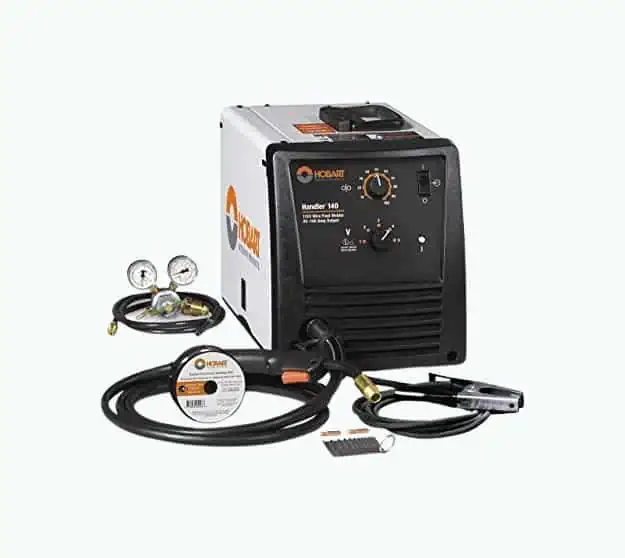
Hobart Handler 140 MIG Welder
Best Aluminum MIG Welder
MIG welders are a great option when it comes to working with sheet aluminum, and this Hobart Handler stands out as a quality machine
It has a 5-position voltage control that gives the user complete power over the smoothness of the arc and adjustments for the thickness of the sheet aluminum. It means you can fine-tune your welder to cater to thinner material or work on 0.25-inch thick metal at the other end of the spectrum.
It has an industrial-grade, cast aluminum drive system, and a heavy-duty work clamp to give the Handler industrial performance capabilities. It operates from a domestic power supply, and the wire feed is an impressive 40 to 700 inches per minute.
What We Like
Top Quality Casing
The stainless steel casing makes this a robust and reliable welder. It meets the industrial demands of the construction site and is the type of welder that will last for years.
Superior Voltage Control
Different grades and gauge of aluminum require a welder with adjustability. 5 voltage settings mean you have all the control you need to switch between different metals and material thicknesses.
Easy To Use
If you want a welder that is simple to operate, this could be a perfect choice. It has two dials on the front, one for voltage and the other for amperage. Find the setting you want, and you are ready to go.
What We Don't Like
20 Percent Duty Cycle
This welder only has a 20 percent duty cycle. For every 2 minutes spent welding, you will need to rest this welder for 8 minutes to let it cool down.
Product Specs
| Weight (pounds) | 57 |
| Dimensions (inches) | 19 x 11 x 13 |
| Multi-process | MIG, flux-cored |
| Voltage | 115 |
| Max amps | 140 |
| Duty cycle | 20 percent |
| Price | $$$ |
| Warranty | 5-year |
Our Ratings
Personal Perspective
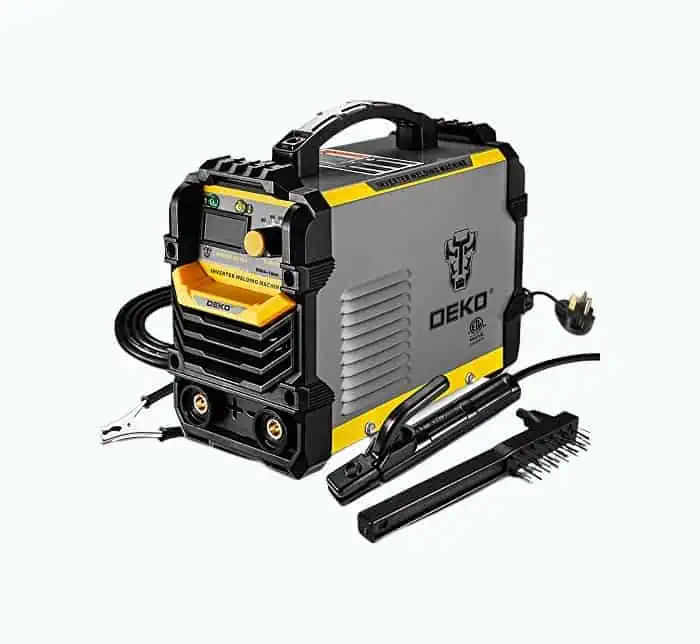
DEKOPRO 110/220V MMA Welder
Best Portable Aluminum Welder
Inverters are the new replacement version of transformers, enabling you to regulate the quality of the arc and the heat better. Inverters are more efficient and precise. However, they don’t have the same capacity handling load that transformers do, so you might be limited to workload.
This stick welder is suitable for welding aluminum, mild steel, stainless steel, and other non-ferrous materials. It is a go-anywhere welder, weighing just 12.1 pounds. It makes it the ideal welder if you are looking to take your skills on the road.
The package comes with a stick torch, power adaptor, wire brush and earth clamp.
What We Like
Lightweight Inverter Technology
Inverters are more efficient than transformers as a means of controlling the accuracy of the heat and the arc. Also, inverters are lighter and more advanced, so they can deal with adjustments more rapidly.
Great Price
For a starter welder, this is an excellent price. It isn’t going to rival the premium models, but it will set you on course for learning to weld and be a reliable machine for several years.
Simple Controls
If you are learning the ropes and want to keep things as simple as possible, you can’t go wrong with these controls. With an on/off switch, a current dial, and a current meter, this welder is so simple to use.
What We Don't Like
Build Quality Issues
When things are this cheap, the quality of the parts reduces compared to higher-end models. Less expensive components feature heavily, reducing the operating lifespan of this welder.
Rods Stick at 110V
Everyone reports that this welder works well at 220 volts, but at 110 volts, the rod tends to stick, making it almost impossible to get a great weld line and joint.
Product Specs
| Weight (pounds) | 12.1 |
| Dimensions (inches) | 16.1 x 11.4 x 6.3 |
| Multi-process | Stick |
| Voltage | 110/220 |
| Max amps | 160 |
| Duty cycle | 40/60 percent |
| Price | $ |
| Warranty | 1-year |
Our Ratings
Community Feedback
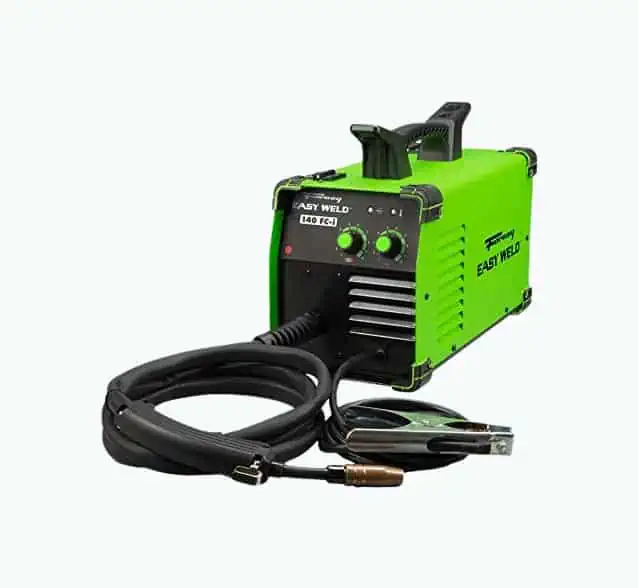
Forney Easy Weld 261 FC-iMIG Welder
Best Beginner Aluminum Welder
This is a MIG welder, so it is the easiest method to learn, making it ideal for beginners. It has a maximum output of 140 amps and a 120V input.
It is also a gasless, flux-cored welder, so again, if you are learning the ropes, you don’t have to pay out for expensive gas canisters. It also makes it an easier process to learn. This welder has infinite voltage and wire speed control to regulate the welding rate.
It is ultra-lightweight, compact and easy to store away, making it the ideal choice for hobbyists and DIY enthusiast welders working from the garage or home workshop.
What We Like
Lightweight and Portable
These welders are easy to set up and pack away, taking up a minimum amount of room space, making them ideal for the home market. Being lightweight and compact is a major bonus.
Gasless Capabilities
Because there is no gas, it means you can start welding straight from the box. Sure, at some point, you are going to need to learn about gas protection, but for now, enjoy the process in its simplified state to get you used to how a welder handles.
Great Price
When you are a beginner, the budget is always a factor because you don’t need to spend piles of cash to get onto the welding ladder. Some budget machines will get you onto the lower rungs for a fraction of the price.
What We Don't Like
Build Quality Issues
Forney has used lesser quality materials, relying on plastic instead of metal. If you accept that you get what you pay for, who cares? But it is the difference between a welder for now or a welder for life.
Product Specs
| Weight (pounds) | 19 |
| Dimensions (inches) | 16.7 x 12 x 8.1 |
| Multi-process | MIG |
| Voltage | 120 |
| Max amps | 140 |
| Duty cycle | 30 percent |
| Price | $$ |
| Warranty | 1-year |
Our Ratings
First-Hand Impression
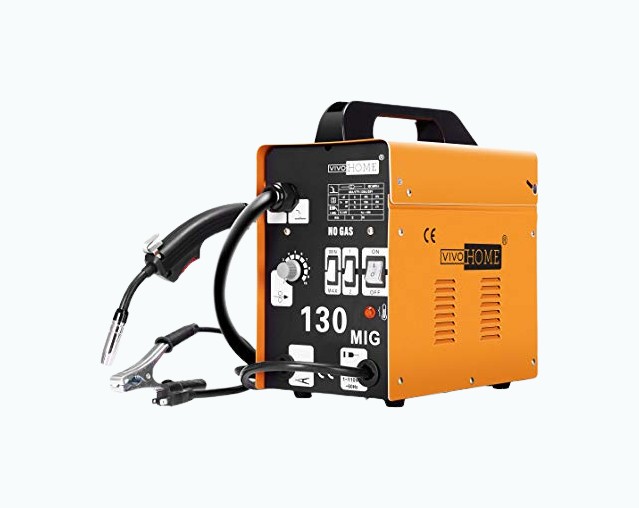
VIVOHOME Portable Flux-Core MIG Welder
Best Budget Aluminum Welder
While this might not be the lightest welder, it is a gasless version, so it requires no shielding to produce good quality welds. For that reason, it is a great option when traveling to and from job sites.
The gasless feature means that the flux-cored wire self-releases metal inert gas from the welding process that prevents oxidation of the weld. You can switch between MIG and gasless, depending on the material type, but it does give you the flexibility to work outdoors.
It has 4 levels of current flow and 10 welding speeds, so you can increase the welding rate as you improve your accuracy depending on the thickness of the aluminum.
What We Like
Complete Package
This welder comes with everything you need to get started. It even comes with a welding face shield and several other useful accessories.
Safety First
This model has overheat protection, a built-in fan and rubber feet for extra grip. It also requires no gas for inert shielding, so you don’t need to store dangerous canisters.
Entry Level, Entry Price
It makes welding affordable, but remember it won’t last as long as the high-end models. Use it, learn from it, and when you graduate, seek out a better machine.
What We Don't Like
Cheap Price, Cheap Parts
Buying a cheap welder is a great idea, but it has limitations that will become apparent as you progress. And that’s where dissatisfaction sets in. Before too long, you’ll be seeking a new aluminum welder.
Weak Power
This 110V welder is aimed at the domestic market. Don’t ask too much of this welder as it might not deliver. It is better suited to lighter duties and thinner materials like sheet aluminum.
Product Specs
| Weight (pounds) | 36.9 |
| Dimensions (inches) | 20.6 x 15.1 x 12.4 |
| Multi-process | MIG |
| Voltage | 110 |
| Max amps | 130 |
| Duty cycle | 60 percent |
| Price | $ |
| Warranty | 1-year |
Our Ratings
User Experience
| Product | Best | Weight | Dimensions | Multi-process | Voltage | Max amps | Duty cycle | Warranty |
|---|---|---|---|---|---|---|---|---|
| AlphaTig 200X AC/DC Welder | TIG | 69 lbs | 19 x 23 x 12″ | TIG, stick | 110/220 | 200 | 60% | 3-year |
| Hobart Handler 140 MIG Welder | MIG | 57 lbs | 19 x 11 x 13″ | MIG, flux-cored | 115 | 140 | 20% | 5-year |
| DEKOPRO 110/220V MMA Welder | Portable | 12.1 lbs | 16.1 x 11.4 x 6.3″ | Stick | 110/220 | 160 | 40/60% | 1-year |
| Forney Easy Weld 261 FC-iMIG Welder | Beginner | 19 lbs | 16.7 x 12 x 8.1″ | MIG | 120 | 140 | 30% | 1-year |
| VIVOHOME Portable Flux-Core MIG Welder | Budget Pick | 36.9 lbs | 20.6 x 15.1 x 12.4″ | MIG | 110 | 130 | 60% | 1-year |
Is It Difficult To Weld Aluminum?
Aluminum is difficult to weld because it is soft, highly sensitive to heat and is insulated by a tougher oxidized layer that melts at a different temperature, meaning the weld pool is gummy and difficult to work with.
Aluminum melts at 1,260 degrees Fahrenheit, unlike aluminum oxide, which melts at 3,700 degrees Fahrenheit, meaning the oxide doesn’t melt into the weld pool at the same time as the aluminum, and that affects its fluidity.
Can You Weld Different Grade Aluminum?
You can, but some grades of aluminum are easier to weld than others. Essentially, there are 4 grades of aluminum suitable for welding:
- 1XXX
- 3XXX
- 5XXX
- 6XXX
There is a 4XXX aluminum, which is highly weldable but more commonly used as a filler material. Let’s briefly investigate these 4 grades of aluminum.
1XXX
This is the closest to pure aluminum and the easiest to weld using filler 1100 and 4043. This grade of aluminum is low-strength but highly corrosion-resistant. It makes an ideal material for conducting electricity or transporting chemicals.
3XXX
This is aluminum alloyed with manganese and is also easier to weld. Use filler 4043 and 5356 for the best results. 3XXX aluminum is typically used in heat exchangers and air conditioning units. It is a medium-strength alloy, so unsuitable for construction and structural applications.
5XXX
This grade is a popular choice among welders thanks to its high-strength. It is an alloy containing magnesium and is not suited to 4XXX filler. This aluminum grade is commonly used in construction and heavy-duty applications like shipbuilding.
6XXX
6XXX is alloyed with magnesium and silicon and is suited to fabrication work involving structural components, thanks to its high-strength.
Aluminum Alloys To Steer Clear of Welding
Not all aluminum alloys are suited for welding. The main two to avoid are:
- 2XXX
- 7XXX
Let’s investigate why:
2XXX
This is a wrought aluminum alloy containing copper and sometimes nickel and manganese to increase strength. This changes its chemical composition, leaving 2XXX susceptible to cracking. This grade of aluminum is often used in the aerospace industry thanks to superior durability.
7XXX
This alloy contains zinc, and like 2XXX, it is extremely strong, again, a favorite of the aerospace industry. It is also prone to cracking under the wrong conditions. However, zinc makes the metal corrosion-resistant.
If you were to work with either of these aluminum alloys, make sure you have the skills and experience needed for a successful outcome.
Types of Aluminum Welders
As with other metals, there are different methods of achieving the same welding results.
MIG
MIG welding is the easiest method to learn and is relatively cheap to set-up and execute. MIG is better suited to thinner sheet aluminum because it lacks the penetration and heat control of TIG welding.
Argon is the most popular shielding gas when MIG welding aluminum. There are two ways to MIG weld aluminum. The first is to use the pulse method, which requires a welder with an inverter. The second is spray arc welding, which uses a constant voltage and current machine.
TIG
TIG welding is the go-to method when welding aluminum. It requires a high degree of heat control, and TIG gives you that versatility. Also, aluminum holds heat, and TIG machines are excellent at keeping the metal from overheating.
TIG is also suitable for thick and thin materials, so it gives you flexibility. The only thing to remember is that TIG requires a filler rod, so make sure you select a filler material that best matches the grade of aluminum you are welding. If not, you could damage the integrity of the weld.
Also, TIG is difficult to master, so it requires a degree of skill.
Torch
Torch welding is the most complicated way to weld aluminum, although experienced professionals may opt to do this because they can control the heat better. Burn through is a frequent occurrence with torch welding, but get it right, and it is a forgiving technique, but only in the hands of a seasoned welder.
How To Choose the Best Aluminum Welder
You have to make several decisions when choosing the right welder, but there are also some fundamental basics you should seek before handing over your hard-earned dollars.

AC or DC
AC is the preferred way for professionals to weld aluminum. DC increases the temperature too much, making the welding process tricky and breaking down the electrode. The best way to DC weld is to switch the polarity from reverse to straight. It struggles to break down the oxide coating on the aluminum, but you get a more stable arc that’s easier to control.

Output Power
The greater the power, the deeper the weld penetration. This means you can weld thicker metals. If your welder has a small amperage range, you will be limited to the types of applications you can weld.
110-volt, domestic welders have a lower output than 220-volt equivalents, so they are better suited to lighter duties and thinner materials.
A welder with an ampere range of between 5 and 230 amps is flexible enough to weld aluminum to a thickness of 60 mm. Anything less and you will be limited to a thickness of between 31 and 47 mm.
On the flip side, operating on a low amperage range is equally important. It means you maintain a stable arc below 10 amps, again, stretching your versatility.

Pulse Welding
Heat control is another factor to consider because too little and the metal heats up and distorts. Pulse control works by switching between a high and low current load, helping to keep a steady heat and arc, allowing the welder to cool while maintaining the arc.

Duty Cycle
The duty cycle is measured in 10-minute intervals and demonstrates how long your welder will run until it needs time to cool down. So, if you see a welder with a 30 percent duty cycle, it means that the welder will run for 3 minutes, and you will then need 7 minutes to let it cool down before you can safely use it again.
The higher the duty cycle, the more efficient the machine and the longer you keep working instead of standing around between cycles waiting for the welder to cool down.
Typically, machines with higher welding currents heat up faster and take longer to cool down, which shortens your usage time.

Budget
Everything is subject to your budget. You might have the longest shopping list of features in the world, but if your budget doesn’t stretch, you have to work within your means. Welders range in price from a few hundred dollars to a couple thousand dollars.
You almost always get what you pay for, with the high-end models lasting many years and giving hassle-free welding. Cheaper welders have lower-grade components and are more prone to malfunction.
Aluminum Welding FAQs

Is It Better To Weld Aluminum With MIG or TIG?
You can use both methods. However, MIG is easier to master but has less heat control, while TIG is the preferred method thanks to its higher heat control and penetration levels. MIG is better suited to thinner materials, while TIG has broader applications.

What Rod Do I Use for Aluminum TIG Welding?
The most versatile rod is the 4043, especially when welding 3003, 6061 and A355 aluminum castings.

Can All TIG Welders Weld Aluminum?
All TIG welders can weld aluminum. However, several factors determine how well and easy it is to weld aluminum. The most important is the amp rating.

Can I Weld Aluminum With a Wire Feed Welder?
You can, but preparation is the key to welding with a wire-feed welder. Aluminum is highly-conductive, which causes problems welding at lower voltages because the pool generated by the weld disperses rapidly and unevenly.
Is Brazing Aluminum as Strong as Welding?
A properly brazed joint is as strong and sometimes stronger than welded joints, thanks to the relatively low temperatures needed to braze compared to welding. Heat distorts the metal and reduces the tensile strength of the joint.

What Welder Is Best for Welding Aluminum and Stainless Steel?
The Square Wave TIG 200 is designed for welding things like aluminum and stainless steel. Its high amperage range makes it awesome for welding thicker materials. It also has a high-duty cycle which lets it run for a long period before needing to cool down.

What Kind of TIG Welder Is Best for Aluminum?
The AHP AlphaTIG 203Xi is the premier tool for any aluminum welding project. It boasts high visibility LCD screen, meaning you can easily monitor current, voltage, and other functions to ensure precise welding with every pass.
Its advanced inverter technology provides high-quality arc starts and helps control high-frequency noise while welding.
But, a TIG welder with a high-frequency start feature, square wave AC output, pulse welding capability, high amperage range, and the high-duty cycle is considered the best option for welding aluminum.

What Is the Best Welder for Aluminum?
The Hobart 500559 Handler is an incredibly versatile, all-in-one machine for MIG and FCAW welding. It’s perfect for aluminum and has 5-position voltage control that lets you adjust the intensity of your weld based on the thickness of the material.
Aluminum Welding Made Easier
Choosing the right welder for aluminum is vital for the neatest and most accurate results. Aluminum is a tricky material to work with, especially as the alloy mix varies, and so does the way it welds.
Get it right, and aluminum is as easy to weld as steel. Get it wrong, and you will make life more complicated than it needs to be.