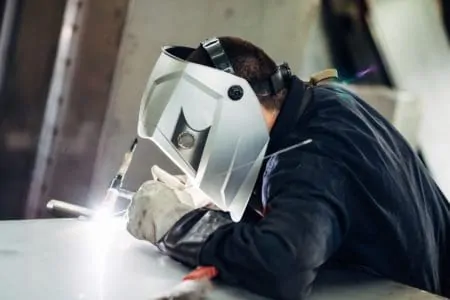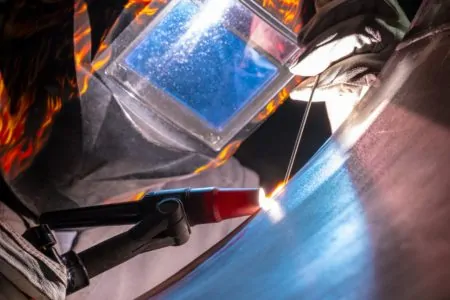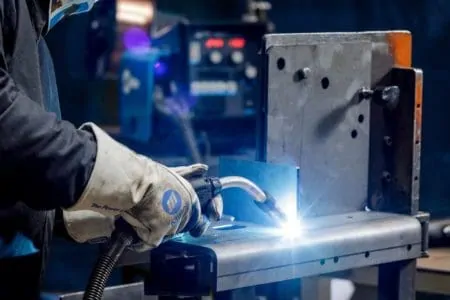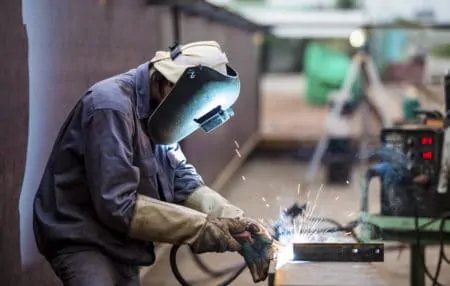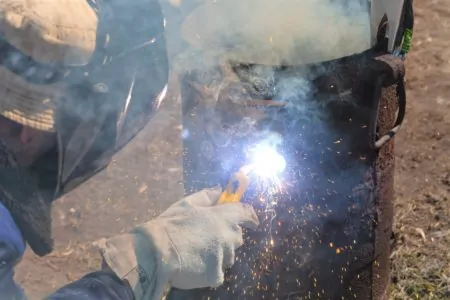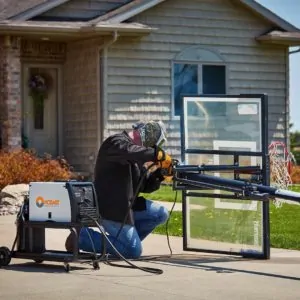
Flux-cored welding is a great way to learn the art of welding. The equipment is easy to use, and after a few hours of practice, you should have the technique mastered. Flux-cored welders are simple to set up and work well with rusty metals and other impurities.
Here is our take on the best 6 flux-core welders money can buy.
- Industrial-grade quality
- Superior voltage control
- Only weighs 57 pounds
- Reliable & durable
- Aluminum spool gun included
- Comes with multiple accessories
- Only weighs 37 pounds
- No gas needed
- Easily affordable
- Suitable for entry-level welders
- Powerful machine
- Heat protection
- Beginners in mind
- Lightweight option
- Usable for a variety of work
- Stainless steel construction
- Adjustable current flows
- Weighs 35 pounds
Review Methodology: At Sensible Digs, we strive to provide you with comprehensive, hands-on assessments of the best flux-core welders on the market. Our team of professionals meticulously research, test, and compare each product based on critical performance criteria such as power, durability, ease of use, and welding quality. We use concrete data and evidence from our first-hand experience to measure and benchmark each welder, identifying key decision-making factors and rating each product accordingly. From an in-depth analysis of design choices to sharing our findings on what sets each welder apart, we evaluate products from your perspective, helping you make the most informed decision. Trust in our expertise and let Sensible Digs guide you to the best flux-core welder for your needs.
The Best Flux-Core Welders of 2024
These are our top flux-core welder picks.
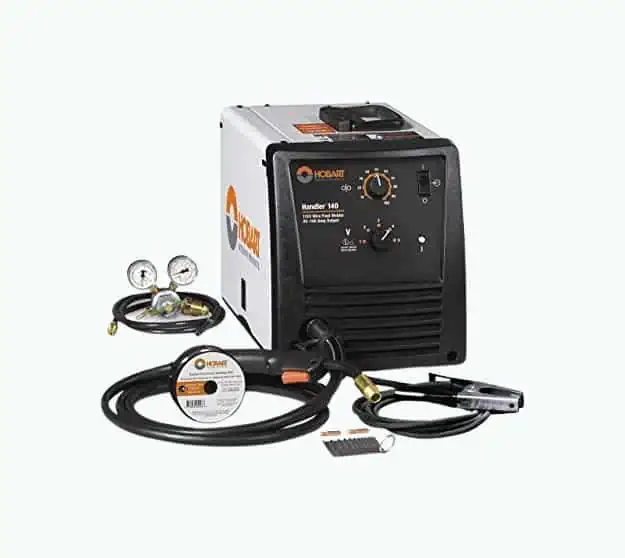
Hobart Handler 140 MIG Welder
Best Flux-Core Welder for Sheet Metal
It’s worth pointing out that in general, flux-core welders are not the best option when it comes to working with sheet metal. However, this Hobart Handler is by far the best for thinner materials.
It has 5-position voltage control that gives the user complete power over the smoothness of the arc and adjustments for the thickness of the sheet material. It means you can fine-tune your welder to cater to thinner material or work on 0.25-inch thick metal at the other end of the spectrum.
It has an industrial-grade, cast aluminum drive system and a heavy-duty work clamp to give the Handler industrial performance capabilities. It operates from a domestic power supply, and the wire feed is an impressive 40 to 700 inches per minute.
What We Like
Industrial-Grade Quality
Encased in stainless steel makes this a robust and reliable welder. It certainly meets the demands of the construction site. It is the type of welder that will last for years.
Superior Voltage Control
Working with different grade and gauge metals requires a welder with adjustability. 5 voltage settings mean you have all the control you need to switch between metals and depths.
Only Weighs 57 Pounds
This welder has a large handle that folds neatly away. It also weighs just 57 pounds, making it the ideal welder to pack into your car and take on the road. You can also store it away easily in the garage or workshop.
Easy To Use
If you want a welder that is simple to operate, this could be a perfect choice. It has two dials on the front, one for voltage and the other for amperage. Find the setting you want, and you are ready to go.
What We Don't Like
High Price Tag
It isn’t the most expensive welder available, but it is certainly not a budget option. If you are a beginner, it may be beyond your price range. It is a quality welder, but there are others in the same class that are cheaper models.
20 Percent Duty Cycle
This welder only has a 20 percent duty cycle. It means that for every 2 minutes spent welding, you will need to rest this welder for 8 minutes to let it cool down.
Product Specs
| Weight (pounds) | 57 |
| Dimensions (inches) | 19 x 11 x 13 |
| Multi-process | MIG, flux-cored |
| Voltage | 115 |
| Max amps | 140 |
| Duty cycle | 20 percent |
| Price | $$$ |
| Warranty | 5-year |
Our Ratings
User Experience
Lotos MIG175-Amp Wire Welder
Best 220-Volt Flux-Core Welder
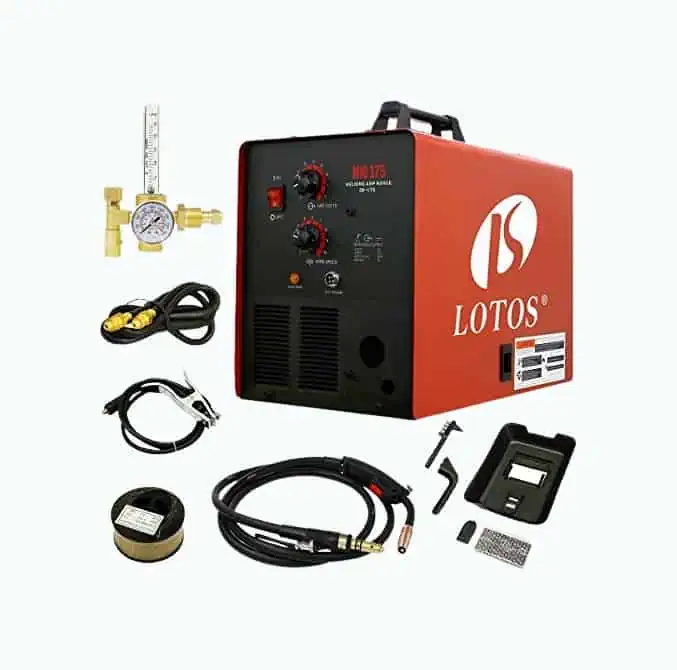
This flux-core welder is versatile. You get an aluminum spool gun for good measure and a host of accessories. It has a rated output of 175 amps, so it welds stainless steel to a depth of 0.25 inches.
The transformer technology ensures that no matter what the demands on this machine, it can take it. Transformers are better suited to heavy applications and less prone to damage.
The accessories include an argon regulator, a spool gun, a gas hose, spare contact tips and a welding mask. It has everything you need to get flux-core welding. If you use it in the MIG application, you need to factor in the cost of the gas.
What We Like
Reliable and Durable
Transformers are old school and robust. They have been used in welders for generations because they are effective and long-lasting. Why mess with a winning formula?
Aluminum Spool Gun Included
Flux-core welders cannot weld aluminum. But this kit comes with an aluminum spool gun to give you that option. It increases your flexibility and enhances the number of applications you can do.
Accessories Galore
The regulators, gas hose, spool gun and face mask enables you to get flux welding straight out of the box. MIG requires shielding gas, so you may have to factor that in if you want to switch applications.
What We Don't Like
Very Pricey
Be prepared to pay a lot to get this welder. It is easily one of the most expensive flux-core welders available. It might put off beginners and occasional welders.
Old Transformer Technology
We can sing the praises of transformers for being robust, but they are older technology, and inverters are more efficient and save you energy usage through better control.
Product Specs
| Weight (pounds) | 85 |
| Dimensions (inches) | 18 x 12.5 x 10.5 |
| Multi-process | MIG, flux-cored |
| Voltage | 220 |
| Max amps | 175 |
| Duty cycle | 20 percent |
| Price | $$$ |
| Warranty | 1-year |
Our Ratings
Personal Perspective
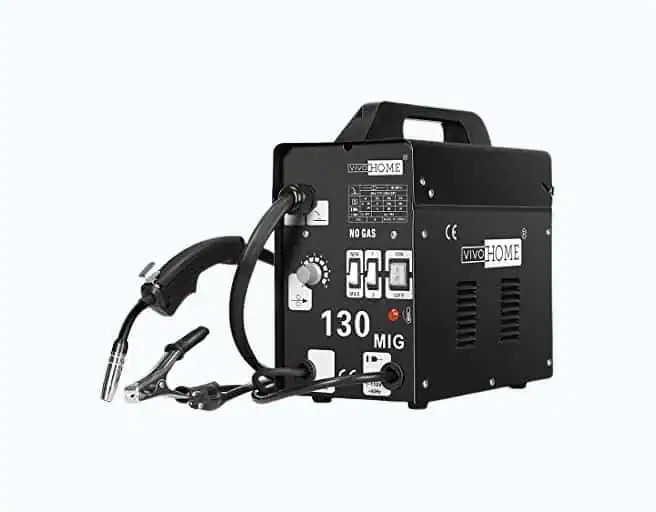
VivoHome Portable Flux-Core MIG 130 Welder
Best Portable-Flux Core Welder
If you want portability, look no further than this VivoHome welder. It costs a fraction of the Lotos model’s price, which puts it within beginner’s budgets. So, how good is this welder, and just how compact is it?
Unsurprisingly, it is a MIG welder, as so many seem to be, but it’s flux-core credentials are excellent. It weighs 37.2 pounds, so it is indeed light, and thanks to the large carry handle on the top, it is easy to pick up. The dimensions are 20.47 x 15.2 x 12.44 inches, so it is compact, making it easy to maneuver and store away.
It’s a no-reaction welder, so you don’t need shielding gas, and it has a maximum output of 120 amps, so it will tackle lighter tasks rather than heavy-duty applications.
What We Like
Easily Affordable
You could buy 3 units at this price and still have change from the cost of a high-end model. If you are welding for the first time, this might be a great option.
Only Weighs 37 Pounds
At 37 pounds, it is a lot lighter than some of the high-end models. This could be down to the construction materials (more plastic than metal), but if you want a compact welder, this unit is easy to store away and maneuver.
No Gas Needed
This welder has an electrode with a flux-cored wire that produces shielding gasses during the welding process. It means that you don’t need to worry about your welds; the flux-cored wire sorts that out.
What We Don't Like
Build Quality Issues
For such a well-priced welder, you won’t be surprised to learn that the quality of the components is not as high as the expensive models. You get what you pay for!
15 Percent Duty Cycle
This welder has a very low duty cycle. For every 1.5 minutes of welding, you need to rest the welder for 8.5 minutes. That is going to hamper your work rate. You’ll spend most of your time sipping coffee while you wait to go again.
Product Specs
| Weight (pounds) | 37.2 |
| Dimensions (inches) | 20.47 x 15.2 x 12.44 |
| Multi-process | MIG, flux-cored |
| Voltage | 110 |
| Max amps | 120 |
| Duty cycle | 15 percent |
| Price | $ |
| Warranty | 1-year |
Our Ratings
Community Feedback
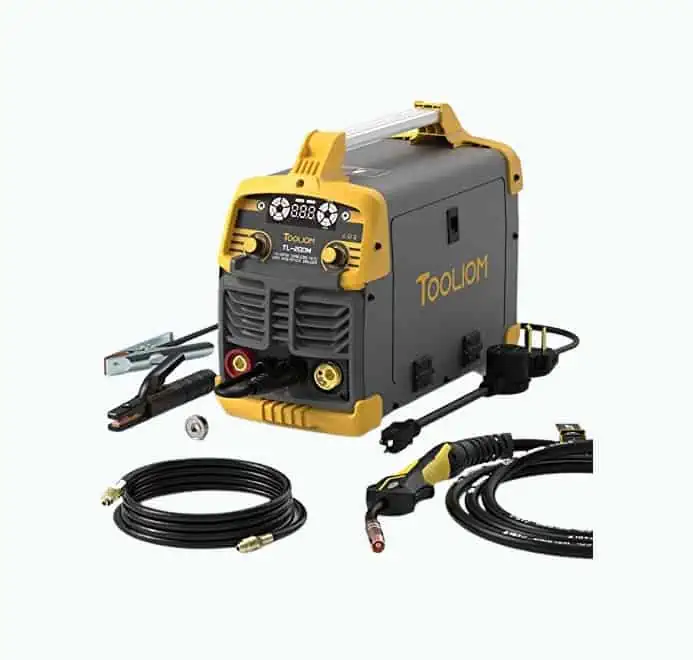
Tooliom 200A MIG Welder 3 in 1
Best Multi-Function Flux-Core Welder
This popular 3 in 1 welder is a very versatile and multi-purpose option. It works as a flux-core welder, a Lift TIG, and a stick welder. It also uses solid wire to aid your projects. Being a multi-purpose welder means you get more bang for your buck since all of these purposes are packed into one awesome machine.
You can also use this as an ARC machine when connecting the cable end plug to the negative connector. To switch between welding methods, simply press one button to select your mode. This is a very user-friendly machine. Even beginners will love it.
Something To Note
What We Like
Suitable for Entry-Level Welders
With everything available in one machine, this is a suitable choice for beginners. The Synergic Adjustment Function means that you don’t need to adjust anything manually. The voltage values are automatically matched, making this easy to get to grips with.
Powerful — Up to 200A Output Current
This is a powerful machine that will impress you as you work. With up to 200A output current, you can weld up to a 4.0mm plate. It’s also big enough for both two and 10-pound rolls of wire and E7018 basic electrode.
Heat Protection
This is a safe option, thanks to the cooling fan included. This heavy-duty addition dissipates heat to avoid overheating and motor exhaustion. The automatic thermal overload protection acts as another safety net so that you can rest assured everything will run smoothly.
What We Don't Like
Only for Mild Steel
This isn’t your best option for heavy-duty welding. This is designed for mild steel up to 4.0mm. If you’re looking for something that can handle wider and stronger steel, you should look elsewhere.
Poorly Written Instructions
User manuals are incredibly useful for setting up and learning how to use a new tool. But these instructions are poorly written. You may need to turn to YouTube tutorials to learn best how to manage this machine.
Product Specs
| Weight (pounds) | 20.5 |
| Dimensions (inches) | 18.9 x 8.7 x 14.2 |
| Multi-process | Flux-cored, MIG, Lift TIG, ARC |
| Voltage | 110/220 Dual |
| Max amps | 200 |
| Duty cycle | 60 percent |
| Price | $$ |
| Warranty | Case by case basis(1) |
Our Ratings
First-Hand Impression
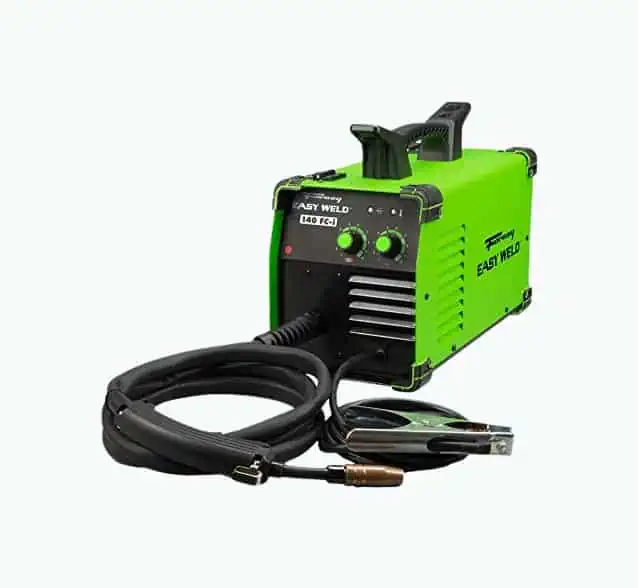
Forney Easy Weld 261 140 FC-i Welder
Best Beginner Flux-Core Welder
When you call your welder “Easy weld,” it has to be simple for beginners to use. Unlike others on the list, this is not a multi-process welder. It welds to a depth of 0.25 inches, and it has a 120-volt input and a 140-amp output.
These models are built with beginners in mind. The controls are simple themselves. You only have two dials to contend with. It has infinite voltage and speed control so that you can dial in just the right weld.
If you are a novice, spending less time fathoming how your welder works and more time practicing welding is a good thing.
What We Like
Made With Beginners In Mind
It is a welder with everything stripped back to make it functional and easy to master. It doesn’t TIG or MIG, it flux-cores, and that’s it. Period.
19 Pounds — Lightweight Option
Take this with you anywhere. Weighing only 19 pounds, this is a lightweight option that you can transport from place to place.
Usable for a Variety of Work
While this isn’t a heavy-duty option for super-avid welders, it’s suitable for various tasks. You can use this for general metal fabrication, repair, maintenance, vehicle work, farm work, and more. It even works on mild steel.
What We Don't Like
Not a Heavy-Duty Option
While Forney indicates that this is good for avid welders, as well as beginners, we’re not so sure. If you’re an avid welder and are going to take thicker bits of material to this product, you might want to opt for something a little more durable and strong. This is for light projects only.
Product Specs
| Weight (pounds) | 19 |
| Dimensions (inches) | 16.7 x 12 x 8.1 |
| Multi-process | Flux-cored |
| Voltage | 120 |
| Max amps | 140 |
| Duty cycle | 30 percent |
| Price | $$ |
| Warranty | 1-year |
Our Ratings
User Experience
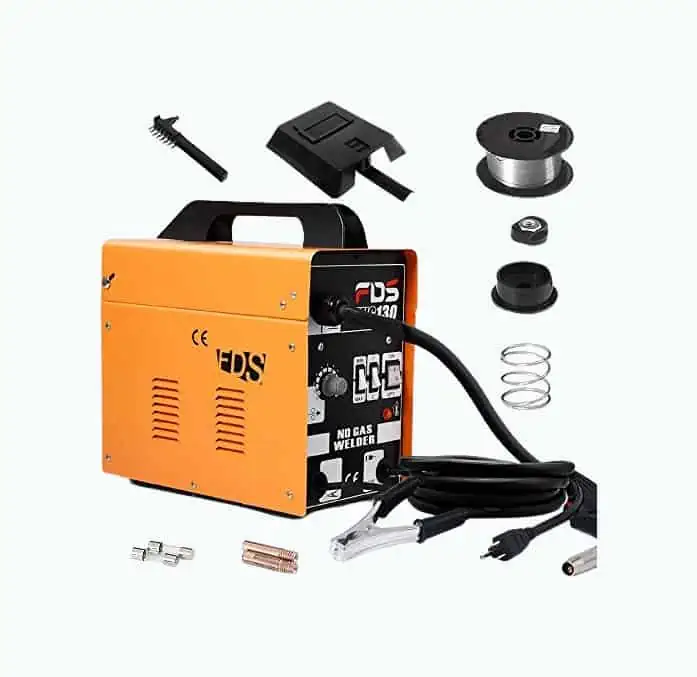
Goplus MIG130 Welder Flux-Core Wire
Best Budget Flux-Core Welder
The Goplus welder also has an automatic wire feed. This welder can handle lighter duties like car body panel work and sheet material, and it has 4 adjustable current levels to cater to different applications.
It has safety features like overheat protection and two vents to keep the machine cool. It’s lightweight, weighing just 35 pounds, so it is the ideal home and workshop welder for smaller tasks around the home.
It comes with accessories, including a chipping hammer to remove hardened slag and a welding mask.
What We Like
Stainless Steel Construction
The stainless steel body protects the welder from damage and the rigors of daily use. It is a feature typically found in more expensive welders rather than budget models.
Adjustable Current Flows
Adjusting the current flow gives you greater flexibility to weld thinner or thicker material. It makes it possible to do repair work on car body panels without the fear of melting the sheet metal.
Weighs 35 Pounds
This welder weighs 35 pounds, so getting it to and from the welding site is easy. It also makes it simple to store away in the garage or workshop.
What We Don't Like
Cheap Components
This machine has such a low retail price that the quality of the components are not as good as the high-end models. It all adds up to a higher risk of a malfunction, with the possibility of seeking a full replacement.
Lacks Power
This welder tackles the lighter duties, restricting the types of metals you can work with and the applications.
Product Specs
| Weight (pounds) | 35 |
| Dimensions (inches) | 14 x 8 x 12 |
| Multi-process | Flux-cored, MIG |
| Voltage | 110 |
| Max amps | 130 |
| Duty cycle | 20 percent |
| Price | $ |
| Warranty | 3-month |
Our Ratings
Personal Perspective
| Product | Best | Weight | Dimensions | Multi-process | Voltage | Max amps | Duty cycle | Warranty |
|---|---|---|---|---|---|---|---|---|
| Hobart Handler 140 MIG Welder | Sheet Metal | 57 lbs | 19 x 11 x 13″ | MIG, flux-cored | 115 | 140 | 20% | 5-year |
| Lotos MIG175-Amp Wire Welder | 220-Volt | 85 lbs | 18 x 12.5 x 10.5″ | MIG, flux-cored | 220 | 175 | 20% | 1-year |
| VivoHome Flux-Core MIG 130 Welder | Portable | 37.2 lbs | 20.47 x 15.2 x 12.44″ | MIG, flux-cored | 110 | 120 | 15% | 1-year |
| Tooliom 200A MIG Welder 3 in 1 | Multi-Function | 20.5 lbs | 18.9 x 8.7 x 14.2″ | Flux-cored, MIG, Lift TIG, ARC | 110/220 Dual | 200 | 60% | Case by case basis |
| Forney Easy Weld | Beginner | 19 lbs | 16.7 x 12 x 8.1″ | Flux-cored | 120 | 140 | 30% | 1-year |
| Goplus MIG130 Flux-Core Wire | Budget Pick | 35 lbs | 14 x 8 x 12″ | Flux-cored, MIG | 110 | 130 | 20% | 3-month |
What Is Flux-Core Welding?
Flux-core welding is a process that uses a hollow wire electrode packed full of flux, fed through a welding gun into the joint to weld two pieces of metal. As the wire heats, it melts and releases a gas that protects the weld from oxidation.
It is very similar to MIG welding in style and process, but unlike MIG welding, which requires gas to protect the integrity of the weld, flux-core welding is performed without such gas. It also differs from MIG because the electrode is hollow.
Is Flux-Core Welding Easy?
Flux-core welding is easier to master than TIG or stick welding. MIG is the easiest method to learn, but alongside that, flux-core takes a couple of hours to understand.
What makes it beginner-friendly is the lack of shielding gas. This is a huge advantage because it means you can perform flux-core in almost any setting and weather condition.
Are Flux-Core Welders Any Good?
It depends on what application you are using your flux-core welder for. This welding method is super-effective when you work with carbon, stainless or low-alloy steels, but it does not work on non-ferrous metals like aluminum.
Flux-core welders also generate a lot of heat, so thinner materials like sheet metal and car body panels are also not suitable for this welding method.
You might think that as MIG and flux-core welding are similar in so many ways, that there would be no distinction between when to use MIG and when to use flux-core. All MIG welders can perform the flux-core function. All you do is swap the electrode and turn off the gas.
So, why buy a dedicated flux-core welder? The first reason is that they can penetrate deeper and they are better suited to thicker material. A multi-process MIG welder might be better suited to general welding.
The second reason is that flux-core welding is suitable for any welding position, so it is more versatile. And the third reason is that when speed is crucial, a flux-core welder is much faster.
There are subtle differences between MIG welders that offer flux-core capabilities and dedicated flux-core welders. The thickness of the wires plays a role. Most household and lighter-duty MIG welders have a wire diameter of 0.03 inches, whereas if you want to work on substantial material, you need a thicker wire.
Also, check out the reel sizes, because most MIG welders have a 6-inch wheel, which won’t last that long when you are using the flux-core application. Look for an 8 or 10-inch reel to keep you welding for longer. This is important because a MIG welder deposits about 8 pounds of wire per hour compared to a flux-core welder at 25 pounds per hour.
What Can I Weld With Flux-Core?
Flux-core welders are great when it comes to machinery repairs in outdoor conditions. The lack of shielding gas means they can operate almost anywhere. Flux-core is a favorite method of the building industry, as well as transport and large-scale infrastructure projects.
You can weld carbon, mild, stainless and other alloy steels with a flux-core welder. You cannot weld aluminum or other non-ferrous metals.
How Thick Can You Weld With Flux-Core?
In general, using a 115-volt welder, you should reach a penetration level of about 0.25 inches. This increases if you up the amperage, with some 200-amp machines hitting depths of 0.375 inches.
This does vary on different materials. Plus, if you add shielding gas to the mix, you might increase the depth of weld.
How To Choose the Best Flux-Core Welder
Before taking the plunge and buying a flux-core welder, decide how you want to use it, and on what materials. Here are some basics to watch for.

Metal Thickness
Flux is better suited to thicker material, so if you are getting a welder to repair a classic car’s bodywork, think again and go for a MIG welder. Flux-core is generally not suitable for sheet metal because it operates at a high-heat and you risk melting the body panels.
Most average flux-core welders will happily penetrate to 0.25 inches, making them ideal for machinery repair on farms and ranches.

Multi-Process or Single-Use Machines
Most MIG welders will act as a flux-core welder because they can accommodate the hollow wire. However, the reverse cannot be said for flux-core machines, even when they state they are MIG devices. They are specifically designed to take hollow and not solid wire.
Also, if you want the option of adding gas to the weld to prevent oxidation, a MIG welder is a better fit.

Type of Metal
Flux-core welders have limitations when it comes to the types of metal they can weld. They are great at welding stainless steel and other steel varieties, but not for aluminum or other non-ferrous metals.
Having AC or DC capabilities will help. They weld steel better in AC, but as a rule, flux-core welders are not good at operating in AC. The quality of your welds may suffer, so consider switching to DC for a better outcome.

Length of the Lead
It may sound minor, but the length of your lead makes a huge difference to your welding experience. A longer lead of about 10 to 24 inches and a ground lead of around 12 inches means you can move around the weld without having to drag the welder closer.

Reel and Wire Size
Most wire reels are 6 inches, which is fine for MIG and TIG welders, but because flux-core is faster, it feeds more wire. A typical MIG welder deposits 8 pounds of wire every hour compared to 25 pounds for a flux-core welder. Look for a reel of 8 inches and try and get a welder with thicker diameter wire. The standard is 0.03 inches, but 0.035 inches would be better.
Flux-Core Welders FAQs

Is MIG Welding Better Than Flux-Core?
MIG is more versatile for general applications, but less effective when it comes to working outdoors. Flux-core is the go-to method on farms, ranches, and repairs to transport and building infrastructure, thanks to its ability to work in almost all conditions.
They need no gas, and so produce high-quality welds out in the field.

What Can I Weld With a 125-Amp Flux-Core Welder?
You can weld 18-gauge mild steel to a depth of 0.188 inches.

Can You Weld Stainless Steel With Flux-Core?
You can weld stainless steel with a flux-core welder as long as you use the correct wire. Type 309 will weld stainless steel rated from 300 to 309, while type 316L wire will weld 316 stainless steel.

Is Flux-Core Reverse Polarity?
Flux-core works with DC Electrode Negative (DCEN) or straight polarity rather than reverse. Reversed polarity creates a lot of heat on the electrode because electrons flow from negative to positive.

Do You Push or Pull Flux-Core Welding?
You always drag (pull) the welding gun away from the completed weld. Flux-core welding creates a lot of slag which needs to be removed. You’ve probably heard this before, but if there’s slag, you drag.

Is Flux Core a Strong Weld?
Flux core welding, also known as flux-cored arc welding (FCAW), uses a continuously fed wire that is coated in flux. The flux creates a protective shield around the weld, which helps prevent oxidation and other welding defects.
This welding can produce strong welds similar in strength to those made with other welding methods, like gas metal arc welding (GMAW) and shielded metal arc welding (SMAW).
But the strength of the weld will depend on various things. These include the wire’s quality, the welder’s skill, and the conditions under which the welding is done.
Flux core welding is generally considered to be a more efficient and less labor-intensive method than SMAW, and it is primarily used in outdoor and windy environments.
So, flux core welding can produce strong welds. But the strength of the weld will depend on the wire’s quality, the welder’s skill, and the conditions under which the welding is done.

What Are the Downsides of Flux Core Welding?
One downside of flux core welding is that it can produce a lot of smoke and fumes. The flux in the wire creates a protective shield around the weld, but it also makes a lot of smoke and fumes that can harm the welder’s health if proper ventilation is not used.
Another downside is that the quality of the flux core wire can vary greatly, which can affect the quality of the weld. Low-quality wire can result in a weaker weld or other welding defects.
Flux core welding can also produce more spatter than other welding methods, making cleanup more difficult.
Plus, flux core welding is not recommended for thin materials, as the wire can cause warping and other forms of distortion.
And don’t forget FCAW requires a particular type of machine, which is not as common as other welding methods, and the process is not as visually appealing as other methods like TIG welding.
While flux core welding can produce strong welds, it also has some downsides, such as smoke, fumes, spatter, wire quality, and lack of versatility.

What Flux Core Welder Is the Best?
The TOOLIOM 200M flux core welder is one of the most sought-after welding devices in the market due to its highly advanced synergic control, multi-process functionality, and powerful output current.
It offers an impressive 200A output current on dual voltage input for unprecedented efficiency in welding. Synergic Control allows for simple operation by automatically setting the correct voltage/amperage every time, making it highly user-friendly.
Plus, its multi-process capabilities allow you to take on various projects easily, while its compact design and power make this ideal for heavy-duty applications. The TOOLIOM 200M flux core welder is nothing less than a powerhouse and the perfect tool to get the job done right.
Go Gasless
Flux-core welding has its limitations, and it isn’t for everyone, but if you work in the field and need a speedy welding technique to make repairs no matter what the conditions, flux-core is for you.
There are so many instances where gasless welders are useful, so the next time you need to make a repair, try using a flux-core welder.