There are few better ways to spend the summer than camping or exploring the countryside in your RV. After a long day of roaming the wilderness, you will probably be looking forward to a warm shower.
If you are part of a large group, however, an RV water heater tank of about 6 gallons might not be big enough. An RV tankless water heater can heat water almost instantly, so the last user won’t have to ensure a cold shower.
With so many RV tankless water heaters to choose from, it can be difficult to choose one. That’s why we have reviewed five of the best models currently available, to help you decide.
- Self-modulating technology
- Easy-to-use digital thermostat
- Under 12 inches tall
- Produces 1.3 gallons per minute
- 0.99 energy factor
- Whisper quiet
- Off-grid camping with propane
- Large handle for hanging or moving
- Includes most required equipment
- Sleek digital design
- Touch panel and remote control
- Easy to install
- Attractive blue finish
- Self-modulating technology
- Compact 17 inch height
Review Methodology: At Sensible Digs, we provide an in-depth analysis of the best RV tankless water heaters, ensuring that our assessment is based on hands-on experience, professional research, and performance data. Our objective evaluation allows us to measure and compare key decision-making factors, such as energy efficiency, capacity, ease of installation, and durability. We take into account the design choices and their effect on users and share our findings to rank the top models available in the market. Our comprehensive review is designed to instill trust in our readers by offering them evidence-based insights and quantitative measurements while highlighting the unique features that set each product apart from its competitors. With Sensible Digs, you’ll have all the information you need to make an informed decision on the best RV tankless water heater for your needs.
The Best RV Tankless Water Heaters of 2024
Here are our five best RV tankless water heaters available today.
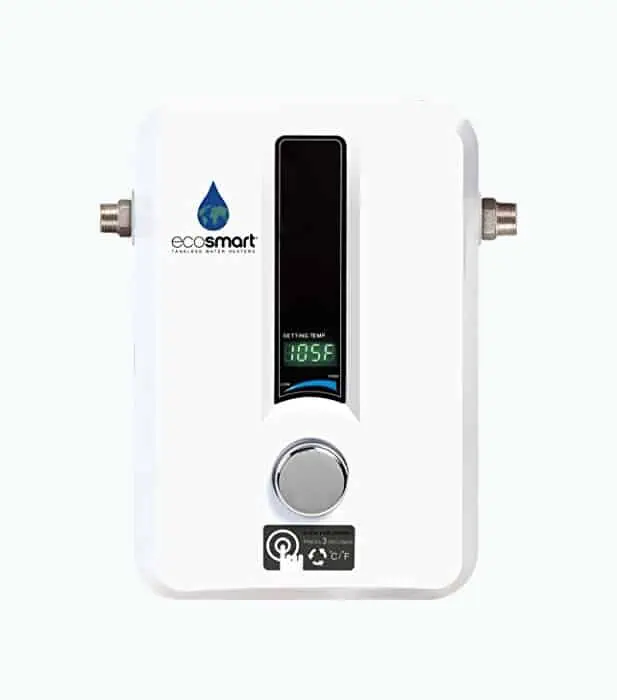
EcoSmart 8 KW Electric Tankless Water Heater
Best Tankless Water Heater for Eco-Friendly Camping
Spending time in your RV is often about exploring nature, so why not choose an eco-friendly boiler? This electric tankless water heater from EcoSmart is an ideal candidate.
We admire the innovation of this product. It utilizes a self-modulating technology that adjusts the energy input to match the amount of hot water required.
It also features a digital temperature control that allows you to set your ideal temperature in 1-degree increments. The unit is compact, measuring just 12 inches by 8 inches.
Although EcoSmart designed this primarily as a whole-home boiler, it works equally well as a point-of-use heater under your sink. The unit will heat around 1.5 gallons per minute to a temperature of 105 degrees Fahrenheit.
The only drawback is that it doesn’t perform well in very cold conditions. Under these circumstances, the gallons per minute will likely decrease.
What We Like
Excellent Use of Smart Technology
The use of smart technology in this unit is very impressive. It features one of the most innovative self-modulating technologies available today. The boiler will adjust its energy demand based on the amount of hot water you need.
It also features durable, threaded heating elements that heat the water quickly and efficiently. EcoSmart claims these are easy to replace.
Easy-To-Use Digital Thermostat
The digital thermostat is very precise and can be adjusted in 1-degree increments. This allows you to set the specific temperature you want, whether it’s for a shower or cleaning dishes.
Space-Saving Design
This tankless water heater from EcoSmart will save space. It’s compact and would fit comfortably in any size RV. The heater measures just under 12 inches tall — approximately 11.5 inches by 8 inches with a depth of 3.75 inches.
The unit requires at least a 100-amp electrical panel and a 40-amp double pole circuit breaker.
What We Don't Like
Not Ideal in Colder Climates
If you plan on spending the cold winter months in your RV, this tankless water heater isn’t your best option. EcoSmart recommends that you avoid using it in conditions colder than 67 degrees Fahrenheit.
If you must use it in colder conditions, be sure to place it exactly where you need it. This will help it deliver hot water more effectively.
Product Specs
| Measurements | 11.5 inches by 8 inches by 3.75 inches |
| Flow rate | 1.5 gallons per minute |
| Temperature range | 80 to 140 degrees Fahrenheit |
| Weight | 5.3 pounds |
| Warranty | Limited lifetime warranty |
Our Ratings
User Experience
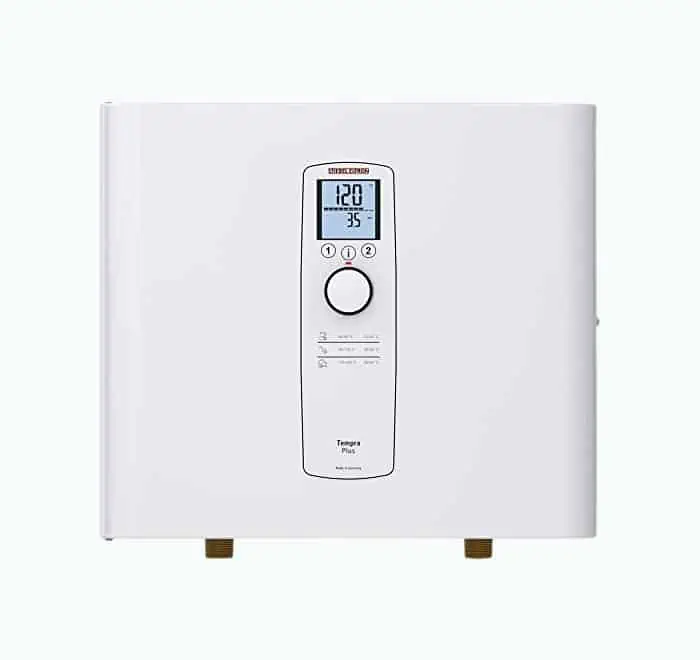
Stiebel Eltron 12 Plus Tempra Tankless Water Heater
Best Tankless Water Heater for Larger RVs
If you spend your vacation in a large RV such as a fifth wheel, this might be for you. This tankless water heater from Stiebel Eltron is both sleek and capable of providing an endless flow of hot water.
They designed this boiler as a whole-house unit. This means it is capable of producing hot water for two running showers and one sink.
Depending on your inlet water temperature, it has a flow rate of 1.3 to 2.5 gallons per minute. The unit also has an energy factor of 0.99 with no standby heat loss. It has excellent energy savings thanks to its self-modulating technology.
Stiebel Eltron is a pioneer in the industry and produced their first unit 90 years ago, so this boiler won’t disappoint. It’s very quiet, which is perfect for an RV. The unit also features a digital, easy-to-operate, display.
What We Like
Produces Lots of Hot Water
This unit is capable of producing a lot of hot water. It works on-demand, supplying you with an endless flow. The flow rate depends on your incoming water temperature.
If you’re traveling somewhere inlet temperatures don’t exceed 52 degrees Fahrenheit, the flow rate is 1.3 gallons per minute. In warmer regions where temperatures range between 62 to 72 degrees Fahrenheit, the flow rate is 2.5 gallons per minute.
It also features a flow-rate control. This feature reduces the flow rate if your hot water demand increases, such as when taking a shower.
Energy Efficient
Stiebel Eltron prides itself on producing units with an energy factor of 0.99. This is thanks to the unit’s advanced auto-modulation technology that alters the power input according to the flow rate, saving a lot of energy.
Quiet
When living in an RV, the last thing you need is a noisy appliance. This unit is whisper quiet when it operates, perfect for a peaceful holiday.
Features a Digital Display
One great feature of this unit is the digital display. It shows you exactly what you need to maximize your energy savings. This eliminates the guesswork when it comes to temperature settings.
Another benefit of their plus model is that it features some additional functions. On the display, it has pre-set temperature buttons and memory settings. The plus unit also features water flow and savings monitors that constantly provide you with information.
What We Don't Like
Not Easy to Install
The plumbing is pretty straightforward and most users say they installed it themselves. However, they also warn not to mess with the electrics, which are more complicated. Unless you have electrical knowledge, you’ll need a professional to come and wire it.
Product Specs
| Measurements | 14.5 inches by 16.2 inches by 4.5 inches |
| Flow rate | 1.3 gallon to 2.5 gallons per minute |
| Temperature range | 86 to 140 degrees Fahrenheit |
| Weight | 13.5 pounds |
| Warranty | Seven-year warranty |
Our Ratings
Personal Perspective
Camplux 2.64 GPM Tankless Propane Water Heater
Best Tankless Water Heater for Off-Grid Camping
Off-grid camping, or boondocking, is a popular way of getting away from the hustle and bustle of everyday life. This tankless gas water heater from Camplux is ideal for that.
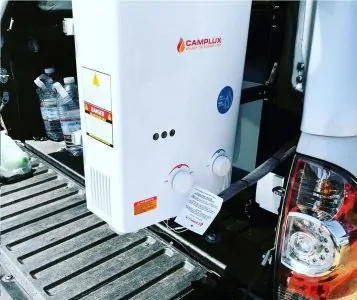
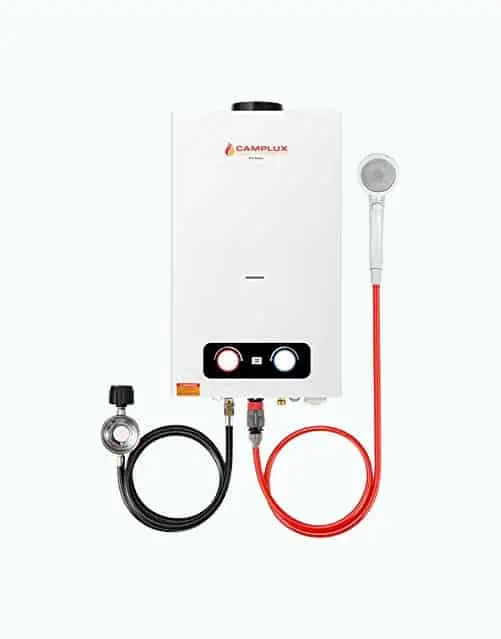
The unit is slightly different from the others on our list; it’s actually a small outdoor shower. It consists of a “tank” that you connect to a gas regulator and water source. It heats the water on-demand before it exits through the attached showerhead.
It’s perfect for smaller RVs or campers without a shower, such as teardrops and foldable campers. It includes a handle that you can hang on any wall for convenience, or hold when you’re moving it. Along with the heater, you’ll get most of the pipes and hoses needed to use the unit.
What We Like
Great for Off-Grid Camping
If you’re planning a getaway in your mini teardrop camper, this unit is perfect. It’s made for outdoor use where you simply connect it to the water source and propane gas, then enjoy your shower.
Large Handle for Easy Hanging and Transportation
The large handle enables you to hang the heater wherever is most convenient. It also allows you to move the unit more easily. It isn’t too heavy either, weighing about 18 pounds.
Most of the Equipment Is Included
Along with the unit, you’ll receive:
- Pedestal and showerhead.
- 5-feet shower hose.
- 5-feet CSA-approved gas hose and regulator.
- 0.5-inch BSP female times 0.75-inch GHT female garden hose.
- 0.5-inch BSP female times 0.75-inch GHT male garden hose.
- 0.5-inch BSP female times 0.625 NPT inverted flare male gas inlet connector.
- Water tape and screws.
- Instruction manual.
What We Don't Like
Not for Use in Enclosed RVs or Campers
Because this is a gas-powered unit, it requires ample room for combustion and ventilation. If you’re planning to install this inside your RV, make sure you have proper ventilation.
Low-Quality Shower Hose Included
Some users pointed out that the included shower hose is of poor quality. Most recommend that you replace it with a more durable one before leaving for your trip.
Product Specs
| Measurements | 12.8 inches by 6.1 inches by 21.65 inches |
| Flow rate | 2.64 gallons per minute |
| Temperature range | Not specified |
| Weight | 18 pounds |
| Warranty | N/A |
Our Ratings
Community Feedback
EcoTouch Tankless Water Heater Electric
Best Tankless Water Heater for High-Tech RV's
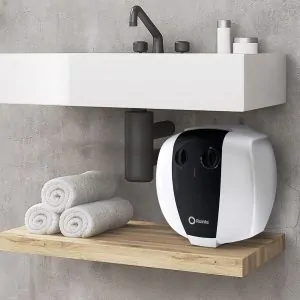
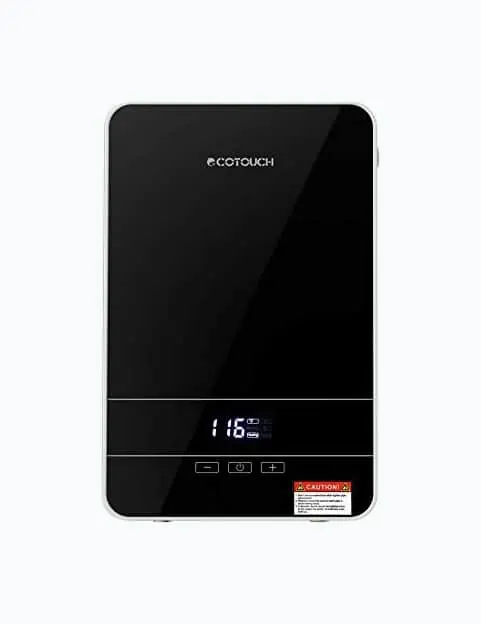
We live in a world full of smart technology, and that now extends to water heaters. This one from EcoTouch is both sleek and compact, about the size of an oatmeal box. We chose the black model because it blends in nicely with any decor.
It features a digital display with a touch control panel making it very convenient. Even more convenient is its easy to install model.
The unit also features smart modulation of power input. Based on your temperature setting and flow rate, the boiler adjusts its power use. This protects you from scalding as you reduce the flow from the tap.
What We Like
Sleek Compact Design
As mentioned above, we chose the black model, but you can also get it in white. The whole unit is sleek and lightweight; the surface is smooth and won’t be an eyesore. It blends perfectly with RV decor.
The tankless boiler is also compact. It measures 11 inches by 7.5 inches by 2.35 inches and weighs roughly five pounds. There’s no bulky tank in your RV causing bacterial growth or rust.
Features Touch Panel and Remote Control
On the smooth black surface, there is a touch control panel. This panel enables you to set the exact temperature you want. It removes the guesswork of turning a dial and crossing your fingers that the water will be right.
Another reason why we chose the black model is that it includes a remote control. You can mount the remote on the wall above your sink and quickly adjust the temperature to meet your needs.
Easy Installation
The installation of this unit is pretty straightforward. EcoTouch claims that you can do it all yourself without the help of a plumber. For the installation, you will receive a 0.5-inch NPT pipe fitting, brackets, and a 8 AWG power cord already attached.
The unit is intended as a point-of-use water heater, meaning you can install it wherever you need it.
Smart Modulation Technology
The unit features smart modulation technology which not only saves energy but also prevents scalding water.
This technology allows the unit to calculate its required power input and adjust accordingly. If you reduce the water flow while washing your hands, the boiler reduces its power use to prevent scalding water.
This adjustment reduces energy waste. Thanks to this feature, the unit can achieve up to 99.8% in energy savings, ideal for saving some money while on vacation.
What We Don't Like
Not Ideal for Showering
EcoTouch warns that their tankless boiler works best as an under-sink water heater. It produces about a gallon of hot water per minute, which may not be enough for a shower.
Product Specs
| Measurements | 15.74 inches by 10.24 inches by 2.05 inches |
| Flow rate | 1 gallon to 1.3 gallons per minute |
| Temperature range | 67 to 115 degrees Fahrenheit |
| Weight | 10.78 pounds |
| Warranty | N/A |
Our Ratings
First-Hand Impression
Eemax EEM24018 Electric Tankless Water Heater
Best Aesthetically Pleasing Tankless Water Heater Unit
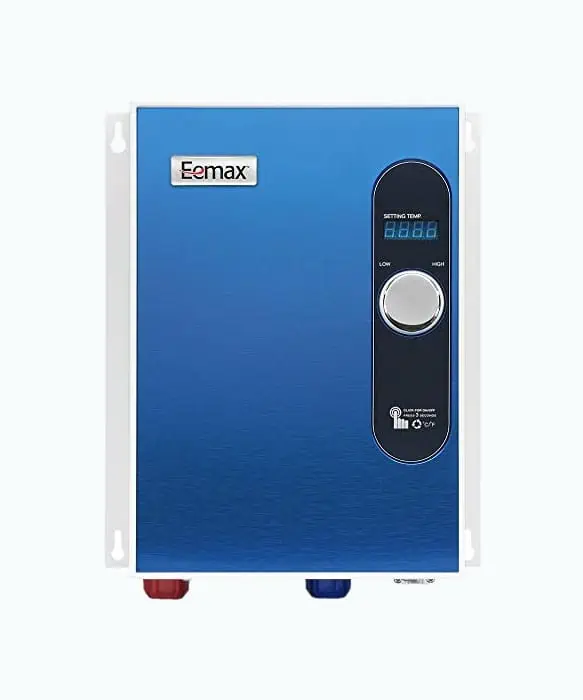
From an aesthetic point of view, this product delivers. It is metallic blue and features a digital thermostat, which is easy to read and use.
With that said, we didn’t only pick this tankless water heater because of its appearance. It’s also energy-efficient and supplies a large amount of hot water. Much like some of the other products, it features a self-modulating technology.
It adjusts itself according to need, reducing the risk of wasting energy. Eemax claims that the unit can provide enough hot water for a sink and shower to run simultaneously. However, some users reported that it doesn’t perform as advertised, so you might have to choose between a shower or doing the dishes.
What We Like
Beautiful Design
The unit is very attractive with its metallic blue finish and sleek digital thermostat. It displays the exact temperature and you can choose between “high” and “low” settings. The unit is also quite compact, which saves a lot of valuable space inside your RV.
Prevents Excessive Energy Waste
The Eemax heater also comes with advanced self-modulating technology. As with other products on our list, it will adjust how much power it draws depending on your use, saving energy and water.
Compact
Measuring 17 by 14 by 3.75 inches, this water heater is a real space saver.
What We Don't Like
Doesn’t Perform as Advertised
Eemax claims that the unit can provide enough hot water for a sink and shower to run simultaneously. However, users have said that it barely coped with a hot 8-minute shower.
Product Specs
| Measurements | 17 inches by 14 inches by 3.75 inches |
| Flow rate | 2.3 gallons per minute |
| Temperature range | 80 to 140 degrees Fahrenheit |
| Weight | 14.47 pounds |
| Warranty | Five-year warranty on leaks, one year on parts |
Our Ratings
User Experience
| Product | Award | Measurements | Weight (lbs) | Temp. Range (F) | Flow rate (GPM) | Warranty |
|---|---|---|---|---|---|---|
| EcoSmart 8 KW | Best For Eco-Friendly Camping | 11.5″ x 8″ x 3.75″ | 5.3 | 80 – 140 | 1.5 | Limited lifetime |
| Stiebel Eltron 12 | Best For Larger RVs | 14.5″ x 16.2″ x 4.5″ | 13.5 | 86 – 140 | 1.3 – 2.5 | 7 years |
| Camplux 2.64 GPM | Best For Off-Grid Camping | 12.8″ x 6.1″ x 21.65″ | 18 | N/A | 2.64 | N/A |
| EcoTouch | Best For High-Tech RVers | 15.74″ x 10.24″ x 2.05″ | 5.7 | 67 – 115 | 1 – 1.3 | N/A |
| Eemax EEM24018 | Best Aesthetically Pleasing | 17″ x 14″ x 3.75″ | 11.25 | 80 – 140 | 2.3 | 5-year on leaks, 1 year on parts |
How to Choose a RV Tankless Water Heater
A tankless water heater is a great addition to any RV. They connect to your onboard water tank to provide you with hot water on demand. Before reading our RV water heater reviews, there are a few things you should consider.

Water Capacity and Cost
Most standard storage RV water heaters have a tank with about 6 gallons capacity. You could get a 10-gallon appliance but these naturally occupy more space.
A common issue with RV tank water heaters is their recovery time; a 10-gallon tank can take up to an hour to reach its target temperature. If you’re traveling with friends or family, this means it can take hours for everyone to get showered.
A major advantage of a tankless heater is that it doesn’t have any recovery time. It heats the water on-demand when you need it. When you turn on the faucet, burners ignite inside the unit, heating the cool water as it passes, which is almost instant.
The initial price of a tankless water heater is more than tank units. However, it will make life much easier if you regularly travel as part of a group. It also won’t use as much electricity or gas as it only turns on when needed.
In time, this energy-saving should recoup the initial price difference.

Water Consumption and Flow Rate
Having some idea of how much hot water you use on trips can help you choose the right heater. There’s no point buying a larger unit than necessary but getting one that’s too weak is also a waste of money.
Consider how many places within your RV will need hot water. For example, the bathroom needs hot water for showers, the kitchen needs hot water for cleaning dishes, and you might even have a dishwasher or washing machine.
Tankless water heaters for RVs will usually provide you with two to six gallons of hot water per minute, depending on the model you choose. After estimating your water consumption, choose an appropriate heater.
The most important number here is the heater’s water flow rate. This is the amount of hot water the unit can provide per minute. It should be stated on the label.
In an RV, the majority of hot water is used in the bathroom for showers. It’s unlikely that you will need to buy the biggest model. Units with a 2 to 2.5-gallon flow rate should be enough for an average family of four.

Fuel Type
It’s important to decide how you will power your tankless water heater. Tankless units are usually gas or electric, and each has pros and cons. Let’s take a quick look at each type.
1. Electric
An electric tankless water heater is the most cost-effective and environmentally-friendly option.
They are quick and easy to install in your RV. They can be powered by your campground’s electrical supply when you’re parked.
On the road, it can operate using your RV’s electrical system. Using solar panels to help it charge is a great way of being kinder to the environment. If you don’t have solar panels, you can use an external generator.
The electric unit itself doesn’t emit greenhouse gasses, but a generator does.
2. Gas
As you won’t have access to natural gas in your RV, this type of heater requires propane or kerosene.
Although a gas-powered unit is cheaper than an electric one, it comes with other costs. The heater releases small amounts of greenhouse gasses, which are harmful to the environment.
You might be worried that you’ll need to buy a lot of propane. However, a tankless heater uses less propane than a standard tank unit. This is because it doesn’t need to keep water at a set temperature.
Don’t Forget

Safety
When traveling in an RV, power shortages or spikes can occur, especially when parked at a campsite. Some tankless models have features that protect them against any sudden changes. Extreme temperatures can sometimes also trigger an electric ignition, but a good unit will be protected.
Types of RV Tankless Water Heaters
Another thing you should consider is the type of unit. For an RV, you can choose from two types: portable and home systems. Let’s take a closer look.
Portable
A portable tankless water heater is exactly what it says: portable. This type of unit is very easy to take on the road and you can even use it when camping. These are great for moderate hot water usage, such as taking a daily hot shower.
Pros
- Portable: It doesn’t have to stay in your RV permanently. You can easily take it outside. Some models even allow you to connect a shower head directly to the unit.
- Easy installation: Portable units don’t require any complicated piping or wiring. They’re fairly easy to install and, if you’re handy, you could install one anywhere in the RV.
- Inexpensive: Portable tankless water heaters are cheaper than permanent units.
Cons
- Not enough for simultaneous use: Portable heaters may be cheaper, but they also won’t be powerful enough for more than one outlet at a time.
Home Systems
Fitting a home system tankless water heater in your RV will require professional assistance. As the name suggests, it’s a whole system that has to be installed. However, if you use a lot of hot water, it will probably be worth it.
Pros
- Good for high demands: If you travel in a group, a home system will be worth it. It will be able to keep up with your demands and cope with simultaneous use.
- High flow rate: These types of heaters have a higher flow rate, which means you will get more hot water faster.
Cons
- The initial price is higher: Home systems are generally higher-priced and you will need to pay for installation, but it is worthwhile as a long-term investment.
FAQs

How Should I Install a Tankless Heater in My RV?
Before installing the unit, consider where it should be located. Once you find the right spot, you will likely need to mount the unit to a wall or the floor. You then need to connect gas or electricity lines to power the unit.
If you have a gas-powered water heater, you will also need to install a flue. This will direct and discharge the fumes created by the gas. It’s essential that the flue pipe rises for the gases to successfully exit the heater (1).
It’s critical to get rid of these gases as they contain carbon monoxide, which can be fatal (2).
Your last task is connecting the boiler to the onboard water tank. Grab the inlet and outlet pipes and connect them to the unit. Follow the user manual for more specific instructions.
If you have any doubts about installing the unit properly, we recommend that you seek professional help.

Can I Install a Tankless Heater Under an RV Sink?
You can, and doing so provides numerous benefits. For one, having the tankless heater closer to the faucet means you won’t have to wait as long for the hot water to arrive, improving efficiency.
Most tankless heaters are easy to install beneath a sink. There’s no need for complicated wiring or specialist plumbing tools. However, before you purchase a heater for your sink, make sure it will fit so you don’t end up disappointed.

Are RV Tankless Water Heaters Worth It?
RV tankless water heaters are worth it if you spend a lot of time in your RV so that you can get a lot of use out of it. They generate a never-ending supply of hot water that may be accessed on-demand. Additionally, there is no downtime between hot water usage to allow for recovery.
What is the Best RV Tankless Water Heater?
The Furrion 2.4GPM Tankless RV Gas Water Heater is one of the best in its category.
Even when the temperature outside is 32 degrees Fahrenheit, this unit can provide instantaneous delivery of hot water because of its high heating capability.
If you are concerned about your safety, this water heater has two sensors that will immediately shut off the electricity to the unit if the water temperature rises above the acceptable range.

How Much Is an RV Tankless Water Heater?
The average cost for an RV tankless water heater is around $1,000. They may be purchased for as little as $100 to $200, but their heating capacity is only about one to one and a half gallons of water per minute, which is only sufficient for one faucet at a time.

How Big of an RV Tankless Water Heater Do I Need?
The size of an RV tankless water heater for your needs is determined based on how much water you use at a time. Determine the total number of fixtures that will be active at the same time to determine whether or not the water heater that operates on-demand will be able to supply the required number of gallons per minute (GPM).
Since your RV only comes with a shower and a sink, you most likely have to know how much water the shower needs. You should undertake the bucket test if you don’t have the user manual for your showerhead.