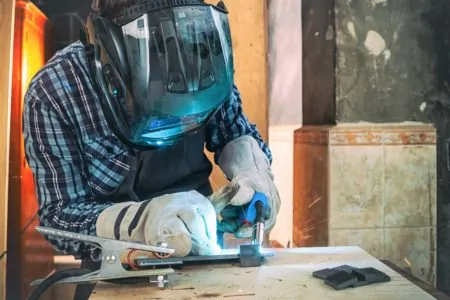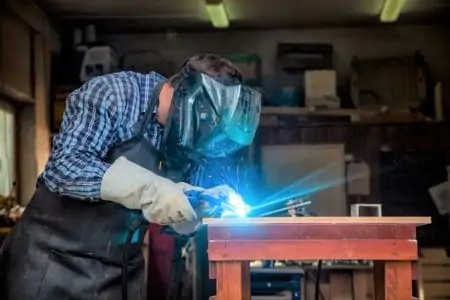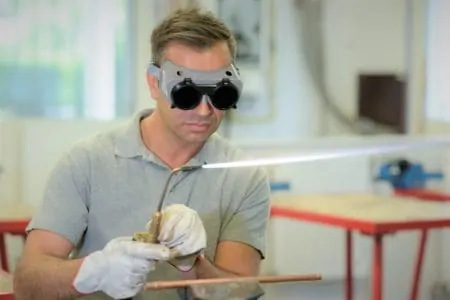
Whether you are looking for the best welding safety glasses or protective goggles, deciding which one is right for you depends on several factors. What type of welding are you doing, and how much protection do you need?
Getting the choice right comes down to research. We look at the 7 best welding glasses and goggles.
- Unisex & universal size
- Lightweight
- Polycarbonate lenses
- Shade 5 protection
- Fit over prescription glasses
- Flip-up front
- Adjustable
- 3 levels of protection
- Easy-swap lenses
- Face & head shield
- Adjustable shades
- Lightweight
- 1/1/1/2 optical clarity
- Auto-shade adjuster
- Large viewing area
- Fully adjustable
- UV & infrared-resistant
- Shade range from 3 to 12
- Look like conventional glasses
- Radiation resistance
- Scratch-resistant
Review Methodology: At Sensible Digs, we apply a comprehensive approach to evaluating the best welding safety glasses. We use our experience and hands-on testing to rank and review each product, based on crucial criteria such as safety, comfort, lens clarity, durability, and UV protection. We compare different brands, check for design choices, and measure their performance to provide you with accurate, evidence-backed evaluations. Our professional analysis and assessment are grounded on facts and data, ensuring that our findings are reliable and trustworthy. By focusing on these essential decision-making factors, we provide a user’s perspective for a more informed choice. We are committed to helping you identify the best welding safety glasses that set themselves apart from their competitors.
The Best Welding Safety Glasses of 2024
There are so many types and styles of welding glasses that boiling it down to the best 7 was a challenge. Here is our take on the 7 best welding safety glasses.
Miller Electric Shade 5.0 Safety Glasses
Best Budget Welding Safety Glasses
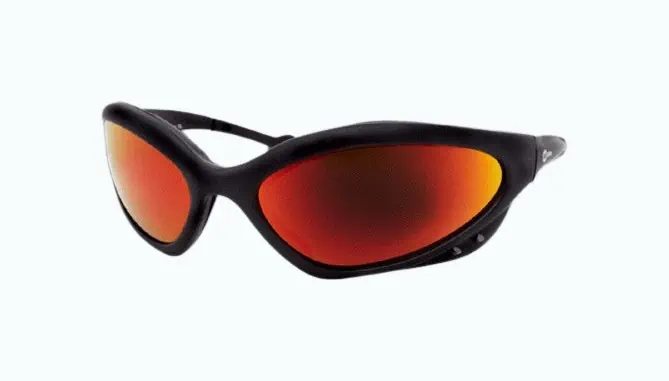
If you are looking for glasses that are stylish, unisex and universal in size, then choose these Miller Electric safety glasses. And the best bit is they are super-affordable. Miller Electric is a long respected name in welding circles, so it is a surprise to find these glasses at such a steal.
They are shade 5, so suitable for brazing and soldering, but you might struggle actually welding in them. Prolonged use might generate spots on your eyes.
However, the lenses are polycarbonate, so they are excellent at blocking 99.9 percent of the ultraviolet rays generated by the welding machine. The frames are also polycarbonate, but they feel cheap, like they might break easily.
Pros
- Super-cheap.
- Unisex.
- Universal size.
- Lightweight.
- Polycarbonate lenses.
Cons
- Break easily.
- Scratch easily.
- Not suitable for welding.
Product Specs
| Weight | Not stated |
| Dimensions (inches) | 7.6 x 3.2 x 1.8 |
| Shade rating | 5 |
| Auto-darkening | No |
| UV protection | Yes |
| Suitable for | Brazing, soldering and oxy-fuel |
| Price | $ |
| Warranty | No warranty |
Our Ratings
User Experience
Forney 55320 Goggles
Best Prescription Welding Safety Glasses
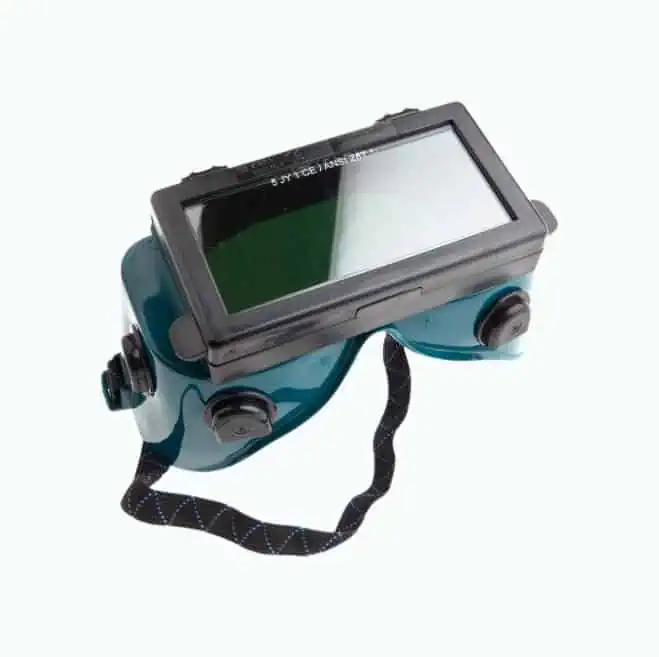
How do you weld if you wear prescription glasses and need to see clearly? You buy something like these Forney goggles that fit comfortably over your existing eyeglasses. It is the ideal way to see clearly, and it saves you from ordering a bespoke pair of safety glasses at a high cost.
They are a shade 5, so suitable for gas welding, brazing and soldering, and they have a flip-up front so you can examine your handy work without removing them altogether. These glasses provide 99.9 percent protection against UV and meet the ANSI Z87.1 safety standard.
Pros
- Shade 5 protection.
- Fit over prescription glasses.
- Ideal for brazing and gas welding.
- Flip-up front.
Cons
- Not suitable for most welding.
Product Specs
| Weight | 9.6 ounces |
| Dimensions (inches) | 3.44 x 7.5 x 3.75 |
| Shade rating | 5 |
| Auto-darkening | No |
| UV protection | Yes |
| Suitable for | Brazing, soldering, plasma cutting and gas welding |
| Price | $ |
| Warranty | 90-day |
Our Ratings
Personal Perspective
Titus Cup Type C Frame Welding Goggles
Best Welding Safety Glasses Shade 14
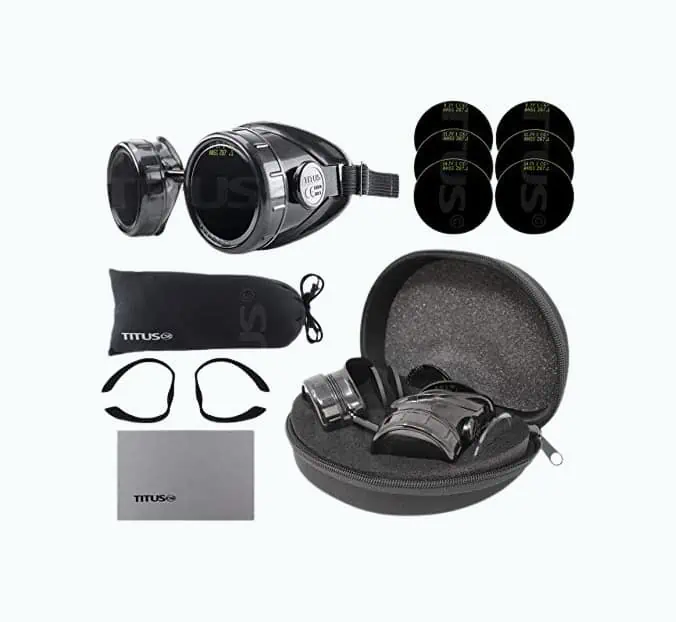
These goggles most resemble the style of eye protection that your dad or grandfather would have worn back in the day. They come in a carry-case that contains the goggle frames with an adjustable nose bridge and three grades of lens.
The lenses are easy to swap. Simply remove the ring, change the lens and tighten the ring back up. The lenses range in shade from 9, 11 and 14, so you can undertake a variety of welding tasks safely in the knowledge you are protected.
There are side vents to allow the goggles to breathe, and the straps are adjustable.
Pros
- Adjustable.
- 3 levels of protection.
- Easy-swap lenses.
- Carry-case.
Cons
- Side vents let in light.
- Hard plastic frames.
Product Specs
| Weight | 4.8 ounces |
| Dimensions (inches) | 7.28 x 4.61 x 2.28 |
| Shade rating | 9,11,14 |
| Auto-darkening | No |
| UV protection | No |
| Suitable for | All types of welding (Small projects only) |
| Price | $$ |
| Warranty | Lifetime warranty |
Our Ratings
Community Feedback
Miller Electric Welding Goggles
Best Arc Welding Safety Goggles
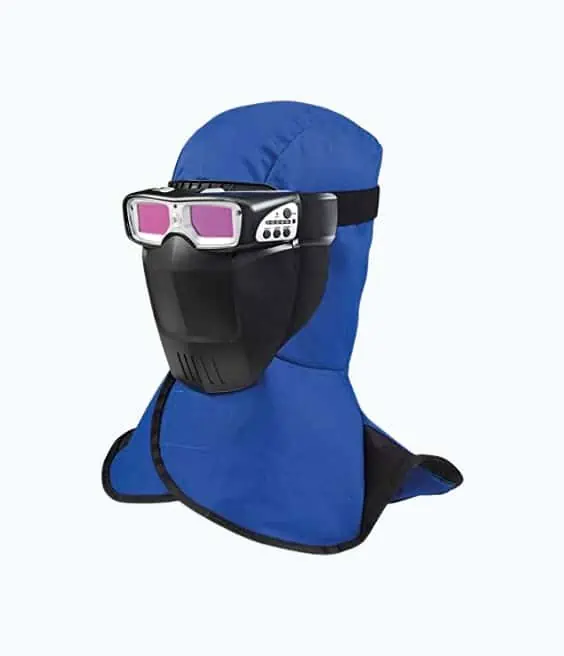
If you want complete protection from the harshest punishment that arc welding can cause to your eyes, look no further than these Miller Electric welding goggles. The eye coverings fit tightly to the face and block out light. They also have an adjustable shade button to cater to all types of welding.
Plus, these goggles have a clip-on face shield to protect your nose and mouth and a silicone head covering. The snug fit means that these won’t sit over prescription glasses and the lack of vents mean that the lenses fog easily.
However, if you are looking for a lightweight alternative to a full welding mask for TIG, stick and MIG welding, these glasses are the perfect choice.
Pros
- Face and head shield.
- Suitable for TIG, MIG and stick welding.
- Adjustable shades.
- Lightweight.
Cons
- Fogs easily.
- No vents.
- Don’t fit over prescription glasses.
Product Specs
| Weight | 1.75 pounds (shipping weight) |
| Dimensions (inches) | 12 x 4 x 9 |
| Shade rating | 5,7,9,11,13 |
| Auto-darkening | No (Manually adjusted) |
| UV protection | Yes |
| Suitable for | MIG, Stick, TIG |
| Price | $$$$ |
| Warranty | 2-year |
Our Ratings
First-Hand Impression
YESWELDER True Color Welding Goggles
Best Welding Safety Glasses Shade 12
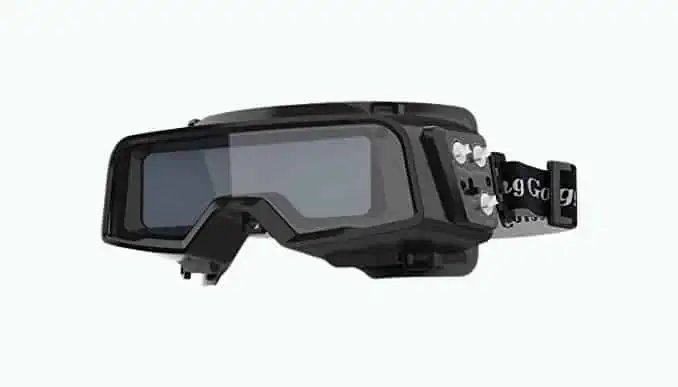
This is another goggle set with a shade range from 5 to 13, meaning that these are suitable for TIG, stick, MIG and other forms of welding. They are part of YESWELDER’s True Color range, and they have an auto-darkening feature that allows the lens to change shade thanks to sensors.
It means that you never have to worry about the shade setting while you work, and it also allows you to keep your concentration on the task at hand.
The True Color lens affords the user a 1/1/1/2 optical clarity, and is a great lightweight option when welding in hot conditions. It has a 4.82-inch by 1.37-inch viewing area, which is about a third larger than other similar goggles.
Pros
- 1/1/1/2 optical clarity.
- Auto-shade adjuster.
- Large viewing area.
- Shade range 5 to 13.
Cons
- Requires lithium batteries.
Product Specs
| Weight | 7 ounces |
| Dimensions (inches) | 9.5 x 8.4 x 4.4 |
| Shade rating | 5 to 13 |
| Auto-darkening | Yes |
| UV protection | UV plus Infrared |
| Suitable for | All types of welding |
| Price | $$$ |
| Warranty | 1-year |
Our Ratings
User Experience
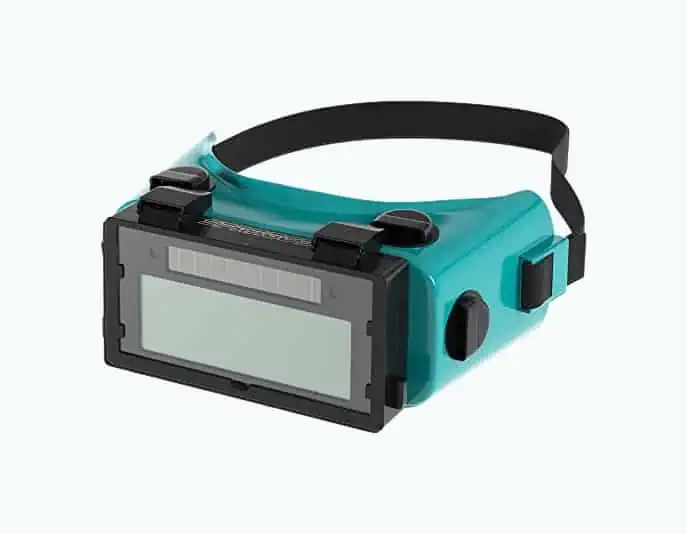
Spargo Auto Darkening LCD Goggles
Best Auto-Darkening Welding Safety Glasses
These auto-darkening safety glasses have a shade range from 3 to 12, so it should have your favored welding technique covered. They are UV and infrared resistant, and they have a fully adjustable sensitivity function.
The darkening happens so fast that by the time you strike the arc, the glasses react, which means you never have to stop what you are doing to wait for them to catch up. You can also keep focused on the job at hand without interruption.
The headband is fully adjustable, and you even get spare lenses.
Pros
- Auto-darkening.
- Fully adjustable.
- UV and infrared-resistant.
- Shade range from 3 to 12.
Cons
- Fogs easily.
- Feels cheaply made.
Product Specs
| Weight | 9.3 ounces |
| Dimensions (inches) | 8.19 x 3.9 x 3.43 |
| Shade rating | 3 to 12 |
| Auto-darkening | Yes |
| UV protection | Yes |
| Suitable for | MIG, stick, TIG, plasma (most welding techniques) |
| Price | $$ |
| Warranty | Not stated |
Our Ratings
Personal Perspective
Safety Glasses Shade 10
Best Welding Safety Glasses Shade 10
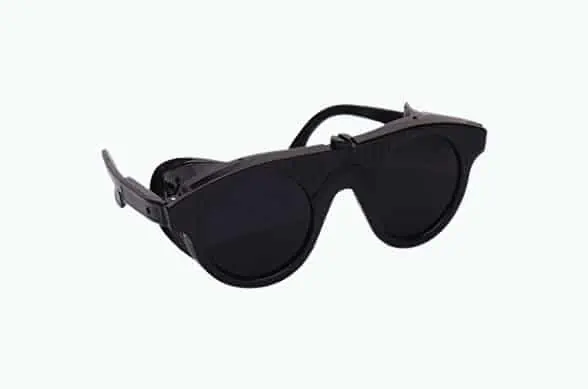
These shade 10 safety glasses are the ideal thing to wear when brazing, soldering or gas welding. They look like standard shades but have side panels that protect your eyes from extreme light.
They also offer high optical quality and radiation resistance. The lenses are scratch-resistant polycarbonate, and the frames are adjustable for maximum comfort. These glasses are made in Germany and offer a high degree of quality for an affordable price.
Pros
- Look like conventional glasses.
- Radiation resistance.
- Scratch-resistant.
- Adjustable frames.
Cons
- Limited use.
- No UV or infrared protection.
Product Specs
| Weight | 3.21 ounces |
| Dimensions (inches) | 7 x 3.5 x 3.2 |
| Shade rating | 10 |
| Auto-darkening | No |
| UV protection | No |
| Suitable for | Brazing, soldering and gas welding |
| Price | $ |
| Warranty | Not stated |
Our Ratings
Community Feedback
| Product | Best | Weight | Dimensions | Shade rating | Auto-darkening | UV protection | Suitable for |
|---|---|---|---|---|---|---|---|
| Miller Electric Safety Glasses | Budget Glasses | N/A | 7.6 x 3.2 x 1.8″ | 5 | No | Yes | Brazing, soldering & oxy-fuel |
| Forney 55320 Goggles | Prescription Glasses | 9.6 oz | 3.44 x 7.5 x 3.75″ | 5 | No | Yes | Brazing, soldering, plasma cutting & gas welding |
| Titus Cup Type C Frame Goggles | Shade 14 | 4.8 oz | 7.28 x 4.61 x 2.28″ | 9,11,14 | No | No | All types of welding |
| Miller Electric Welding Goggles | Arc Welding | 1.75 lbs | 12 x 4 x 9″ | 5,7,9,11,13 | No | Yes | MIG, Stick, TIG |
| YESWELDER True Color Goggles | Shade 12 | 7 oz | 9.5 x 8.4 x 4.4″ | 5 to 13 | Yes | Yes | All types of welding |
| Spargo Auto Darkening LCD | Auto-Darkening | 9.3 oz | 8.19 x 3.9 x 3.43″ | 3 to 12 | Yes | Yes | MIG, stick, TIG, plasma |
| Safety Glasses Shade 10 | Shade 10 | 3.21 oz | 7 x 3.5 x 3.2″ | 10 | No | No | Brazing, soldering & gas welding |
What Are Welding Glasses Made Of?
Welding glasses are constructed from hardened materials that can withstand the rigors of the construction site and day to day home use.

Polycarbonate
Polycarbonate is both lightweight and hard-wearing, so it serves the best of both worlds. It also protects against UV rays created during the welding process. The downside is they aren’t as clear as other lenses and may impede your vision.

Acrylic
Acrylic is lighter than glass and scratch-resistant. It is cheaper than other materials, but it doesn’t provide a clear vision like glass, and it is less durable than polycarbonate.

NXT Polyurethane (Trivex)
Trivex is lightweight, like polycarbonate, and it is super-durable, but unlike polycarbonate, it is a lot clearer, improving the welder’s sight. The downside is the cost; trivex is very expensive.

Optical Glass
Glass is treated to make it scratch-resistant, and it won’t distort like other materials. The downside with glass is that it is heavy, making for an uncomfortable wearing experience over extended periods. Glass also breaks easily, making it less robust than Trivex and polycarbonate.
Types of Eye Protection for Welding
There are two main types of eye protection other than welding safety helmets.
Safety Glasses
These look the most like your normal eye-wear. They have a frame and two lenses, adjoined by a bridge over the nose. The lenses are harder than regular glasses, and they have a side shield to further protect your eyes.
Safety Goggles
These look more like old-fashioned motorcycle goggles with an entirely enclosed frame that covers your eyes completely. They protect from the front and the side. They sometimes fit over your prescription glasses, thanks to their generous proportions.
Welding Lenses Shade Numbers
The shade number is the single most crucial factor to consider when choosing your welding glasses. The shade number refers to the darkness of the lens and directly relates to the types of welding you can do.
Some welding techniques produce a more acute light and require higher-grade eye protection. Some are not so blinding, so you can choose a lighter shade to see the welding pool clearly.
What Shade Is Safe for Welding?
As a rule of thumb, brazing and soldering produce less brightness and require a shade of around 3 or 4, while stick welding needs a shade minimum of 8 to 12. MIG and TIG welding uses a higher amperage and produces the brightest arc, so a shade of 8 to 13 is ideal, and carbon arc welding needs to be 14 or above.
Here’s a handy reference chart.
| Type of Welding | OSHA Recommended Shade |
| Torch soldering | 2 to 3 |
| Torch brazing | 3 to 4 |
| Plasma arc cutting | 10 to 14 |
| Plasma arc cutting (light) | 8 to 9 |
| Plasma arc welding | 6 to 14 |
| Air carbon arc cutting (heavy) | 11 to 14 |
| Air carbon arc cutting (light) | 10 to 12 |
| Gas tungsten arc welding | 8 to 14 |
| Flux-core arc welding | 7 to 14 |
| Oxygen cutting | 5 to 6 |
| Gas welding | 4 to 8 |
| Shielded metal arc welding | 7 to 14 |
How To Choose the Best Welding Safety Glasses
There are so many factors that make up the ideal safety glasses, but what are the fundamental things to look for?
It’s All About the Shade
As we’ve already said, the shade is the single most important factor when choosing safety glasses. If you TIG weld, a shade level of 3 will leave you blinded, while soldering with a shade of 14 will leave you unable to see the weld pool. This will affect the quality of your work.
Welding glasses range in shade from 3 to 14, with some going higher still, so as long as you research the correct shade for your style of welding, you should be protected.
What About Auto Darkening?
Auto-darkening goggles and glasses are a great idea because they adjust the shade to adapt to the welding technique. Some high-end models do this automatically, while others allow you to preselect the shade.
These goggles have lithium batteries and typically have a shorter shade range of between 9 to 13. Check the specifications before you buy, and remember that the cost of these goggles exceeds that of everyday eye protection.

Do They Meet the 5 Tests?
Every pair of safety glasses and goggles must meet the 5 tests.
- They must provide protection to the eyes from the front and sides.
- They must fit and be comfortable to wear for long periods.
- They must not restrict your view.
- They must be robust, durable and clean. Anti-smudging is also a must.
- They must not interfere with the work you are doing or impede you in any way.

What Lens Material?
We’ve already touched on the types of material you can get for lenses, but which is better for you? Do you want something light, robust and clear? If so, then you should look to Trivvex as an option.
If you are operating on a budget, the cheapest is acrylic or glass, although acrylic doesn’t offer the same quality of lightness and clear vision as others. Glass is heavy and fragile, while acrylic is light but hard to see clearly.

It Boils Down To Budget
What you spend makes a world of difference. At the top end, the world is your oyster. You can get Trivex lenses, auto-darkening, higher shade protection, you name it, for the right money, you can have it.
If you are shopping on a budget, you need to scale back expectations to either safety or comfort. Glass offers the best vision but is prone to cracking if dropped, and it is the heaviest material.
Acrylic or polycarbonate are harder-wearing but less clear for good vision.
Welding Safety Glasses FAQs
Can You Weld With Shade 5 Glasses?
You can weld with shade 5 glasses but only for lighter duties. Don’t attempt to TIG or stick weld because the arc is too bright, and you risk retinal damage that could lead to permanent sight loss.
Soldering or brazing is fine with shade 5 glasses.

Can We See a Solar Eclipse With Welding Glasses?
NASA recommends that the only grade of lens suitable for looking directly at a solar eclipse is a shade 14. Anything less than that, and you risk eye damage.
Do Welding Glasses Block UV?
The majority of safety glasses are made from polycarbonate, which naturally blocks 99.9 percent of all UV light, so if you are worried about ultraviolet rays, look for this type of welding glasses.

Do You Need To Wear Safety Glasses Under a Welding Helmet?
According to the Occupational Safety and Health Administration (OSHA), safety glasses should be worn under safety helmets, especially where they provide inadequate side protection (1).
To comply with ANSI Z87.1, they should be worn to provide the necessary protection because welding helmets alone do not offer enough protection.

Why Do Welders Wear Black Glasses?
Welders need to use black glasses because different types of cutting and welding can produce heat and light. This type of UV radiation can cause damage to your eyes when you are exposed to it for longer periods.
Black glasses can help prevent this damage because they have special lenses designed to protect against radiation and UV.

Do Blue Light Glasses Help with Welding?
Blue light glasses do not help with welding because their lenses are efficient in filtering the blue light from devices such as smartphones, computers, laptops, and TVs.
While blue light glasses are highly efficient for those who work in front of a computer or some other blue light-emitting screen, they don’t do much for welders.
But the welding process produces infrared and UV radiation, which is harmful to the human eye, even more so than blue light. That’s why welders used black glasses instead of blue ones.

Can You Weld with Prescription Glasses?
You can weld with prescription glasses if you take an extra protective measure to shield your face. If you cannot swap your prescription glasses for contacts while welding, you have to use special welding goggles or a mask that goes above your regular glasses.

Can You Get Welding Flash Through Safety Glasses?
It depends on the type of safety glasses. As a general rule, safety glasses cannot protect you from welding flashes because they are a standard piece of safety equipment that was not explicitly designed for welding.
Chances are you will get a welding flash if you use standard safety glasses instead of special black-lens ones. Remember that a welding flash emits strong infrared and ultraviolet radiation, and you need protective glasses to shield you against those.

What Are the Best Glasses for Welding?
These Titus glasses are considered one of the best options for welding. You get a lot of value for the money, as these come with their own protective case, a stylish pouch, spare infrared filters, a wipe cloth, and two foam pads for extra comfort.
Since they comply with safety standards, these adjustable 14-shade glasses are good for casual welders. They offer three levels of protection, but their plastic frames can feel a bit hard and sometimes uncomfortable (especially if you wear them for prolonged periods).
Protect Those Eyes
You cannot put a price on great eyesight. Safety glasses are designed to keep you safe and stop you from suffering the ill effects of arc-eye and retinal damage from inadequate equipment. If you can’t see what you are doing, you will end your welding career before it has started.
Spend the money and invest in a decent pair of safety goggles. You won’t regret it.