Our Top Picks

- Shade 3/5 to 13
- 4 arc sensors
- True color OpTCS lens

- HE filtered fresh air
- Flip-up shield with side windows
- 9100XX large-view lens

- Highest grade optical rating
- Perfect weight balance
- Solar powered

- ClearLight true color lens
- Weld shade 8 to 13
- Trusted pro brand

- 180-degree 3-lens view
- 7 arc sensors
- Built-in LED work light

- 1/1/1/1 true color optics
- Blue light blocking lens
- Solar with spare battery

- 4 light-adjusting sensors
- Weld or grind capabilities
- Large viewing area

- Solar plus CR2450 battery
- 1/1/1/1 large view
- 4 arc sensors
- Large viewing screen
- 4 premium sensors
- Multi-use helmet

- Shade range 9 to 13
- Fatigue-free comfort headgear
- Optical grade of 1/1/1/1.
Our Review Criteria: Optical clarity came first, graded on the four-digit EN 379 scale, where a 1/1/1/1 lens marks the best result for clarity, distortion, diffusion, and angle of view. We then compared shade range and the low-amp shade floor that low-amperage TIG demands, arc-sensor count and switching speed, viewing-area size, weight and headgear balance for long sessions, and powered-air filtration on the air-fed option. Every helmet was confirmed against the ANSI Z87.1, and where stated CSA Z94.3, eye and face protection standards, with manufacturer specifications weighed alongside aggregated owner feedback. Each pick is re-checked for availability, and a discontinued helmet is swapped out.
The best welding helmets do far more than darken when you strike an arc. They shield your eyes from the intense visible light, ultraviolet, and infrared radiation that a welding arc throws off, and they protect your face from spatter and grinding debris.
The right helmet also makes you a better welder. A clear, true color lens and a fast auto-darkening filter let you see the puddle without lifting the hood, so your beads stay consistent and your eyes stay protected.
Helmets Prevent Severe Eye Injuries
Welders face a high risk of “arc eye,” a painful condition where the cornea becomes inflamed. You also risk retina burns that can lead to permanent sight loss. Brilliant white light flashes burn the retina without proper shielding.
Unprotected exposure to high levels of ultraviolet and infrared light damages your eyes. Helmets also protect your face and skin from molten metal sparks and poisonous fumes created during the welding process.
Darker Shades Offer Better Protection
Welding helmets use darkened glass to filter infrared and UV light. A darker glass equals greater protection. However, darker shades can affect clarity.
Welders often feel tempted to lift the helmet for a better view, but this negates protection. The American National Standard for Occupational and Educational Personal Eye and Face Protection Devices (ANSI Z87.1) sets strict standards to protect your eyes from these dangers (1).
OSHA requires eye and face protection devices used for welding to comply with one of three consensus standards, ANSI/ISEA Z87.1-2010, ANSI Z87.1-2003, or ANSI Z87.1-1989 (R-1998), under 29 CFR 1910.133(b)(1) (2).
Consider These Factors Before Buying
Coverage and filtering capability remain the two most essential elements of any safety mask.
Product Reviews
Choosing a welding helmet comes down to a handful of decisions: shade range, optical clarity, the number of arc sensors, weight, and the kind of welding you do most. We weighed those factors against current availability to land on these ten picks, from an entry-level hobby hood to a professional air-fed system. Each one is in stock and covers a different need.
ESAB Sentinel A60 Welding Helmet
Best Welding Helmet for TIG Welding

Low-amp TIG welding is where cheap helmets fail, because the arc is dim and a slow or under-sensitive lens leaves you squinting at the tungsten. The ESAB Sentinel A60 is built for exactly that work. Its sensors react down to about 2 amps, and the wide 3/5 to 13 shade range, adjustable in half steps, lets you dial in the precise darkness fine TIG demands.
ESAB’s OpTCS true color optics and a large 13 square inch viewing area give you an honest, open view of the puddle, which matters when you are feeding filler by hand. Four arc sensors and a switching time near 0.08 milliseconds keep the flash off your eyes, and onboard memory stores up to nine setting profiles so you can jump between processes without re-tuning.
It also handles MIG, stick, plasma cutting, and grinding, so it is not a one-trick hood. The curved external grind button and low-profile nylon shell are built for daily shop use. This is a premium pick, and the price reflects that, but for a TIG-focused welder the optics and sensitivity justify it.
Pros
- Sensors trigger down to about 2 amps for low-amp TIG.
- Wide 3/5 to 13 shade in half-step increments.
- Large 13 square inch true color viewing area.
- Stores up to 9 setting profiles.
- Fast switching near 0.08 milliseconds.
Cons
- Premium price, the most expensive of our picks bar the air-fed system.
- Internal controls take a session to learn.
- Heavier than the bargain hoods.
Product Specs
| Weight (pounds) | 1.27 |
|---|---|
| Dimensions (inches) | 4.65 x 2.80 (lens) |
| Optical rating | 1/1/1/2 |
| Size of lens (inches) | 4.65 x 2.80 |
| Auto-darkening | 3/5 to 13 |
| Hard hat compatible | No |
| Price | $$$ |
| Warranty | 3-year |
3M Speedglas 9100 FX-Air with Adflo PAPR
Best Air Fed Welding Helmet

Weld fume is the hazard hobby hoods ignore, and for anyone welding all day, especially on coated or galvanized metal, breathing protection matters as much as the lens. The 3M Speedglas 9100 FX-Air paired with the Adflo powered air purifying respirator is the professional answer, and the current successor to 3M’s older Adflo kit. A belt-mounted blower draws air through a high-efficiency particulate filter and feeds it up a self-adjusting tube into the helmet, so you breathe air far cleaner than the shop around you.
The 9100 FX-Air shell flips up so you can switch between welding and a clear face shield without removing the helmet, and side windows widen your field of view to see more of the work area. The 9100XX auto-darkening filter gives the largest viewing area in the Speedglas line at 4.2 by 2.8 inches. Constant airflow keeps the lens from fogging and your face cooler over a long shift, which is where fatigue usually sets in. The kit ships with a lithium-ion battery, charger, HE filter, prefilter, spark arrestor, and the breathing tube.
This is overkill for occasional garage projects and carries by far the highest price in this guide. But for a working welder or anyone routinely exposed to fume, the respiratory protection and all-day comfort are exactly what a standard hood cannot offer.
Pros
- HE filtered powered air for fume protection.
- Flip-up shield with a clear face view.
- Side windows widen the field of view.
- Airflow stops lens fogging and cuts fatigue.
- Complete kit with battery, charger, and filters.
Cons
- By far the most expensive option here.
- Overkill for occasional hobby use.
- Filters and battery need ongoing upkeep.
Product Specs
| Weight (pounds) | 3.5 (with PAPR) |
|---|---|
| Dimensions (inches) | Full kit with belt unit |
| Optical rating | 1/1/1/2 |
| Size of lens (inches) | 4.2 x 2.8 (9100XX) |
| Auto-darkening | 5 to 13 |
| Hard hat compatible | No (flip-up shell) |
| Price | $$$$ |
| Warranty | 3-year (helmet) |
Lincoln Electric K3034-4 Viking
Best Welding Helmet for Sensitive Eyes
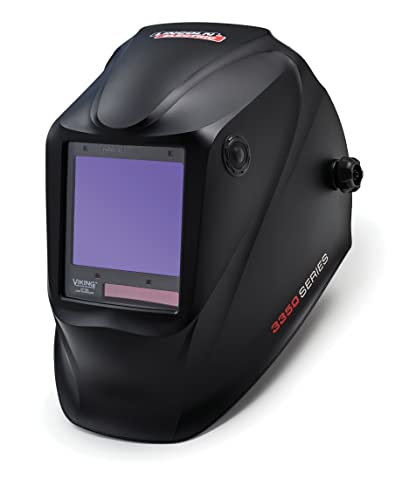
If bright arcs and after-images leave your eyes raw, the Lincoln Electric VIKING 3350 is the helmet built to fix that. Its 4C lens technology renders the arc and puddle in close to natural color and cuts the green tint that strains your eyes over a long day, which is why it earns the sensitive-eyes pick.
The lens holds the top 1/1/1/1 optical rating and a large 12.5 square inch viewing window, with an auto-darkening range of 5 to 13 that covers low-amp TIG through heavy stick. Four arc sensors and a three-control panel for shade, sensitivity, and delay let you tune the response to your work and your eyes.
Solar cells with a CR2450 backup keep it powered, and the six-point headgear spreads the load so the hood stays balanced through long shifts. It is a premium-priced helmet, and a few owners report occasional build inconsistencies, but for clarity and eye comfort it sits at the top of this guide.
Pros
- Highest grade optical rating.
- Larger than average lens.
- Solar power backup.
- Auto-darkening range from 5 to 13.
- Perfect weight balance.
Cons
- Higher price point.
- Occasional build quality issues.
Product Specs
| Weight (pounds) | 3 |
|---|---|
| Dimensions (inches) | 12.6 x 10.6 x 10.4 |
| Optical rating | 1/1/1/1 |
| Size of lens (inches) | 3.74 x 3.34 |
| Auto-darkening | 5 to 13 |
| Hard hat compatible | Yes |
| Price | $$$ |
| Warranty | 3-year |
Miller Classic Series Auto-Darkening Welding Helmet
Best Welding Helmet for Stick Welding

Stick welding is forgiving on your hood in one sense, you rarely need the very low shades a TIG welder chases, but it rewards a lens that shows the puddle clearly and a brand that holds up in a working shop. The Miller Classic Series is our stick pick because it pairs Miller’s pro-grade reputation with ClearLight true color optics at a price a hobbyist or student can reach.
The weld shade range runs 8 to 13, which brackets the bracket most stick electrodes need, with separate cut and grind modes for the rest of the job. ClearLight lets more of the visible spectrum through than an older green lens, so the arc and the surrounding plate read in natural tones instead of a murky tint. Two arc sensors and a fast switching speed keep the flash off your eyes.
At just under a pound it is easy on the neck through a long session, and the ratchet headgear dials in a secure fit. The trade-off is a smaller viewing window and fewer advanced controls than premium hoods, but for general stick work that simplicity is part of the appeal.
Pros
- ClearLight true color lens for a natural view.
- Weld shade 8 to 13 with separate cut and grind modes.
- Trusted Miller build and 3-year warranty.
- Light at just under one pound.
- Ratchet headgear for a secure fit.
Cons
- Smaller viewing window than large-view hoods.
- Only two arc sensors.
- Few advanced controls compared with premium models.
Product Specs
| Weight (pounds) | 1 |
|---|---|
| Dimensions (inches) | 6 sq in (lens) |
| Optical rating | Not listed |
| Size of lens (inches) | 6 sq in viewing area |
| Auto-darkening | 8 to 13 (weld) |
| Hard hat compatible | No |
| Price | $$ |
| Warranty | 3-year |
ARCCAPTAIN Panoramic Auto-Darkening Welding Helmet
Best Welding Helmet for MIG Welding

MIG runs longer and hotter than most home processes, so a wide field of view and steady eye comfort matter more here than raw shade range. The ARCCAPTAIN panoramic helmet wins the MIG slot on visibility. A 4.6 by 3.2 inch main lens plus two side windows give a roughly 180 degree view, so you can track a long bead and watch the work coming up beside you without turning your whole head.
All three lenses carry a 1/1/1/1 optical rating, and seven arc sensors switch the filter in about 1/30,000 of a second, which guards against the side flashes a single-window hood can miss. An internal display lets you set shade, sensitivity, and delay by hand, or hand them to the smart auto mode that reads the arc brightness for you and stores up to nine profiles.
A built-in LED work light helps in dim corners, and the rechargeable battery with solar assist gives long runtime between charges. It is heavier and pricier than a plain hood, and the extra side glass means more lens covers to replace over time, but for production-style MIG the open view is worth it.
Pros
- Roughly 180-degree view from a 3-lens design.
- 1/1/1/1 optics on every lens.
- Seven arc sensors switching near 1/30,000 second.
- Smart auto mode with 9 memory profiles.
- Built-in LED work light.
Cons
- Heavier than a single-window hood.
- More lens covers to replace over time.
- Feature menu is a lot to learn at first.
Product Specs
| Weight (pounds) | 1.7 |
|---|---|
| Dimensions (inches) | 7.2 x 3.2 (total view) |
| Optical rating | 1/1/1/1 |
| Size of lens (inches) | 4.6 x 3.2 main plus 2 side |
| Auto-darkening | 4 to 13 |
| Hard hat compatible | No |
| Price | $$ |
| Warranty | 1-year |
YESWELDER LYG-M700H True Color Welding Helmet
Best Budget Welding Helmet

The YESWELDER LYG-M700H is the helmet to buy when you want real auto-darkening performance for the least money. It earns the budget pick because it delivers a genuine 1/1/1/1 optical rating, the top score, at a price most hobby hoods with worse optics can’t touch.
True color technology strips out the old lime-green tint so you see the puddle in close to natural color, and a blue light blocking outer lens cuts the harsh glare that tires your eyes over a long session. The shade adjusts from 3.5 for grinding up to 13 for high-amp work, so one hood covers TIG, MIG, stick, and grinding.
It is light, around one pound, and runs on solar power with a replaceable CR2450 battery and a spare in the box. The trade-off for the low price is two arc sensors instead of four, which is fine for general welding but worth knowing before you commit to overhead or production work.
Pros
- Top 1/1/1/1 optical rating for the price.
- Wide 3.5 to 13 shade range.
- Blue light blocking outer lens.
- Solar powered with a spare battery included.
- Light at roughly one pound.
Cons
- Only two arc sensors, fewer than premium hoods.
- Basic headgear that some find needs fiddling.
- Battery life is modest under heavy daily use.
Product Specs
| Weight (pounds) | 1 |
|---|---|
| Dimensions (inches) | 3.64 x 1.67 (lens) |
| Optical rating | 1/1/1/1 |
| Size of lens (inches) | 3.64 x 1.67 |
| Auto-darkening | 3.5/9 to 13 |
| Hard hat compatible | No |
| Price | $ |
| Warranty | 1-year |
Jackson Safety Ultra-Lightweight Welding Helmet
Best Lightweight Welding Helmet

Neck fatigue is the quiet reason welders cut a session short, and the Jackson Safety Insight is the helmet that solves it. Its HLX shell design keeps the weight low and balanced, so it earns the lightweight pick by feeling like far less than it is over hours of work.
The 1/1/1/1 optical rating gives a clear, true view, and a 3.93 by 2.36 inch window lets you keep the hood down between tacks instead of lifting it into the fume. Four sensors catch the arc reliably, and a quick toggle moves you between weld and grind modes. The shade range runs 9 to 13, which suits most stick and MIG work.
The headgear is comfortable and easy to dial in, and the helmet meets ANSI Z87.1 and CSA Z94.3. The honest limits: the shade floor is too high for low-amp TIG, and it is not hard hat compatible, so heavy fabrication or detailed tungsten work points you elsewhere in this list.
Pros
- Lightweight design.
- 4 light-adjusting sensors.
- Weld or grind capabilities.
- Large viewing area.
Cons
- Not hard hat compatible.
- Reduced shade range.
- Limited low-amp capability.
Product Specs
| Weight (pounds) | 2 |
|---|---|
| Dimensions (inches) | Not stated |
| Optical rating | 1/1/1/1 |
| Size of lens (inches) | 3.93 x 2.36 |
| Auto-darkening | 9 to 13 |
| Hard hat compatible | No |
| Price | $$$ |
| Warranty | 2-year auto-darkening filter |
ARCCAPTAIN Large View Solar Welding Helmet
Best Solar Powered Welding Helmet

Solar power on a welding helmet does not mean you charge it in the sun. Two front solar panels keep the auto-darkening filter topped up while you weld, and a replaceable CR2450 backup handles the rest, so the helmet never sits dead when you need it. The ARCCAPTAIN large-view helmet does that better than most and adds a screen worth seeing through.
The 3.94 by 3.66 inch window is large for this class, with 1/1/1/1 optics and true color so the puddle reads naturally. Four arc sensors switch the lens in about 1/25,000 of a second across a 4/5 to 13 shade range, covering stick, MIG, TIG, cutting, and grinding. A clip-on USB LED light is included for dark corners, though you attach it yourself.
At roughly one pound with ergonomic, breathable padding, it stays comfortable through a long session. The DIN 16 auto UV and IR protection runs even in light state. The honest caveats: the LED ships uninstalled, and the lighter PP shell is less rugged than a pro hood, so treat it with care on a busy floor.
Pros
- Dual solar panels plus replaceable CR2450 battery.
- Large 3.94 x 3.66 inch true color window.
- 1/1/1/1 optical clarity.
- Wide 4/5 to 13 shade range.
- Light at about one pound with breathable padding.
Cons
- LED light ships uninstalled.
- Lighter PP shell is less rugged than a pro hood.
- Side coverage is narrower than a panoramic design.
Product Specs
| Weight (pounds) | 1 |
|---|---|
| Dimensions (inches) | 3.94 x 3.66 (lens) |
| Optical rating | 1/1/1/1 |
| Size of lens (inches) | 3.94 x 3.66 |
| Auto-darkening | 4/5 to 13 |
| Hard hat compatible | No |
| Price | $ |
| Warranty | 1-year |
YesWelder True Color Auto-Darkening Helmet
Best Auto Darkening Welding Helmet
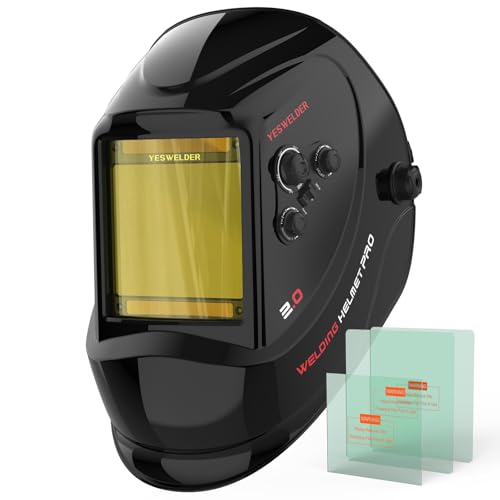
When the auto-darkening lens itself is what you care about most, the YESWELDER large-view hood gives you the most capable filter for the money, which is why it takes the auto-darkening pick. It handles MIG, TIG, arc, MMA, and plasma, and includes a dedicated grind mode, so one helmet covers nearly everything a home shop throws at it.
Four arc sensors trigger the lens quickly across a wide 3/5 to 9 and 9 to 13 shade range, and true color optics clean up the old green cast for a natural view of the puddle. The large 3.94 by 3.66 inch window gives strong peripheral awareness, useful when you are moving around a workpiece.
Solar plus a CR2450 lithium battery keeps it running, and the kit ships with spare lens covers. It is light and well-featured for the price. The trade-offs are an occasional darkening lag noted by some users and a plastic shell that feels less rugged than premium hoods, so it rewards careful handling.
Pros
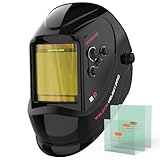
- Large viewing screen.
- 1/1/1/2 optical clarity.
- 4 premium sensors.
- Multi-use functionality.
- Lightweight.
- Includes accessories and spares.
Cons
- Slower response time than premium brands.
- Occasional auto-darkening lag.
- Plastic shell feels thin.
Product Specs
| Weight (pounds) | 2.05 |
|---|---|
| Dimensions (inches) | 12.5 x 7.9 x 9.75 |
| Optical rating | 1/1/1/2 |
| Size of lens (inches) | 3.93 x 3.66 |
| Auto-darkening | 5 to 13 |
| Hard hat compatible | No |
| Price | $$ |
| Warranty | 1-year |
Tekware Solar Powered Welding Helmet
Best Welding Helmet for Beginners

A first helmet should be safe, simple, and cheap enough that a beginner can learn on it without overthinking the spec sheet. The Tekware solar-powered hood hits that mark, which is why it is our pick for new welders. It surprises at its price with a genuine 1/1/1/1 optical grade, the same top clarity score the premium hoods carry.
The filter switches in about 1/25,000 of a second, fast enough to protect a beginner who has not yet learned to look away, and sensitivity and delay adjustments let you ease into rapid light changes. It runs on solar with battery backup, so there is little to maintain, and it tolerates a wide temperature range for an unheated garage.
The 3.66 by 1.69 inch window is on the small side and there are only two arc sensors, so it is a learner tool rather than a production hood. But for picking up the basics safely and inexpensively, it is hard to beat, and many welders keep it as a spare once they upgrade.
Pros
- Viewing window of 3.66 x 1.69 inches.
- Shade range of 9 to 13.
- Fatigue-free comfort headgear.
- Optical grade of 1/1/1/1.
Cons
- Only 2 arc sensors.
- Durability concerns over time.
Product Specs
| Weight (pounds) | 1.65 |
|---|---|
| Dimensions (inches) | 12.2 x 9.2 x 7.6 |
| Optical rating | 1/1/1/1 |
| Size of lens (inches) | 3.66 x 1.69 |
| Auto-darkening | 9 to 13 |
| Hard hat compatible | No |
| Price | $ |
| Warranty | 1-year |
| Product | Best | Weight | Dimensions | Optical rating | Lens size | Auto-darkening | Hard hat compatible |
|---|---|---|---|---|---|---|---|
| ESAB Sentinel A60 Welding Helmet | TIG Welding | 1.27 lbs | 4.65 x 2.80″ (lens) | 1/1/1/2 | 4.65 x 2.80″ | 3/5 to 13 | No |
| 3M Speedglas 9100 FX-Air with Adflo PAPR | Air Fed | 3.5 lbs | Full kit with belt unit | 1/1/1/2 | 4.2 x 2.8″ | 5 to 13 | No |
| Lincoln Electric K3034-4 Viking | Sensitive Eyes | 3 lbs | 12.6 x 10.6 x 10.4″ | 1/1/1/1 | 3.74 x 3.34″ | 5 to 13 | Yes |
| Miller Classic Series Welding Helmet | Stick Welding | 1 lbs | 6 sq in (lens) | Not listed | 6 sq in viewing area | 8 to 13 (weld) | No |
| ARCCAPTAIN Panoramic Welding Helmet | MIG Welding | 1.7 lbs | 7.2 x 3.2″ (total view) | 1/1/1/1 | 4.6 x 3.2″ main plus 2 side | 4 to 13 | No |
| YESWELDER LYG-M700H Welding Helmet | Budget Pick | 1 lbs | 3.64 x 1.67″ (lens) | 1/1/1/1 | 3.64 x 1.67″ | 3.5/9 to 13 | No |
| Jackson Safety Ultra-Lightweight Helmet | Lightweight | 2 lbs | N/A | 1/1/1/1 | 3.93 x 2.36″ | 9 to 13 | No |
| ARCCAPTAIN Large View Welding Helmet | Solar Powered | 1 lbs | 3.94 x 3.66″ (lens) | 1/1/1/1 | 3.94 x 3.66″ | 4/5 to 13 | No |
| YesWelder True Color Helmet | Auto Darkening | 2.05 lbs | 12.5 x 7.9 x 9.75″ | 1/1/1/2 | 3.93 x 3.66″ | 5 to 13 | No |
| Tekware Solar Powered Welding Helmet | Beginners | 1.65 lbs | 12.2 x 9.2 x 7.6″ | 1/1/1/1 | 3.66 x 1.69″ | 9 to 13 | No |
FAQs
Final Thoughts on Protection
Match the helmet to your work and you will not go wrong. Low-amp TIG needs a low shade floor and sharp optics, so the ESAB Sentinel A60 leads there. MIG and production work reward the wide view of the ARCCAPTAIN panoramic, while a beginner or a tight budget is well served by the Tekware or the YESWELDER. If you weld in fume all day, the air-fed 3M Speedglas system protects your lungs as well as your eyes.
Whatever you choose, confirm it meets ANSI Z87.1 before you strike an arc. A welding helmet is the cheapest insurance you will ever buy against an injury you cannot undo. Before you start, line up the rest of your gear too, including any welding project idea you plan to tackle.