If you have shopped for a new water heater, the name A.O. Smith is hard to miss. It sits on tanks in basements and utility closets across the country, and it is the brand behind many units that carry other labels too.
This guide explains what A.O. Smith actually makes, how its lineups differ, what the warranties really cover, and roughly what each type costs installed. The goal is a clear picture before you talk to a plumber or walk into a store.
Water heaters run on gas or high-voltage electricity and often need professional venting and permits, so treat this as background reading. Sizing and installation belong with a licensed pro.
Who A.O. Smith Is and What It Owns
A.O. Smith is the largest water heater manufacturer in North America, holding more than a third of the market. That scale matters for a buyer in a practical way: parts are widely stocked, most plumbers know the units, and replacement models are easy to source years down the road.
The company also sells under several other names. It owns the State and American Water Heater brands, and its American division has long been the supplier behind Lowe’s private-label tanks. So even when a heater does not say A.O. Smith on the front, there is a good chance it came off the same engineering.
Lowe’s is A.O. Smith’s main retail partner for do-it-yourself and homeowner-direct sales, while the professional trade line moves through plumbing distributors. That split is the single most important thing to understand about the brand, and it shapes the rest of this guide.
The A.O. Smith Water Heater Lineups
A.O. Smith covers every common fuel type and configuration. Here is what each family is good for.
Electric Tank Heaters
Standard electric tanks are the simplest option: no venting, no gas line, just a 240-volt circuit. They cost the least up front and suit smaller homes or spots where gas is not available. The trade-off is higher running cost in most areas, since resistance heating draws a lot of power. New federal rules are pushing this category toward heat pumps, covered below.
Gas and Propane Tank Heaters
Gas tanks are the workhorses of the lineup and a common pick for larger families or colder climates where incoming water is cold most of the year. They recover quickly, meaning they reheat a drained tank faster than electric. Power-vent models add a blower so exhaust can run horizontally out a side wall, which gives you more flexibility on where the unit sits. Those power-vent and other higher-output gas tanks are usually sold through plumbers rather than off a store shelf.
Voltex Hybrid Heat Pump Heaters
The Voltex line is A.O. Smith’s hybrid heat pump family, and it is the efficiency leader. Instead of making heat directly, a heat pump pulls warmth from the surrounding air and moves it into the water, using standard electric elements only as backup during heavy demand. The payoff is large: heat pump water heaters use far less energy than resistance electric, and manufacturers cite reductions of up to roughly 70 percent, which is why the technology carries the ENERGY STAR label (1).
Two things to plan for. First, a heat pump needs breathing room, roughly 700 to 1,000 cubic feet of air or a ducting kit, so a tight closet may not work. Second, it runs a fan and slightly cools and dehumidifies the space around it, which is a bonus in a damp basement but a consideration next to a living area. Recovery also slows in very cold rooms, when the unit leans on its electric backup.
Tankless Heaters
A.O. Smith’s gas tankless units heat water on demand, so you never store or reheat a full tank and you free up floor space. Condensing models capture heat from the exhaust to squeeze more out of the fuel, which is why their efficiency ratings run high. Properly sized, a single unit can supply several bathrooms at once. The catch is a more involved install: larger gas lines, dedicated venting, and careful flow-rate sizing all add complexity and cost.
The Best A.O. Smith Water Heaters of 2026
Most of the A.O. Smith range moves through Lowe’s and plumbing distributors, so only part of the lineup is orderable online at any given time. These are the models that are actually in stock, one per fuel type.
A.O. Smith Signature Premier GT15-240-NO Outdoor Gas Tankless
Best A.O. Smith Tankless Water Heater

For a household that runs out of hot water during the morning rush, this is the A.O. Smith unit to look at. It is a condensing outdoor tankless model, so it heats water only when a tap opens and mounts on an exterior wall, which frees up the closet or basement corner a tank would occupy.
The numbers are strong. It fires up to 160,000 BTU and delivers 6.6 gallons per minute at a 35 degree rise, enough for two or three bathrooms in a temperate climate. Its 0.95 Uniform Energy Factor comes from condensing operation, where exhaust heat that a standard unit throws away preheats the incoming water.
Because it lives outside, there is no indoor venting to run, which is usually the most involved part of a tankless install. The trade-off is climate: an outdoor unit leans on its built-in freeze protection, so it suits mild winters far better than hard ones. If you get long deep freezes, the indoor version of the same heater is the safer pick.
Pros
- Condensing design reaches a 0.95 UEF, among the best in the A.O. Smith lineup.
- 160,000 BTU supplies multiple bathrooms at once.
- Outdoor mounting skips indoor venting and frees floor space.
- 15-year heat exchanger warranty covers the part that matters most.
Cons
- Outdoor placement is a poor fit for very cold climates.
- Needs a larger gas line than a tank in many homes, which adds to the install.
Product Specs
| Uniform Energy Factor | 0.95 |
|---|---|
| Flow rate | 6.6 gallons per minute at a 35 degree rise |
| Maximum input | 160,000 BTU |
| Measurements | 23.625 inches by 17.75 inches by 11.25 inches |
| Energy Star Rated | Yes |
| Warranty | 15-year heat exchanger warranty and five years on parts |
A.O. Smith GCR-40LP ProMax Plus Propane Gas Water Heater
Best A.O. Smith Gas Water Heater
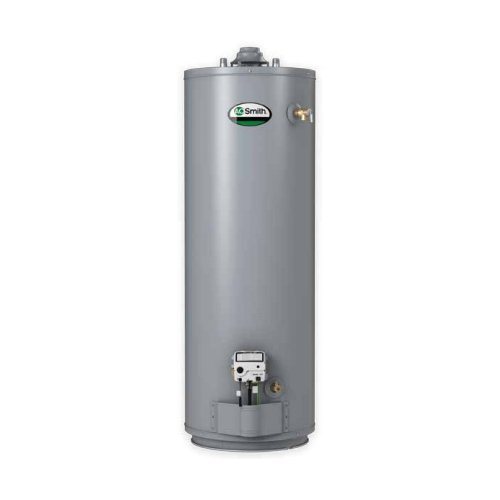
This is the conventional tank most homes actually end up with, in the propane version for houses off the natural gas main. A 36,000 BTU burner under a 40-gallon tank gives a 70-gallon first-hour rating and about 41 gallons per hour of recovery, which covers a family of three or four without much drama.
The build is where the A.O. Smith reputation lives. The tank carries the company’s glass lining, and the DynaClean dip tube stirs incoming water so sediment cannot settle into an insulating crust on the bottom, which is what quietly kills cheap tanks. A CoreGard anode rod handles corrosion duty and is the one part worth checking every few years.
Ignition is self-powered: a thermopile generates the current the gas valve needs, so the heater keeps working through a power cut. It is a plain, serviceable unit with no control board to fail, and it meets Low NOx emission rules.
Pros
- Runs without household power thanks to the self-powered gas valve.
- Glass-lined tank and CoreGard anode rod resist corrosion.
- DynaClean dip tube limits sediment buildup.
- Simple mechanical design with little to go wrong.
Cons
- A 0.62 energy factor trails hybrid and condensing models by a wide margin.
- Not Energy Star qualified, so utility rebates rarely apply.
Product Specs
| Energy Factor | 0.62 |
|---|---|
| Recovery rate | 41 gallons per hour |
| First-hour rating | 70 gallons |
| Capacity | 40 gallons, liquid propane |
| Energy Star Rated | No |
| Warranty | Six-year limited warranty on tank and parts |
A.O. Smith EJC-6 Compact Electric Water Heater
Best A.O. Smith Compact Electric Water Heater

Not every hot water problem needs a full tank. The EJC-6 is a 6-gallon compact unit built for the sink at the far end of the house, a workshop, a bar, or a garage utility sink, where waiting for hot water to travel from the main heater wastes both water and patience.
It runs on a standard 120-volt circuit, which is the whole point: no 240-volt line, no gas, no venting. A single 1,650-watt element recovers about 8 gallons per hour, so it keeps up with handwashing and light dish duty rather than a shower.
Size makes it flexible. At roughly 15 inches tall and 14 inches across, it tucks under a counter, onto a shelf, or onto a wall bracket. Inside, it gets the same Blue Diamond glass coating as the full-size tanks, and it carries the same six-year tank warranty, which is unusual for something this small.
Pros
- Runs on a standard 120-volt circuit, so no new 240-volt line is needed in most cases.
- Delivers hot water at a remote sink with almost no wait.
- Compact enough to sit under a counter, on a shelf, or on a wall bracket.
- Six-year tank warranty and the same glass lining as the large models.
Cons
- Six gallons is a point-of-use supply, not enough for a shower.
- Recovery is slow compared with a 240-volt tank.
Product Specs
| Capacity | 6 gallons |
|---|---|
| Element | 1,650 watts, 120 volts |
| Recovery rate | 8 gallons per hour at a 90 degree rise |
| Measurements | 15.25 inches tall by 14.25 inches in diameter |
| Warranty | Six-year limited warranty on tank and parts |
| Product | Award | Fuel | Efficiency | Recovery or Flow | Energy Star Rated | Warranty |
|---|---|---|---|---|---|---|
| Signature Premier GT15-240-NO | Tankless | Natural gas | 0.95 UEF | 6.6 gal/min | Yes | 15-year (heat exchanger); 5 years (parts) |
| GCR-40LP ProMax Plus | Gas tank | Liquid propane | 0.62 EF | 41 gal/hr | No | 6-year (limited) |
| EJC-6 Compact | Compact electric | Electric (120V) | 1,650 W element | 8 gal/hr | No | 6-year (limited) |
Signature vs. ProLine: The Two Trade Lines
A.O. Smith residential heaters come in two parallel lines, and knowing which one you are looking at prevents a lot of confusion.
Signature Series is the retail line sold through Lowe’s, aimed at homeowners and do-it-yourself buyers. It is organized by tier, and the tier sets the warranty: the Signature 100 carries a 6-year limited warranty, the 300 a 9-year, the 500 a 12-year, and the 900 heat pump around a 10-year term.
ProLine is the professional line sold through plumbing distributors and installed by contractors. ProLine units generally use upgraded components, such as better anode rods, brass drain valves, and thicker insulation, and tend to deliver stronger recovery. Warranty length can look similar on paper, but the practical difference is the installing plumber standing behind the job.
For most homeowners the choice follows the buying path: if you are hiring a plumber, you will likely get a ProLine; if you are buying at Lowe’s, you are getting a Signature. Both are genuine A.O. Smith products.
Strengths and Weaknesses
Where A.O. Smith consistently earns its reputation:
- Availability: units, parts, and knowledgeable installers are everywhere, which shortens downtime when something fails.
- Durable tanks: the company pioneered the glass-lined steel tank, a coating fused to the interior that resists rust and remains an industry standard.
- Full range: whatever your fuel, space, and budget, there is a matching configuration, from simple gas tanks to high-efficiency Voltex hybrids.
Where buyers should go in with open eyes:
- Retail vs. pro confusion: the Signature and ProLine split means two units with similar names can differ in components and support.
- Electronics on high-tech models: hybrid and condensing units add sensors and control boards, which are more to go wrong than a plain mechanical tank.
- Install demands: heat pump and tankless models need the right space, venting, and sizing to perform as promised.
Warranty, Lifespan, and What to Expect
Residential A.O. Smith warranties typically run from 6 to 12 years depending on the model tier, and they usually cover the tank and parts, not labor. The number on the box is a decent proxy for build quality, since longer-warranty units get thicker anode rods and better linings, but it is not a promise of lifespan.
In practice, a well-maintained storage tank lasts about 8 to 12 years, while tankless units often reach 20 years because there is no tank to corrode. The biggest lever on lifespan is maintenance: check the anode rod every few years and flush the tank periodically, especially with hard water. Always read the rating plate on your specific unit, because warranty terms shift with model and installation.
How A.O. Smith Compares to Other Brands
The two names you will hear alongside A.O. Smith are Rheem and Bradford White, and the honest answer is that all three are solid.
Rheem is the other retail giant and is stocked at Home Depot, and it is often praised for its smart-home app integration. A.O. Smith is the brand you will find at Lowe’s and is known for its glass-lined tank durability. Bradford White is a contractor-only brand with a strong reputation among plumbers, so you will not find it on a store shelf at all. For most homeowners, availability, the installing plumber’s preference, and the specific model tier matter more than the badge on the front.
What A.O. Smith Water Heaters Cost to Install
Prices vary widely by region, home layout, and how much the existing setup needs to change, so treat these as general market ranges rather than quotes. Get a licensed plumber to price your specific job.
- Electric tank: roughly $900 to $1,800 installed for a common 40 to 50 gallon unit.
- Gas tank: roughly $1,200 to $2,400 installed, with high-efficiency power-vent models reaching higher.
- Heat pump (Voltex): roughly $2,500 to $6,500 installed, since the unit costs more and may need electrical or space changes.
- Gas tankless: roughly $2,700 to $5,500 installed, often more because of gas-line and venting upgrades.
The higher-efficiency options cost more up front but cut running costs, and heat pump and other qualifying units may be eligible for federal tax credits and local utility rebates. Those programs change often, so check the current offers in your area before you count on them.
Where to Buy A.O. Smith Water Heaters
There are three realistic channels, and none of them is a big online marketplace for the full lineup.
Lowe’s carries the Signature Series for homeowners and do-it-yourself buyers, both in store and for delivery. Plumbing distributors and supply houses stock the ProLine trade line, along with power-vent gas and higher-output models that never reach retail shelves. And a licensed plumber is the most common path, because they source the right unit, size it correctly, pull permits, and handle gas or high-voltage connections safely.
For gas, power-vent, and heat pump models especially, professional installation is not just convenient, it is a safety and code requirement in most areas. Improper venting of a gas unit can allow carbon monoxide into the home, so this is not a place to cut corners.
How to Choose the Right A.O. Smith Model
Start with fuel: if you already have a gas line and want fast recovery for a busy household, a gas tank or gas tankless is the natural path. If you want the lowest running cost and have the space, a Voltex heat pump usually wins over time. Where gas is not available and the space is tight, a standard electric tank is the simple fallback.
Then size it. For tanks, match the first-hour rating to your peak morning demand rather than just the gallon number, and for tankless, calculate the flow rate for the fixtures you run at once. A unit that is too small runs cold during the rush, and one that is too large wastes energy. A licensed plumber runs these numbers as part of the quote, which is another reason to involve one early.
Efficiency rules are also shifting. Under new U.S. Department of Energy standards taking effect in 2029, most electric storage tanks larger than about 35 gallons will need heat pump technology to comply (2). If you are choosing an electric unit and plan to keep it a long time, a Voltex hybrid is the future-proof choice.
FAQs
In Conclusion
A.O. Smith earns its place as the default water heater brand for a lot of American homes: durable tanks, parts on every shelf, and a model for every fuel and budget. The one thing to get straight before you buy is the retail-versus-pro split, because a Lowe’s Signature and a plumber’s ProLine are related but not identical.
Match the fuel and size to your household, decide whether long-term efficiency is worth a higher up-front cost, and let a licensed plumber handle the sizing and install. Get those right and an A.O. Smith unit should quietly do its job for well over a decade.