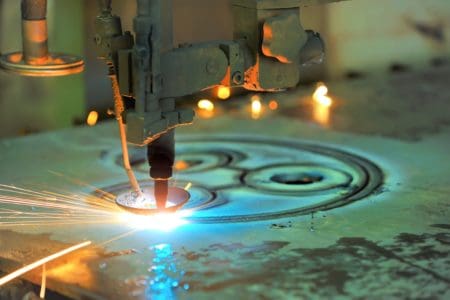
Cutting metal can be laborious and expensive. Plasma cutters utilize gas to form an efficient and clean arc that cuts various metals at different thicknesses. They are precise but costly, which is why you need a versatile plasma cutter to cater to most tasks.
We show you the 7 best plasma cutters to help you decide which is the right one.
- 3-in-1 tool
- 5-year warranty
- Easily portable
- Super-light at 22 pounds
- Dual voltage
- Makes clean lines
- Convenience & precision
- Easily portable
- Dual cutter
- Simple controls
- Drag touch technology
- Light & easy to handle
- Has a DC inverter
- Zero aftercare cuts
- Low-energy consumption
- Lightweight & portable
- Super-fast set-up
- Advanced cooling system
- Loves cutting stainless steel
- Lasts a lifetime
- Wind tunnel technology
Review Methodology: At Sensible Digs, we believe in providing you with comprehensive, objective, and hands-on analysis of the best plasma cutters. Our team of professionals meticulously test and compare each product, assessing key factors such as performance, design, and user experience. We collect and track data, use it to rank products, and share our findings in an easily understandable manner. Our evaluations are based on evidence derived from our own use of the products, ensuring our reviews and scores are backed by real-life experiences. The criteria for our reviews are set to help you make an informed decision, highlighting what sets a product apart from its competitors. Trust us to guide you in finding the perfect plasma cutter that suits your needs.
The Best Plasma Cutters of 2024
Plasma cutters come in all varieties, prices and features, so we had our work cut out finding you the 7 best plasma cutters available.
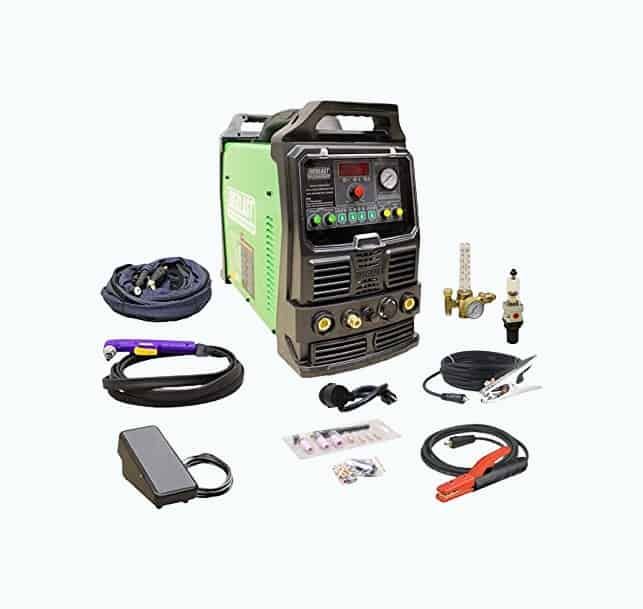
Everlast PowerPro 164 Plasma Cutter
Best Professional Plasma Cutter
If you are a professional, your wish list is different from hobbyist and occasional fabricators. So what makes this plasma cutter better? Firstly, it’s a 3-in-1 combination plasma cutter; it TIG welds, stick welds and plasma cuts.
Secondly, it is lightweight and portable, making it the ideal choice for transporting to and from the job site. It has a cutting depth of 0.625 inches, so it can tackle thicker material, increasing your cutting repertoire. The other advantage, as a professional, is the warranty. This unit comes with a 5-year warranty that protects you from expensive repair costs and keeps you on the job.
What We Like
3-in-1 Tool
The ability to cut and weld is a real bonus. It speeds up your work rate and means you don’t have to set-up another machine when you have finished plasma cutting. One unit covers all your options.
5-Year Warranty
Professionals rely on their tools to keep them at work and on the job. A broken plasma cutter is lost income to a contractor. So, a 5-year warranty gives them the peace of mind that they are covered in emergencies.
Easily Portable
This plasma cutter is built for the harshest environments. It is job-site rugged. And that extends to its portability. Taking the knocks and bumps of life on the road helps to keep this cutter in working order, whatever the circumstances.
What We Don't Like
Professional Price
This cutter is aimed squarely at the professional market, and the price reflects this. It is two or even three times the cost of some cutters on the list. Quality costs and this unit is the highest quality.
Product Specs
| Weight (pounds) | 60 |
| Dimensions (inches) | 20 x 12.5 x 13.5 |
| Multi-process | TIG, stick |
| Voltage | 240 |
| Max amps | 200 |
| Price | $$$ |
| Warranty | 5-year |
Our Ratings
User Experience
PrimeWeld 50A Air Inverter Plasma Cutter
Best Plasma Cutter for Metal Art
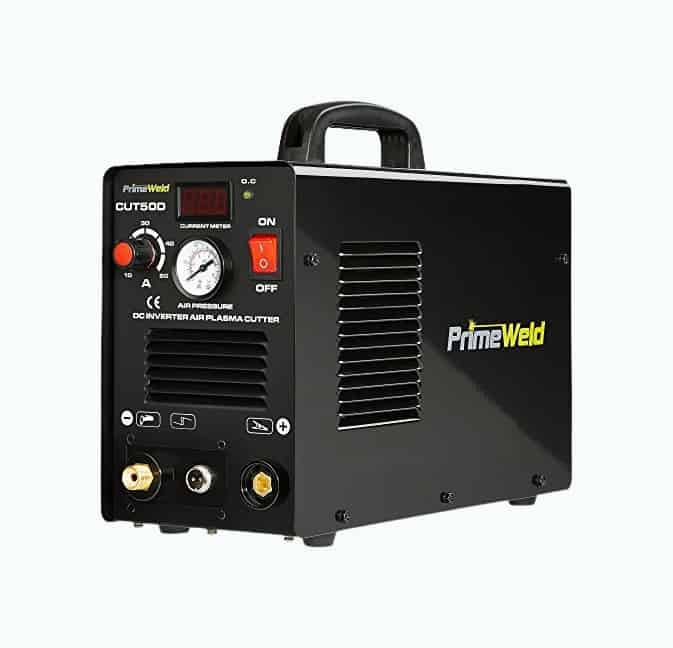
If you are into creating metal art, you will need a plasma cutter that is precise and makes clean lines. This PrimeWeld is just that machine. It can cut to a depth of 0.50 inches, and thanks to the high-frequency DC, it cuts faster than standard plasma cutters.
This machine is at home in the workshop or the domestic artist’s studio, where it can operate on dual voltage. The high-output transistors provide a high power output to cater to thicker material, as well as a steady supply to cut thinner sheet metal accurately.
All of these attributes make it the ideal cutter for creating the finest metal art.
What We Like
Bargain Price
The price is one of the standout factors when choosing this plasma cutter. It is a fraction of the cost of the models featured so far, making it the ideal artist cutter.
Super-Light at 22 Pounds
Thanks to the inverter technology, this plasma cutter is high-tech, making it lighter than many industrial spec models. It weighs just over 22 pounds, which is ideal for carting it from project to project without straining your back or arms.
Dual Voltage
It operates on a dual voltage, which means it is equally at home in the workshop as it is in a commercial studio making bespoke art.
What We Don't Like
Scratch Start Machine
Scratch start cutters are notoriously difficult to start and maintain a stable arc. This makes it a challenge if you are using it for the first time.
Product Specs
| Weight (pounds) | 22.5 |
| Dimensions (inches) | 15 x 6 x 12 |
| Multi-process | No |
| Voltage | 110/220 |
| Max amps | 50 |
| Price | $$ |
| Warranty | 3-year |
Our Ratings
Personal Perspective
Shuangbing Welder Portable CNC Plasma Cutter
Best Plasma Cutter for CNC
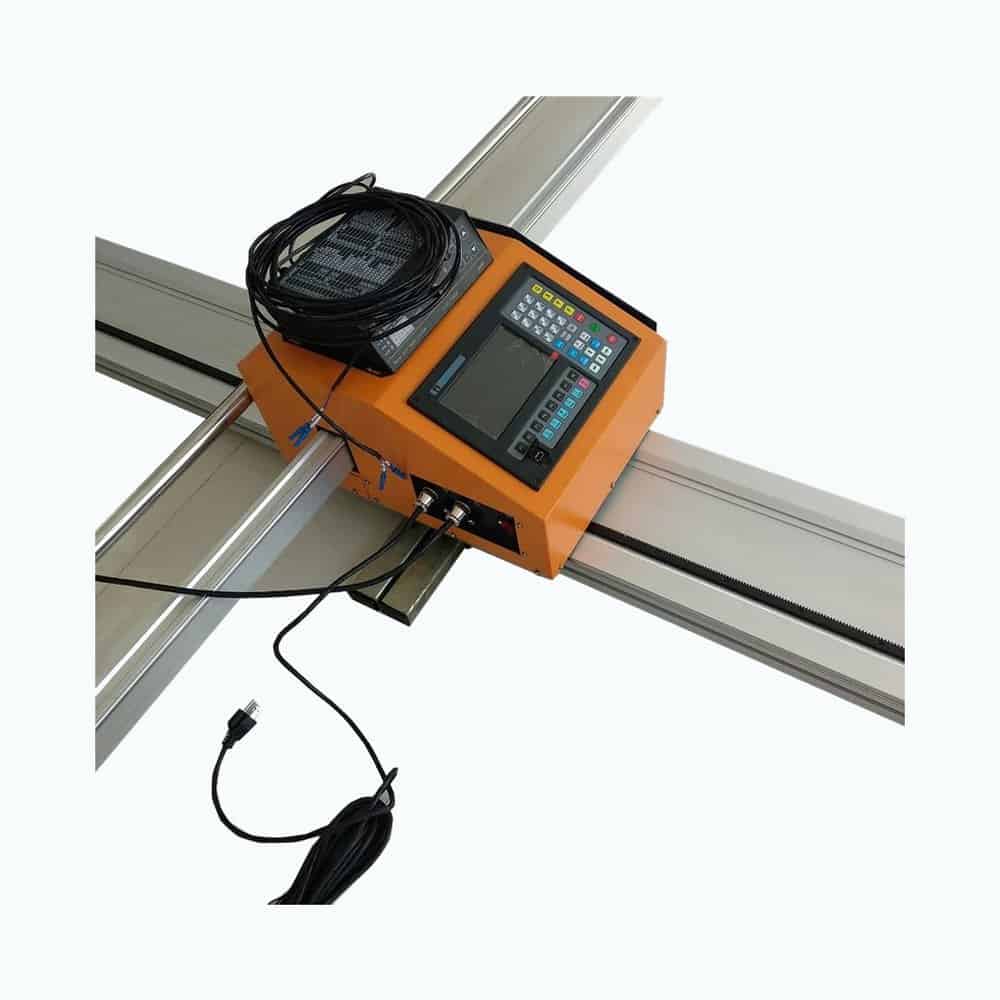
CNC plasma cutting machines are not as common as plasma cutters. However, this portable unit makes cutting a whole lot easier. Because it is computer controlled, it produces hands-free cutting at exceptional speed and accuracy.
It has a flame cutting depth of 6 inches and a plasma thickness of 15mm. It means that you can program the computer to make the cuts in advance, set the material in place, and let the machine do its job.
It also enables you to get on with another task while waiting for the CNC plasma cutter to complete its instructions.
What We Like
Convenience and Precision
What could be more convenient than a machine that takes all your measurements and translates them into a precise cutting action while you wait? The FastCam software controls the plasma torch height, and the device has a cutting range of between 63 inches by 98 inches.
Easily Portable
Larger CNC plasma cutters are factory-based and non-transportable. This machine comes with you to the work-site. It can be set up quickly, and it speeds up your work rate immeasurably, making you more profitable where time is money.
Dual Cutter
You get two options with this cutter. It has a plasma setting with a cutting depth of 15mm, and it also has an oxy-fuel cutter that cuts a thickness of 6 inches, although with less precision.
What We Don't Like
Weighs 231 Pounds
While this is portable, don’t confuse the weight of this cutter with that of a standard plasma machine. It weighs 231 pounds, so when you transport it to the job-site, you might need some assistance to carry it.
Very Expensive
Don’t think this type of cutter is a budget option. It will cost you a lot more than most standard plasma cutters would cost.
Product Specs
| Weight (pounds) | 231 |
| Dimensions (inches) | 88.98 x 5.91 x 3.94 |
| Multi-process | Oxy-fuel and Plasma |
| Voltage | 110 |
| Max amps | 120 |
| Price | $$$ |
| Warranty | 2-years |
Our Ratings
Community Feedback
Forney Easy Weld 251 20 P Plasma Cutter
Best Plasma Cutter for Beginners
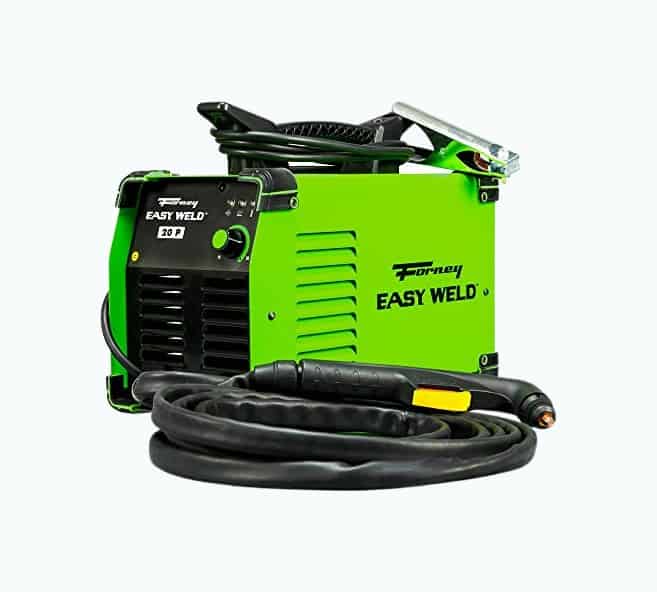
As a beginner, everything on a plasma cutter looks scary and new. Getting to know your cutter and what it can do is crucial to how quickly you expand your knowledge base and improve. This Forney Easy Weld model is easy to use, with a built-in regulator and air dryer, as well as Drag Touch Technology that allows the tip to make contact with the metal as you cut.
It cuts mild steel, stainless steel, and aluminum to a thickness of 0.25 inches. As far as cutters go, this is a great machine to learn on, thanks to the easy one-dial controls. It is light and portable, yet it has an all-steel case that helps it stand the rigors of day to day life.
What We Like
The Simplest Controls
Nothing could be easier. Plug the machine in and use the one dial on the front to control the cutter. Even the cables are pre-attached, so you don’t need to fret about connecting them.
Drag Touch Technology
Drag Touch Technology means that the user no longer needs to worry if the tip of the torch touches the base metal. With this plasma cutter, you are encouraged to do this for stable cutting action and clean lines. What more could a beginner ask for?
Light and Easy To Handle
Transporting this cutter is a cinch, given it weighs just over 21 pounds. Also, it isn’t too intimidating for beginners. Mastering this cutter is a breeze, adding to your confidence as you grow more experienced.
What We Don't Like
Restricted To 0.25-Inch Thick Material
As you might expect for a cutter fit for beginners, it isn’t the most powerful machine. It operates on the domestic 120 volts system, so the amperage is less, affecting the cutter’s potency. It restricts you to cutting 0.25-inch thick material.
Oversimplified
One of it’s biggest strengths is also a weakness. This cutter is easy to use, but as you get more experience, you quickly outgrow this machine, meaning more expense getting something more powerful.
Product Specs
| Weight (pounds) | 21.1 |
| Dimensions (inches) | 15.13 x 8.13 x 12 |
| Multi-process | No |
| Voltage | 120 |
| Max amps | 20 |
| Price | $$ |
| Warranty | 1-year |
Our Ratings
First-Hand Impression
Zeny DC Inverter Plasma Cutter
Best Budget Plasma Cutter
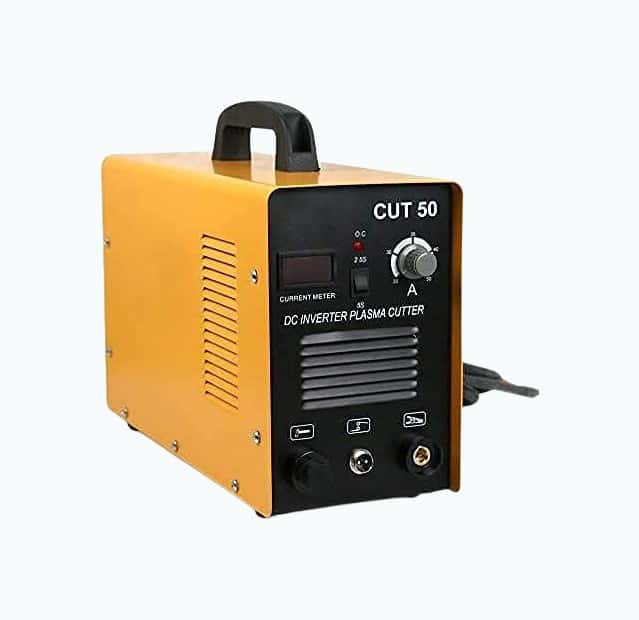
When the pennies are tight, you have to compromise and buy a cheaper model. Say hello to Zeny plasma cutter. This unit retails for a fraction of the cost of the mid-priced and high-end models. It makes it a great investment for novices and occasional users.
This model has a DC inverter, which means it is efficient and quiet. It has enhanced cutting speed and makes smooth, clean cuts that require zero aftercare. It even has a digital display that’s easy to read and low-energy consumption.
The maker’s claim this cutter can slice through metal up to 0.47 inches thick.
What We Like
Budget Pricing
You cannot argue with a plasma cutter that retails at such an affordable price. It means those with limited budgets are getting in on the action, which exposes them to a whole new world of metal fabrication.
Zero Aftercare Cuts
The cuts this machine makes are so neat and precise that they require no clean-up or aftercare. Make the cut and move on. What’s not to love about that?
Easy Controls
As if the price wasn’t enough, this cutter has the simplest controls. Even novices can use this with relative ease, making it a quick learning experience. It even has a 2.5 and 5-second air blow after the cutter has finished to help it cool rapidly.
What We Don't Like
Quality Issues
Some things are just too good to be true. This plasma cutter is the budget option, which means lesser quality materials. This has led to several people receiving cutters that either stop working or never worked in the first place.
Catered To Small Tasks
This plasma cutter is better suited to smaller jobs rather than huge projects. Also, try and keep the cutting too short bursts for the best performance.
Product Specs
| Weight (pounds) | 22.5 |
| Dimensions (inches) | 19 x 14 x 11 |
| Multi-process | No |
| Voltage | 110/220 |
| Max amps | 50 |
| Price | $ |
| Warranty | 1-year |
Our Ratings
User Experience
Lotos LT5000D 50-Amp Inverter Plasma Cutter
Best Plasma Cutter for Hobbyists
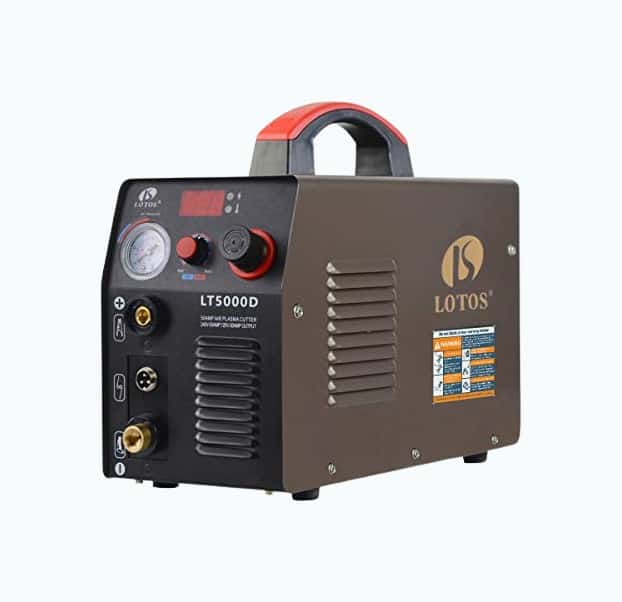
LOTOS is a popular plasma cutter manufacturer. They make some of the best selling models. This air inverter, 50-amp cutter, is ideal for cutting stainless steel, aluminum, mild steel, alloy steel and copper.
It makes a 0.50-inch clean-cut, but if you want to settle for a severance cut, that can stretch to 0.75 inches. This cut will require some aftercare. It’s a dual voltage model, so it’s at home in the factory or the garage, and it has an advanced cooling system to keep the plasma cutter in a stable condition.
The makers also claim that it can be set-up in 1 minute, thanks to the quick connectors for the compressor.
What We Like
Lightweight and Portable
This unit weighs just 22.5 pounds, so transporting it from place to place is a breeze. It means that the dual voltage feature is tested as you cart this from the job site to your home.
Super-Fast Set-Up
Imagine starting a welding project, and it takes forever to set up your plasma cutter. This one is operational in just 1 minute. The compressor connectors are easy to use, and it comes with a factory-installed plug.
Great Price-Point
This isn’t the budget model, but you are certainly saving when you buy this compared to the high-end machines. It is an excellent plasma cutter to graduate to when you outgrow your beginner model.
What We Don't Like
Build Quality Issues
As the prices drop, so does the quality of the construction and the components used. This cutter certainly suffers from its fair share of technical issues.
Cutter Falls Short of Max Cutting Depth
Many users have reported that the advertised half an inch cutting depth is hard to reach, especially with stainless steel. Their experience is the cutter falls way short.
Product Specs
| Weight (pounds) | 22.5 |
| Dimensions (inches) | 15 x 6 x 12 |
| Multi-process | No |
| Voltage | 110/220 |
| Max amps | 50 |
| Price | $ |
| Warranty | 1-year |
Our Ratings
Personal Perspective
Hobart 500565 Airforce 27i 240-Volt Plasma Cutter
Best Plasma Cutter for Stainless Steel
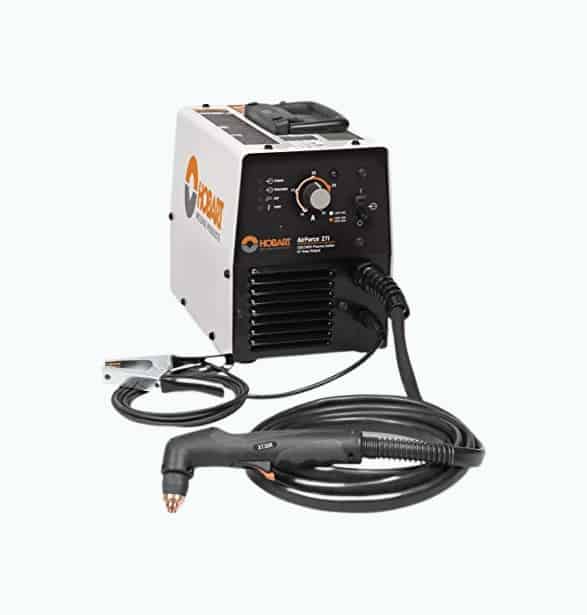
Okay, so we’ve saved the most expensive plasma cutter until last. This Hobart model is excellent at cutting stainless steel to a thickness of 0.625 inches. What is also impressive about this cutter is that it has wind tunnel technology, which prevents particles and dust from damaging the internal components.
The cost may be prohibitive to some, leading us to conclude this plasma cutter will interest the professional and experienced fabricator market rather than the hobbyists. That said, it does have a multi-voltage power supply, so it caters to 120 and 240 volts.
The fan-on-demand feature kicks in when dust or debris are in danger of clogging the internal components.
What We Like
Loves Cutting Stainless Steel
It can slice through stainless steel like a knife through butter. Depths of 0.625 inches are impressive, meaning you can work on sheet material and thicker metal, increasing your cutting prowess.
Lasts a Lifetime
Hobart welders and plasma cutters are renowned for their quality and resilience, and this model is no exception. If you want to spend a little more to get the plasma cutter of your dreams, you should look at Hobart.
Dual-Voltage Plug
This is very much a professional tool, but there is no reason you can’t use this at home. The dual voltage plug allows you to access the domestic power supply for home and workshop use and then switch to 240 volts when you are back on the job site.
What We Don't Like
Incredibly Expensive
There is no escaping that price. This is truly an eye-watering sum to spend on a plasma cutter. We know they are good, but that good? Reputation is everything, and Hobart is literally banking on theirs.
Product Specs
| Weight (pounds) | 32.1 |
| Dimensions (inches) | 11.25 x 8.25 x 14.25 |
| Multi-process | No |
| Voltage | 120/240 |
| Max amps | 27 |
| Price | $$$$ |
| Warranty | Maximum of 5 years |
Our Ratings
Community Feedback
| Product | Best | Weight | Dimensions | Multi-process | Voltage | Max amps | Warranty |
|---|---|---|---|---|---|---|---|
| Everlast PowerPro 164 Plasma Cutter | Professional | 60 lbs | 20 x 12.5 x 13.5″ | Yes | 240 | $200 | 5-years |
| PrimeWeld 50A Air Inverter Plasma Cutter | Metal Art | 23 lbs | 15 x 6 x 12″ | No | 110/220 | 50 | 3-years |
| Shuangbing Portable CNC Plasma Cutter | CNC | 231 lbs | 88.98 x 5.91 x 3.94″ | Yes | 110 | 120 | 2-years |
| Forney Easy Weld Plasma Cutter | Beginners | 21 lbs | 15.13 x 8.13 x 12″ | No | 120 | 20 | 1-year |
| Zeny DC Inverter Plasma Cutter | Budget Pick | 22.5 lbs | 19 x 14 x 11″ | No | 110/220 | 50 | 1-year |
| Lotos 50-Amp Inverter Plasma Cutter | Hobbyists | 22.5 lbs | 15 x 6 x 12″ | No | 110/220 | 50 | 1-year |
| Hobart Airforce 240V Plasma Cutter | Stainless Steel | 32 lbs | 11.25 x 8.25 x 14.25″ | No | 120/240 | 27 | 5-years |
What Is a Plasma Cutter?
A plasma cutter is a tool that utilizes gas to send an electric arc through a constricted opening, located on the end of a torch. The gas can be argon, air, or nitrogen, and it elevates the temperature, helping the cutter achieve the 4th state of matter. Whoa! Now we’re getting heavy.
The 4th state of matter is neither gas, liquid or solid. It is the state when there is the same number of positive and negatively charged particles produced when the atoms in the gas ionize. It is more common than you think. Plasma naturally occurs on the surface of the sun, and 99 percent of visible matter in the universe is thanks to plasma.
Plasma is produced naturally everywhere, except on earth.
What Does a Plasma Cutter Run Off?
Plasma cutters use electricity to form the arc, and gas is added to increase the intensity of the heat to make metal-cutting possible. You also need an air compressor, unless your cutter unit has one built-in.
What Should I Look for When Buying a Plasma Cutter?
Plasma cutters are a great addition to any fabricator’s arsenal of tools, but what should you look for when shopping for a plasma cutter. Here are the most important considerations.
What Are You Cutting?
The type of cutting you undertake is the biggest consideration. If you are cutting through sheet metal, you don’t need a 200-amp machine designed to cut 0.75-inch steel. You could get away with a smaller, less expensive plasma cutter that runs on 110 volts.
Equally, if you are cutting thicker material, you should try and max-out the amps and get the most powerful cutter you can.

Compressor or Built-In Air Source
Some cutters have built-in compressors, negating the need to purchase a separate compressor. These are more expensive but you don’t have to pay extra for a compressor. If you have to buy an air compressor, mitigate the expense by getting one that can adapt to power spray guns and air tools.

What About the Power?
Power levels are also important because the smaller, 110/120-volt machines produce less impact than the larger, 230/240-volt cutters. This is another factor in deciding what type of cutter to get. The simple answer is to opt for a dual voltage machine; then you can switch between 110 and 240 volts to adapt to the thickness of the material.

Look for Advanced Features
Some plasma cutters are better than others. There are a few convenient features that make life that bit easier.
- Arc Starting: Some machines start the arc by touching the base metal while others drag the torch like a scratch start on a welder. Beware when buying no-touch varieties as they can interfere with electrical devices like tablets and smartphones.
- Air-Flow Adjustment: Having the ability to adjust the air-flow means you can continue to flow air when cooling the metal. You can get automatic adjustments as well as manual.
- Automatic Settings: Some cutters have computerized controls that detect changes in conditions and adjust the temperature and electrical current setting to accommodate. Others have a factory setting that you preselect before you start cutting.
- Automatic Arc Restrike: This function allows the torch to cut across large gaps in the metal. Electromagnetic sensors detect changes in the metal surface being cut, and shut the torch off automatically as you pass over the opening, and restrike when you are over metal again.

How Much Do You Spend?
The budget is always one of the most crucial factors when choosing anything new. Plasma cutters are expensive, and so you need to make sure your dollars get you the very best machine you can. Research is the key, and knowing what you will use the device to cut brings us back to the very first point.

How Long Is the Warranty?
The warranty is the ideal way to test the manufacturer’s faith in its product. Longer warranties indicate that they are confident the machine will last the distance, whereas shorter guarantees usually mean the opposite.
How Do You Use a Plasma Cutter?
Here is a simple to follow guide to using a plasma cutter. It is not the definitive version. For this exercise, we’ll assume you will need an external air compressor.
1. Connect the Air
Recede the flange of the outer flange of the female connection and connect the male section. This ensures there is enough air-flow to keep the plasma stream under sufficient pressure. Now plug the machine in and turn on the air.
2. Ground Clamp
Attach the ground clamp to the base metal to create the circuit. Now turn on the machine.
3. Set the Current
For this exercise, we will set it to 25 amps for 18-gauge sheet metal.
4. Cut the Metal
Activate the plasma cutter by depressing the trigger. You need to lift the safety before pressing the trigger. Keep the cutter end of the torch close to the material and make the cut. Take care to move slowly but steadily.
5. Power Off
Always switch the cutter off and unplug it to make sure no accidents occur. And don’t forget to disconnect the ground clamp. Now turn off the air and disconnect.
Plasma Cutters FAQs

Do You Need Gas for a Plasma Cutter?
You need gas to maintain pressure on the plasma stream and increase the heat as it flows through the narrow opening. You can use air, argon, or nitrogen.

Is a Plasma Cutter Better Than a Torch?
Plasma cutters outperform torches because you don’t need to preheat the metal before cutting, and you can cut in greater detail for fine lines. Also, plasma cutters cut stacked metal more efficiently, which can speed up your work rate.

What Size Air Compressor Do I Need for a Plasma Cutter?
You should get an air compressor rated at 1.5 times the cubic feet per minute of your plasma cutter. When it comes to plasma cutters, the golden rule is the bigger the compressor, the better.

How Thick Can a 50-Amp Plasma Cutter Cut?
A 50-amp plasma cutter typically cuts approximately 1-inch deep, but this does vary depending on the material you are working on.

Can You Cut Wood With a Plasma Cutter?
The short answer is no. You need the material to be electrically conductive. Unfortunately, wood is not conductive, and so cannot be plasma cut.

What Is the Most Powerful Plasma Cutter?
The Everlast Welders Canada 2020 PowerArc 140ST is the most powerful plasma cutter available today due to its compact and portable design, dual-volt capability, and impressive 140 maximum amp output.
It has an auto-adaptive hot start feature which allows you to cut any material up to 12mm with stable arc ignition while producing minimal spatter.
Its inverter technology makes it more efficient than traditional plasma cutters and helps protect the equipment from surges or voltage instability. Therefore, there’s no better choice than this highly-advanced plasma cutter when it comes to getting the job done quickly and reliably.

What Cuts Better Than a Plasma Cutter?
A plasma cutter is ideal for cutting through metal and other electrically conductive materials. However, oxy-fuel cuts are often preferred because they offer a much deeper cut and do not require continuous electricity like a plasma cutter.
Oxy-fuel cuts produce sweltering temperatures that quickly melt their way through any material, making them perfect for thicker metals or when greater accuracy is needed than the processes offered by a plasma cutter.
Additionally, oxy-fuel cuts often require less setup and are generally less expensive than a plasma cutter, making them an increasingly attractive choice for those needing power tools.

What Is the Best Plasma Cutter for a Beginner?
The Forney Easy Weld 251 is the ideal plasma cutter for beginners due to its easy-to-use design, easy accessibility, and affordability. It runs on standard 120 volts, making it easy to find the power needed for operating the unit.
It’s lightweight and portable. The Forney Easy Weld 251 can impressively cut thin sheet metal up to 1/8 inch thick or thick. This makes it an accessible tool for any DIY or side project that requires a quality plasma cutter.

What’s the Best Plasma Cutter You Can Buy?
There are a few good ones but the PrimeWeld 50A makes perfect cuts on both thick and thin materials. Plus, it’s super lightweight and portable. It also has dual voltage capabilities, so it functions with 110V or 220V outlets without needing an adapter.
Making the Cut
Which plasma cutter is right for you is down to personal choice. Budget, cutting prowess, and what type of material you are cutting all have roles to play. The best plasma cutter isn’t necessarily the most expensive, nor is the cheapest the worst.
Value for money is a personal thing. Do your research and make sure you get it right when you make your choice.