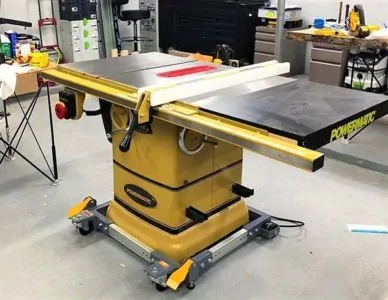
Hybrid saws combine the sturdiness and quality of a traditional contractor saw with the convenience and versatility of a modern cabinet saw. They are ideal for passionate woodworkers looking to take their creations to the next level.
There are many hybrid saws to choose from, including those made by some of the leading names in power saws. However, they can vary greatly in terms of performance, which means it might be difficult to choose the right one for your workshop.
To help you make the right choice, we have reviewed seven of the best hybrid table saws that are currently available. We chose these saw units based on their cutting power, drive type, robustness, and any extra features they have.
- Portable
- Easy to set up
- SquareLock rip fence
- 260 pounds
- Toolless setup
- 45-degree blade tilt
- Precision-ground cast iron
- Toolless guard assembly
- Independent side leaves
- Cast iron construction
- Digital bevel angle reading
- Effective dust extraction
- Dust collection
- Reduces vibrations
- Blade guard
- 32.5-inch rip capacity
- Dust collection port
- Onboard storage
- Dust control
- UL-compliant
- Quiet
Review Methodology: At Sensible Digs, we bring a comprehensive analysis of the best hybrid table saws, directly from a user’s perspective. Our expert team conducts hands-on tests, checks, and compares the performance, design, and key features of each product. We use data-driven criteria and professional benchmarks to rank and review each table saw. Our detailed evaluation is based on factual evidence and hands-on experience, focusing on key decision-making factors such as power, accuracy, safety features, ease of use, and value for money. We strive to highlight what sets each product apart from its competitors, providing you with all the necessary information to make an informed purchase decision.
The Best Hybrid Table Saws of 2024
There is a lot to think about when choosing a hybrid saw, which is why we tried to make it easier by doing much of the research for you. After looking at numerous models, we have reviewed seven of the best hybrid table saws that are currently available. These saws were chosen for their size, cutting ability, drive type, and safety features.
Bosch 10-Inch Worksite Table Saw 4100XC-10
Best Portable Table Saw
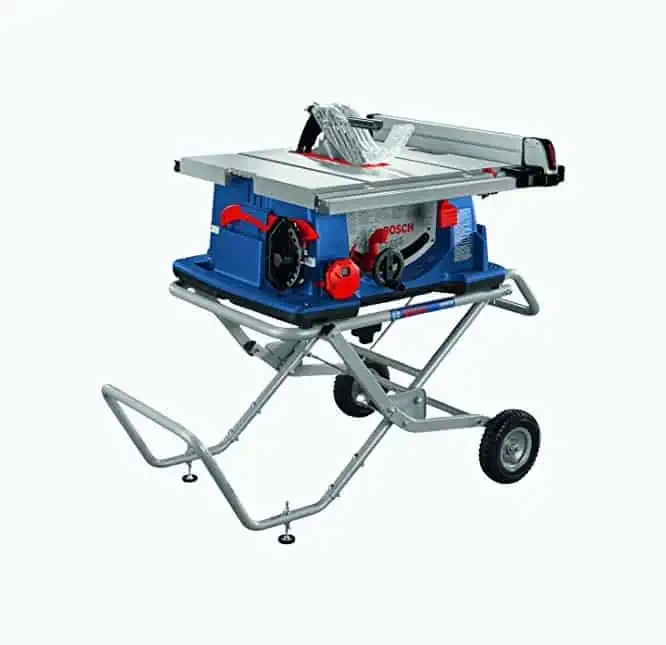
This Bosch 10-inch table saw is portable and collapsible, thanks to its gravity-rise wheeled stand. The adjustable height means it will be comfortable for any user and suitable for working in various environments.
One of its standout features is its SquareLock rip fence, which increases the accuracy of its cuts. As some of its competitors don’t have a table saw fence or lack accuracy, it is easy to appreciate this model.
It also has a large 10-inch cutting surface, and the ripping capacity can accommodate stock up to 30 inches wide. In terms of safety features, this table saw has an adjustable riving knife, an anti-kickback device, and a barrier device guard.
What We Like
Portable
The wheels and lightweight, collapsible design make this hybrid saw ideal for anyone without a dedicated space for it. It won’t occupy much space when collapsed, so you will be able to store it almost anywhere, and it is portable enough to be taken with you to work on location.
Easy Setup
Multiple user reviews mention how easy this saw is to set up. This ease of use extends to adjusting it and collapsing it for storage.
Accurate Cutting
Users praise this saw’s cutting accuracy, which is thanks to its SquareLock rip fence. It also makes smoother cuts thanks to its efficient 3,650 RPM motor.
What We Don't Like
Manual Assembly
You will need to assemble this saw’s stand yourself after it arrives, as it is not supplied in one piece.
Product Specs
| Warranty | 1-year limited warranty |
| Dimensions | 27 x 32.5 x 13 inches |
| Horsepower | 4.0 HP |
| Rip Capacity | 30 inches |
| Weight | 109 pounds |
Our Ratings
User Experience
Shop Fox W1837 2 HP Open-Stand Hybrid Table Saw
Best Hybrid Table Saw for Beginners
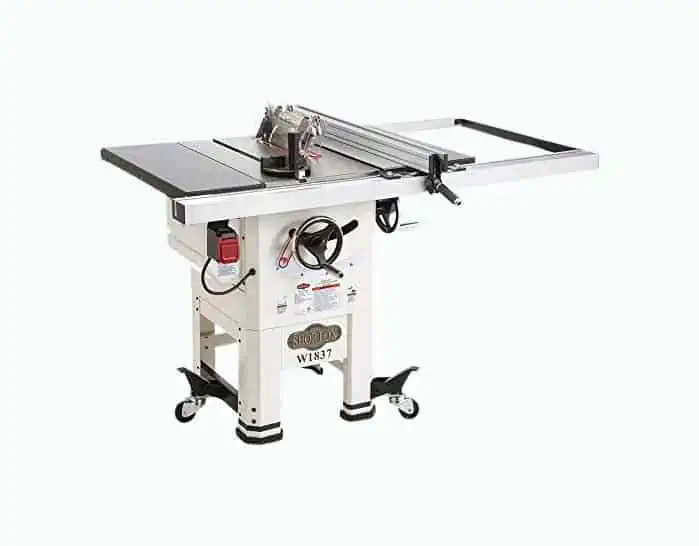
This Shop Fox hybrid table saw is a great option for contractors and woodworkers who are looking for an affordable first saw unit.
One of its most helpful features is that its feet can be leveled. If you don’t have a perfectly flat floor to work on, this adjustment means you will still be able to make cuts on a level cast iron table surface.
The table’s extendable wings enable you to cut up to 30 inches to the right of the blade. The blade can also be tilted 45 degrees to make precise angled cuts.
What We Like
Portable
At 260 pounds, this saw isn’t very lightweight but it is still relatively easy to move. This means it should be suitable for working in different locations.
Easy to Assemble
The saw’s instructions are easy to follow and you won’t require any tools to get it set up, so this is one of the easier models to get started with.
Blade Tilt
The ability to cut at a 45-degree angle is an excellent feature and will be a major help if you make furniture. To do it, you simply need to loosen the lock, turn the blade tilt wheel to the desired angle, and then lock it again.
What We Don't Like
High Maintenance
This saw doesn’t include a dust collection system, so it will require frequent maintenance to keep it cutting smoothly. It will also slow down your work if you need to interrupt it to stop and remove any sawdus that has piled up.
Wing Alignment
Some user reviews mention the saw making uneven cuts when using the extendable wings, which suggests there is an issue with their alignment.
Product Specs
| Warranty | 2 years |
| Dimensions | 58 x 38 x 36 inches |
| Horsepower | 2 HP |
| Rip Capacity | 30 inches to the right, 15 inches to the left |
| Weight | 260 pounds |
Our Ratings
Personal Perspective
Powermatic PM1000 Table Saw
Most Beautiful Cabinet Table Saw
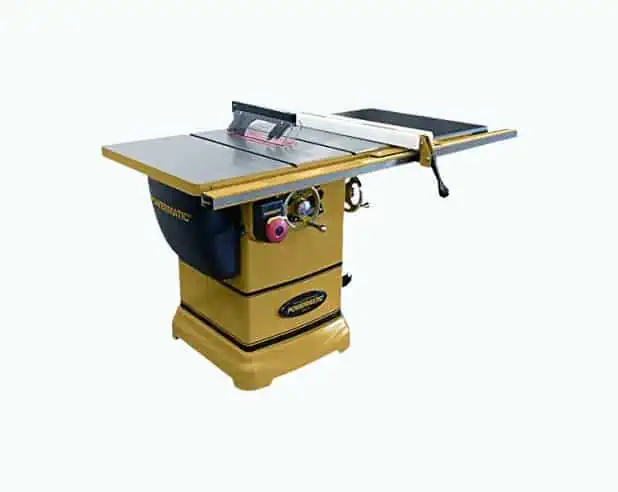
If you want a table saw that is both effective and beautiful to look at, the Powermatic PM1000 is an excellent option. This 100-year anniversary version was designed with great care to combine vintage cabinet saw design with modern cutting technology.
Its work surface is made of precision-ground cast iron, with a striking black finish that highlights how smooth it is. This sturdy material also reduces how much the unit vibrates when cutting, which is important for making accurate cuts.
User friendliness is an essential part of any saw, which is why this one has a hands-free power switch. This means you will be able to use both hands for your work, rather than having to use them to turn the saw on and off. The saw is also protected by a generous 5 year warranty.
What We Like
Precision-Ground Cast Iron
With a precision-ground cast iron work surface in a bold black finish, this is a tough but luxurious option. It is both beautiful to look at and very reliable. This cast iron material should significantly reduce the amount of vibrations when cutting.
Safety First
Safety is a priority with any power tool and Powermatic has included a toolless guard assembly and independent side leaves. This saw is very safe to use and has a hands-free power switch that makes it quicker and easier to turn on and off.
Precise Angled Cuts
This table saw will help you make very precise cuts thanks to its AccuFence. The miter gauge pivots 60 degrees to both sides. This gives you a wide range of cuts while maintaining the saw’s excellent accuracy.
What We Don't Like
Very Expensive
This saw is visually striking and very effective but that quality is reflected in its price. It will be beyond the budget of many shoppers and you can find powerful hybrid saws that cost far less money.
Product Specs
| Warranty | 5-year warranty |
| Dimensions | 53 x 42 x 33 inches |
| Horsepower | 1.75 HP |
| Rip Capacity | 30 inches |
| Weight | 347 pounds |
Our Ratings
Community Feedback
Grizzly Industrial G0651-10 Inch Table Saw
Best Quality Hybrid Table Saw
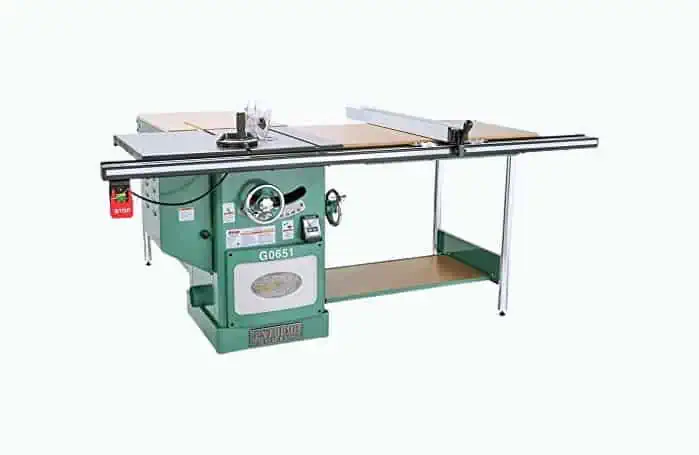
This Grizzly Industrial table saw is a high quality unit with various beneficial features. It has a 52-inch rip capacity thanks to its extendable sides and rear. This means you should be able to prop up full sheets of plywood while making rip and crosscuts safely and accurately.
The work surface is made of cast iron, which is very strong and durable. This will provide many years of reliable cutting on a level surface. A digital bevel display will help you make angled cuts with great precision.
It also includes an interchangeable riving knife to prevent kickback and binding while cutting. The rail-mounted magnetic switch comes complete with thermal overload protection, so you won’t need to worry about it overheating while cutting through material.
What We Like
Cast Iron Material
This saw is very durable thanks to its cast iron construction. Cast iron is one of the strongest metals used in power tools, so you can be confident that your purchase will be a long-term investment.
Digital Bevel Angle Reading
There is a digital readout when setting the bevel angle, so you will be able to set it to the exact angle you want. The bevel cutting itself is also very precise, so this saw is ideal for making furniture and frames.
Dust Extraction
You won’t have to deal with much sawdust thanks to this unit’s four-inch dust port. This effectively removes dust from the table using a blade and an internal dust hose. Aside from helping you work more easily, this makes it far less likely that you will inhale harmful dust.
What We Don't Like
Heavy and Bulky
Some customers find that the locking feet, equipped with thick nuts, are too thick. This prevents the table from retracting enough, meaning it gets dragged around the floor when you move it.
As the table is very heavy at 435 pounds, this makes it difficult to adjust. Users recommend getting the heavy-duty mobile base and two extension kits to make this easier.
Product Specs
| Warranty | 1 year |
| Dimensions | 38 x 30 x 41.25 inches |
| Horsepower | 3 HP |
| Rip capacity | 52 inches right, 18 inches left |
| Weight | 435 pounds |
Our Ratings
First-Hand Impression
Powermatic PM1000 Table Saw With 30-Inch Fence
Best for Low Power Consumption
This Powermatic table saw is a great option for anyone who works at home or in a small workshop as it only requires a 115V power supply to function. It provides an excellent balance of cutting power and energy efficiency.
This machine has a compact design, so it won’t occupy a lot of space in your workshop. It also has a 50-inch fence that provides plenty of space for cutting larger pieces of material.
Your cutting accuracy will be helped by the saw’s poly-v belt, which reduces how much it vibrates during use. There is also a blade guard that can be easily installed and removed without the need for any tools.
What We Like
Dust Collection
The Powermatic PM1000 includes a dust collector that will remove the vast majority of sawdust created while cutting. A collection hose provides a direct path for the dust to travel through on its way to the collection port.
Size
Although this hybrid table saw is heavy at 418 pounds and can’t be easily maneuvered, it is also relatively small. It won’t occupy much floorspace, which is another reason that it should be ideal for placing in a corner of your garage or a small workshop.
Reduces Vibration
The poly-v belt reduces how much the saw vibrates and maximizes the motor’s efficiency. This will make it much easier to cut smooth, straight lines.
Blade Guard
The Powermatic PM1000 includes a blade guard. This guard can be easily assembled or removed without using any tools. We recommend keeping the guard in place at all times when cutting to make it as safe as possible.
What We Don't Like
Customer Service
We have seen a lot of complaints about the Powermatic support team. Some customers felt they didn’t receive the necessary help to resolve their issues.
Blade Guard Bolt
Some users reported that the blade guard’s bolt sometimes comes into contact with the blade. Although this is rare, it can damage the blade and compromise cutting quality.
Product Specs
| Warranty | 5 years |
| Dimensions | 36 x 27.5 x 63.8 inches |
| Horsepower | 1.75 HP |
| Rip Capacity | 30 inches |
| Weight | 418 pounds |
Our Ratings
User Experience
DeWalt DWE7491X Table Saw
Best Hybrid Table Saw for Small Shops
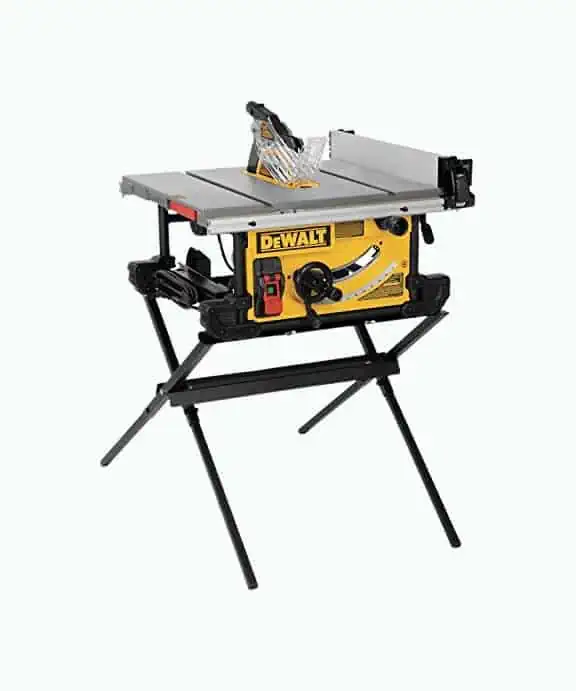
DeWalt is one of the most respected names in power tools and this table saw is a great example of why. It is praised for both its cutting power and its compact size. If you have a small workshop but want a saw that will make quick, accurate cuts, this is an excellent choice.
It is easy to set up and take down thanks to its high-quality scissor stand, which keeps the saw very stable. This saw is designed with portability in mind, so it is much lighter than the majority of saws we have reviewed.
Despite its small size and weight, this DeWalt saw still has a 32.5-inch rip capacity and the power to cut through tough wood. It is an ideal saw for taking with you to cut materials on site.
What We Like
32.5 Inch Rip Capacity
For such a compact saw, this model has a useful rip capacity of 32.5 inches, which will allow you to cut both thin and wide materials. It is also ideal for trimming.
Dust Collection Port
A 2.5-inch dust collection port enables you to connect the saw to a vacuum. This provides easy sawdust extraction, keeping your workshop cleaner and protecting your lungs.
Onboard Storage
You can store your required tools on the table saw. These include your riving knife, miter gauge, blade guard assembly, fence, push stick, and cord wrap. This means you won’t need to interrupt your work to go looking for something as it should always be close to hand.
What We Don't Like
Unclear Instructions
Some customers had issues with the instruction manual. It doesn’t clearly explain how to set the saw up and make adjustments, and you won’t want to rely on trial and error with a power saw.
Product Specs
| Warranty | 3-year limited |
| Dimensions | 26.75 x 26.75 x 30.25 inches |
| Horsepower | 2.4 HP |
| Rip Capacity | 32.5 inches |
| Weight | 87 pounds |
Our Ratings
Personal Perspective
Grizzly G1023RLWX Industrial Hybrid Table Saw
Best for Accurate Cutting
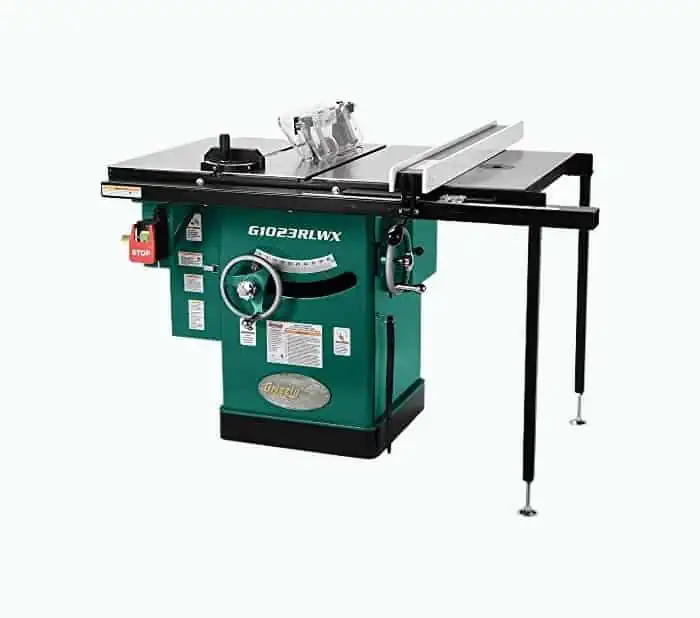
This Grizzly Industrial saw excels at high-precision cutting, as you would expect from one of the most respected names in power saws. It is also designed with reliability and user comfort in mind.
The five horsepower 220V motor is ideal for commercial woodworking. It has a magnetic pin that needs to be in place for the saw to function, which makes it far safer to use.
This model’s cutting power is maximized by its serpentine belt system. This is used primarily to drive the blade and enhance the machine’s overall efficiency.
What We Like
Dust Control
User reviews praise this unit’s dust removal. This will help you maintain a clear view of the cutting line, which should improve your accuracy. Another benefit is that you won’t need to clean your saw as frequently as there will be less sawdust created.
Safety Features
The blade is enclosed to prevent you from coming into contact with it. Grizzly is one of the first power tool companies to comply with the UL safety standard in all their products.
Quiet
This saw cuts relatively quietly compared to similar saws. You should be able to use it late at night or early in the morning without waking your housemates or neighbors.
What We Don't Like
Expensive
This saw is one of the more expensive on our list but that is to be expected from a saw with commercial-grade power.
Product Specs
| Warranty | Not mentioned |
| Dimensions | 29.5 x 30.5 x 39.75 inches |
| Horsepower | 5 HP |
| Rip Capacity | 32 inches |
| Weight | 623 pounds |
Our Ratings
Community Feedback
| Product | Best | Warranty | Dimensions | Horsepower | Rip Capacity | Weight |
|---|---|---|---|---|---|---|
| Bosch Worksite Table Saw 4100XC-10 | Portable | 1-year limited | 27 x 32.5 x 13″ | 4.0 HP | 30″ | 109 lbs |
| Shop Fox W1837 2 HP Open-Stand | Beginners | 2 years | 58 x 38 x 36″ | 2 HP | 30″(right), 15″(left) | 260 lbs |
| Powermatic PM1000 | Most Beautiful | 5-years | 53 x 42 x 33″ | 1.75 HP | 30″ | 347 lbs |
| Grizzly Industrial G0651 | Quality Table Saw | 1 year | 38 x 30 x 41.25″ | 3 HP | 52″(right), 18(left) | 435 lbs |
| Powermatic PM1000 Table Saw | Low Power Consumption | 5 years | 36 x 27.5 x 63.8″ | 1.75 HP | 30″ | 418 lbs |
| DeWalt DWE7491X Table Saw | Small Shops | 3-year limited | 26.75 x 26.75 x 30.25″ | 2.4 HP | 32.5″ | 87 lbs |
| Grizzly G1023RLWX Industrial | Accurate Cutting | N/A | 29.5 x 30.5 x 39.75″ | 5 HP | 32″ | 623 lbs |
What Is a Hybrid Table Saw?
Before the introduction of hybrid table saws, woodworkers looking for a large stationary saw had to choose either a contractor saw or a cabinet table saw. The saw they chose was usually decided by how much space they had, whether or not they needed to move the saw, and their budget.
However, modern hybrid table saws combine the best features of both saw types, with the cutting power and stability of a contactor saw but the maneuverability of a cabinet table saw.
These hybrid saws provide a robust, stable base that is still relatively lightweight, but they also have powerful motors that will help you work efficiently and achieve a smooth finish.
How to Choose the Best Hybrid Table Saw
Hybrid table saws vary greatly in terms of their size, cutting power and capacity, and extra features. Which ones will be suitable for you will be influenced by the space you have to work in and the kind of cutting tasks you do. You can narrow your options significantly by considering some key points:

Power
Most standard hybrid table saw motors generate between 1.5 HP and 1.75 HP. This horsepower range will be ideal if you are an amateur woodworker or only need it occasionally for professional work — anything higher will be a bonus.
If you need professional power in your hybrid saw, it is possible to find them with up to 2 HP. However, you will need to make sure you have enough space and a strong enough electrical outlet to supply the necessary voltage. This will vary from model to model, so it is something you should take the time to find out.

Drive
You will have two drive options to choose from when selecting a hybrid table saw:
Belt Drive
Many users prefer belt drive saws as they provide greater longevity and torque through the use of a belt and pulley. However, these saws can be loud while operational and you will need to replace the belt regularly as part of your saw maintenance.
Direct Drive
With a direct drive saw, the motor is connected directly to the blade. The only drawback of these saws is that they collect dust easily and will need to be cleaned regularly to keep them working smoothly.

Sturdiness
Metal parts are usually preferable in power tools as they will last longer than plastic ones. This is especially true when using stationary tools, as you won’t need to hold their weight as you would with a handheld tool.
For the most durable hybrid saw, choose cast iron instead of aluminum or steel as it has a much better compression strength. It is generally also less expensive, so there is no reason to settle for a different material.
You should also read user reviews to get a sense of how durable the work surface is. It is natural for a saw’s surface to eventually become uneven, but this process should take a very long time.

Portability
Hybrid table saws are designed to be easier to move than traditional contractor saws, but they aren’t lightweight. The heaviest units can weigh 300 pounds or more. This means they won’t be too difficult to wheel around your workshop but will be very challenging to move from place to place.
If you don’t anticipate needing to move your saw often, its weight shouldn’t be an issue. However, if portability is a priority, it will be much easier with a saw unit that weighs 250 pounds or less.

Safety
All hybrid table saws have built-in safety features, but they will vary from model to model. Still, there are a couple of features you should look for:
- Translucent guards: These transparent guards let you see where the blade is cutting, protecting you while ensuring you can still make accurate cuts.
- Safety sensor: Some hybrid table saws have a safety sensor. This automatically stops the blade when it comes in contact with skin, significantly reducing the risk of severe injuries. It achieves this by detecting electrical conductivity, as the human body is much more conductive than wood.
Power Button

Riving Knife
An effective riving knife is an important part of any power saw as it significantly reduces the risk of kickbacks. Kickback is one of the most common issues with table saws and is a frequent cause of accidents.
The riving knife should have a curve similar to the saw blade. When you rotate or raise the blade, the knife should maintain its position.
How to Use a Hybrid Table Saw
Every hybrid table saw is different so you should always check the instruction manual before using it. However, the process of using one will usually follow these basic steps:
- Safety: Ensure you are wearing your safety gear. This should include goggles and a mask to protect you against flying debris and sawdust.
- Switch off: Before marking the material and maneuvering the saw, ensure it is switched off at the power source.
- Mark: Mark the material you are cutting so you can follow the markings while cutting.
- Secure: Secure the material in place using the saw’s clamps or other clamps if you have them.
- Switch on: Switch the saw on at the power source and then on the saw itself.
- Cut: Once the blade is spinning at the required speed, move the material toward the blade and start cutting.
Safety Tip
FAQs

How Long Should a Hybrid Table Saw Last?
Even though they’re pricey, table saws can easily last a lifetime if they’re properly maintained. A hybrid table saw is a machine designed to be compact while still packing a significant amount of power. Look for one that offers at least a five-year warranty.

How Many Teeth Is Best for a Hybrid Table Saw?
The number of teeth on the blade will affect the smoothness of the cut and the speed of the cut. A saw with more teeth will create a smoother finish but will take longer to cut.
A saw with fewer teeth can move through the wood more quickly but might leave a rougher edge so you’ll have to sand it. Generally, a hybrid table saw with between 40 and 60 teeth is ideal for most woodworking tasks.

Does SawStop Make Hybrid Table Saws?
SawStop makes hybrid table saws and the CNS175-TGP236 is here to prove that it’s one of the best brands.
It is known for several other things in addition to safety. This hybrid has a robust motor that generates 1.75 horsepower and can power through virtually any material. It can withstand regular use and will last number of years to come.
The cutting speed of 4,000 RPM creates exceptionally clean cuts, which can tear through sheet goods with an amazing feed speed. It outperforms any contractor saw that we have ever seen, both in terms of power and capability.

What Is the Best Hybrid Table Saw on the Market?
The Grizzly Industrial G0651 hybrid table saw gives you exceptional quality at a decent price, which makes it one of the better choices for hybrid table saws.
You can transform your workshop with this powerful machine and get precise, clean cuts every time. It equips a precision-ground cast iron table to ensure accuracy and stability. It also features a magnetic switch with thermal overload protection for safety.