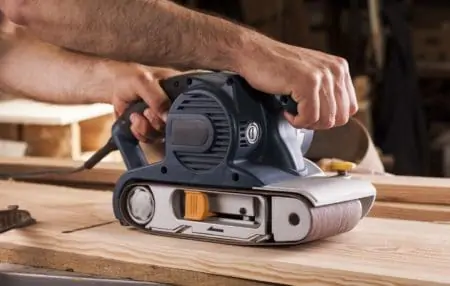
Hand sanding is laborious and tiring. Ask anyone who’s sanded for hours on end. The best tool for the job is a belt sander. They speed up your work rate and are excellent at smoothing large wooden pieces and removing worn or rough layers on many materials.
We look at the best belt sanders to determine why they are so effective.
- 84 dB noise level
- 11-amp motor
- Completely sealed motor
- Adjustable pivoting arm
- 0.5 horsepower motor
- Universal belt fitment
- Tabletop design
- Cast iron base
- Additional grinding wheel
- Versatile sanding
- 1,020-watt motor
- 5-Year warranty
- 2-in-1 Sanding station
- Tilting sanding belt
- 4.3-Amp motor
- Interchangeable battery
- Brushless motor
- Vacuum hook-up
- Pressure warning indicator
- Micro-filtration canister
- 6-Amp motor
- 7-Amp motor
- 3-position handle
- Quick-release feature
- Minimal vibration
- Dust collection chute
- Good for odd shaped stock
- Includes beveling worktables
- Heavy-duty and stable base
- Features a miter gauge
Review Methodology: At Sensible Digs, we scrutinize every belt sander through a meticulous assessment process. Our hands-on approach involves running each tool through a battery of tests to gather data on performance, design, and key decision-making factors. We rank each sander based on criteria such as power, ease of use, and durability, providing a clear picture of what sets each product apart. We share our findings from a user’s perspective, giving you the evidence you need to make an informed choice. Trust our experienced team and our professional, fact-based reviews to guide you to the best belt sander that suits your needs.
The Best Belt Sanders of 2024
It’s time to put belt sanders in the spotlight with our top 10 choices.
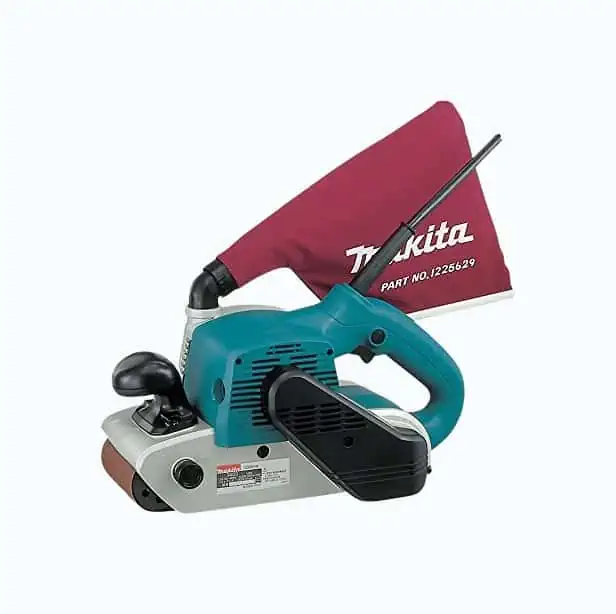
Makita 9403 Power Belt Sander
Best Belt Sander for Wood Floors
Not only is this the best belt sander for wooden floors, but it is also the quietest, running at 84 decibels. It comes with a 4-inch wide belt, making it a great choice for larger flooring projects, and the dust collection bag ensures that sawdust stays away from your face.
The labyrinth construction seals the motor, stopping any contaminants from damaging the internal components. The belt runs at 1,640 feet per minute to ensure an efficient working speed.
Comfort comes from the large front grip, designed for maximum control. This sander also benefits from an innovative design that allows flush sanding to the wall with the side and front edge.
What We Like
84 Decibel Noise Level
Belt sanders are not the quietest hand tools, but this Makita has an industry-leading 84 decibel running volume. That’s the equivalent of a domestic vacuum cleaner.
11-Amp Motor
The 11-amp motor turns the 4-inch sanding belt a cool 1,640 feet per minute to ensure faster removal of material. If you are laying an entire floor, speed is vital if you want to get the task done in the shortest time.
Completely Sealed Motor
Sawdust gums up motors if left to get into the internal components. Makita has developed a labyrinth-sealed motor that ensures no contaminants can access the inside of your sanding tool.
What We Don't Like
Very Expensive
If you want to own this Makita belt sander, you will need to dig deep. It costs over 5 times the price of the budget model. That said, this model is a firm favorite with professionals.
Product Specs
| Weight (pounds) | 13 |
| Dimensions (inches) | 9 x 16.1 x 9.76 |
| Amperage | 11 |
| Belt width | 4-inch |
| Speed | 1,640 feet per minute |
| Price | $$$$$ |
| Warranty | 1-year |
Our Ratings
User Experience
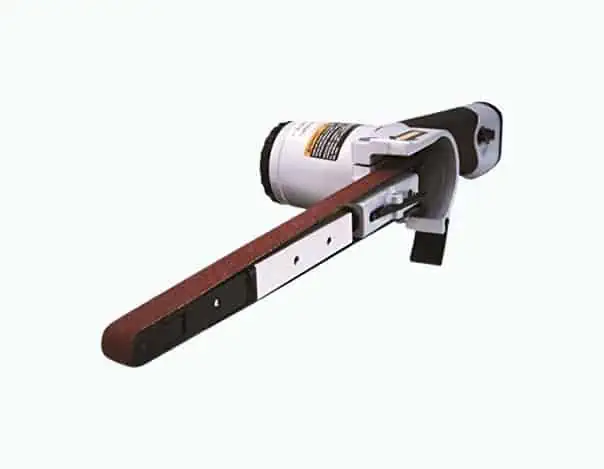
Astro Tools 3037 Air Belt Sander
Best Belt Sander for Metal Work
If you need to tidy up spot welds, this is the belt sander to own. Thanks to its long and thin nose, it reaches into tight spots, making it ideal for the automotive repair industry.
A simple lever controls the belt tension, so adjustments are super-easy. It also has the easiest speed-adjustment lever that allows you to speed up or slow down to match the material you are working with.
The arm adjusts to cater to tight angles, and the belt can be swapped out easily thanks to a universal fitment. Spend less time fiddling with the sander and more time working.
The only downside with this sander is it requires an air compressor to operate, which will increase the overall initial costs.
What We Like
Super-Adjustable
Having flexibility is the key to grinding spot welds, especially in the tightest spots. This belt sander has an adjustable arm that pivots. Plus, it has belt tension and speed adjustment levers to control the sanding process better.
0.5 Horsepower Motor
The motor ensures you can grind spot welds flat along with other metal preparation.
Universal Belt Fitment
When it’s time to swap out the sander belt, the universal belt fitment allows you to do it swiftly, spending less downtime and increasing your productivity.
What We Don't Like
Requires an Air Compressor
To operate this air tool, you will need an air compressor. Air compressors are expensive and add to the overall spend compared to plug-in varieties.
Product Specs
| Weight (pounds) | 2.2 |
| Dimensions (inches) | 15.5 x 3.5 x 2 |
| Amperage | Not stated |
| Belt width | 0.5-inch |
| Speed | Not stated |
| Price | $$ |
| Warranty | 1-year limited |
Our Ratings
Personal Perspective
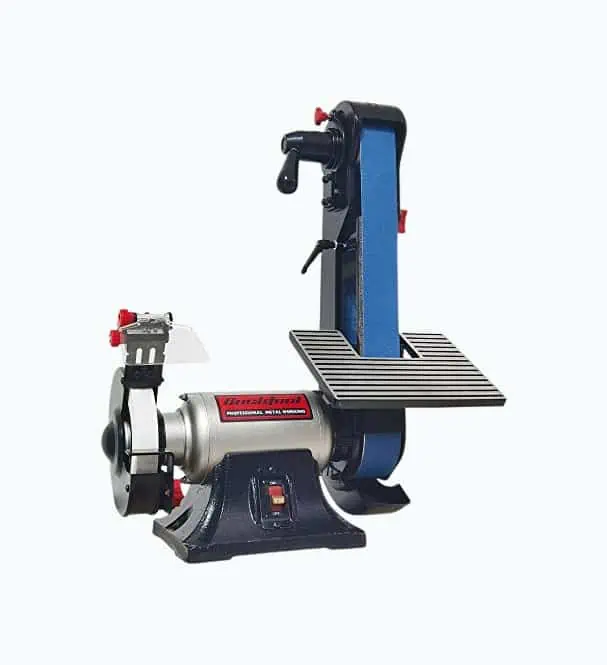
Bucktool Combo Belt Sander
Best Belt Sander for Knife Sharpening
When you want sharp knives, this tabletop belt sander is the perfect tool. It has a 3.5-amp, 0.3 horsepower motor that generates 3,450 RPM. The sanding belt enables the user to adopt multiple positions to cater to different types of knives.
It has a cast iron belt table to enable better support when sharpening. It also has a grinder for more general-purpose uses and finishing. The belt can also be set vertically and horizontally for greater flexibility.
It has a belt guard, easy tension adjustment, an eye shield, and an LED light for better clarity. This Bucktool has a quick belt replacement feature as well as a 2-inch wide metal sanding belt.
What We Like
Tabletop Design
The sander is stationary so that you can move the knife around the sander belt to get more detail. It also enables you to swap and change the types of knives you can sharpen.
Cast Iron Base
Cast iron makes the sander feel substantial. It also adds weight, which creates stability. You can also use the cast iron table to get a better grip when maneuvering the knives.
Additional Grinding Wheel
What makes this the perfect sharpening station is the added grinding wheel that is better for general-purpose sharpening and finishing.
What We Don't Like
Stationary Tool
If you want a sander to sharpen knives, this is great. However, it has limited uses. You couldn’t use it to lay flooring or decking. It’s more of a sharpening station than a belt sander.
Quite Pricey
Tabletop sanders are more expensive, so if you want one, be prepared to spend a few extra dollars.
Product Specs
| Weight (pounds) | 38.9 |
| Dimensions (inches) | 25 x 19.5 x 12.25 |
| Amperage | 3.5 |
| Belt width | 2-inch |
| Speed | 4,480 feet per minute |
| Price | $$$$ |
| Warranty | 2-year limited |
Our Ratings
Community Feedback
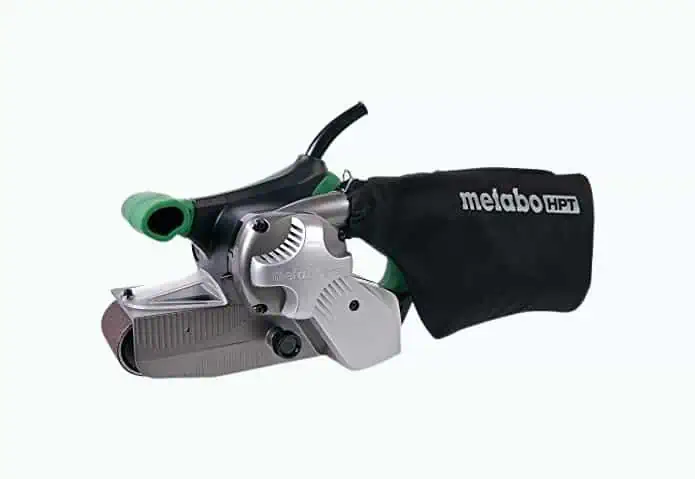
Metabo HPT Belt Sander
Best Belt Sander for Warranty
Most belt sanders have a 1 or 2-year warranty, but this Metabo tool comes with a 5-year warranty. That’s 5 years of hassle-free sanding! It has a 9-amp motor that generates 1,475 feet per minute.
It means you can tackle the toughest sanding materials, giving you complete flexibility. The variable speed keeps you in control when you need to swap and change different surfaces, and like the Makita, it has a flush sanding feature to get into all the corners.
This Metabo is so rugged, it can sand wooden floors, metal, rust, and prepare concrete and slate. It even comes with a dust collection bag to keep you safe from hazardous particles.
What We Like
Versatile Sanding
If you want a sander that can handle almost any surface, this Metabo is a great choice. It sands wood, metal, rust, paint, and even concrete and slate.
5-Year Warranty
If you want the best warranty, get this Metabo. It dwarfs almost every other warranty out there. It ensures you have 5 hassle-free years of sanding.
1,020-Watt Motor
The 9-amp, the 1,020-watt motor generates a maximum speed of 1,475 feet per minute. That’s enough to take on the biggest and toughest jobs.
Flush Sanding
When you are sanding floors and walls, sometimes the sander struggles to get right to the edges, but this Metabo has a flush sanding feature that allows you to get up close, leaving no gaps.
What We Don't Like
Cheap Components
Even though this sander can tackle a variety of surfaces, it has a plastic rear drum that overheats when placed under duress. Some have even reported that the drum melts when it gets hot.
Product Specs
| Weight (pounds) | 9.5 |
| Dimensions (inches) | 6 x 6.75 x 4 |
| Amperage | 9 |
| Belt width | 3-inch |
| Speed | 1,475 |
| Price | $$$ |
| Warranty | 5-year |
Our Ratings
First-Hand Impression
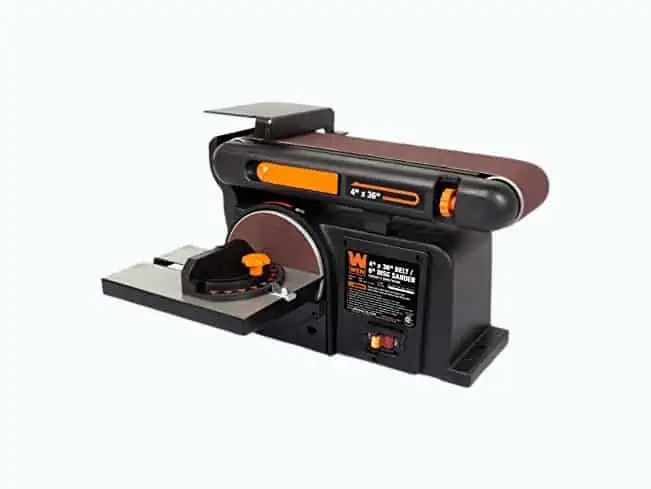
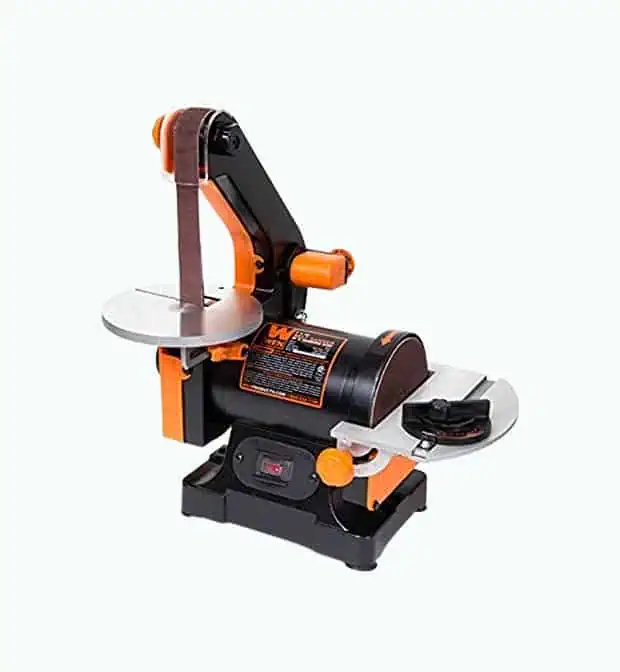
WEN 6502T 4.3-Amp Belt Sander
Best Benchtop Belt Sander
Like the Bucktool model, this is a 2-in-1 belt sander. It has a 4-inch sanding belt and a 6 x 6-inch grinding disc for general-purpose finishing. This is a versatile sanding machine because the belt tilts anywhere between 0 and 90 degrees.
It also has a sturdy cast iron base to prevent vibration, which gives the option of bolting it to the tabletop, and it has a tension release lever to make swapping belts easier. The motor is 4.3 amps, generating 3,600 RPM, so while it isn’t the most potent sander, it certainly performs admirably.
It has a 2.5-inch dust port and a beveling cast iron table with a miter gauge.
What We Like
2-in-1 Sanding Station
The sanding belt deals with wood and metal, plus sharpens knives, while the 6-inch sanding disc allows you to sharpen tools and achieve a better standard of finish.
Tilting Sanding Belt
It offers so much maneuverability, especially as the sanding belt tilts anywhere between 0 and 90 degrees. It increases your ability to shape and cut wood and other material.
4.3-Amp Motor
The motor generates 3,600 RPM, which is enough to tackle most sanding jobs, and the 0.5 horsepower motor provides enough power to prevent the sander from bogging down under large loads.
Great Price
Compared to some benchtop sanders, this one is keenly priced. It makes it a great beginner benchtop sander.
What We Don't Like
Heavy and Stationary
This sander is versatile, but it isn’t the best tool to use when laying flooring or decking. This is a stationary machine, affixed to your tabletop, so you bring the material to it rather than the tool to the material.
Product Specs
| Weight (pounds) | 39 |
| Dimensions (inches) | 22 x 12.5 x 11 |
| Amperage | 4.3 |
| Belt width | 4-inch |
| Speed | 1,900 feet per minute |
| Price | $$$ |
| Warranty | 2-year |
Our Ratings
User Experience
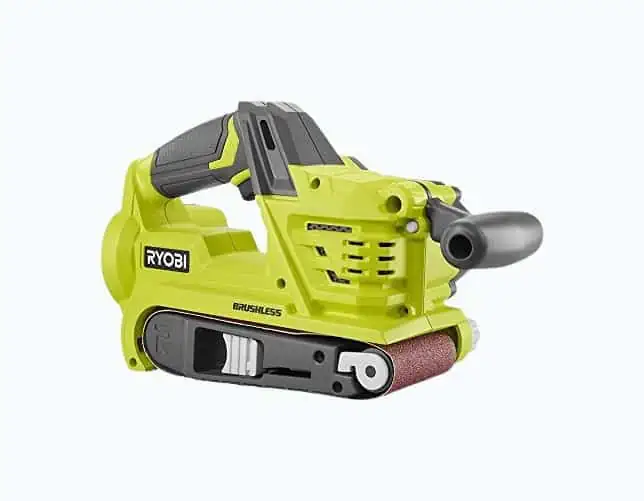
Ryobi P450 One+ Brushless Belt Sander
Best Cordless Belt Sander
When you need a belt sander that you can take anywhere, opt for a battery-operated model like this Ryobi. It has a brushless motor, which gives the tool a greater runtime and increases the battery’s charge life.
It all comes courtesy of an 18V lithium-ion battery that interchanges between this and other Ryobi tools. It has an adjustable pommel, which can adopt 5 positions for better ergonomics and control.
The 3-inch sanding belt runs at 850 feet per minute, so while it isn’t the fastest, it is still an adequate tool to get most jobs done.
Make sure you purchase 2 batteries because the charge is finite, and while you are waiting, you can keep working with the spare.
What We Like
Cordless Freedom
Thanks to the lithium battery, you can go anywhere with this sander. Use it on the worksite, the yard, and even at the cabin in the woods.
Interchangeable Battery
Like many cordless power tools, this Ryobi belt sander has a lithium battery that slots into other compatible Ryobi power tools. It saves you from paying for additional batteries at an extra cost.
Brushless Motor
Brushless motors are the latest in motor technology. They increase the tool’s efficiency and squeeze the maximum out of the battery runtime to increase the period between charges.
Vacuum Hook-Up
You can either use a dust collection bag with this device or hook it up to a dry vacuum system. It completely removes all traces of potentially lethal dust from the air, protecting your lungs.
What We Don't Like
Diminishing Power
Just remember that because it is a cordless sander, as the battery fades, you need to consider when to swap it with a fresh one. As the power wains, you might experience a loss in performance.
Product Specs
| Weight (pounds) | 5.79 |
| Dimensions (inches) | 7 x 5 x 7 |
| Amperage | 18V (Cordless tools are judged on voltage) |
| Belt width | 3-inch |
| Speed | 850 feet per minute |
| Price | $$$ |
| Warranty | Not stated |
Our Ratings
Personal Perspective
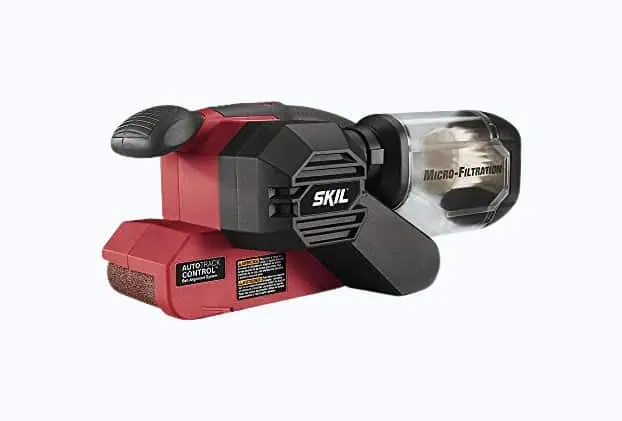
SKIL 7510-01 Sandcat Belt Sander
Best Budget Belt Sander
For many, the budget is the driving factor in which belt sander to choose. This SKIL is a great place to start for beginners and the budget-conscious among you. Don’t be fooled by the price. This is a great tool.
It has a pressure warning indicator that tells you when you are applying too much downward force to the sander. It also has a clear dust canister with micro-filtration to collect the smallest dust particles.
The auto-track technology keeps your belt centralized and on track. The 6-amp motor ensures that it keeps the 3-inch belt turning, but because it is a budget model, it only has one speed. On the plus side, it has a flush sanding feature that lets you get right up to the edges.
What We Like
Budget Price
You just can’t argue with the price. It is so affordable it is the best choice for beginners and the cost-conscious. This tool is priced at over 5 times less than the most expensive to make the list.
Pressure Monitor
The tool will tell you when you apply too much pressure when pushing down on the sander. It’s useful because you can adjust your technique and it preserves the life of the 6-amp motor.
Micro-Filtration
Removing dust particles from the atmosphere is crucial if you want to avoid lung problems later. This transparent dust collector extracts the smallest particles to keep you safe.
What We Don't Like
One Speed
This SKIL only has one speed, so it reduces your versatility when changing between materials and surfaces. It decreases your ability to complete varying projects.
Product Specs
| Weight (pounds) | 6.75 |
| Dimensions (inches) | 6.63 x 13.75 x 6.5 |
| Amperage | 6 |
| Belt width | 3-inch |
| Speed | Not stated |
| Price | $ |
| Warranty | 1-year |
Our Ratings
Community Feedback
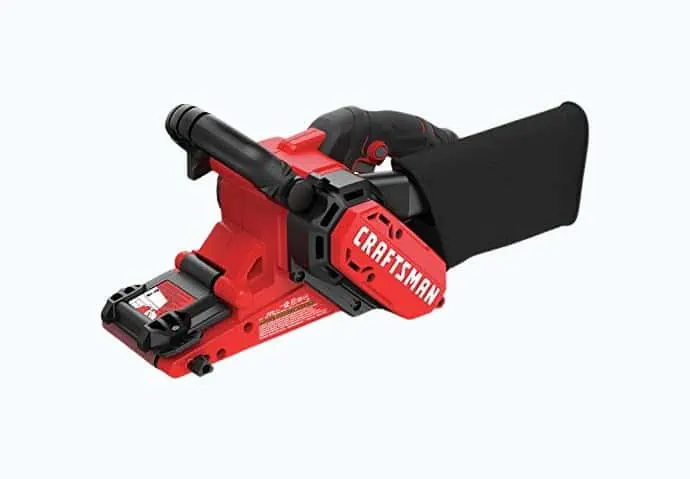
Craftsman Belt Sander
Best Handheld Belt Sander
This Craftsman belt sander has a 7-amp motor that generates speeds of 800 feet per minute for fast material removal. The belt has a quick-release feature to make it easier to swap sanding belts.
You get an onboard dust bag and a 3-position molded handle to improve comfort levels and control. It also has an angled belt design to get you closer to the edges.
This model almost rivals the Metabo with a 3-year guarantee. That gives you the peace of mind you need and affirms this tool’s quality, thanks to the manufacturer’s confidence.
What We Like
Great Price
It costs a fraction of the most expensive models yet it has equal power. Why spend hundreds of dollars unnecessarily when you can save money with this tool?
3-Position Handle
For comfort and grip, the 3-position handle is a real treat. It gives you increased control and coupled with the angled belt system, you get as close to the edges as possible.
3-Year Warranty
Most belt sanders offer a miserly 1-year warranty, except the Metabo, but this Craftsman comes with a respectable 3 years, so you can relax knowing that you are covered.
What We Don't Like
One Speed
Variable speed gives you the ability to switch between materials and surfaces with ease. One-speed belt sanders don’t offer this, limiting your versatility.
Product Specs
| Weight (pounds) | 7.7 |
| Dimensions (inches) | 14.37 x 5.44 x 5.64 |
| Amperage | 7 |
| Belt width | 3-inch |
| Speed | 800 feet per minute |
| Price | $$ |
| Warranty | 3-year |
Our Ratings
First-Hand Impression
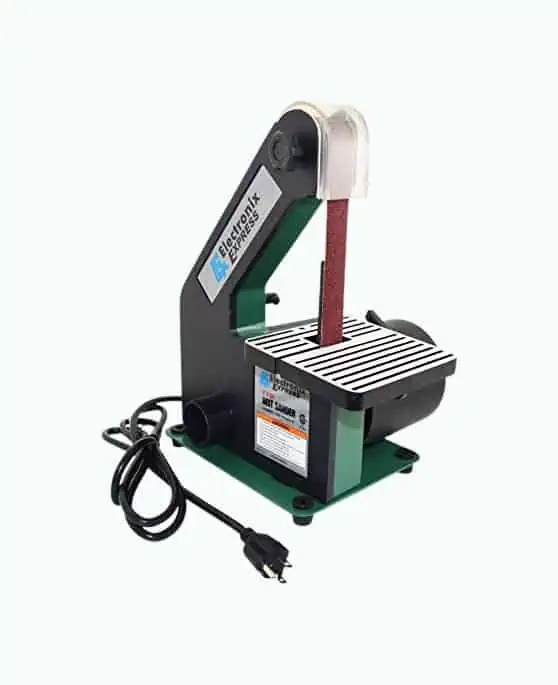
EX Electronix Express Mini Belt Sander
Best Mini Belt Sander
Are you looking for something compact and light? This mini belt sander from EX ELECTRONIX may be just the thing you’re looking for.
With a ⅓ HP motor and 3260 FPM power, this is an excellent light-duty sander. But it can still achieve great things. It will provide a lovely flawless finish and deliver quick results.
This is a fantastic choice for a mini belt sander with a wide range of cool specs, such as rubber feet, dust collection tubes, and sturdy construction.
What We Like
Minimal Vibration
Being small, this will already be minimal on the vibration front. But the rubber feet ensure that while you’re working hard, this thing remains very sturdy.
Dust Collection Chute
Say goodbye to excess dust. With a handy dust collection chute, this ensures your work area is as clean as can be.
Good for Odd Shaped Stock
This comes with a removable backplate. So no matter what shape of stock you need to cut, this can do the trick. Curved, straight edges, or just wonky shapes — this has got you covered.
What We Don't Like
Not for Heavy Use
As mentioned, this is a light-duty purchase. So if you want something for repeated heavy use, specifically commercially, you may want to check out one of our other options.
Misaligned Parts
Some customers found that the belts were slightly unaligned. By just a few degrees, it may not seem like a deal-breaker. But when trying to get a perfect finish, this may disappoint.
Product Specs
| Weight (pounds) | 1.11 |
| Dimensions (inches) | 14.5 x 10 x 10 |
| Amperage | 3 |
| Belt width | 1-inch |
| Speed | 3400 feet per minute |
| Price | $$ |
| Warranty | No warranty included |
Our Ratings
User Experience
WEN 6515T Belt Sander
Best Belt Sander With Vacuum Capabilities
When you’re sanding, having the ability to vacuum simultaneously is super handy. After all, there’s a lot of dust. This belt sander from Wen has the ability to vacuum while you sand. It has two dust ports which increase maximum vacuuming power. All you need to do is add vacuum attachments (sold separately), and you’ll be well on your way to clean sanding!
As well as these ports, this also comes with a 5-inch sanding disc which is ideal for smoothing down all kinds of pointed edges and nasty splinters. The 2.3 amp motor provides up to 3160 feet per minute speeds on the belt and 3450 on the disc.
It’s a nice compact tool allowing you to take it with you anywhere. But it still has a heavy-duty construction for tougher jobs.
What We Like
Included Beveling Worktables
Included on the tool is a bevelling worktable. This ensures stability for your workpieces. This is available on both the disc and the belt up to 45 degrees. We love this for angled workpieces!
Less Wobbling
The quality construction of this tool features a heavy-duty and stable base. It also has mounting holes so you can secure it to your station. This minimizes wobbling while you work, ensuring you have a smooth user experience.
Miter Gauge
This tool features a miter gauge, so you don’t have to use one separately. Having everything in one place is super handy. The miter gauge included on the five-inch disc ensures precision while you sand.
What We Don't Like
Doesn’t Stay In Place
While you can expect less wobbling, some customers found that the tool didn’t stay in place for long while they worked. While you can screw it in and there are suction feet, customers found the belt sander came loose from its spot after a while.
Belt May Slip Off
Some dissatisfied customers found that the belt itself didn’t stay on. Some found that it slipped off or wasn’t well-aligned in the first place. This isn’t a problem for everyone, but keep in mind that some people did experience it.
Product Specs
| Weight (pounds) | 16 |
| Dimensions (inches) | 11.5 x 11.5 x 15.5 |
| Amperage | 2.3 |
| Belt width | 1-inch |
| Speed | 3160 FPM for belt and 3450 RPM for disc |
| Price | $$ |
| Warranty | 2-year |
Our Ratings
Personal Perspective
| Product | Best | Weight | Dimensions | Amperage | Belt width | Speed | Warranty |
|---|---|---|---|---|---|---|---|
| Makita Power Belt Sander | Wood Floors | 13 lbs | 9 x 16.1 x 9.76″ | 11 | 4″ | 1,640 ft/min | 1-year |
| Astro Tools Air Belt Sander | Metal Work | 2 lbs | 15.5 x 3.5 x 2″ | N/A | 0.5″ | N/A | 1-year limited |
| Bucktool Combo Belt Sander | Knife Sharpening | 39 lbs | 25 x 19.5 x 12.25″ | 3.5 | 2″ | 4,480 ft/min | 2-year limited |
| Metabo HPT Belt Sander | Warranty | 10 lbs | 6 x 6.75 x 4″ | 9 | 3″ | 1,475 | 5-year |
| WEN Belt Sander | Benchtop | 39 lbs | 22 x 12.5 x 11″ | 4 | 4″ | 1,900 ft/min | 2-year |
| Ryobi Brushless Belt Sander | Cordless | 5.79 lbs | 7 x 5 x 7″ | N/A | 3″ | 850 ft/min | N/A |
| SKIL Sandcat Belt Sander | Budget Pick | 7 lbs | 6.63 x 13.75 x 6.5″ | 6 | 3″ | N/A | 1-year |
| Craftsman Belt Sander | Handheld | 7.7 lbs | 14.37 x 5.44 x 5.64″ | 7 | 3″ | 800 ft/min | 3-year |
| EX Electronix Express Mini | Mini Belt Sander | 1.11 lbs | 14.5″ x 10″ x 10″ | 3 | 1″ | 3400 ft/min | No warranty included |
| WEN 6515T Belt Sander | Vacuum Capabilities | 16 lbs | 11.5 x 11.5 x 15.5″ | 2.3 | 1″ | 3450 RPM | 2-year |
What Is a Belt Sander For?
Belt sanders are multi-use tools. They are ideal for tackling large projects like floors and decking, as well as trimming to a scribed line. They smooth very rough surfaces, and because they are versatile, you can freehand around awkward shapes.
Belt sanders are also useful for removing layers of paint on wood and metal, smoothing out blemishes and uneven surfaces.
How To Choose the Best Belt Sander
Belt sanders vary from make and model, so getting the best one for your dollars is challenging. Let’s boil it down to the basics and look at the important factors to consider.

Type of Belt Sander
The type of sander you choose depends on the frequency with which you use it and the kind of projects you have in mind.
Hobby Belt Sander
This type of sander is better suited to the infrequent user. They tackle smaller and lighter tasks because they lack the power of larger, professional models. For this reason, they are also cheaper.
Semi-Professional Belt Sander
Now we move up a notch in size, power, and capabilities. Semi-professional belt sanders have higher amperage motors, delivering a faster motion. They also have a larger sanding surface to complete substantial projects.
These sanders cost more, but they are more reliable and robust.
Professional Belt Sander
This is the pinnacle of sanders because professionals use them in construction, woodworking, and carpentry, as well as laying flooring and decking. They have all the power you need to get the task done and typically come with an array of features.
They are heavier and cost a lot more, but when your livelihood depends on your tools, the price of the sander is a minor consideration.

Power, Power, Power!
The power your sander wields is the number one influence on its efficiency. If you increase capacity, you can tackle harder materials and larger projects. Belt sanders range in power from 500 watts at the hobby end of the market to 1,200 watts for a professional model.
For everyday, general-purpose sanding, look for one with about 800 watts. That’s plenty to see you complete most tasks and materials.

Running Speed
Most belt sanders operate between 400 and 1,500 RPM (revolutions per minute). The cheaper models run slower than the professional sanders. The faster the belt sander runs, the more substantial work you can complete. It also means you can take on harder materials like metal to remove paint and smooth rough surfaces.

Contact Surface Size
The contact surface is the part of the sander that makes direct contact with the material. Professional sanders have a much larger contact surface, making them more efficient.
The surface can be square or rectangular and can range in dimensions from 75 mm to 100 mm. You can buy sanders with a narrow contact width for detailed sanding, but in the main, the bigger the sanding surface, the more efficient the machine is.

Variable Speed
Variable speed allows you to get the best of both worlds. Sometimes you need to be gentle and focus on the smoothness of the finish, and other times you need pure power to grind hard and fast.
Variable speed makes this possible.

Added Features
If you spend more money, you get more features. Well, that’s the theory, at least. You might get limited features on the budget models, but as you get to the professional end of the market, expect bells and whistles.
- Dust collection: Sanding produces harmful dust particles, so having a dust collector is crucial in keeping pollutants away from your face.
- Lock-on: Set the work speed and lock it on. It means you don’t need to keep your finger on the trigger.
- Soft-grip handles: You want the sanding experience to be as comfortable as possible, especially during prolonged uses of the belt sander.
- Adjustable handles: You get more flexibility and maneuverability with an adjustable handle.
- Automatic belt adjustment: It helps you adapt to changing surfaces with minimum of fuss. You can work faster and longer without stopping.

Warranty Length
Warranties can vary depending on the manufacturer. The minimum you should expect is 12 months, but the longer the warranty, the more confidence the maker has in the sander’s longevity and reliability.
An extended warranty is a great indicator of quality.
Belt Sanders FAQs

Why Does My Belt Sander Keep Breaking Belts?
Many factors cause your sander belt to break. Heat, humidity, and age are all responsible for belt seam failures. You could also have the incorrect tension on the belt, either causing it to run loose or too tight, putting it under strain.
It might also be the quality of your sanding belt. Some of the cheaper makes are so weak you may as well try sanding with tissue paper.

How Long Do Belt Sander Belts Last?
Drum sander belts should last between 250 and 300 square feet each, while edger discs need changing every 20 linear feet.
Is a Belt Sander Better Than an Orbital Sander?
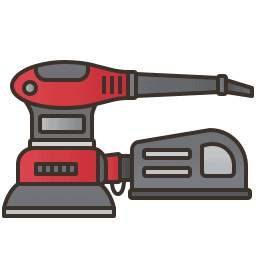
Maybe not better but different. A belt sander uses a continuous loop of abrasive paper, whereas an orbital sander uses a sanding disc. Belt sanders are better for substantial projects that need speed and efficiency.
Orbital sanders are more suited to detailed and smaller projects.

What Is the Difference Between Belt Sanders and Palm Sanders?
It comes down to uses. A belt sander can smooth rough surfaces like decking and hardwood flooring with ease. Think of it more as an industrial-strength tool. A palm sander is a more effective tool for small to medium-size tasks like refinishing furniture or rust spots.
Think of a palm sander as a more general-use tool.
What Is the Difference Between Belt Sanders and Belt Grinders?
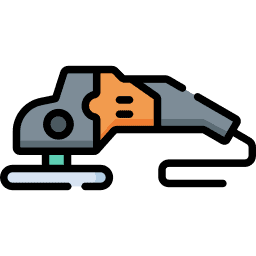
The difference is speed. A belt grinder will run at about 8,000 surface feet per minute, so it is better suited to various materials, including wood and metal. A belt sander is better for just wood because it runs at about 1,200 RPM, although you can tackle metal and rust spots.

Why Is My Belt Sander Not Sanding Evenly?
The most common reason why belt sanders don’t sand evenly is a worn-out belt. The more you use the belt, the more it loses its abrasiveness.
A big mistake is applying pressure when sanding. Belt sanders are bulky tools, and their weight does most of the work when it comes to the pressure you need.
Another reason belt sanders produce an uneven result is improper belt tracking. When this occurs, the belt isn’t steady on the sander, so the surface you’re sanding won’t be even.
If your belt has dents or holes or is damaged, you’ll face uneven sanding.

What Size Belt Sander Is Best for Making Knives?
When it comes to producing knives, the ideal option is to use a belt sander with a belt size of 2 by 72 inches.

Why Is My Belt Sander Shocking Me?
If your belt sander is shocking you, identify the problem and fix it immediately. Unplug the belt sander and don’t use it in the meantime, because it can be a severe electrical problem.
The most common reason for shocking belt sanders is static shock. Belt sanders produce a lot of friction when you use them, thus building up this static electricity.
Electrocution can also result from a broken power cord. Fraying or a crack in the insulation might cause this. So, check for any potential wiring problems, and if you don’t know how to work with electricity, call a professional for help.
What Are the Disadvantages of a Belt Sander?
Most disadvantages of using a belt sander will disappear once you get used to them. However, they are still worth mentioning, so you know what to expect.
One big drawback of these tools is the noise. People who have used belt sanders before will tell you that you need ear protection. Even handheld belt sanders can produce as much as 100 dB of noise, so imagine what larger models can do.
Even with proper care, you will have to replace the belt every couple of years. That is one extra consumable that you need to account for.
Belt sanders have a higher heat output than other types of sanding devices. It can be very uncomfortable if you work in an unventilated area or are stuck in the workshop on a hot summer day.

What’s the Best Belt Sander on the Market?
The RYOBI P450 One+ belt sander is the best in its class due to its brushless motor and vast array of accessories. Its cordless design allows for use with or without a power outlet, meaning you can take this sander anywhere.
It includes an adjustable sanding arm which allows for greater depth range and control, along with a comfortable grip handle to provide support while it sands away all sharp edges.
Equipped with lever-lock dust bags that keep your workspace clean, you’ll be hard-pressed to find another belt sander on the market offering these features at such an excellent price point.
Belt and Braces
Belt sanders get the task done quickly, so if you have a large project to complete, using one of these tools will make life easier. But don’t despair if you have smaller tasks because these sanders are versatile, with options like low-profile rollers, retractable hoods, and angled sander belts to get as close to the edges as possible.