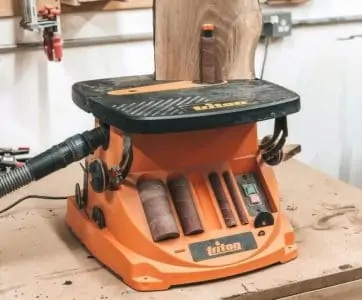
When you need to create rounded or intricate edges, a spindle sander is the best tool to use.
Not only does it relieve the strain on your hands and wrists, but it also speeds up the process of detail sanding. Imagine hand-sanding all those edges to achieve the same results.
We’ve found the best spindle sanders to help you make an informed buying decision.
- Includes onboard storage
- 3.5-Amp motor
- Comes with 6 sanding sleeves
- 3,200 RPM
- 5-Amp motor
- Includes multiple accessories
- Lightweight at 30 lbs
- Locking safety switch
- 6 spare sanding sleeves included
- Only weighs 7.13 lbs
- Has table clamps
- Variable speed adjustment
- Worm gear system
- Removable on/off switch
- Quick spindle change
- 2 sanders in 1
- Belt speed of 1,575 ft per min
- Pivoting table
- 1,725 RPM
- 2.5-inch dust port
- Extra large sanding table
Review Methodology: At Sensible Digs, we pride ourselves on delivering thorough, hands-on analysis and professional assessments of the best spindle sanders on the market. Our research and evaluations are based on data, experience, and facts. We test each product, measure their performance, compare them against industry benchmarks, and track their results to help you make an informed decision. With each review, we identify key decision-making factors such as design choices, effectiveness, durability, and value, and rate each product accordingly. Our aim is to provide you with an objective, comprehensive guide to help you find the best spindle sander for your needs.
The Best Spindle Sanders of 2024
Spindle sanders are specialist tools. However, they vary in quality and price, as well as features. Getting the model that’s right for you is a challenge, but one that we have accepted.
We bring you the 7 best spindle sanders.
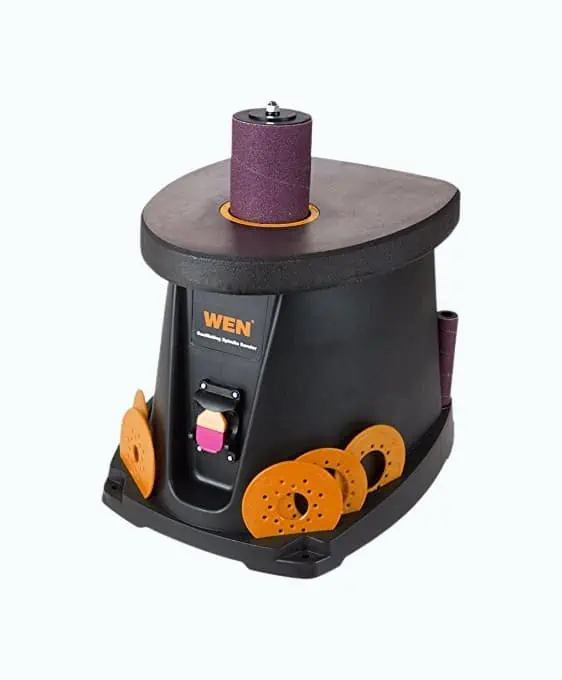
WEN 6510T 3.5-Amp Oscillating Spindle Sander
Best Oscillating Spindle Sander
For sales figures alone, this spindle sander wins hands down. It has a powerful 0.50 HP, 3.5-amp motor that generates 58 orbits per minute and 2,000 RPM. The cast iron work table measures 15 x 11.5 inches.
You get 6 sanding sleeves for size adjustments and different curves, plus 5 rubber drum spindles. It also has a dust collection port that hooks up to a collection bag or a central vacuum system.
The sandpaper is 80-grit, and you get onboard storage to keep all your spares in one place. This sander also has pre-drilled holes for tabletop mounting. This increases the stability of the sander.
What We Like
Onboard Storage
Nothing is as frustrating as losing spares when you need them. With onboard storage, you needn’t worry because all the accessories you need are at your fingertips. It also means you waste less time searching and more time being productive.
Popular Brand
One way to tell if a spindle sander is any good is to read the reviews. This model scores the highest and has the biggest customer base. If that doesn’t tell you how great this sander is, nothing will.
Great Price
You might expect this spindle sander to cost the earth, but you’d be mistaken. It is incredible value for money compared to others that make the review.
What We Don't Like
No Tilting Table
While a tilting table isn’t crucial, it does add more versatility to your sanding repertoire. This one is a stationary table, so it will reduce the number of angles available to you.
Product Specs
| Weight (pounds) | 30.2 |
| Dimensions (inches) | 20.3 x 15.5 x 24 |
| OPM | 58 |
| RPM | 2,000 |
| Table size (inches) | 15 x 11.5 |
| Amps | 3.5 |
| HP | 0.50 |
| Price | $$ |
| Warranty | 2-year |
Our Ratings
User Experience
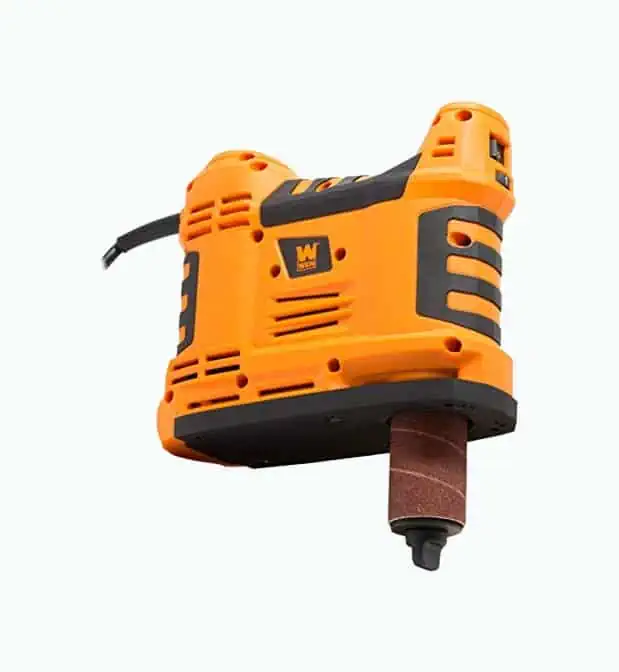
WEN HA5932 5-Amp Portable Spindle Sander
Best Budget Spindle Sander
This is turning into the WEN show. There are 3 sanders in the review in total. This is a portable spindle sander, so it is easier to perform curves and intricate shapes on the road.
It is lightweight and portable, has a 5-amp motor that generates between 1,800 and 3,200 RPM and 50 to 90 OPM. Not bad for a hand-held device. This model also comes with table clamps to turn it into a fixed worktop sander.
The sanding spindles range from 0.50 inches to 1.5 inches, and you get 4 sanding sleeves, plus 3 rubber drums. It even comes with an adjustable straight-edge guide and a 1.5-inch dust port.
What We Like
Portable and Lightweight
Hand-held spindle sanders are the ultimate go-anywhere tools. When you make your living traveling from job-site to construction site, having a portable sander is a bonus.
Accessories Galore
This set comes with 3 spare rubber drums, 4 sanding sleeves, and a straight-edge guide. You also get a non-marring rubber mounting pad and 2 clamps to fix it into position as a tabletop sander.
Great Price
This portable version is less than half the cost of the previous WEN sander. It may lack a cast iron table and the same stability as tabletop sanders, but it is incredible value for money.
What We Don't Like
No Table
Without a table, getting the level of detail you can achieve with a tabletop spindle sander is challenging. The table adds stability and enables you to keep a steady hand when maneuvering the wood.
Product Specs
| Weight (pounds) | 6.64 |
| Dimensions (inches) | 12.2 x 11.2 x 4 |
| OPM | 50 to 90 |
| RPM | 1,800 to 3,200 |
| Table size (inches) | N/A |
| Amps | 5 |
| HP | Not stated |
| Price | $ |
| Warranty | 2-year |
Our Ratings
Personal Perspective
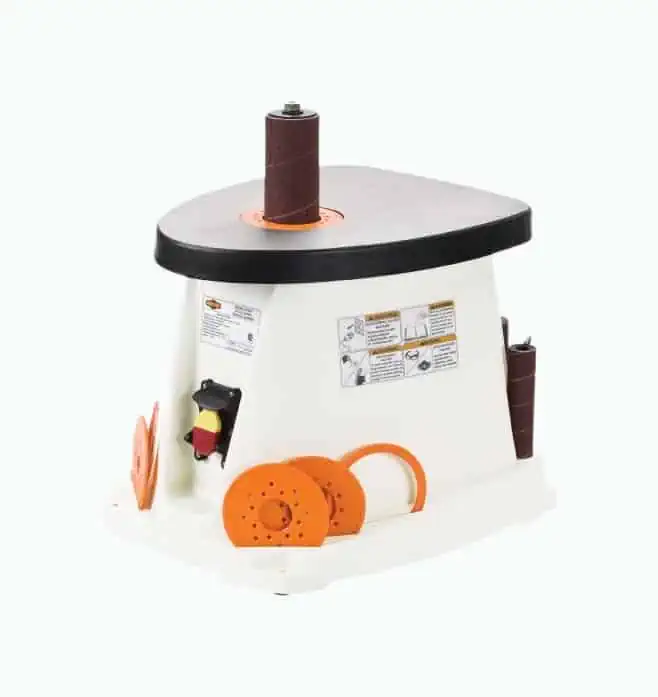
Shop Fox W1831 Single Phase Oscillating Spindle Sander
Best Portable Spindle Sander
Strictly speaking, the most portable spindle sanders are the hand-held models. However, they are not as versatile as tabletop varieties. This Shop Fox is an excellent mobile-friendly choice because it only weighs 30 pounds.
The 0.50 horsepower motor generates 2,000 RPM and 58 OPM. It comes with onboard storage for the 6 spare sanding sleeves, spindle washers, and 5 drums. It has a 15 x 11.5-inch table to help you control your wooden workpiece.
Shop Fox has safety in mind with a locking power switch with a removable key to stop unwanted operation.
What We Like
Portable and Lightweight
It doesn’t match hand-held devices for portability and weight, but at just 30 pounds, this model is an excellent full-size spindle sander that you can load in the car and take on your travels.
Onboard Storage
Organization is the mother of efficiency, so knowing where all your spares are is vital, especially when time is money. Onboard storage delivers this, keeping all your supplies in one place.
Safety Switch
All power tools are dangerous, so Shop Fox has fitted this model with a lockable paddle switch when the sander is in storage. When the sander is in operation, the paddle can be unlocked and used to shut the sander off in an emergency.
What We Don't Like
Top Price
Essentially, this spindle sander is almost identical to the WEN model, and yet it costs a lot more. It is hard to justify this price increase when compared to other models.
Product Specs
| Weight (pounds) | 30 |
| Dimensions (inches) | 14 x 15 x 17 |
| OPM | 58 |
| RPM | 2,000 |
| Table size (inches) | 15 x 11.5 |
| Amps | 3.5 |
| HP | 0.50 |
| Price | $$$ |
| Warranty | 1-year |
Our Ratings
Community Feedback
Triton TSPSP650 Portable Spindle Sander
Best Handheld Spindle Sander
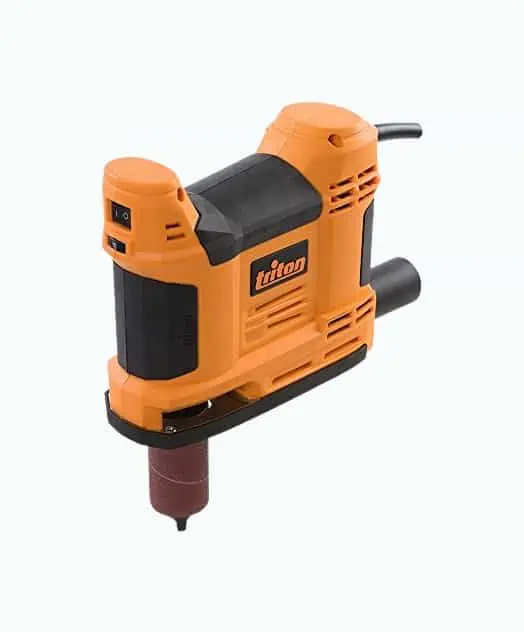
This Triton is another portable spindle sander. It weighs just 7.13 pounds, and the 650-watt motor produces 1,800 to 3,200 RPM and 50 to 90 OPM. The high speeds ensure burn-free sanding.
Like the other hand-held sander to feature, this one comes with an array of accessories that include inverted bench-mounting set, four sanding sleeves, dust port adaptor, and an adjustable edge guide.
It is ergonomic to improve comfort, control, and grip. You also get variable speed control and an adjustable edge guard.
What We Like
Portable and Lightweight
It is impossible to better hand-held sanders for maneuverability and portability. It weighs just 7.13 pounds, making it light to work with and better for reducing hand and wrist strain.
Table Clamps
If you want to get better detail, this portable sander comes with a non-slip bench mat and adjustable clamps to fix it in place as a bench tool. It means you can maneuver the material more accurately for intricate designs.
Variable Speed
This model comes with a separate speed adjustment dial that allows you to operate between 1,800 and 3,200 RPM and 50 to 90 OPM. Changing the rate the sander works helps you adapt to different materials.
What We Don't Like
Replacement Sleeves
It may be difficult to find a replacement sleeve that is compatible with this unit. This is something you must consider when buying the item.
Product Specs
| Weight (pounds) | 7.13 |
| Dimensions (inches) | 10.25 x 3.31 x 10.25 |
| OPM | 50 to 90 |
| RPM | 1,800 to 3,200 |
| Table size (inches) | N/A |
| Amps | 5 |
| HP | Not stated |
| Price | $$ |
| Warranty | 3-year |
Our Ratings
First-Hand Impression
Jet JBOS-5 Benchtop Oscillating Spindle Sander
Best Benchtop Spindle Sander
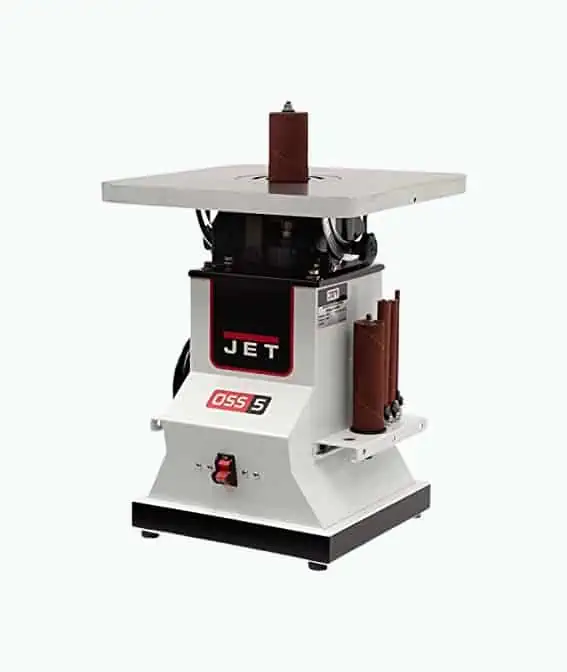
This Jet benchtop sander has a tilting table that adjusts to 45 degrees for versatility and increased accuracy. It also has a 1-inch oscillating action that protects the wood and prolongs the sleeve life.
It comes with interchangeable table inserts, a 2-inch dust port, and an assortment of spindle assemblies. It has a removable safety on/off switch to prevent accidental start-up.
The 0.50 HP motor generates 30 OPM and 1,725 RPM, making it the ideal tool for detail sanding. The oscillating gears are housed in a lubricated box to preserve their working life, and the onboard storage ensures that all your accessories are kept conveniently close.
What We Like
Worm Gear System
The heavy-duty gear system drives the 1-inch oscillation action that improves the sanding quality and preserves the life of the sleeves. It also prevents burnishing of the workpiece.
Safety Features
This tool is designed with safety in mind. It has a removable on/off switch to prevent accidental start-up and 4 non-skid rubber feet to improve grip and stability.
Quick Spindle Change
If speed is a crucial driver, having a quick spindle change is vital. It ensures that your productivity is maintained, reducing downtime while you change the drums.
What We Don't Like
Very Expensive
The elephant in the room with this sander is the price. It costs almost 4 times the average price of the others to make the list. It means only professionals and experienced users will be interested.
Product Specs
| Weight (pounds) | 77 |
| Dimensions (inches) | 14.5 x 14.5 x 18.75 |
| OPM | 30 |
| RPM | 1,725 |
| Table size (inches) | 14.5 x 14.5 |
| Amps | Not stated |
| HP | 0.50 |
| Price | $$$$$ |
| Warranty | 5-year |
Our Ratings
User Experience
WEN 6524 Oscillating Belt and Spindle Sander
Best Belt and Spindle Sander
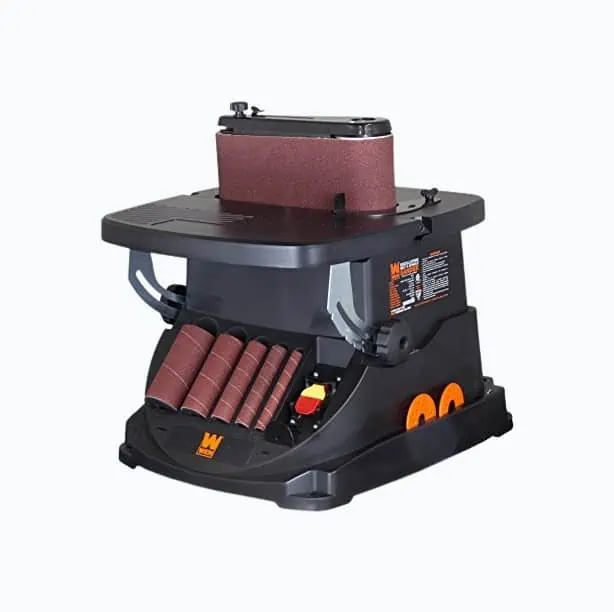
This tool is versatile because it doubles up as a belt sander and spindle sander. It means you can start on a larger project, increasing the level of detail as you go. Make a start with flat boards, smoothing them on the belt sander, and shape them on the spindle sander.
It comes with 4 spindle drums, ranging in size from 0.50 inches to 2 inches. It also has a 24 x 4-inch belt. The 3.5-amp motor generates belt speeds of 1,575 feet per minute and spindle speeds of 2,000 RPM. The belt and spindles oscillate at 58 OPM.
This set also comes with a beveling work table, 5 throat plates, a belt sanding attachment, and 6 pieces of 80-grit sandpaper.
What We Like
2 Sanders in 1
Start big, sanding sheets and flat pieces of wood, and gradually increase the level of detail by swapping the belt sander attachment for the spindle one. Now you can create intricate designs without shelling out for a new sander.
Lots of Accessories
You get 5 throat plates, a belt sanding attachment, 4 spare spindle drums to accommodate for size adjustments, and 6 extra 80-grit sandpaper sleeves.
Pivoting Table
Adjusting the table angle increases your options for curves, angles, and intricate designs. It allows you to hold the workpiece steady while creating bespoke projects.
What We Don't Like
It’s Not Cheap
This is not a budget tool. We get that it is 2 sanders for the price, but it is still unlikely to appeal to starters and novices.
Product Specs
| Weight (pounds) | 27 |
| Dimensions (inches) | 18.5 x 16.5 x 18 |
| OPM | 58 |
| RPM | 2,000 |
| Table size (inches) | Not stated |
| Amps | 3.5 |
| HP | Not stated |
| Price | $$$$ |
| Warranty | 2-year |
Our Ratings
Personal Perspective
Grizzly Industrial GO538 Oscillating Spindle Sander
Best Industrial Spindle Sander
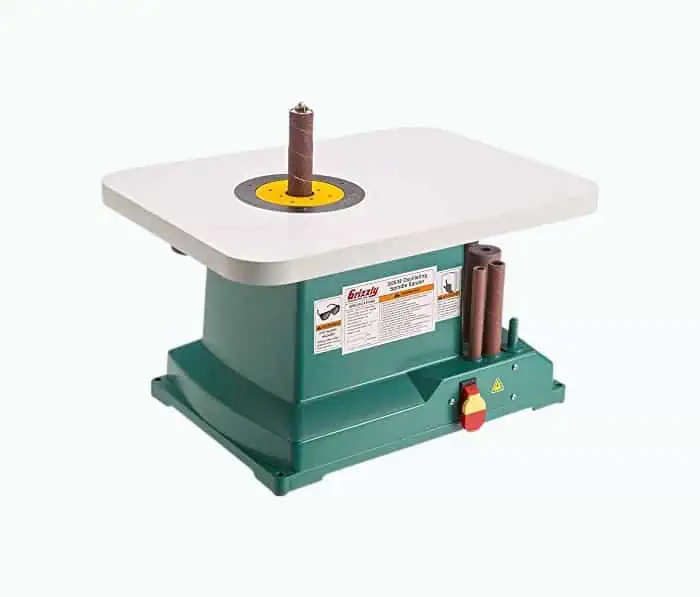
For sheer strength and durability, look no further than this Grizzly Industrial spindle sander. It has a single-phase, 4-amp motor that generates 72 OPM and 1,725 RPM, making it ideal for heavy-duty tasks.
The sanding table is extra-large, at 20 x 14 inches, so it can handle significant workpieces, and it has a toggle on/off safety switch, plus a 2.5-inch dust port for superior extraction. This is a tool designed to live in a commercial environment.
Grizzly uses the finest quality materials in the construction of this model, ensuring a superior running life. It also comes with 6 spare spindles, 3 x 80-grit sanding sleeves, 3 x 150-grit sanding sleeves, and 6 table inserts.
What We Like
Built To Last
Grizzly has produced a sander built to last. The base is heavy-duty metal, and all the components are of the highest quality. It all adds up to a machine that serves you well for years to come.
Lots of Accessories
How would you like 6 spare spindles, 3 x 80-grit sanding sleeves, and 3 x 150-grit sanding sleeves? Plus, it comes with 6 table inserts and onboard storage.
Pivoting Table
The sanding table is extra-large, measuring 20 x 14 inches. It gives you the ability to scale up your projects. Imagine sanding large workpieces and increasing your versatility.
What We Don't Like
Very Expensive
While this is an industrial-grade sander, so you should expect to pay quite a bit if you want it. It costs double the price of most sanders that make the list.
Product Specs
| Weight (pounds) | 35.6 |
| Dimensions (inches) | 17.75 x 22 x 16 |
| OPM | 72 |
| RPM | 1,725 |
| Table size (inches) | 20 x 14 |
| Amps | 4 |
| HP | 0.30 |
| Price | $$$$ |
| Warranty | Not stated |
Our Ratings
Community Feedback
| Product | Best | Weight | Dimensions | OPM | RPM | Table size | Amps | HP | Warranty |
|---|---|---|---|---|---|---|---|---|---|
| WEN Oscillating Spindle Sander | Oscillating Sander | 30 lbs | 20.3 x 15.5 x 24″ | 58 | 2,000 | 15 x 11.5″ | 3.5 | 0.5 | 2-year |
| WEN Portable Spindle Sander | Budget Pick | 7 lbs | 12.2 x 11.2 x 4″ | 50 to 90 | 1,800 to 3,200 | N/A | 5 | N/A | 2-year |
| Shop Fox Oscillating Spindle Sander | Portable | 30 lbs | 14 x 15 x 17″ | 58 | 2,000 | 15 x 11.5″ | 4 | 0.5 | 1-year |
| Triton Portable Spindle Sander | Handheld | 7.13 lbs | 10.25 x 3.31 x 10.25″ | 50 to 90 | 1,800 to 3,200 | N/A | 5 | N/A | 3-year |
| Jet Oscillating Spindle Sander | Benchtop | 77 lbs | 14.5 x 14.5 x 18.75″ | 30 | 1,725 | 14.5 x 14.5″ | N/A | 1 | 5-year |
| WEN Belt & Spindle Sander | Belt & Spindle | 27 lbs | 18.5 x 16.5 x 18″ | 58 | 2,000 | N/A | 4 | N/A | 2-year |
| Grizzly Oscillating Spindle Sander | Industrial | 35.6 lbs | 17.75 x 22 x 16″ | 72 | 1,725 | 20 x 14″ | 4 | 0.3 | N/A |
What Is a Spindle Sander?
A spindle sander is a specialist tool used for creating edges on boards and cupboard doors, as well as shaping wood. It consists of a flat table with a drum rising from the center. The drum holds sanding sleeves of varying grades, and the table enables you to control the wood.
How Does a Spindle Sander Work?
The spindle sander works by moving an abrasive drum in an oscillating motion. It rotates and moves up and down for maximum material removal. This movement reduces friction, which eliminates band marks and wood burns.
It also spreads the wear over the entire surface of the sanding sleeve, which prolongs the sandpaper’s life.
What Are Spindle Sanders Used For?
They create smooth curved surfaces on wood. They are ideal for intricate designs, curves, and edges. Cabinet makers, carpenters, and bespoke kitchen makers all see and realize the benefit of a spindle sander.
You can create smooth edges with minimal fuss, and it reduces the pressure placed on your hands and wrists by taking away the manual effort needed. Without a spindle sander, the only way to create such perfection is to use a sanding block and work by hand.
Do I Need a Spindle Sander?
You do if you want to achieve intricate shapes and curves in wood. A spindle sander lets you sand in a smooth and fluid motion. It reduces band marks and wood burns for a better outcome.
If you are making bespoke furniture, cabinetry, and hand-built kitchens, a spindle sander is invaluable. It speeds up your work rate and makes life so much easier when you want to shape the wood.
If you are a professional, time is money, and deadlines must be met to build a reputation for reliability and quality. A spindle sander gives you another string to your bow.
How To Choose the Best Spindle Sander?
When selecting a new spindle sander, there are some fundamental things to look for. But what are they? Let’s take a look.

Motor Capacity
The most you should expect from your spindle sander is between 0.50 and 1.0 horsepower. Don’t be fooled by the low HP because a slower speed is better for precision and lighter work. It allows you to get superior results and puts less strain on the sander.

Dimensions and Weight
Remember that you will be moving your oscillating spindle sander a lot, so the weight has a bearing on your decision. You want it to be heavy enough to stay still while sanding but light enough to make it portable.
Balance is also essential, as well as lower vibrations. When it comes to the size of your sander, where you store it, and how large your workspace is, plays a role. Plus, the size of your project is a vital factor in the decision-making process. Larger pieces of wood will require a larger table, and cast iron tables increase the weight considerably.

Included Accessories
Look for a spindle sander that offers spare sanding sleeves to help you grade the smoothness and tackle different size curves and edges. More accessories increase your versatility, adding to your repertoire of skills.
Onboard storage is also a crucial feature because you could easily misplace your spare sanding sleeves and spend ages hunting them down. Organization is the mother of efficiency.

Tool-Free Option
When you need to change sanding sleeves or adjust the sander, speed is a priority, and the last thing you want is for it to be a protracted process. What you want is to achieve the swap in easy steps and get on with the project.
Sleeves should slip on and off with ease and lock in place in seconds. Drum changes should be a straightforward process as well.

Additional Features
While spindle sanders are relatively simple tools, you should still seek additional features to improve the sanding process and increase safety.
Safety Shut-Off Paddle
If you need to close the sander down in an emergency, a safety paddle is the best way. It enables you to whack it into the off position without any fuss. And thanks to this large and prominent switch, you are unlikely to miss it.
Increased Oscillation Stroke
A longer oscillation stroke reduces friction and preserves the sandpaper. It also makes for a smoother sanding action, reducing marks and wood burns.
Dust Extraction
Sanding is a messy business, and it creates a lot of dust, so making sure you have a safe way of removing that debris is crucial. A dust extraction port enables you to channel the hazardous waste to either a collection bag or a central vacuum.
A tidy workplace is safer and more productive.
Tilting Table
A tilting table increases the angles you can achieve while improving your versatility. It means you can tackle increasingly complicated projects and achieve a professional finish.

What’s Your Budget?
We always have one eye on the price because unless money is no object, we are all constrained by the depth of our pockets. The more you spend, the better quality sander you can get, but there are still some good quality models available for a lower price.
That said, you get what you pay for. Try and avoid sanders with cheap components. It will shorten the lifespan of your device, which is a false economy. You’ll end up replacing it before too long when you should have bought a quality sander in the first place.
Spindle Sander FAQs

How To Keep Spindle Sander Cylinders From Slipping?
Slippage is a common problem, but one that is easily solved. Slipping occurs as a result of an ill-fitting sanding sleeve. There is a gap between the sleeve and the drum.
On the top of the drum, there is a bolt and washer, which can be tightened to expand the rubber drum to fill the gap. The drum should now grip the sleeve and stop slipping.
How To Change Sandpaper on Oscillating Spindle Sanders?
The sandpaper sleeves slide on and off the rubber sanding drum. Sometimes, you need a little help getting the new sandpaper to slide down the drum. Cornstarch or baby powder could be a solution to the problem.
Rub it onto the inside of the sleeve and then slide it onto the drum using a twisting motion. If you are struggling to remove the old paper, take off the drum and hand-roll it across a work surface to loosen its grip.
Smacking it with a mallet also helps, as does blowing compressed air inside.

How To Store Spindle Sanders?
Spindle sanders should be stored in dry conditions, preferably off the ground. The sanding sleeves should also be stored away in an airtight container to prevent them from deteriorating.
It might be an idea to place a cover over the sander when it is not used to prevent dust and moisture from penetrating the internal mechanisms.

How To Change the Drum on a Spindle Sander?
Follow the steps below:
- Switch off the machine from the wall and pull the plug.
- Remove the table insert.
- Place a wrench on the top of the drum to prevent rotation.
- Place a second wrench on the bottom of the drum and twist counterclockwise.
- Unscrew the drum.
- Place the new drum on the spindle, tightening by hand. Don’t use a wrench to do this.
- Replace the table insert, using the smallest one possible.
- Power up and get started.

Is a Spindle Sander Worth It?
A spindle sander is worth it if you work with irregular shapes. These tools feature rotating drums and are great for woodworkers.
Using a spindle sander, you can sand curves and other irregular shapes with relative ease and speed. They’re great for stubborn finishes, deep wood grain sanding, and giving that scratched and stained piece of wood a brand-new sparkle.

Should I Buy a Spindle Sander?
There is more than one spindle sander, so to know whether or not you should buy it, you have to understand what these tools do.
Portable spindle sanders are worth considering if you work with furniture regularly. The average DIY enthusiast doesn’t need one, but it’s an excellent tool for your arsenal if you like to make your own furniture (whether for sale or personal use).
Benchtop spindle sanders use oscillating motion to give you the best results. If you’re not a professional woodworker, you’ve likely never used or needed one. They are great for sanding board edges.

Can I Use a Drill Press as a Spindle Sander?
Turning a drill press into a spindle sander with cash, time, and patience is possible. Your first purchase is a sanding drum. It costs around $10 at your local hardware store.
Find a piece of wood supporting your workpiece and drill a hole inside it. The hole should match the sanding drum in terms of size. If you don’t own an adjustable circle cutter (which you need for this project), you can find one online for about 30 bucks.
Grab some adhesive-backed magnet strips and attach them to the back of this wooden piece you just cut.
You can begin sanding after inserting your drum sander bit into the press and elevating your table to a position where the sander’s base is below the highest point of the sig.
Note that this contraption won’t be as versatile as a spindle sander, so you can’t use it as a permanent solution.

Can You Use a Router Table as a Spindle Sander?
While you can turn a router table into a spindle sander, many people will tell you it’s a bad idea. The spindle sander has a considerably lower RPM than a router table.

What Is the Best Spindle Sander?
The WEN 6510T is ideal for any woodworking project, offering an onboard storage repository for the 6 included sanding sleeves and a 3.5-amp motor running at 2,000 RPMs for efficient results.
The dust collector adaptor offers large-capacity debris control with hook and loop fastening offerings.
With the option to start with a medium grit sleeve to quickly prepare your workpiece before adding finer abrasives, the WEN 6510T provides the seamless spindle sander you need when tackling more extensive jobs.
How To Use a Spindle Sander
Once you have marked your wood and chosen the correct drum size, it’s time to start sanding. Choose the right sanding sleeve grit to match the project. Use long, sweeping motions as you pass the wood along the drum.
It is the same technique for most other forms of sanding. Jerky motions leave you with uneven surfaces. It’s far better to approach it with a slow and steady attitude. Work the wood back and forth until you see the shape forming.
Try not to exert too much pressure on the material because you will burn or mark the wood. Plus, you could put the sander under undue pressure. Unless you are trying to produce a specific shape, avoid holding the wood in one place, which creates uneven surfaces.