More people have easy access to clean water than ever before, able to simply turn a faucet and fill a glass in seconds. However, depending on where you live, your water supply might not be as clean or healthy as it appears.
Residential water purifiers are a great solution to this problem, but they often only clean the water that comes from a single faucet or appliance. In contrast, a whole house water filter ensures that your entire home has access to clean, high-quality water, whenever you need it.
In this article, we will explain what whole house water filters are and how they work. We have also provided our top whole house water filter reviews, which we have chosen based on effectiveness, capacity, ease of installation, and affordability.
- NSF & ANSI approved
- Made from food grade plastic
- Clear case to monitor sediment
- Three-stage filtration
- Two activated carbon filters
- Clear sediment case
- Commercial grade
- Reverse osmosis filtration
- Water softening system
- NSF and ANSI certified
- Filters sediment & chemical toxins
- Retains mineral content
- 3-Stage filtration system
- Visibly improves water quality
- Simple but effective
- Two-stage space-saver
- Pre-assembled components
- Doesn't reduce water pressure
- Salt-free softening
- Electronic control system
- Automated backwash feature
Review Methodology: At Sensible Digs, we meticulously analyze and assess whole house water filters using rigorous benchmarks and criteria. Our hands-on experience and professional background provide us with the expertise to evaluate these products from a user’s perspective. We dive deep into the data, compare performance levels, and measure factors like filtration efficiency, flow rate, and lifespan. Distinct design choices, their implications on users, and key decision-making aspects such as ease of installation and maintenance are carefully reviewed. We then rank each filter based on our findings, offering you the most comprehensive, fact-based review to guide your purchase decision. Our aim is to help you understand what sets each product apart in the market and which one is the best fit for your home.
The Best Whole House Water Filter Reviews of 2024
If you think a whole house water filter might be the right option for you, it’s time to take a look at some of the filter systems themselves. We have seven recommendations, chosen based on their effectiveness, ease of installation, features, and customer feedback. Here are our whole house water filtration system reviews of the top products you can buy today.
Express Water Heavy Metal Whole House Water Filter
Best for Heavy Metal Purification
This system emphasizes heavy metal filtration, but it is a comprehensive whole house filter. It will take care of almost all your filtration needs.
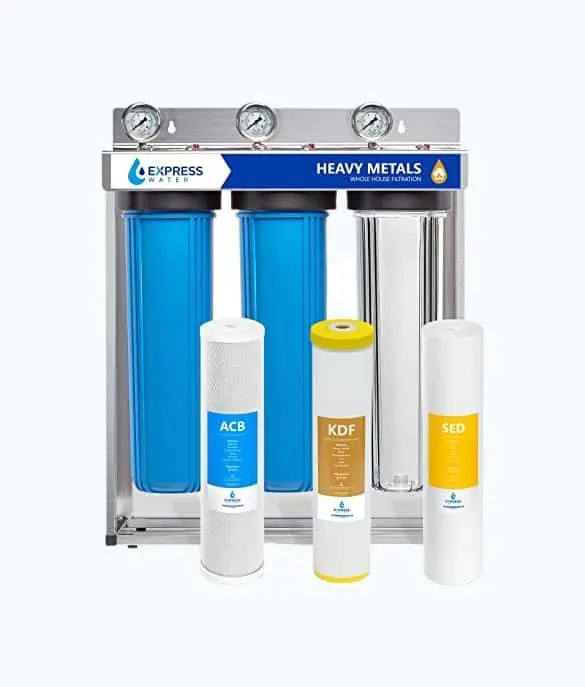
Built to NSF and ANSI standards, this system is made of food-grade plastic. It includes a free-standing stainless steel frame. Clear, first-stage housing allows for easy observation, so you will know exactly when your filter needs changing.
The three stages of filtration are sediment, copper-zinc, and carbon. This system can filter out some heavy metals, chemicals, and pathogens. It also deals with organic pollution and will remove unpleasant odors and tastes from your supply.
What We Like
All-Rounder
This whole house water filter is the complete package. It doesn’t include extras, but the included components filter out the majority of harmful contaminants. Heavy metals, chemical toxins, pathogens, and organic pollution will all be filtered by this system.
Food Grade
This filter meets the standards of NSF and ANSI. Although the regulation is independent, it is a nice bonus that not all systems can boast. The result is food-grade plastic for safer water.
Easy Maintenance
The sediment pre-filter has a clear case so you can see when it’s time to change it. Monitoring how your filter is functioning is easy. As there won’t be any guesswork, you will save time on maintenance.
What We Don't Like
KDF Filter Is Bothersome
Some customers report that there is a pressure drop in the system once stage two kicks in.
The design of the KDF filter is tricky to work around, and it is unclear whether or not the pressure inconsistency is a design flaw. Despite some users complaining that the KDF filter can be frustrating, overall they are pleased with its effectiveness.
Installation Is a Hassle
Most whole house water filter systems are designed to be installed by professionals, so Express Water can’t be blamed for this. Still, many customers complain this system is difficult to install and the filters are tricky to place. This only matters if you are attempting DIY installation.
Product Specs
| What does it filter? | Aluminum, cadmium, chromium, copper, iron, mercury, nickel, lead, chlorine, chloramine, hydrogen sulfate, pesticides, herbicides, sediment, rust, fungi, pathogens |
| Filters included | Sediment filter, KDF filter, activated carbon filter |
| Water softening? | No |
| Special features | Clear casing on the sediment filter, free-standing stainless steel frame, pressure gauges |
| Water pressure | 45–80 psi |
Our Ratings
User Experience
Express Water Standard Whole House Filter
Best Starter Whole House Filter System
This Express Water product makes a great first whole house water filter. We recommend it if you want a versatile filter without an emphasis on heavy metals. It is a well-rounded filter and, for a standard option, it is very effective.
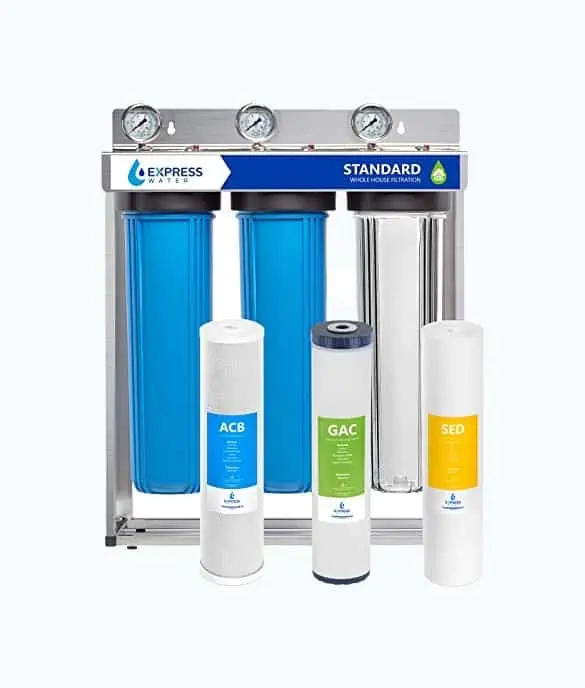
This system filters out a wide range of chemical and organic pollutants in your water supply. Like a specialized system, it uses three-stage filtration, though the filters differ. You receive a sediment filter, granular activated carbon filter, and a carbon block.
Also included are a standing frame, pressure gauges, and a clear case for easy monitoring of your sediment filter.
What We Like
Removes Chemicals
This is an excellent choice if you’re looking for a basic filter that removes chemical toxins from your water supply. It also takes care of a number of organic pollutants, so it is a well-rounded product. We recommend it if you are concerned about chlorine (and other chemical waste).
Two Activated Carbon Filters
This system is great at filtering out chemical contaminants because of the second and third stages of filtration. Express Water doubled down on the activated carbon filter for extra safety and purification. Your drinking water will taste and smell better because of it, and more toxic substances will be filtered out.
Great Features
Although this filter system is the standard option, you still receive pressure gauges, a stainless steel frame, and a clear sediment filter case. Maintenance, storage, and monitoring are almost effortless.
What We Don't Like
No KDF Filter
This system lacks a copper-zinc filter. If you want the complete package, you might need to spend extra to purchase it separately. An additional activated carbon filter has taken its place to compensate.
The two carbon filters do a good job of filtering out various pollutants. This isn’t a major drawback, as many systems use the same setup.
Doesn’t Filter Pathogens
Although this filter does an excellent job of filtering chemicals and natural toxins, it won’t do much against bacteria. Depending on your local water supply, this might not be a big deal. If you’re worried, like the KDF filter, you can always purchase an extra sub-micron or UV filter.
Product Specs
| What does it filter? | Chlorine, pesticides, insecticides, herbicides, volatile organic compounds (VOCs), sediment, rust |
| Filters included | Sediment filter, granular carbon, carbon block |
| Water softening? | No |
| Special features | Pressure gauges, stainless steel stand, clear sediment filter case |
| Water pressure | 45–80 psi |
Our Ratings
Personal Perspective
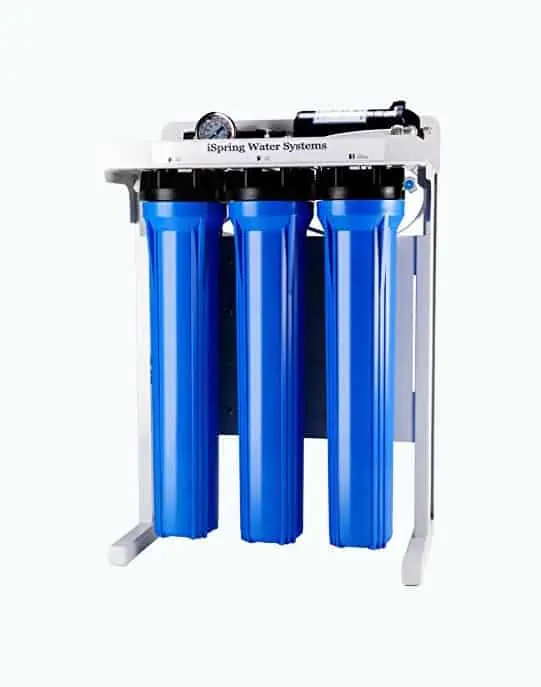
iSpring Commercial Grade Reverse Osmosis System
Highest Capacity Whole House Water Filter
If you’re interested in a whole house system for your business or large property, this commercial-grade water filter system is ideal. It is intended for heavy use, so you can buy it with confidence.
The filters in this system are 20 inches each, which is double the industry standard. This is a reverse osmosis model, so your water will be purified and softened at the same time.
You receive three high-efficiency reverse osmosis membrane filters, a booster pump, and a pressure gauge. It filters heavy metals, chlorine, and impurities.
What We Like
Commercial Use
This is a heavy-duty filter. It is recommended for restaurants, salons, and labs, so it will be suitable for any property that is used by many people.
Consider this filter if you have a large home, as you can be confident that it will cope with the demands of numerous outlets.
Reverse Osmosis
Reverse osmosis filters have grown in popularity in recent years. Rather than using activated carbon, an RO membrane filters out contaminants from your supply. There is no need for added chemicals, and the taste of your water won’t be affected.
Water Softening
Another perk of reverse osmosis machines is that they soften your water supply. This system won’t interfere with the alkalinity of your water, but it will reduce hardness via ion exchange. You will have softer water as a result.
What We Don't Like
Only RO Membranes
This system doesn’t have the usual filters you would expect to find in a whole house system. Rather than a sediment filter, KDF, and carbon filter, it utilizes three reverse osmosis membranes. They are effective but don’t achieve traditional whole house filter specs.
Occupies More Space
We don’t recommend this product unless you have a large home or business. It is sophisticated and heavy-duty but the high capacity comes with a price. If you don’t need commercial-grade filtration, you will be better off with a smaller system.
Product Specs
| What does it filter? | Chlorine, heavy metals, hardness, impurities |
| Filters included | Three reverse osmosis membranes |
| Water softening? | Yes |
| Special features | Free-standing frame, booster pump, pressure gauge |
| Water pressure | 22–95 psi |
Our Ratings
Community Feedback
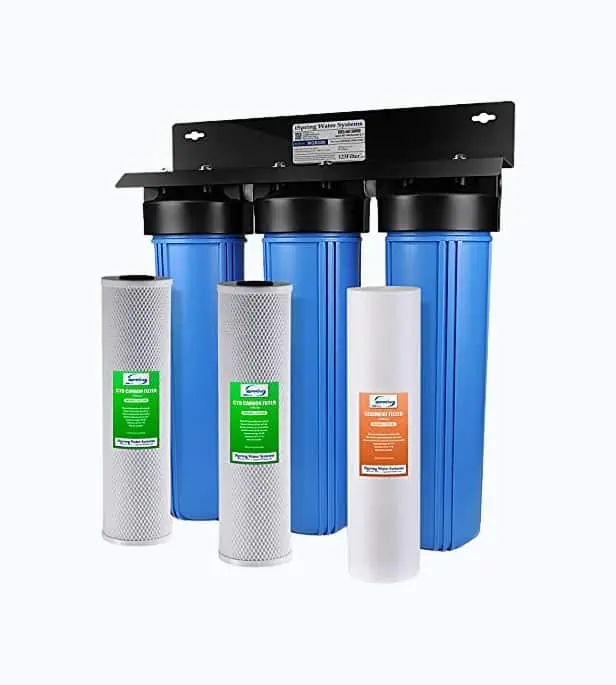
iSpring 3-Stage Whole House Filtration System
Easiest Installation
This system requires very little fuss. It is a great example of a standard whole house water filter. Your water flow won’t be affected by this filter, as it is designed to have very little impact on water pressure.
It meets NSF and ANSI standards, so water quality and safety are guaranteed.
It includes a sediment filter and two activated carbon blocks. This means the system focuses on filtering sediment and chemical impurities.
If you prefer hard water, this product will retain the mineral content in your supply.
Also included are a metal bracket, all filter cases, and a wrench.
What We Like
No Hassle
Customers praise how little fuss this system requires. The filters are easy to connect and remove, so maintenance won’t be any trouble. If you intend to install it yourself, the instructions for this system are clear and simple to understand.
Mineral Water
iSpring emphasizes that this system won’t affect your water’s hardness. All of the mineral content will be retained, so you will have cleaner, healthier water. If you don’t want hard water, you can always install a softener to get the best of both worlds.
Saves Money
This is a mid-range model so you should save a few bucks if you choose it.
It is still a good quality system that is more affordable than other, more advanced models. As it lacks some of the bells and whistles of other models, you won’t pay for potentially unnecessary extras.
What We Don't Like
Two Carbon Filters
This system lacks a KDF filter, but an extra carbon filter has taken its place. Your water will be well-purified by this system, but if you’re looking for a complete package, you will need to buy a KDF filter separately.
Filter Cases Are Fragile
Some customers reported that the cases aren’t made of very strong plastic. A few reviews mention that they are prone to cracks, which result in leaks.
Handle the filter cases with care and take extra time for maintenance to avoid early replacements.
Product Specs
| What does it filter? | Sediment, rust, chlorine, solvents, herbicides, pesticides, volatile organic compounds (VOCs) |
| Filters included | Sediment filter, two carbon blocks |
| Water softening? | No |
| Special features | Metal bracket, three filter cartridges, 4.5-inch wrench |
| Water pressure | Not specified |
Our Ratings
First-Hand Impression
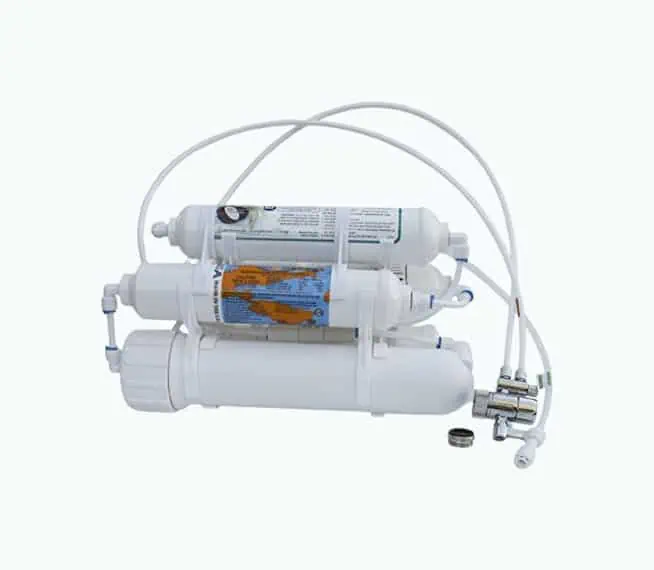
Reverse Osmosis Revolution 3-Stage Filter
Best Budget Pick
You don’t need to sell body parts to afford a whole house water filter. Reverse Osmosis Revolution’s 3-Stage filtration system is an affordable alternative to more advanced models.
Despite the name, this is not a reverse osmosis system. The three stages of filtration are a sediment filter, granular activated carbon, and a carbon block. It cleans a variety of chemical pollutants from your supply, as well as rust, dirt, and other natural impurities.
It is simple and effective. One nice bonus is the extra set of filters you receive with your purchase.
What We Like
Money Saver
This system provides excellent filtration at a fraction of the usual price. The free set of filters is a nice extra that helps you save money on your first round of maintenance.
Great Water Quality
Numerous happy customers have reported that this filtration system noticeably improved their water quality, especially in terms of taste and odor.
This filter might also improve the appearance of your water, making it clearer.
It’s Very Effective
Users praise this system, and many customers have said that they regret not buying it sooner. It has fewer advanced features than most top-rated models, but its efficiency speaks for itself.
What We Don't Like
Missing KDF filter
Like some others on our list, this system does not include a KDF filter. Instead, it uses two carbon filters; one granular and the other a carbon block. This doesn’t seem to be too much of a drawback, given the overall excellent feedback regarding this system’s effectiveness.
Pressure Drops
Some users have reported that the drop in water pressure is significant. The benefits of this system are worth it, but the pressure drops can be frustrating if you use large amounts of water.
Product Specs
| What does it filter? | Sediment, rust, chlorine, radon, volatile organic compounds (VOCs) |
| Filters included | Sediment filter, granular activated carbon, carbon block |
| Water softening? | No |
| Special features | Set of extra filters |
| Water pressure | 20–100 psi |
Our Ratings
User Experience
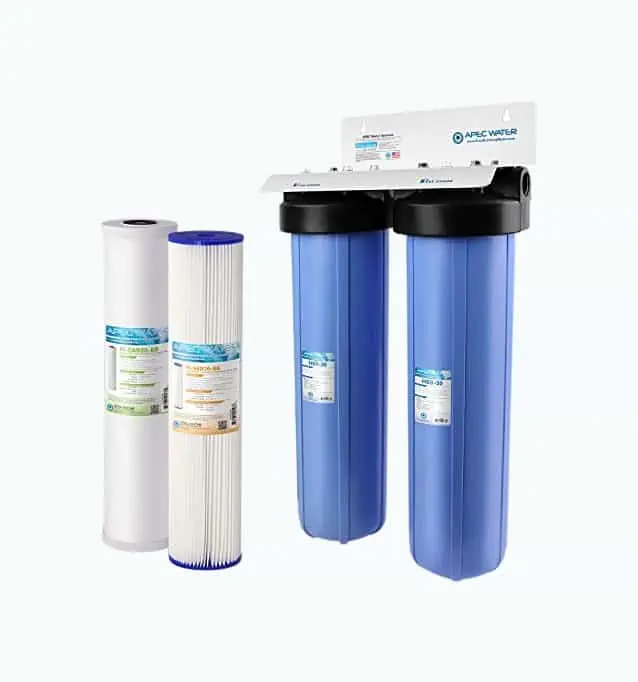
APEC Two-Stage Whole House Filter
Rising Star
This system is perfect if you don’t have much space or aren’t interested in heavy-duty filtration. It is simpler than others but it still gets the job done. Although it is currently less popular, it has high potential.
The two stages of this system are a sediment filter and a carbon filter. It purifies debris, rust, and other dirt, as well as chlorine and VOCs.
It is pre-assembled and ready to go right out of the packaging.
What We Like
Saves Space
One problem with more advanced systems is that they occupy more space. If you live in a small home, this two-stage system is more accommodating. You won’t have to compromise on efficiency if you choose this model.
Hassle-Free
There is no assembly required for this system. Each of the components is ready to be installed as-is. This will save time and avoid confusion when you’re setting it up.
Although APEC has done much of the work for you, it still recommends hiring a professional for installation. Still, your plumber will appreciate how easy this filter is to install.
Seamless Integration
Happy customers report that they did not experience drops in water pressure while using this system.
The improvement in water quality is noticeable. It tastes and smells much better after passing through the filters.
What We Don't Like
More Info Needed
As this system is less popular than some others, we still need to see more feedback. So far, the majority of customers seem to be very satisfied with this system. It needs more time on the market to build a reputation.
Two-Stage
This is an efficient water filter system, but it has a smaller capacity than many others. While competitors use three-stage filtration, this one uses two. You still receive a sediment filter and a carbon filter, so this isn’t a deal-breaker.
Product Specs
| What does it filter? | Sediment, rust, chlorine, VOCs |
| Filters included | Sediment filter, carbon filter |
| Water softening? | No |
| Special features | Pre-assembled |
| Water pressure | Max. 150 psi |
Our Ratings
Personal Perspective
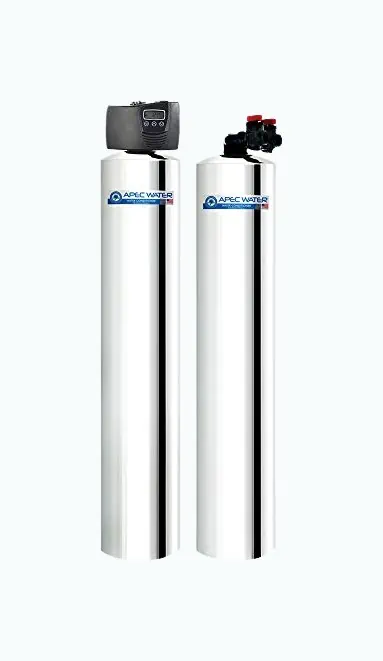
APEC WH-Solution-Max-10
Most Sophisticated
This advanced model by APEC is a heavy-duty whole house system that is designed to provide perfect water in your home. It has some standout features that our other picks lack.
Firstly, this is a maintenance-free model with self-cleaning properties to reduce your workload. The automated backwash feature also improves the system’s performance. It neutralizes hard water and comes with an electronic control valve.
This is a two-stage filtration system that features a granular activated carbon filter and a salt-free water conditioner. It filters chlorine and chloramine and improves the taste, appearance, and smell of your water.
What We Like
Salt-Free Softening
This system doesn’t only purify your water, it also conditions it. You will receive softer water that is gentler on your skin, without increasing sodium levels. It also protects your home and appliances from limescale.
Electronic Control
This convenient feature is not common with whole house water filters. Electronic control makes system management so much easier than manual gauges. It will prevent a lot of guesswork, and it also looks very cool.
No Maintenance
Self-cleaning whole house systems are almost unheard of. You will save yourself a lot of time and effort by investing in this filter system. The automated backwash feature means you will never need to worry about manually cleaning your system.
It also provides higher performance and protects your plumbing from build-up and scale. This also saves money, as you won’t have to spend as much on replacements.
What We Don't Like
Costs More
This is an excellent system but it definitely isn’t a budget option. Its special features mean the initial cost is much higher than it is with competing products. Remember that this is a luxury system, and its price is justified by its features.
Needs More Time
This APEC system isn’t mainstream yet. More time is needed to gather feedback. Considering its features, it’s safe to assume that it will do well on the market once it takes off.
Product Specs
| What does it filter? | Chlorine, chloramine, THMs, VOCs, hardness |
| Filters included | Granular activated carbon filter, salt-free water conditioner |
| Water softening? | Yes |
| Special features | Self-cleaning, automated backwash, electronic control valve |
| Water pressure | 40–80 psi |
Our Ratings
Community Feedback
| Product | Best For | What does it filter? | Filters included | Water softening? | Water pressure |
|---|---|---|---|---|---|
| Express Water Heavy Metal | Heavy Metal Purification | Aluminum, cadmium, chromium, copper, iron, mercury, nickel, lead, chlorine, chloramine, hydrogen sulfate, pesticides, herbicides, sediment, rust, fungi, pathogens | Sediment filter, KDF filter, activated carbon filter | No | 45–80 psi |
| Express Water Standard | Starter System | Chlorine, pesticides, insecticides, herbicides, volatile organic comlbs (VOCs), sediment, rust | Sediment filter, granular carbon, carbon block | No | 45–80 psi |
| iSpring Reverse Osmosis System | Highest Capacity | Chlorine, heavy metals, hardness, impurities | Three reverse osmosis membranes | Yes | 22–95 psi |
| iSpring 3-Stage System | Easy Installation | Sediment, rust, chlorine, solvents, herbicides, pesticides, volatile organic comlbs (VOCs) | Sediment filter, two carbon blocks | No | Not specified |
| Reverse Osmosis Revolution 3-Stage | Budget-Friendly | Sediment, rust, chlorine, radon, volatile organic comlbs (VOCs) | Sediment filter, granular activated carbon, carbon block | No | 20–100 psi |
| APEC Two-Stage | Rising Star | Sediment, rust, chlorine, VOCs | Sediment filter, carbon filter | No | Max. 150 psi |
| APEC WH-Solution-Max-10 | Most Sophisticated | Chlorine, chloramine, THMs, VOCs, hardness | Granular activated carbon filter, salt-free water conditioner | Yes | 40–80 psi |
Types of Whole House Water Filters
Whole house water filters are far more complex and powerful than other types of filter systems. Various components are attached to different points of your water line. These parts then work together to form a system that water flows through as it circulates your plumbing.
The types of whole house water filters will be slightly different, but there are some common features you should expect to see:
1. Sediment Pre-Filter
Sediment pre-filters are used to filter out pollution such as sludge, rust, and debris, which can find their way into the water supply as it approaches your home. This is the first stop for your water as it passes through the filtration system.
Sediment contamination can cause nitrate pollution, which is highly toxic and potentially fatal to infants (1).
2. Activated Carbon Filter
Activated carbon (charcoal) filters are the most common type of water filter. They remove a wide range of contaminants from your water, with an emphasis on chemical pollution. Some activated carbon filters can even remove heavy metal toxins (2).
Part of why these filters are so popular is because they improve the odor and taste of water.
3. Copper-Zinc Mineral Stone Filter (KDF)
The copper-zinc mineral stone filter connects to the same point as your activated carbon filter. This is where scale, chlorine, and heavy metals are filtered out. Copper-zinc filters also tackle pathogens by preventing bacterial growth in your pipes.
Copper-zinc filters are sometimes called KDF (Kinetic Degradation Fluxion) filters, so you can look for either when shopping.
4. Water Softener
Not all home water filter systems include a water softener. Their purpose is to remove mineral content (calcium and magnesium) from your supply. While there are advantages to doing so, particularly if your water supply has high mineral content, some people prefer not to soften their water.
Soft water is kinder to your skin, pipes, and appliances. The most significant benefit is that it eliminates the risk of limescale build-up around your home.
In Contrast
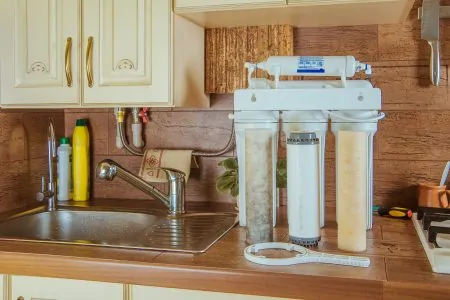
5. Sub-Micron Post-Filter
A sub-micron post-filter is another optional component. It deals with any sediment and natural pollutants that are able to pass through the first three barriers. This is an extra precaution that could make your filter more effective, but it is often unnecessary.
6. UV Filter
Finally, consider a UV filter. This is the last part of your whole home filtration system and kills any remaining pathogens in the water before it reaches you. This is a very effective means of disinfecting water.
An investigation into portable UV water filters concluded that they can destroy between 94% and 99% of bacteria (3).
What to Consider When Choosing a Whole House Filter
Whole house water filters can make a significant difference in your daily life. We strongly recommend them. Even so, they are a big investment and are less simple than smaller systems.
There are a few drawbacks to whole house water filters, but the advantages far outweigh them. Still, you should keep the following in mind.

Professional Installation
We don’t recommend trying to install a whole house filtration system alone, at least not at first. There is a specific method to how the components should be connected to your main water line, and you don’t want to make any mistakes.
Although the risk is small, there is a chance that you could install it incorrectly and damage your plumbing. It’s best to leave it to a professional. This will ensure that your filter works the way it is intended to.

Higher Initial Cost
In most cases, you get what you pay for with plumbing systems, and whole house filters are well worth the money. However much more economical they are in the long term, it doesn’t change the fact that they are the most expensive of the popular residential filtration systems.
Don’t forget to account for installation costs and servicing. A whole house filtration system should ultimately save you money compared to other types, but it isn’t something you can buy on a whim.
Set Filtration
Ironically, the main appeal of a whole house filter is also one of its drawbacks. These systems filter out everything, everywhere — even if it isn’t necessary.
Think about it: your toilet water is filtered as thoroughly as your faucet water when it doesn’t need to be. This isn’t a dealbreaker, but it is pointless and might make you feel that your filter is doing unnecessary work.
It could also impact other areas of your life. For example, some plants prefer hard water, so if you install a softener in your system, you might harm your garden (4). Soft water also isn’t recommended for pools, as it could compromise their structural integrity.
Tip: If you aren’t comfortable with some aspects of whole house filtration, remember that some of the components are optional. As long as you have the sediment filter, carbon filter, and copper-zinc filter, the rest is up to you. You can experiment to see which components are necessary.
FAQs

What Is the Best Whole House Water Filtration System?
The best whole house water filter system for you will depend on your specific needs. If you are concerned that your water supply might be contaminated, you should get a system that has three main components: a sediment pre-filter, an activated carbon filter, and a copper-zinc mineral stone filter. These three filters will ensure that you filter most of the potentially harmful materials that might be in your water supply.
Should I Get a Whole House Water Filter?
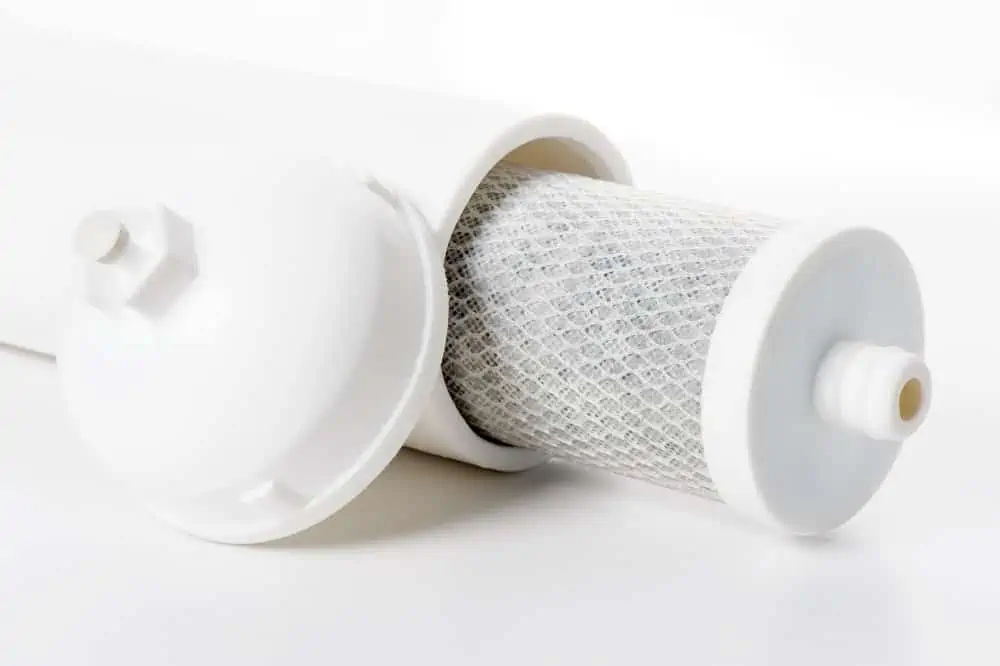
A whole house water filter is the most effective way of filtering the water that leaves the outlets in your home. It is possible to filter the outlets individually by attaching dedicated filters to them, but this is less efficient and will require more maintenance than simply filtering your water where it enters your property. The initial cost of a whole house filter will be higher, but it should save you money in the long run.

Does a Whole House Water Filter Reduce Water Pressure?
A whole house water filter might reduce the water pressure in your home, but this depends on which filtration system you choose. High-end filter systems should reduce pressure less than low-end ones, but this isn’t a universal rule. Take the time to read user reviews, as they will often mention whether or not the water pressure is affected by the filter system.

How Long Does a Whole House Water Filter Last?
In most cases, a whole-house water filter lasts about 12 months. Follow the manufacturer’s instructions as they tell you how often the filter needs to be replaced.

How Often Should I Change My Whole House Water Filter?
Change the filter on a whole-house water system every three to six months. It is recommended that you replace the sub-micron post filter in your water filtration system every nine to twelve months, or depending on how often it is used.
If your system has one, you must update your salt-free water softener once every six years. You don’t need to bother about changing any of the other filters.

Where Should a Whole House Water Filter be Installed?
The best place to install a whole house water filter is next to the shut-off valve. In most homes, this can be found in the basement or the utility closet. Since this is where municipal water enters the house, it marks the ideal spot for a filter serving the entire home.
After the primary water shut-off valve, the plumbing line that is already there will be extended horizontally so that the water filtration system may connect to it. It must be attached before the plumbing line can branch out to other house areas.

Does a Water Filtration System Add Value to Your Home?
A filtration system can add value to your home, as whole house systems are game-changers. It has become necessary in many communities around the United States to install additional filtration systems to eliminate contaminants and chemicals from our water.
On the other hand, many homes have been handling the problem on their own by employing a cumbersome, refillable water filtering pitcher or by purchasing drinking water in environmentally harmful plastic bottles. Neither of these options is ideal.
It’s a genuine luxury and will pay off both now and in the future when it is time to sell your property. So, installing filtered water directly from any faucet in the house is a great way to increase your home’s and impress potential buyers.

What Is the Average Cost of a Whole House Water Filtration System?
Whole-house water filtration systems cost between $1,000 and $4,200, but they can be more expensive, costing an average of $2,600.