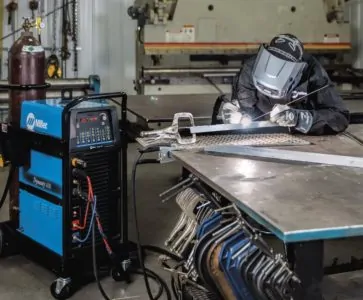
Welding carts are not as essential as a welding machine, but they make moving heavy tools and maneuvering the welder a whole lot easier. They give you the flexibility to work on projects knowing that you have everything by your side.
We rundown the best welding carts to see which is the one you should buy.
- Powder-coated
- Formed steel construction
- 3 tiers
- Sturdy wheels
- Nice looking satin finish
- 100-pound capacity
- All-steel construction
- Sturdy rubber rear wheels
- 3-tiers with large handle
- Wheels swivel 360 deg
- 176-pound capacity
- Universal welding table
- Has 4 drawers
- Large front wheels
- Universal tool
Review Methodology: At Sensible Digs, we pride ourselves on our thorough analysis and hands-on experience in evaluating the best welding carts. Our professional team conducts rigorous tests, comparing the performance of various models based on key decision-making factors such as design, durability, storage capacity, and ease of movement. We assess every aspect from a user’s perspective, sharing our findings, data, and results to help you make the most informed choice. Our reviews, backed by first-hand evidence, measure and rank each product, highlighting what sets each cart apart from its competitors. Trust in our expertise and objective evaluation as we guide you to the best welding cart for your needs.
The Best Welding Carts of 2024
Welding carts come in all shapes and sizes. They also range in price, making it a challenge to find out which one is the best. Here is our take on the best welding carts.
Chicago Electric MIG/TIG Welding Cart
Best Budget Welding Cart
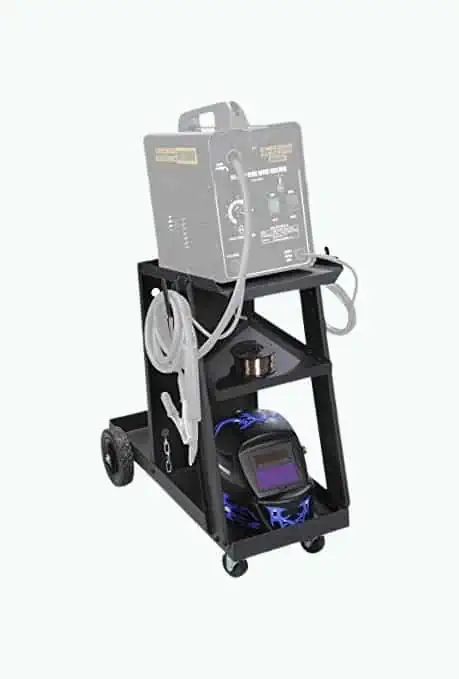
Ironically, the budget option is also one of the highest-rated on Amazon. It shows that sometimes you don’t need to break the bank to get the best deal. This Chicago Electric cart has 3 tiers, is constructed from sturdy formed steel, which has been powder-coated to protect it against the elements.
There are two chains for securing gas cylinders and a sloped top shelf to increase the accessibility of the welding controls. This cart takes MIG and TIG welders, so it should have you covered. There is also a hook for safely storing your welding gun after use.
Pros
- Powder-coated.
- Formed steel construction.
- 3 tiers.
- Amazing value.
Cons
- Wheels are weak.
Product Specs
| Weight (pounds) | 31 |
| Dimensions (inches) | 28.75 x 21.5 x 15 |
| Tiers | 3 |
| Chains | Yes |
| Weight capacity (pounds) | 100 |
| Suitable for | MIG and TIG |
| Price | $ |
Our Ratings
User Experience
4 Drawer Cabinet Welding Cart
Best Welding Cart with Lockable Cabinet
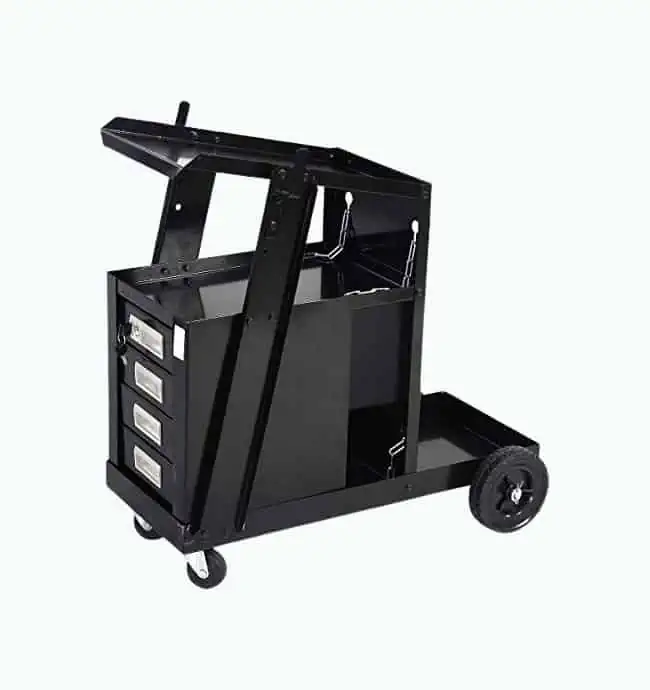
This 4-tier welding cart has a lockable cabinet to keep all your tools and spares safe. The 2.5-inch front wheels and 6-inch rear wheels give this cart superior maneuverability, even when fully laden.
It holds a gas bottle and it is constructed of rugged steel. The wheels have a maximum load capacity of 100 pounds.
Only the top drawer has a lockable cabinet. This might make this cart less user-friendly. Still, it is a quality product, and incredible value for money.
Pros
- Good value for money.
- Sturdy wheels.
- Nice looking satin finish.
- 100-pound capacity.
Cons
- Installation might require drilling.
Product Specs
| Weight (pounds) | Not specified |
| Dimensions (inches) | 28 x 15.5 x 28 |
| Tiers | 4 |
| Chains | Yes |
| Weight capacity (pounds) | 100 |
| Suitable for | MIG, TIG and ARC |
| Price | $$ |
Our Ratings
Personal Perspective
Hot Max WC100 Welding/Plasma Cutter Cart
Best Portable Welding Cart
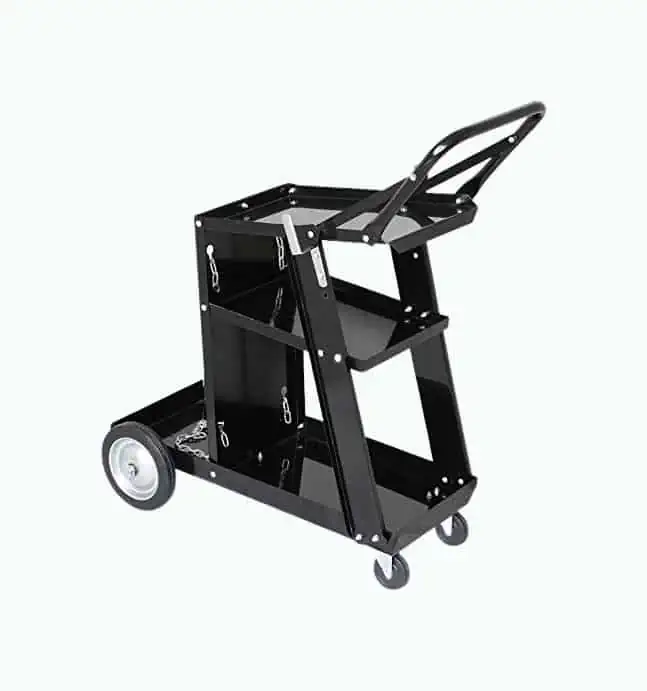
This is a 3-tier cart with a large handle that keeps your hands clear of any cables. It also improves your grip as you steer the cart. It has safety chains to secure a shielding gas cylinder and an easily accessible storage tray on the base for tools and accessories.
It fits most MIG and plasma cutters, and thanks to the all-steel construction and rubber rear wheels, it is durable and sturdy. It will be a long time before you need to source replacements for this welding cart.
It weighs 33 pounds and has a maximum load capacity of 100 pounds. The only gripe is that the front wheels are made from cheaper plastic and may perish over time if the cart is moved while fully loaded.
Pros
- All-steel construction.
- Sturdy rubber rear wheels.
- 3-tiers
- 100-pound capacity.
Cons
- Front wheels are weak.
Product Specs
| Weight (pounds) | 33.7 |
| Dimensions (inches) | 33 x 13 x 29 |
| Tiers | 3 |
| Chains | Yes |
| Weight capacity (pounds) | 100 |
| Suitable for | MIG and plasma |
| Price | $$$ |
Our Ratings
Community Feedback
Yaheetech 3-Tier Welding Cart
Best Heavy-Duty Welding Cart
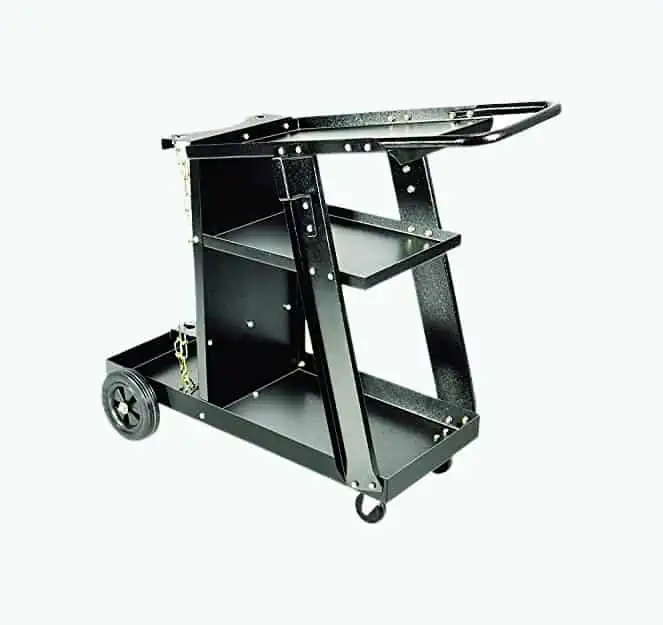
If you are looking for a welding cart that can handle superior loads, this could be the one. This Yaheetech cart has 3 tiers and a maximum load capacity of 176 pounds. That’s 76 pounds more than the competition. It means you can load this cart up and never worry that it will buckle under the weight.
The increased load capacity is largely thanks to the rear rubber wheels set on casters that swivel 360 degrees and the enlarged rubber wheels with metal hubs for added durability.
It has two large chains for securing shielding gas and a large handle, positioned to make pushing and pulling the cart easier. The heavy-duty nature of this cart makes it the ideal tool for MIG, TIG, and arc welders as well as plasma cutters. It is a universal welding table.
Pros
- All-steel construction.
- Sturdy rubber rear wheels.
- 3-tiers.
- 176-pound capacity.
- Universal welding table.
Cons
- Build quality issues.
Product Specs
| Weight (pounds) | 25.3 |
| Dimensions (inches) | 46.6 x 18.9 x 2.36 |
| Tiers | 3 |
| Chains | Yes |
| Weight capacity (pounds) | 176 |
| Suitable for | MIG, TIG, arc and plasma |
| Price | $$ |
Our Ratings
First-Hand Impression
Goplus Welder Cart
Best Welding Cart With Drawers
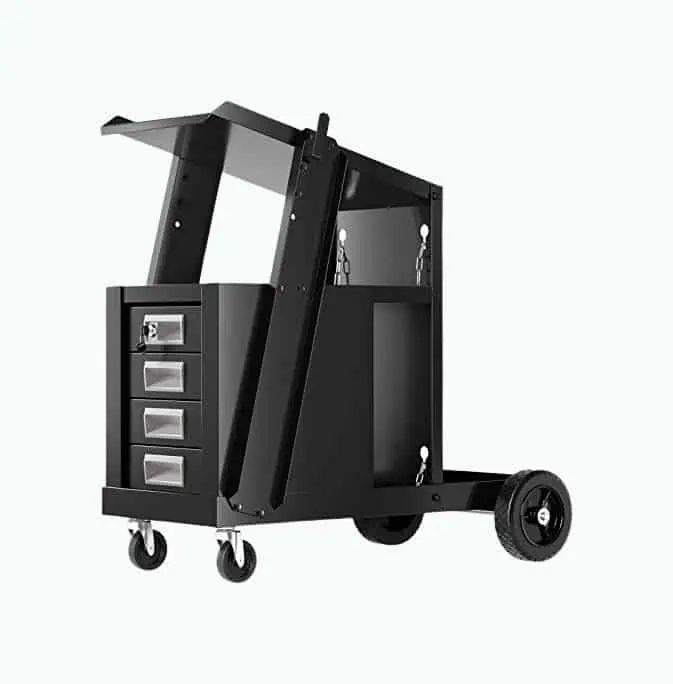
If you like your welding cart to be neat and tidy, with all your tools and accessories organized in separate drawers, this Goplus cart is an ideal choice. It has 4 drawers to keep everything in order when stored away.
It is constructed from durable, painted steel to protect it from rust and corrosion. There are 2.5-inch rubber caster wheels that swivel 360 degrees, and the large front wheels are 6-inch rubber for silent running and better absorption.
This is the ideal cart for carrying a TIG, MIG, arc or plasma cutters, making it a universal tool, and it has a maximum weight capacity of 100 pounds, which is in line with the competition.
Pros
- All-steel construction.
- Sturdy rubber rear wheels.
- 4 drawers.
- 100-pound capacity.
- Universal welding table.
Cons
- Build quality issues.
- Mismatched nuts and bolts.
- Drawers add extra weight.
Product Specs
| Weight (pounds) | 49 |
| Dimensions (inches) | 37 x 12 x 15 |
| Tiers | 3 (including 4 drawers) |
| Chains | Yes |
| Weight capacity (pounds) | 100 |
| Suitable for | MIG, TIG, arc and plasma |
| Price | $$$ |
Our Ratings
User Experience
| Product | Best | Weight | Dimensions | Tiers | Chains | Weight capacity |
|---|---|---|---|---|---|---|
| Chicago Electric MIG/TIG Welding Cart | Budget Pick | 31 lbs | 28.75 x 21.5 x 15″ | 3 | Yes | 100 lbs |
| 4 Drawer Welder Cart | Lockable Cabinet | N/A | 28 x 15.5 x 28″ | 4 | Yes | 100 lbs |
| Hot Max Welding/Plasma Cutter Cart | Portable | 34 lbs | 33 x 13 x 29″ | 3 | Yes | 100 lbs |
| Yaheetech 3-Tier Welding Cart | Heavy-Duty | 25 lbs | 46.6 x 18.9 x 2.36″ | 3 | Yes | 176 lbs |
| Goplus Welder Cart | Drawers | 49 lbs | 37 x 12 x 15″ | 3 | Yes | 100 lbs |
Why Are Welding Carts Angled?
Welding carts are angled to make it easier to see the welding machine controls from a direct angle. Most welding is performed at lower levels, nearer the ground, so looking up and having a clear view of the welder is crucial.
Plus, if you are working on an overhead project, setting the welder so the controls face upwards gives you a better sightline as well as control.
How To Choose the Best Welding Cart
Welding carts perform the same basic functions, but not all welding carts are created equal. Some have better maneuverability, and some feel more sturdy. Choosing the best welding cart takes research and deciding what matters the most to you.

Size Matters
Check that the welding cart you want accommodates the welding machine you have. Sizes vary, so if you have a MIG welder or you want a cart for a plasma cutter, double-check the dimensions.
Also, try and get a cart with the largest storage tray. You want as many tools near you when you weld for added convenience.

Materials Matter
You will want the sturdiest welding cart you can get, so check the materials and the quality of the construction. If there are a lot of plastic elements in the cart, it could spell trouble down the line when they crack or perish.
You also need it to take the weight of your welder, so choosing a flimsy construction is not going to help. Workshops and construction sites are not forgiving places, and there is a high chance your welding cart will take a knock or a dent. It needs to withstand this punishment.

Wheels Matter
Maneuverability is vital to any welding cart’s success. Look for one with rubber wheels as they last longer, thanks to their durability. They also roll smoother, absorbing bumpy and uneven surfaces easier.
Plus, they dampen the noise as the cart rolls along the floor. The back wheels should spin in all directions for increased mobility, and the weight of the welder should be distributed evenly to all four wheels.

Storage Matters
Your new cart should have adequate storage, and if you can get one with a lockable compartment, even better, especially if you use it in a crowded workshop or factory. Make sure the tools and welding accessories can fit into the storage area of the cart.

Maneuverability Matters
Your cart should have large, lockable wheels, and it should be sturdy but never heavy. It should glide along the floor, taking the weight of your equipment with ease. It shouldn’t feel like a chore pushing and dragging it along the ground.
Check the maximum weight capacity of the cart before you buy it. Make sure it can take the weight of all your equipment and tools.

Price Matters
What is your budget? Cheaper carts tend to have less robust components and construction materials. Carts at the higher end of the price scale are better quality and last longer.
Set your budget and try and get the best welding cart for your dollars.
Get a Headstart With a Welding Cart
Welding carts make your life easier. Imagine lugging all that equipment from your truck when you get to the job site when instead, you could load it onto a welding cart and wheel it to the job. And you would have everything you need to get the task completed efficiently.
A welding cart may not seem important, but when you examine how they improve your welding experience, you have to ask how you ever managed without one?