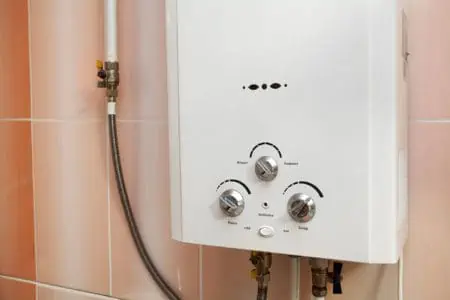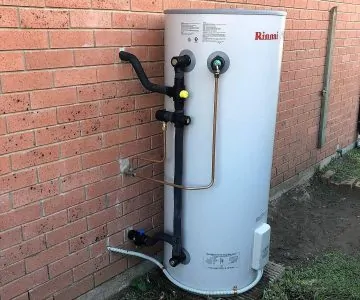
If you are looking for a new tankless water heater, you have probably encountered the name Rinnai more than once. There is a good reason for this, as Rinnai is one of the leading tankless water heater brands.
The company also produces other appliances, but gas-powered tankless water heaters remain its specialty. With so many different models available, you might not know which heater to choose.
To help you decide, we have written five Rinnai water heater reviews. We will also take a closer look at the brand as a whole.
- 199,000 BTU heater
- Flow rate of 9.8 gal/min
- Thermal efficiency of 95%
- 199,000 BTU heater
- Flow rate of 9.2 gal/min
- Features an external thermostat
- 10,300 to 160,000 BTU
- Flow rate of 7.5 gal/min
- Wi-Fi control via Control-R app
- Flow rate of 9.8 gal/min
- Includes digital remote
- Compatible with ThermaCirc360 recirculation technology
- Flow rate of 7 gal/min
- Designed for indoor use
- Compact and space-saver
Review Methodology: At Sensible Digs, we prioritize providing you with a trustworthy and reliable analysis of the best Rinnai water heaters. Our experienced professionals conduct thorough research, hands-on testing, and data-driven evaluations to compare and rank each product based on key decision-making factors. We also assess performance, design choices, and user experience while identifying the top ten most important and relevant factors in choosing the right Rinnai water heater for you. By sharing first-hand evidence and quantitative measurements, we ensure that our recommendations offer the highest standard of quality, helping you make informed choices with confidence.
The Best Rinnai Water Heaters of 2024
Tankless water heaters are increasingly popular and Rinnai’s models are among the best. We considered our past experiences with Rinnai, expert advice, and user reviews to narrow their range down to our top five heaters.
Rinnai RUC98iN Ultra Series Tankless Water Heater
Best Overall Rinnai Water Heater
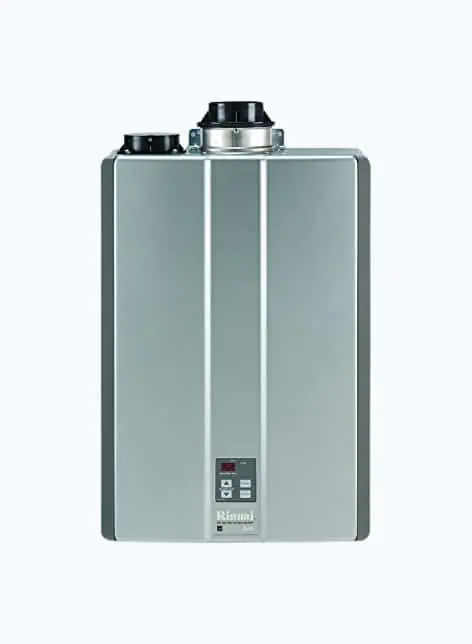
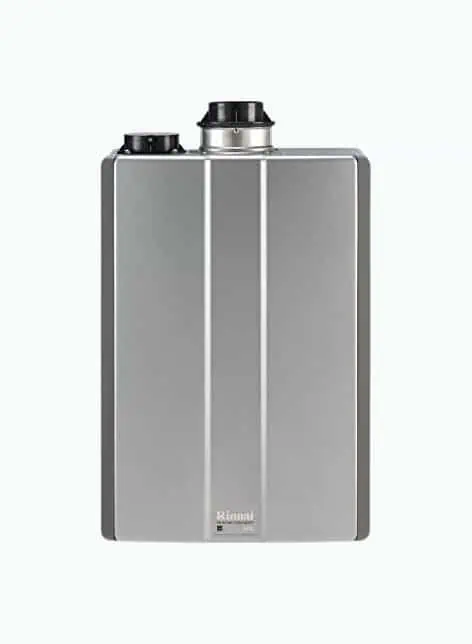
The RUC98iN from Rinnai’s Super High-Efficiency Plus series is a crowd favorite. The RUC98iN is a condensing tankless water heater designed to be ultra-efficient.
This model has a maximum of 199,000 BTU and an impressive flow rate of 9.8 gallons per minute. It also has a uniform energy factor of 0.92. It is intended as an indoor unit and complies with the Ultra Low NOx emission regulations.
The unit is quite easy to install. Considering its power, it’s also compact, measuring 34 inches by 14.5 inches with a depth of 22 inches. It weighs 83 pounds and can easily be mounted on any sturdy wall.
Rinnai lets you choose between PVC or concentric venting to make the installation process even smoother.
This unit is designed to save energy. It boasts a thermal efficiency of 95% and condensing technology allows it to reuse heat, further improving energy savings.
The RUC98iN can supply enough hot water for a home with up to four bathrooms. It’s Wi-Fi ready and you can set a temperature of between 98 degrees and 140 degrees Fahrenheit for residential use.
Pros
- Highly efficient condensing technology.
- Suitable for a four-bathroom home.
- Complies with the Ultra Low NOx regulations.
- Relatively compact and easy to install.
Cons
- Some users had to wait longer than expected to get hot water from their faucet.
Product Specs
| Flow rate | 9.8 gallons per minute |
| Fuel type | Natural gas |
| Installation type | Indoor use |
| Measurements | 34 inches by 14.5 inches by 22 inches |
| Wi-Fi capable | Yes |
Our Ratings
User Experience
Rinnai RL94iN High-Efficiency Plus
Best Rinnai On-Demand Water Heater
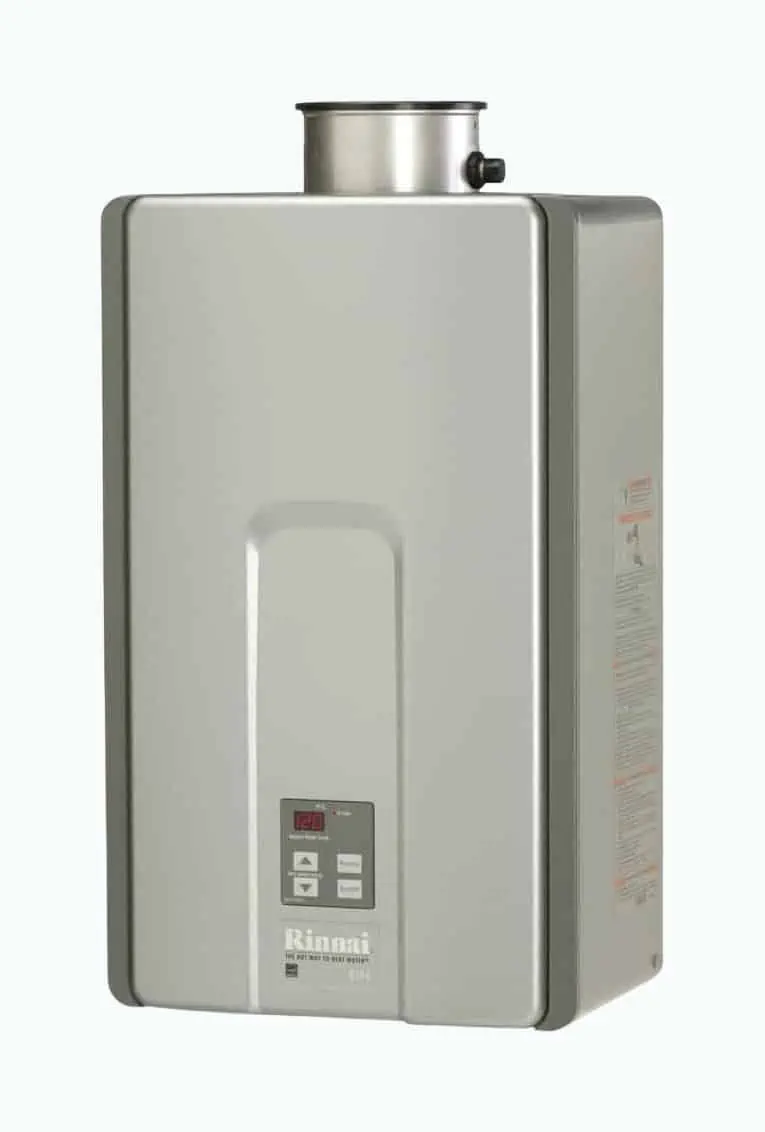
Rinnai made the RL94iN for ultimate efficiency. It’s designed to provide on-demand hot water when you need it most.
It’s fitted with highly-efficient heating coils that can heat the water up to 185 degrees Fahrenheit. Rinnai has made it easy to adjust the temperature using the external digital thermostat. This will show you the exact temperature the water is currently heated to.
You might be shocked by how energy-efficient this heater is compared to a standard, tank-type unit. The RL94iN water heater uses 40% less energy than a regular boiler. It also saves water by delivering hot water within a few seconds, depending on where you install it.
The unit is powered by natural gas and has a maximum BTU input of 199,000 an hour. It is capable of handling four outlets at a time, delivering a flow rate of 9.2 gallons per minute.
You can connect it to an external pump, thanks to Rinnai’s Circ-Logic. This reduces the waiting time for hot water even further. Keep in mind that the external pump is not included.
Pros
- Fitted with very efficient heating coils.
- Saves water by delivering hot water quickly.
- Sufficient for four bathrooms.
- Features an external thermostat.
Cons
- Users reported temperature drops as soon as they opened another faucet.
- Some also complained that the thermostat was not user-friendly.
Product Specs
| Flow rate | 9.2 gallons per minute |
| Fuel type | Natural gas |
| Installation type | Indoor use |
| Measurements | 23 inches by 14 inches by 9 inches |
| Wi-Fi capable | Yes |
Our Ratings
Personal Perspective
Rinnai RUCS75iN Super High Efficiency
Best Rinnai Water Heater for Indoor Use
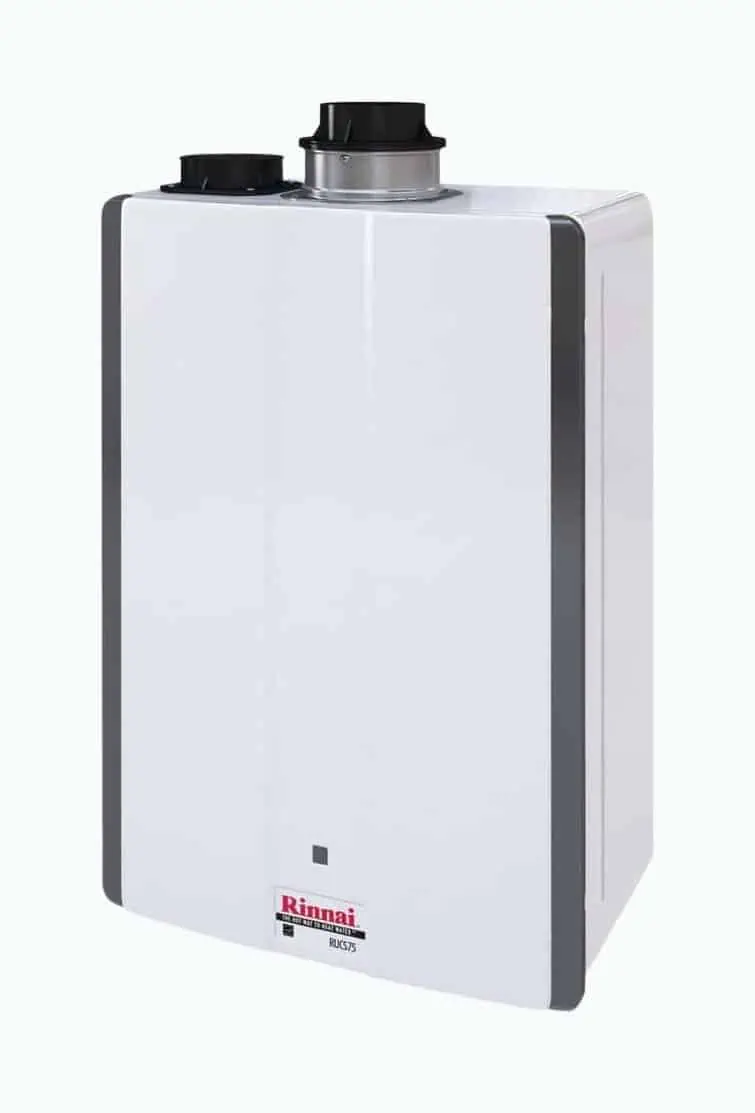
This heater is from Rinnai’s RUCS Super High-Efficiency series. It is a natural gas-powered, condensing tankless water heater with a BTU input of 10,300 to 160,000 an hour.
The RUCS75iN is for indoor use only. It has a uniform energy factor of 0.90 and is Energy Star qualified. This unit is also one of Rinnai’s smallest, which makes it easy to install in almost any space.
With a flow rate of 7.5 gallons per minute, it’s capable of handling up to four outlets at a time. This model has been approved for use at an altitude of 5,400 feet, which is significantly lower than other models that have been approved for up to 10,200 feet.
This unit isn’t fitted with an adjustable thermostat. Instead, it features a small monitor at the front. Here you can see the temperature and various maintenance codes.
It is Wi-Fi ready but you will need to purchase Rinnai’s Wi-Fi module. This will allow you to control the heater from your phone via the Control-R app.
Pros
- Unit is Energy Star Qualified and fitted with Green Technology.
- Relatively compact and easy to install.
- Provides indefinite hot water for a household with three bathrooms.
Cons
- Is only approved to an altitude of 5,400 feet, about half of other Rinnai units.
- There is no fitted temperature controller; you have to buy a separate Wi-Fi module.
Product Specs
| Flow rate | 7.5 gallons per minute |
| Fuel type | Natural gas |
| Installation type | Indoor use |
| Measurements | 26 inches by 18.5 inches by 10 inches |
| Wi-Fi capable | Yes |
Our Ratings
Community Feedback
Rinnai RUR98iN Ultra Series Tankless Water Heater
Best Rinnai Condensing Water Heater
If you’re moving into a newly-built home and need a water heater, this is worth considering. Rinnai specifically recommends its RUR line for use in new homes or as an upgrade from an existing, less efficient unit. This model is an excellent choice for a growing family.
It provides indefinite hot water for three to six outlets, enough for multiple showers, a bath, and perhaps even a hot tub. This unit can do it all while still saving on your utility bill.
With a uniform energy factor of 0.92, it’s powered by natural gas. The unit also has a strong flow rate of 9.8 gallons per minute.
This heater is compatible with the ThermaCirc360 — a recirculation technology. It delivers instant hot water.
The RUR98iN is Wi-Fi capable, so you can control it from a distance using your phone. This boiler is also fitted with a digital controller that you can set to suit your specific needs.
Pros
- It’s capable of handling three to six outlets, enough for four bathrooms.
- A powerful flow rate of 9.8 gallons per minute.
- Compatible with the ThermaCirc360, allowing the unit to provide more hot water while using less energy.
- Includes a digital remote.
Cons
- The unit is quite noisy, especially with the ThermaCirc360 option.
Product Specs
| Flow rate | 9.8 gallons per minute |
| Fuel type | Natural gas |
| Installation type | Indoor use |
| Measurements | 34 inches by 14.5 inches by 22 inches |
| Wi-Fi capable | Yes |
Our Ratings
First-Hand Impression
Rinnai RU160iN Natural Gas Indoor Tankless Water Heater
Best Rinnai Water Heater for Smaller Homes
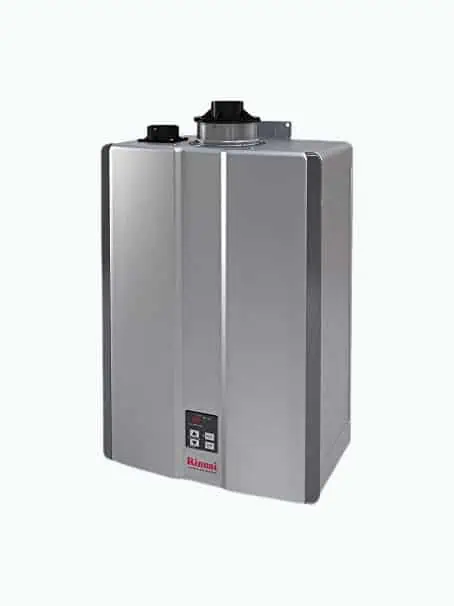
The RU160iN is part of Rinnai’s High-Efficiency series. This compact unit is perfect for small to medium homes. It has a flow rate of 7 gallons per minute.
This small unit combines some of the best traits of Rinnai heaters. It’s a combination of value and efficiency. It only heats water when necessary and is designed to be an indoor unit.
The RU160iN saves up to 32% of energy and provides faster hot water with its ThermaCirc360 technology.
Pros
- Provides a sufficient flow for small to medium homes.
- Small and compact — easy to install.
- Energy-saving feature.
- ThermaCirc360 technology makes hot water readily available.
Cons
- There might be a slight delay before hot water reaches an outlet.
Product Specs
| Flow rate | 7 gallons per minute |
| Fuel type | Natural gas |
| Installation type | Indoor use |
| Measurements | 22.05 inches by 14.76 inches by 33.86 inches |
| Wi-Fi capable | Yes |
Our Ratings
User Experience
| Product | Award | Flow rate | Fuel type | Installation type | Measurements | Wi-Fi capable |
|---|---|---|---|---|---|---|
| Rinnai RUC98iN | Overall Choice | 9.8 gal/min | Natural gas | Indoor | 34″ x 14.5″ x 22″ | Yes |
| Rinnai RL94iN | On-Demand | 9.2 gal/min | Natural gas | Indoor | 23″ x 14″ x 9″ | Yes |
| Rinnai RUCS75iN | Indoor Use | 7.5 gal/min | Natural gas | Indoor | 26″ x 18.5″ x 10″ | Yes |
| Rinnai RUR98iN | Condensing Heater | 9.8 gal/min | Natural gas | Indoor | 34″ x 14.5″ x 22″ | Yes |
| Rinnai RU160iN | Smaller Homes | 7 gal/min | Natural gas | Indoor | 22.05″ x 14.76″ x 33.86″ | Yes |
History of Rinnai
Rinnai was founded in 1920 in Japan by Kanekichi Hayashi and Hidejiro Naito. The company started life manufacturing pressurized oil stoves. By 1930, Rinnai had expanded into making gas appliances (1).
Rinnai became a publicly-traded company in 1950 to further expand and promote its products. In 1958, it formed a partnership with Schwank GmbH. Soon after, the company officially became Rinnai Corporation (2).
Rinnai has always maintained the same philosophy: harmony, spirit, truth. This focus was apparent from the beginning and continues to guide Rinnai’s path as an industry leader.
Customer Service and Reviews
Rinnai offers multiple ways to get help whenever you need it.
On the official website, you can find a self-help center. Frequently asked questions are posted there, as well as recall information. The Rinnai website also provides phone numbers for one-on-one support.
Overall, customers are very happy with Rinnai water heaters. Many owners mentioned seeing a decrease in the cost of their energy bills. Many also said that their water became much hotter than before, and more quickly.
Why Choose a Rinnai Water Heater?
When you choose a Rinnai tankless water heater, you are choosing an established name for high-quality heaters. Rinnai has chosen to focus on perfecting its gas heaters, rather than branching out into electric models.
Rinnai sets high standards throughout the manufacturing process. All appliances undergo rigorous testing before being shipped.
As a mark of their quality, Rinnai tankless water heaters have been approved by the Canadian Standard Association. They also adhere to the strict standards of the American National Standards Institute (3).
Which Rinnai Series Should You Choose?
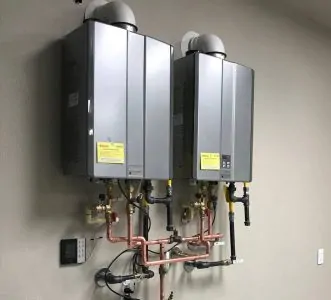
Rinnai is renowned for its tankless water heaters, which we will focus on in this article. The company has four lines of units, which are sorted according to efficiency. These are High-Efficiency, High-Efficiency Plus, Super High-Efficiency, and Super High-Efficiency Plus.
This makes it easier to understand which product is best for your needs. All of the lines come with their own sets of features and functions but they all have some things in common.
One common element is the uniform energy factor, which ranges between 0.79 and 0.95. All units are fuelled by either natural gas or propane.
A feature of Rinnai’s tankless boilers that makes them stand out is their ability to handle multiple outlets simultaneously. Most of their units can be used as a whole-house water heater.
Another thing that all current models have in common is their Wi-Fi compatibility. This makes them conveniently controlled from your phone via the Rinnai Control-R app.
High-Efficiency Series
In a sense, Rinnai’s High-Efficiency series is the brand’s “economy” line and their price reflects this. These heaters are still highly efficient but aren’t fitted with as many high-tech features as the other Rinnai lines.
The High-Efficiency line contains just one series of products: the V series. These are a great choice for small to average households of two to four people.
Most of the products can handle a maximum of four outlets at a time. They have a uniform energy factor of 0.79 to 0.82.
High-Efficiency Plus Series
This series contains two different lines: RL and RLX. These have a uniform energy factor of 0.80 to 0.81 and are capable of supporting a maximum of four outlets.
What sets them apart from the V line is their incorporated recirculation support. This effectively increases the models’ flow rate, delivering a faster flow of hot water.
Super High-Efficiency Series
Rinnai’s third range is its Super High-Efficiency series. Here there are two lines: the RUCS and RUS. Both are Energy Star compliant and have a uniform energy factor of 0.90.
They have an average flow rate of 7 gallons per minute. Although they are less powerful than the RL and RLX lines, most will still be able to support three outlets at a time. This makes them ideal for smaller households.
The models in this series are Wi-Fi-ready and include a 12-year warranty.
Super High-Efficiency Plus Series
Rinnai’s Super High-Efficiency Plus series contains three different lines: RUC, RU, and RUR. These are the créme de la créme of Rinnai’s tankless water heaters.
The products in this series are all Energy Star compliant and able to support a recirculation pump. At the lower end of this series, we have the RUC line which has a uniform energy factor of 0.92. This is followed by the RU line, which has a UEF of 0.91 to 0.93.
At the pinnacle in terms of efficiency, we find the RUR line. These have a UEF of 0.92 up to 0.95. Most of these will also include a ThermaCirc360 recirculation pump, adding to their efficiency.
FAQs

How Long do Rinnai Water Heaters Last?
Rinnai states that the life expectancy of its water heaters is up to 20 years. This can vary greatly depending on your local water quality, how frequently the heater is used and how well it is maintained. Rinnai heaters are renowned for their high quality, so you can trust that your new heater will be a good long-term investment.

Who Makes Rinnai Water Heaters?
Rinnai was founded in Japan and Rinnai Corporation is still based in the country. However, it has also enjoyed great expansion in its century of existence. Today, Rinnai owns factories in both its native Japan and the United States, allowing it to send its high-quality water heaters straight to some of the biggest markets in the world.

How Long Has Rinnai Been in Business?
Rinnai was founded in 1920 in Nagoya, Japan, when it sold pressurized oil stoves. Throughout the 20s, it expanded its product range to include various gas appliances such as lamps. After manufacturing aircraft parts during the Second World War, Rinnai returned to focusing on gas products, expanding greatly and opening offices across Japan and eventually the wider world.

Are Rinnai Water Heaters Good?
Rinnai is regarded as being one of the best brands of water heaters, so it’s safe to say that Rinnai water heaters are good. In addition, every Rinnai water heater features a uniform energy factor (UEF) that ranges from 0.79 to 0.95.
To avoid getting too scientific, higher UEF ratings are preferable for you because they suggest that a heater uses less energy, which in turn will result in cost savings for you.

How Much Is a Rinnai Water Heater?
A Rinnai water heater usually costs between $500 and $2,300. These heaters usually have a warranty of 10 or 12 years, depending on the model in question. An optional wi-fi module is also available, allowing homeowners to control the tankless unit using an app on their smartphone.

How Long is the Rinnai Warranty?
Rinnai warranty is typically 10 or 12 years, so check this information before purchasing one of their water heaters.

What Size Rinnai Water Heater Do I Need?
To determine the right size of the Rinnai water heater for you, you have to consider the number of units attached to the heater to figure out the maximum flow rate at peak consumption times.

Which Is Better, Rinnai or Rheem?
To determine if Rinnai or Rheem makes better water heaters, you have to consider the pros and cons of each and then determine what your water heating priorities are.
Choose Rinnai if you have a little more money to spend, if you want a water heater that has more advanced features (like wireless connectivity or voice control), or if your house has a high hot water demand. Choose Rheem if you want to save money on the water heater, if you want more product options, or if you only need a small water heater.