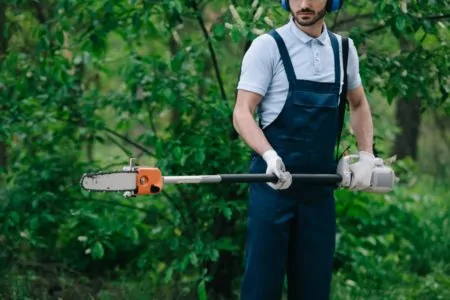
There are various power saws to choose from, and many of them will be suitable for more than one type of task. However, when you want to cut high branches on trees, a pole saw will be the best tool for the job.
These saws are mounted on long poles, greatly extending your reach while keeping your feet planted safely on the ground. A good pole saw can transform the way you work outdoors, but there are many different models to choose from and it is important to make sure you select one that is safe and effective.
To help you make the right choice, we have reviewed seven of the best pole saws that are currently available. We chose these saws for their cutting power, fuel source, and how much reach they provide.
- Automatic oiler
- 65 cuts per charge
- 3-piece pole
- Lightweight at 7 pounds
- Beginner-friendly
- Telescoping pole
- 110 cuts per charge
- Weighs under 10 pounds
- Interchangeable battery
- 42.7cc engine
- Can be used anywhere
- 12-month warranty
- User-friendly
- No maintenance
- Adjustable length
- Cordless
- 42.7 cc engine
- Will complete work quickly
- 5-in-1 kit
- Includes protective equipment
- Very versatile
Review Methodology: At Sensible Digs, we pride ourselves on our thorough, hands-on analysis and assessment of the best pole saws on the market. Our experienced professionals use strict benchmarks and criteria to evaluate each saw from a user’s perspective. We track and compare performance, measure capabilities, and review design choices, providing you with detailed data and evidence to support our findings. Our tests focus on key decision-making factors such as power, reach, weight, and ease of use. We also consider the saw’s unique features that set it apart from its competitors. Our aim is to help you rank and choose the best pole saw based on solid research and results.
The Best Pole Saws of 2024
Pole saws are among the most popular power tools for outdoor use, which means there are now many different models to choose from, made by some of the leading names in tools today. After a lot of research, we have reviewed seven of the best pole saws that are currently available, chosen for their user-friendliness, reach, cutting strength, and how they are powered.
Greenworks 20672 Cordless Pole Saw
Best Battery Pole Saw
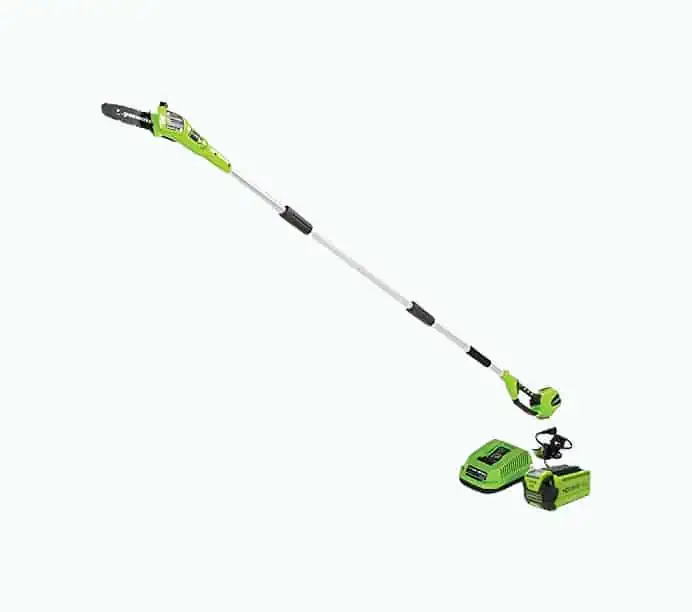
This Greenworks cordless pole saw is powered by a lithium-ion battery, which should retain its charge for longer. Its efficient battery extends its running time, with Greenworks claiming that you can make about 65 cuts per full charge.
At 15.3 pounds, this pole saw is as heavy as some gas-powered models, which is unusual for a battery-powered saw. It has a 3-piece aluminum pole that can reach 8 feet, and an 8-inch cutting bar and chain for tackling thick branches.
It also has an automatic oiler that lubricates the bar and chain when required to preserve the saw for longer. Battery-powered saws are already low-maintenance, so this feature makes it even easier to care for.
What We Like
Automatic Oiler
This saw automatically lubricates its bar and chain with oil. The result is less wear and tear on the moving parts, and a saw that can operate more efficiently.
65 Cuts Per Charge
The manufacturer claims this saw will make about 65 cuts per charge, which should be plenty for most gardens. This long battery life means it is also suitable for removing thicker limbs.
3-Piece Pole
The pole comes in three sections, which enables you to choose the length you want. This is handy for adjusting the height from low to high branches.
Warranty
This Greenworks pole saw has an excellent 4-year warranty. That is twice as long as many of its competitors.
What We Don't Like
Heavy
This saw is quite heavy, especially for a battery-powered tool. At over 15 pounds, it weighs as much as some gas-powered pole saws.
Price
This pole saw isn’t cheap, which is probably due to its excellent battery and long pole.
Product Specs
| Reach | 8 feet |
| Pole Type | Three-piece adjustment |
| Blade Size | 8 inches |
| Weight | 15.3 pounds |
| Suitable Uses | Medium size branches and general garden use |
| Cost | $$ |
| Warranty | 4-year |
Our Ratings
User Experience
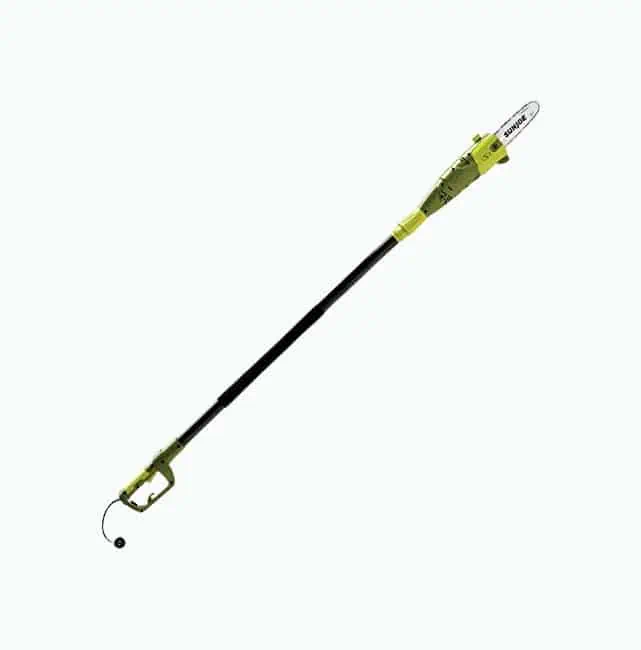
Sun Joe SWJ800E 8-Inch Pole Saw
Best Value for Money
This Sun Joe corded pole saw offers excellent value for money and is available for half as much as some of its cordless equivalents.
Despite its low price, it still provides plenty of features. It has a telescoping pole that extends to 8.7 feet, an 8-inch blade head, and a 6.5-amp motor that cuts branches up to 7.5 inches thick.
It also lubricates its blade automatically, significantly reducing the amount of maintenance it requires. At 7 pounds, this saw is about half as heavy as the average gas-powered model. It is protected by a 2-year warranty, so you will have plenty of time to ensure it works properly after buying it.
What We Like
Lightweight
This pole saw weighs just 7 pounds, which means it can be used for a long time without too much effort. As a result, you should be able to take fewer breaks, speeding up your work overall.
Low Price
This saw is very budget-friendly, so much so that we chose it as our best-value option. This makes it a great option for beginners or people who only need to do some light pruning without breaking the bank.
Telescoping Pole
The telescoping pole is easy to adjust and can be extended to give you a maximum reach of 8.7 feet.
What We Don't Like
Short Power Cord
The power cord is very short and Sun Joe recommends using an extension cable of no longer than 25 feet. This means you will be restricted in where you can use this saw, especially if you have a long garden.
Product Specs
| Reach | 8.7 feet |
| Pole Type | Telescoping |
| Blade Size | 8 inches |
| Weight | 7 pounds |
| Suitable Uses | Medium size branches and general garden use |
| Cost | $ |
| Warranty | 2-year |
Our Ratings
Personal Perspective
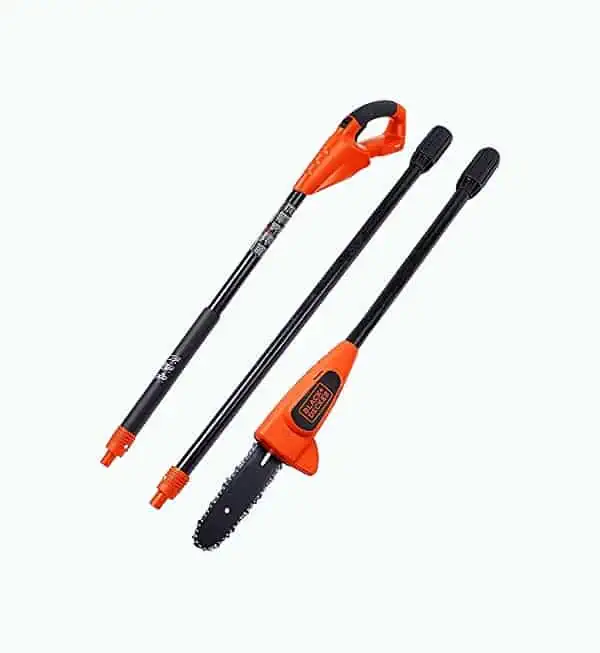
Black + Decker Max 8-Inch Pole Saw
Best Electric Pole Saw
Black+Decker has been one of the leading names in power tools for generations, so it is no surprise that this electric pole saw lives up to that lofty reputation.
The pole extends to 10 feet, and the 8-inch blade can chop as many as 110 times between charges, using 1.5-inch pine branches as an example. This means a great deal of pruning before you need to recharge the battery.
This pole saw has a maximum cutting diameter of 6 inches, so it won’t be suitable for removing thick branches. However, it is a great option for general pruning in the garden.
What We Like
110 Cuts Between Charges
This saw can cut about 110 small branches before it needs to be recharged, which means less downtime. Its power efficiency also means you won’t use as much energy to charge the battery.
Lightweight
At just under 10 pounds, this electric pole saw is lightweight and maneuverable. You will be able to work for longer without placing a significant strain on your body.
Interchangeable Battery
The lithium-ion battery is interchangeable with other cordless Black+Decker power tools. This means you can swap in another battery if this one runs out, and any extra batteries you purchase can also be used for other B+D tools.
What We Don't Like
Battery and Charger
The battery and charger are not covered by the saw’s warranty, which is unusual as they are part of the product.
Build Quality Issues
This saw is affordable, but it seems Black+Decker has used cheaper materials in its construction, resulting in some durability issues.
Product Specs
| Reach | 10 feet |
| Pole Type | Telescoping |
| Blade Size | 8 inches |
| Weight | 9 pounds |
| Suitable Uses | Medium size branches and general garden use |
| Cost | $ |
| Warranty | 2-year |
Our Ratings
Community Feedback
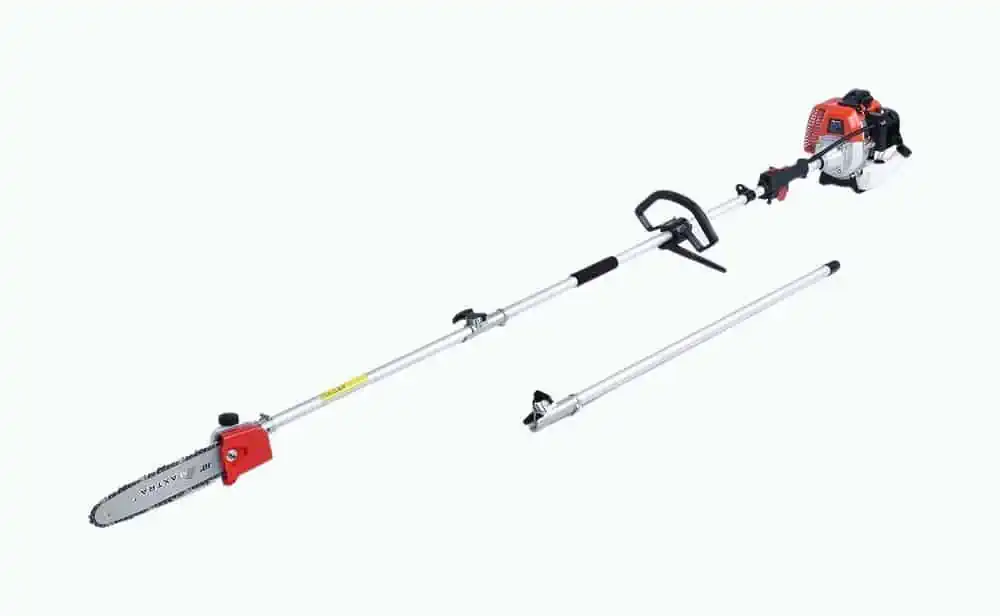
Maxtra Gas Pole Saw
Best Gas Pole Saw
This Maxtra gas-powered pole saw is a heavy-duty tool that will tackle thick, dense branches. It has a 3.6-foot extender pole that can reach up to 15 feet. The blade can also be adjusted from 90 degrees up to 180 degrees, ideal for making awkward cuts.
The saw blade is 10 inches long and powered by a 42.7cc engine, enough to cut through tough wood. As it is a gas pole saw, you will have the freedom to take it anywhere. This makes it an excellent option if you have a large garden or need a saw for large-scale work.
What We Like
High Power
This Maxtra saw will rip through most wood and makes short work of cutting tasks. Its gas-powered engine is far more powerful than electric pole saws.
Go Anywhere
Gas-powered saws provide greater freedom than other power saws. You can take them to the far end of your garden, however large it is, or even to work in other locations. Unlike a battery saw, you won’t need to plug it in to refuel it, as long as you have a can of gas with you.
12-Month Warranty
A one-year warranty means you can buy this saw with confidence and ensure it works properly. Reviews also praise the quality of Maxtra’s customer service.
What We Don't Like
Price
Gas-powered pole saws are generally the most expensive type and this saw is no exception. It costs three times more than some of the other power saws on this list.
Product Specs
| Reach | Up to 16 feet |
| Pole Type | Rotating Extender pole |
| Blade Size | 10 inches |
| Weight | 22 pounds |
| Suitable Uses | Medium-sized branches and more difficult cutting tasks |
| Cost | $$$ |
| Warranty | 1 year |
Our Ratings
First-Hand Impression
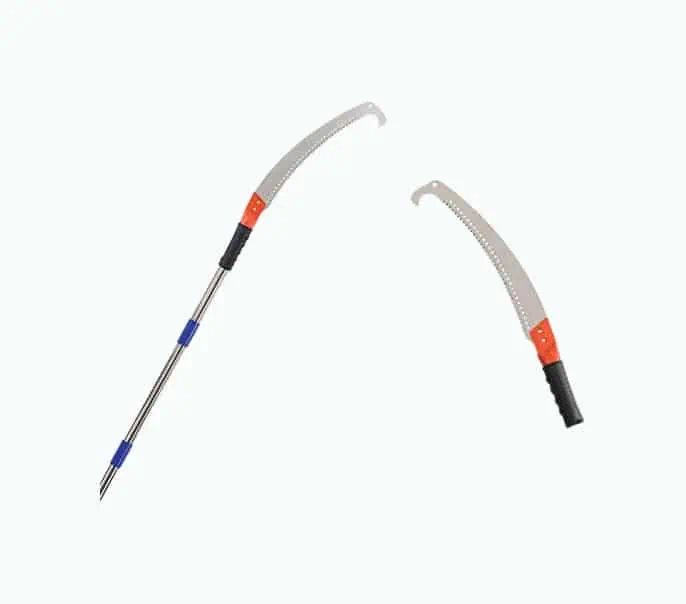
Hosko Hand Pruning Saw
Best Manual Pole Saw
In contrast to the power saws we have reviewed, this Hosko product is a manual pole saw, which means you will need to use your arm strength to move it back and forth and cut wood.
As it is a manual saw, you never need to worry about it running out of fuel or adding to your electrical bills. It can be taken absolutely anywhere, making it very versatile. This versatility is enhanced further by the fact that the saw can be detached from the pole, meaning you won’t need to carry an extra handsaw for pruning.
This saw has a 22.8-inch pole, helping you reach high branches. It has a single-sided barb design for more efficient sawing, which is particularly important when you will be cutting by hand.
What We Like
Simple to Use
Using this manual saw is as straightforward as it gets. You can simply take it from the box and start cutting.
No Maintenance
Other than sharpening the blade occasionally, this saw won’t require any maintenance to keep it cutting effectively.
Detachable Saw
The saw can be detached from the pole, so you can also use it as a hand tool. The threads are universal and should fit any standard extension pole.
Won’t Malfunction
There are no moving parts, so you won’t need to worry about this saw malfunctioning. You should be able to use it for years to come.
What We Don't Like
Requires Physical Strength
Although this saw is lightweight, it requires physical strength and endurance to use as it is a manual saw. This means it won’t be suitable for people with limited strength and dexterity.
Slower Work Rate
As you are sawing manually, it is inevitable that you won’t be able to cut as quickly as if you were using a power saw. This shouldn’t be a problem for occasional cutting but could be an issue if you have a large garden.
Product Specs
| Reach | 12 feet |
| Pole Type | Telescoping pole |
| Blade Size | 12 inches |
| Weight | 4 pounds |
| Suitable Uses | Small to medium-sized branches and general garden pruning |
| Cost | $ |
| Warranty | 100% returns policy |
Our Ratings
User Experience
Maxtra Gas Pole Saw
Best Pole Saw for Thick Wood
This Maxtra gas-powered pole saw has a 10-inch saw blade and is capable of cutting through branches that are 7 to 9 inches thick, depending on the type of wood. It is mounted on an extender pole that can reach a maximum length of 11.4 feet letting you cut branches as high as 15 feet.
This saw will cut through the majority of tree limbs with ease thanks to its powerful 42.7 cc engine, which provides a maximum speed of 7,500 RPM.
What We Like
Cordless
Gas power means this saw can go anywhere, without needing access to an electrical outlet. On a full tank, it will keep cutting long after a battery would go flat.
Very Powerful
If you are struggling to cut a particularly tough branch, this powerful pole saw should make short work of it. With a 42.7 cc engine that produces 7,500 RPM, it should rip through even the densest types of wood.
Works Quickly
Gas pole saws are the best option when you want to make numerous cuts quickly. They make rapid cuts and will keep working for a long time on a full tank of gas, so you will be able to prune your garden in relatively little time.
What We Don't Like
Weight
The powerful engine adds weight to this pole saw, bringing it to a total of about 18 pounds. This is heavy even for a gas-powered saw, so it won’t be suitable for everyone.
Expensive
This saw is expensive, and it might be unnecessary unless you need one that can cut through the toughest branches. You are unlikely to need a saw this powerful for general garden pruning, so you could save money by choosing another option.
Product Specs
| Reach | 11.4 feet maximum |
| Pole Type | Telescoping pole |
| Blade Size | 10 inches |
| Weight | 18 pounds |
| Suitable Uses | 6 to 9-inch branches and heavy-duty work |
| Cost | $$$ |
| Warranty | 1-year |
Personal Perspective
Proyama 5-in-1 Multi-Functional Gas Trimming Tool Set
Best Pole Saw for Commercial Use
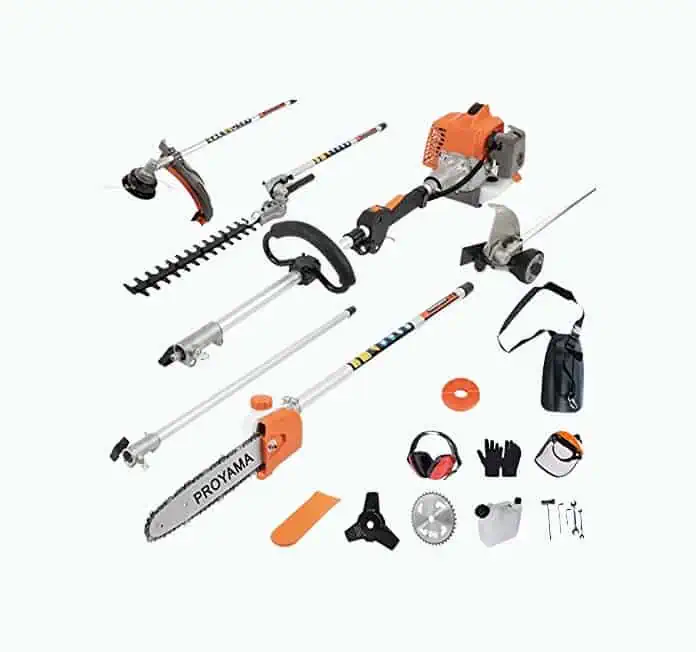
This Proyama multi-purpose gas pole trimming set contains everything you need to shape trees, whether you are an amateur or a professional. It includes a hedge trimmer attachment, a pole saw, a string trimmer, and a brush trimmer.
You will even receive safety gloves, a face shield, a hard hat, and ear defenders to ensure you have the necessary protective equipment.
This saw has a 26 cc engine and a pole that extends up to 11.4 feet. The blade itself is a substantial 12 inches, so it should be able to handle whatever you ask of it.
What We Like
5-in-1 Kit
This kit is a complete solution for heavy-duty garden cutting and trimming. Whatever you need to do to your trees, this set should have an attachment that is suitable for the task.
Protective Equipment
If you are looking to start working as a commercial gardener or groundskeeper, this kit contains all the personal protective equipment you need. These include a hard hat, face shield, and ear defenders.
Excellent Value
You should be able to find this pole saw at a similar price to others in its class, despite having numerous accessories. This makes it an excellent option if you want a complete pole saw solution without breaking the bank.
What We Don't Like
Heavy
When mounted on its pole attachment, this saw weighs about 18 pounds. That is a lot of weight to carry around, especially if you need to work for hours at a time. Consider whether or not you are up to the task physically.
Confusing Instructions
This might not be a deal-breaker if you know what you are doing, but the instructions are not well translated into English. Considering how careful you need to be when using a pole saw, this could be a major drawback.
Product Specs
| Reach | 11.4 feet maximum |
| Pole Type | Telescoping pole |
| Blade Size | 12 inches |
| Weight | 18 pounds |
| Suitable Uses | 6 to 9-inch branches and heavy-duty work |
| Cost | $$$ |
| Warranty | 1-year |
Our Ratings
Community Feedback
| Product | Best | Reach | Pole Type | Blade Size | Weight | Suitable Uses |
|---|---|---|---|---|---|---|
| Greenworks 20672 Pole Saw | Battery | 8 ft | Three-piece adjustment | 8″ | 15.3 lbs | Medium size branches & general garden use |
| Sun Joe SWJ800E Pole Saw | Value for Money | 8.7 ft | Telescoping | 8″ | 7 lbs | Medium size branches & general garden use |
| Black + Decker Max Pole Saw | Electric | 10 ft | Telescoping | 8″ | 9 lbs | Medium size branches & general garden use |
| Maxtra Pole Saw | Gas | 16 ft | Rotatable Extender pole | 10″ | 22 lbs | Medium size branches & heavier cutting tasks |
| Hosko Pole Saw | Manual | 22.8 ft | Telescoping pole | 12″ | 4 lbs | Small to medium-sized branches & general garden pruning |
| Maxtra Gas Pole Saw | Thick Wood | 11.4 ft | Telescoping pole | 10″ | 18 lbs | 6 to 9-inch branches & heavy-duty work |
| Proyama 5-in-1 Gas Trimming Tool | Commercial Use | 11.4 ft | Telescoping pole | 12″ | 18 lbs | 6 to 9-inch branches & heavy-duty work |
What Are Pole Saws Used For?
Pole saws are power saws mounted on a long pole, giving them much greater reach than standard saws, particularly chainsaws. This makes them suitable for cutting objects that would otherwise be out of reach, particularly high branches, without needing to climb a ladder.
Using a power saw on a ladder is always dangerous, but particularly so when working outdoors on uneven ground. A pole saw also makes it possible for people with limited mobility to make cuts that would otherwise be impossible for them to reach.
Types of Pole Saws
You will have four main types of pole saws to choose from:
Electric pole saws are the most common type and can be found in garages and storerooms around the world. They are generally less expensive than other pole saws with alternate power sources and they emit zero emissions.
These types of pole saws are among the easiest to use. Simply plug them into an electrical outlet and you can start cutting.
Pros
- Convenient
- Easy to use
- Affordable
- Relatively safe
- No emissions
Cons
- Limited range
- Reduced power
- Suitable for light pruning
Battery
Battery pole saws are also electrical saws but they allow you to go anywhere, which is important for any outdoor tool. This is especially true if you have a large garden and it also means you won’t accidentally cut the cord or become tangled.
The only downside is that you will need to remember to charge the battery before you can use the saw. For this reason, it is a good idea to keep a spare battery charged so you won’t have to worry about running out in the middle of a job.
Newer pole saws typically use lithium-ion batteries, which are more efficient and can be charged faster.
Pros
- No power cord means a longer reach
- Can access distant corners of your garden
- Doesn’t release any emissions
Cons
- Batteries have a limited life
- Need to be charged frequently
- Battery increases the price
Gas
Gas pole saws are the most heavy-duty type, with greater cutting power and a longer reach. They are suitable for cutting through thick, tough branches and don’t need charging, which is why they are used by professionals working outdoors.
The size and torque of these saws make them the best option for serious garden work. However, their motors and gas tanks mean they are heavier than electrical saws, so they require some strength to use, especially for prolonged periods.
Pros
- Powerful
- Cuts thicker branches
- Can go anywhere
Cons
- Heavy
- Expensive
- Need to buy fuel
Manual
The manual pole saw is the safest, most eco-friendly type. It isn’t powered, so you will need to rely on your upper body strength to cut with it, which means these saws are more suitable for light pruning rather than thick tree branches.
There are obvious downsides of a manual pole saw; they can be exhausting to use and cut far more slowly than their powered equivalents.
Pros
- Least expensive type
- Very safe
- No fuel source required
- Can be used anywhere
- Very environmentally friendly
Cons
- Requires physical strength
- Tiring to use
- Slower cutting rate
- More suitable for small-scale pruning
How to Choose a Pole Saw
There are many pole saws to choose from, with varying cutting power and reliability. To narrow your search, you should pay special attention to the following aspects:

Reach
Pole saws are designed to cut high branches, so how far they can reach is one of their most important qualities. Most of these saws have a telescoping pole that can be extended to safely cut low and high branches.
Keep in mind that the ranges specified by some manufacturers include the average height of users, so how far you can reach might vary. In other words, a pole that is an ideal length for a tall user might not be long enough for a short user to reach the same branches.

Power Source
The three power sources (not including manual) each have advantages and possible drawbacks:
| Power Type | Suitable Use | Suitable Users |
| Electric | Lighter pruning that is relatively near electrical outlets. General gardening use. | Gardeners and novice users. People with relatively small gardens. |
| Battery | Light use and general pruning. | People with larger gardens, for pruning away from electrical outlets. |
| Gas | Heavy-duty cutting and thicker tree branches. | Professional tree surgeons, gardeners, and other experienced users. |

Physical Restrictions
When choosing a pole saw, consider how fit and mobile you are. Gas pole saws are about twice the weight of electric saws, usually weighing around 18 pounds. This might not sound like much, but consider that you will need to hold it up, with the majority of its weight at the far end of the pole.
If you are concerned that a gas pole saw might be too heavy for you, consider an electric model instead. Electric pole saws typically weigh 8 or 9 pounds, which is much lighter. Unfortunately, they are also less powerful, so you shouldn’t expect them to be able to complete the same tasks as a gas saw.
You should only choose a manual pole saw if you are fit and have upper body strength. Removing tree limbs with a power saw is tiring enough, never mind a manual one. It is slow, demanding work.

What Will You Be Pruning?
What you need to cut will influence the type of pole saw you should buy. For thicker branches, choose a gas-powered saw, which will be suitable for almost any task. Don’t attempt to save money by buying an underpowered electric saw, as it probably won’t be able to cope with the task.
On the other hand, if you are removing smaller branches and pruning shrubs and bushes, you can choose an electric saw, whether it is battery-powered or has a cord. These types of saws will be ideal for the majority of users and are much lighter than gas-powered saws.
If you only occasionally need to cut small branches, consider a manual pole saw. These saws are the cheapest to buy but require the most physical strength and endurance to use. For this reason, if you have limited mobility or strength, you should consider a powered pole saw instead.

Maintenance
Like any power tool, your pole saw will require regular maintenance to keep it working properly. This is especially true of gas-powered saws, which will require cleaning, oiling, and occasionally being stripped down to troubleshoot any issues you encounter.
If you prefer to avoid maintenance, you should choose an electric pole saw instead. These saws will largely take care of themselves, as long you use them properly.

Warranty
Warranties reflect a manufacturer’s confidence in the quality of its products. If they offer a short warranty, it might be because an item lacks durability.
If the warranty is long, it is because the manufacturer has faith in its products. After all, they are unlikely to guarantee a tool to keep working past its expected lifespan.
Before you buy a pole saw, try to find some customer reviews online. This will give you a sense of how a saw performs during real-world use and the honest feedback of people who have used it.

Frequency of Use
If you only need to trim some minor foliage once a year, you can save money by choosing an electric or manual pole saw. These should be up to the task, as long as you aren’t trying to cut anything too thick.
However, if you are a professional or have a large garden and need to remove branches frequently to stay on top of the growth, you will need a more powerful saw. In this scenario, a gas-powered saw will be more suitable.

Price
When buying any tool, the price is an unavoidable part of the equation. If you want to spend as little as possible, choose a manual pole saw. They are simple to use, don’t require any fuel, and rarely fail.
However, if you have enough money, you will be better off with a powered pole saw. An electric saw should be sufficient for the majority of pruning tasks in your garden without breaking the bank.
If you need a more heavy-duty saw, you should try to get a gas pole saw. They are more expensive to buy and run, but they also deliver far more power and will help you work quicker and easier.

Safety
There is an element of danger when using any power saw. This is especially true of pole saws as you will be raising them overhead and cutting potentially heavy branches. To prevent accidents, you should ensure you also have the proper protection:
- Goggles protect you against splinters and sawdust.
- Gloves protect your hands and make it easier to maintain a grip on the saw.
- Hard hats protect against falling debris and branches.
- Thick clothes will protect your body against falling debris.
- Sturdy shoes or boots that will protect your feet if anything falls on them.
FAQs

Can I Use a Pole Saw to Trim Hedges?
You can use a pole saw to trim hedges but you shouldn’t unless the hedge is high to reach. In general, you should trim your hedges with a hedge trimmer.
These two tools are relatively similar, except a hedge trimmer has fewer teeth, which are set further apart. This makes them better suited to cutting soft foliage rather than tougher materials such as thick branches.
It is also possible to get hedge trimmers that can be mounted on poles. If you want to save money, you can use your pole saw, but you are less likely to achieve a neat finish.

Are Battery Powered Pole Saws Any Good?
Battery-powered pole saws can be very effective for less intense tasks such as cutting twigs and thin branches. They have similar cutting power to corded saws, but with far greater freedom as you won’t need to stay near an electrical outlet.
If you need to trim your entire garden or work professionally, it is worth keeping a spare battery charged. Otherwise, you might have to wait 4 to 6 hours for your saw’s battery to recharge.

What Thickness Can a Pole Saw Cut?
The maximum thickness you can cut will vary depending on the specific model. Generally, the limit will be between 6 and 7 inches with a blade of about 10 inches. However, some gas-powered saws with larger blades can add a couple of inches to this. If you want to cut through thicker branches, you will probably need to climb a ladder and do it with a chainsaw.

How Do I Use a Pole Saw?
1. Prepare the Area
Clear the area under the tree you want to prune and cordon it off if there is any risk of someone coming along. Check for uneven ground and any surface roots that could present a trip hazard. Remove anything that makes it more difficult to stand safely.
2. Prepare Yourself
With the area clear, put on safety goggles, gloves, and a hard hat to protect you from falling debris. You might also want to wear ear defenders if you have a gas-powered saw, as they can be loud during use.
3. Plan Your Cuts
Look at the tree and consider which branches you want to cut and in what order. If you are removing a longer branch, remember to make several cuts to gradually reduce its length, rather than a single cut near the trunk of the tree.
4. Prepare the Saw
Extend the pole to the required height and make sure you lock it into position. If the pole is loose, the saw might retract while you are cutting, which could be very dangerous.
Familiarize yourself with how the saw feels and how its weight is balanced. Once you have, place the blade against the branch where you want to make the first cut.
5. Position Your Body
Stand with one foot forward to take the weight of the saw and maintain your balance. Your front hand should hold the pole at approximately chest height, while your other hand holds the base. Don’t stand directly below the branch you are cutting as this will lead to it falling on you.
6. Start Sawing
Hold the saw blade perpendicular to the branch and start by slowly cutting a groove. This groove will act as a guide later when you increase the cutting speed. The blade of the saw will likely bounce along the branch until it bites, so make sure you hold it securely.
As the saw blade starts to cut through the wood, apply steady pressure to ensure it stays in place.
7. Increase Speed
Once the saw’s blade is safely in the groove, increase its speed to continue cutting through the wood. Before long, you will cut through the branch and it will fall to the ground. Be sure to stay at a safe distance and out of the way of any falling debris, as the branch might have been holding up dead branches.
Repeat this process for any other branches you need to cut.

How Much Does It Cost to Rent a Pole Saw?
If you want to rent a pole saw rather than buy one, expect to pay between $20 and $100 per day, depending on the type of saw. Many companies increase their prices at the weekend and during the summer months when demand is at its highest.

Are Pole Saws Worth It?
Pole saws can be powered by gasoline, electricity, or battery. They’re also available in different sizes, depending on the diameter of the branches being cut.
The main benefit of using a pole saw is that it helps to prevent ladder injuries. According to the CDC, more than 500,000 people yearly are treated in hospital emergency rooms for ladder-related injuries.
Ladder falls are often caused by overreaching, losing balance, or climbing with your hands full. A pole saw eliminates the need to climb a ladder, which reduces the risk of falling and injuring yourself.
Another benefit of using a pole saw is that it helps you to save time and energy. If you need to trim branches high up and out of reach, a pole saw can help you do the job quickly without having to set up a ladder.
This is especially helpful if you have a lot of branches to trim or if the branches are thick and require multiple cuts.
There are some downsides to using pole saws, including the risk of electrocution if you’re using an electric model near power lines.
Gasoline-powered models can also be dangerous if they leak gas or oil onto the ground. Also, pole saws can be more expensive than traditional handheld saws.
But, when you consider the time and energy you can save using a pole saw and the safety benefits, many people find that they are worth the investment.

How Long Does a Pole Saw Blade Last?
On average, a pole saw blade will last for about a month before it needs to be replaced. However, this can vary depending on how often the saw is used and what material is cut.
If the saw is used frequently or if it is used to cut hardwood, then the blade will need to be replaced more often.
Conversely, if the saw is only used occasionally or if it is used primarily to cut softwoods, then the blade will last longer. Regardless of how often the saw is used, it is important to inspect the blade regularly and sharpen or replace it as needed to keep the saw in good working condition.

Can I Use a Pole Saw Like a Chainsaw?
You can use a pole saw like a chainsaw, but that depends on what you’re cutting. Gas-powered pole saws are designed for cutting branches and limbs high up in trees. Their long reach makes them ideal for pruning, but they can also be used for felling small trees.
While a gas-powered pole saw may look like a chainsaw, the two tools have some important differences. For one, a gas-powered pole saw is much lighter than a chainsaw, making it easier to handle.
Additionally, a gas-powered pole saw typically has a smaller cutting blade, which helps to reduce kickback. Gas-powered pole saws usually have an adjustable cutting head, which allows you to customize the angle of the blade for more precise cuts.
While a gas-powered pole saw may not be as powerful as a chainsaw, it can still be useful for completing various yard tasks.

What Is the Difference Between a Pole Pruner and a Pole Saw?
The trimming and pruning of larger trees with the assistance of telescopic poles can be accomplished with either a pole saw or pole pruning shears.
However, each garden equipment has its own set of highly specific applications and benefits that set it apart from the other.
The use of pole saws, which can be either manually operated, electrically powered, or gas-powered, is primarily limited to the rough cutting of huge branches that are both too large and too high for ordinary chainsawing.
But, pole pruning shears are specifically designed for precise tree trimming and pruning with a large canopy.
In a nutshell, pole saws are used to cut branches that would otherwise be inaccessible, while pole pruning shears are used for precisely trimming such branches.

Which Pole Saw Has the Longest Reach?
For pole saws with a long reach, inspect the Sun Joe SWJ800E. Because of its low weight (7 pounds), this pole saw eliminates the need to put unnecessary strain on your arms and back while working with it.
Additionally, it permits you to work for extended periods without needing to take breaks.
If you have never used a pole saw before, purchasing a model like this one that is not too expensive is the ideal way to get started without breaking the bank. This pole saw’s most notable characteristic also led us to determine that it offers the most value for the money.
The saw can be adjusted to any height you choose thanks to the telescopic pole, which is also very easy to operate.

Which Pole Saw Is the Lightest?
HOSKO’s pole saw is the perfect option for people who want a lightweight tool to trim tall branches and large bushes.
This manual pole saw doesn’t run out of power unless you do which is a great feature to look for.
Because the pole on this model is 22.8 inches long, you can reach even the highest branches. Even more effective tree-trimming is possible thanks to its barbed design on one side.
The only maintenance required to keep this saw in functioning shape is to make sure that the blades are kept sharp.
It’s possible to use the saw as a hand tool because it may be detached. All conventional extension poles can be used with these threads because they are universal.

What Brand of Pole Saws Is the Best?
Greenworks is pretty popular and is a brand known for its quality and durability, especially in its pole saws. They have a wide variety of pole saws to choose from, and each one is designed to tackle a specific task.
For example, the Greenworks G-MAX 40V Cordless Pole Saw is perfect for trimming branches and cutting through thick brush.
If you need a more powerful saw, the Greenworks Pro 80V Cordless Pole Saw can handle even the toughest jobs.