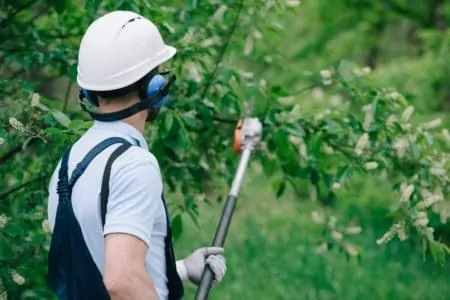
Trees and shrubs are beautiful natural garden features but it is important to keep them under control. This means pruning them, which can be difficult if they are already large.
A pole saw has a long reach, which allows you to cut high branches without climbing a ladder. Keeping your feet on the ground is much safer but it is still important to learn how to use these saws properly.
In this article, we will explain how to use a pole saw to keep your trees and shrubs under control. This includes what you can cut, the equipment you need, how to make cuts, and some important tips.
Key Takeaways
- Wear safety gear like a hard hat, goggles, gloves, and earplugs while using a pole saw.
- Pole saws are ideal for pruning, trimming, and brush clearing in your garden.
- Follow safety precautions like clearing the area, planning your cuts, and keeping a balanced stance.
- Use the pole saw at a 60-degree angle and avoid standing directly under the branch being cut.
What Can a Pole Saw Cut?
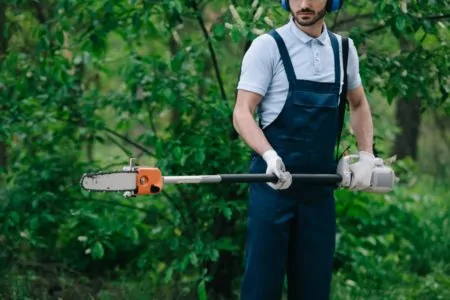
Pole saws are essentially chainsaws on the end of long poles, extending your reach significantly. This makes them ideal for some specific tasks:
Pruning
If you need to prune high branches, a pole saw will enable you to do it without climbing a ladder. Unlike traditional pole saws, which could be exhausting to use, modern power saws can remove branches in seconds.
Trimming
Pole saws are also useful for lighter garden work such as trimming bushes and shrubs. Wide bushes can be difficult to cut with manual garden tools but a pole saw will trim them easily with quick sweeps of the blade.
Brush Clearing
Brush grows quickly and can become a problem if left unchecked. A pole saw provides sufficient cutting power to chew through the most stubborn branches and makes short work of keeping your garden tidy.
What You Need
Like any DIY task, there are some important pieces of equipment you will need to complete the job safely.
Gloves
You should wear thick protective gardening gloves that will enable you to pick up branches, shrubs, and brush without worrying about thorns. They also help you maintain a secure grip on the pole saw for longer periods.
Goggles
Protecting your eyes against falling debris is essential. Most of the branches you cut will be above head height, so you might dislodge material caught in them and have it fall toward your eyes.
Hard Hat
You shouldn’t stand directly below the branches you are cutting but accidents happen. To protect yourself against branches that fall unexpectedly, you should always wear a hard hat.

Earplugs
Pole saws are loud, especially gas-powered models. Using one for prolonged periods can damage your hearing, so you should wear earplugs or other ear protectors while making cuts with a pole saw.
A Rake
Keep a garden rake nearby so you can gather the leaves and twigs that fall onto the ground. If you are cutting several branches, it is also a good idea to have a wheelbarrow ready to remove them later.
How to Use a Pole Saw Safely
Pole saws are simple tools and will cut through shrubs and branches quickly. However, there are some important steps you should take before, during, and after the cutting process.
1. Before You Start
- Remove any fallen branches or large stones from the area where you will be standing. Pole saws are powerful tools, so it is critical to remove any trip hazards to ensure you don’t lose your footing.
- Decide which branches you want to cut in advance to help you work safely. Removing smaller branches first will make it easier to access thicker and taller limbs. You should also remove longer branches in sections rather than in one large piece.
- Hold the saw so its weight is balanced and it feels comfortable in your hands. When fully extended, pole saws can place a strain on your arms and back.
- Adopt a comfortable, balanced stance to ensure you don’t fall while cutting.
- Only use a pole saw when the weather is dry. Rain will make the ground slippery and increase the risk of losing your footing. It will also make it more difficult to maintain a grip on your electric pole saw, and you shouldn’t expose the tool to rain.
- Only makes cuts in daylight. If you can’t see your work clearly, you won’t be able to complete it safely.
- If your saw isn’t cordless, always be aware of where the power cord is. Cords are a common trip hazard and you need to avoid cutting them accidentally.
- Never try to force the saw to cut more quickly than it is capable of. If you apply too much pressure, you could lose your balance and suffer an injury.
- Don’t cut trees if there are low-hanging power cables nearby.
- Check for bird nests on the branches you want to cut. Try to remove branches at times when birds aren’t nesting in your region, so it is best to do it in fall and winter.
- When in doubt, hire a professional. Removing branches is relatively straightforward but you shouldn’t try it if you are uncomfortable.
2. Put on Your Safety Gear
Put on your protective goggles, gloves, hard hat, and earplugs. Falling debris is a common hazard when using a pole saw. It’s also important to make sure you are wearing appropriate clothing and footwear. Ideally, you should wear tough boots with protective toecaps. Thick clothes will also offer some protection if small pieces of debris fall on you.
3. Clear the Area
As mentioned previously, make sure there are no trip hazards or other obstacles that could cause you to lose your footing. It might be worth cordoning off the area you are working in, to prevent anyone else from wandering in while you are cutting.
Top Tip
4. Power Up
If you have a corded saw, plug it in, ensuring the cord is out of the way and won’t trip you or get cut accidentally.
5. Follow the Plan
Start removing branches, starting with those that are smaller and lower down to prevent them from breaking off the bottom branches unexpectedly. Place the saw’s blade against the top of the wood and press its trigger to start sawing. It should cut through the branch quickly, causing it to fall to the ground.
Top Tip
6. Cut the Thicker Branches
Once you have removed the smaller branches, you can start cutting the thicker limbs. Don’t try to cut them off with a single sweep. Make a groove cut at a 45-degree angle, followed by a straight downward cut so the two cuts connect. Then, place the saw’s blade in the point of the groove and slice through the branch, increasing the speed as it progresses through the wood.
Top Tip
7. Power Off
Once you have successfully removed all the branches you want to be gone, unplug or switch off the saw. Make sure the saw’s blade has stopped completely before going near it. You can now remove your safety goggles and ear protection and start cleaning up.
Tips on How to Use a Pole Saw
Always Cut Branches From Above
Placing your saw’s blade on the top of a branch will help you cut more easily without needing to stand in the path of falling debris. Gravity will also encourage the blade to work its way through the wood. There will be situations where you need to cut the underside of a branch but you should avoid it where possible.
Read the Owner’s Manual
You should always read the owner’s manual before using a power tool for the first time. This will teach you exactly how to operate it and how to deal with any common situations that might occur.
Practice
Before trying to tackle major cutting tasks, practice using your pole saw for smaller cuts to familiarize yourself with how it feels to use it. This will reduce the risk of any surprises when you use it for larger-scale cutting later, which will improve your overall safety.
Use a Safety Harness
A safety harness clips onto the saw and connects to your torso. This also takes some of the saw’s weight, so you won’t have to carry it all with your hands. As a result, prolonged use will be more comfortable, which makes a harness ideal for larger pruning jobs.
Wear Steel-Capped Boots
Ideally, no branches or debris will fall on you but accidents happen, so it is worth wearing protective footwear. Boots with steel toecaps are designed for industrial use so they will save your toes if anything falls on them. They also have thick soles to reduce the risk of slipping, so they are ideal for working in your garden.
Pole Saw FAQs

What Thickness Can a Pole Saw Cut?
Pole saw heads usually range in size from 8 inches to 12 inches. The longer the head, the thicker the branches it will be able to cut. Gas-powered pole saws are more powerful than electrical models and can handle heavier-duty cutting tasks. This is why professional gardeners and tree surgeons prefer to use gas-powered pole saws.
The maximum thickness you can safely cut with a pole saw is generally between 7 and 9 inches.

Can You Use a Pole Saw to Cut Down a Tree?
This depends on the thickness of the tree and the size and power of your pole saw. If it is a small tree with a thin trunk, a pole saw will cut it down effectively, just as it would if you were removing a small branch from a large tree.
However, you probably won’t need to use a pole saw for these trees, as they can easily be removed with a handsaw. If you need to cut a thicker tree trunk, a pole saw won’t have enough power or a large enough blade. You should use a standard chainsaw or, if you prefer to use manual tools, a sharp axe.

Can You Use a Pole Saw on a Ladder?
It is possible to use a pole saw while standing on a ladder but you should avoid doing it. Pole saws are designed to allow you to make high cuts while staying on the ground. If the branch you want to cut is so high that you need a ladder in addition to a pole saw, it might be best to contact a professional to discuss your options.
How High Can a Pole Saw Reach?
The maximum reach of a pole saw varies from model to model. Most powered pole saws extend to have a reach of around 8 to 12 feet. However, manual pole saws are capable of reaching far beyond this, with some as long as 16, 18, or even 20 feet.
Manual pole saws are lighter as they don’t have motors mounted alongside their blades. This makes it far easier to hold longer poles due to their lack of extra weight.

Are Pole Saws Worth It?
Investing in a pole saw can be well worth it for anyone who needs to trim trees, shrubs, or bushes. Pole saws allow the job to be done safely and effectively from a comfortable standing position – no need to use a ladder or climb the tree itself.
They are much more lightweight and maneuverable compared to traditional chainsaws, making them easier to use in tight spaces or over extended periods.
Many modern pole saws come with features such as adjustable heads and extendable handles, which give users greater control and reach when cutting.
All in all, pole saws make a great addition to any toolbox for those looking for an efficient way of pruning their outdoor plants.

What is the Rope on a Pole Saw For?
The rope on a pole saw provides users with maximum control when cutting branches. It’s typically attached to the handle of the pole saw to give you greater leverage when pulling it down to make cuts.
It also allows for much smoother operation, as it helps keep the pole saw in place and steadies the user’s motions. This feature also makes it much easier for beginners to learn how to properly operate a pole saw without fear of injury or damage due to a lack of experience.

Do I Need Oil for Pole Saw?
Having the right oil for your pole saw is crucial to keeping it running smoothly. The job of oil is to lubricate the bar and chain of a pole saw and reduce friction between two moving parts.
Without proper lubrication, the chainsaw can wear much faster and become ineffective at cutting wood. Poles operated without oil tend to generate more heat which can cause significant damage to vital components like sprockets or drive links.
Therefore, when you purchase a new pole saw, check if it comes with enough oil to prolong its life and ensure maximum performance for many years to come.

Can You Turn a Chainsaw into a Pole Saw?
Although it is not recommended, turning a chainsaw into a pole saw is possible. To do so, you will need to buy an attachment that securely sits on the end of the chainsaw bar.
This attachment consists of either an aluminum or fiberglass pole with a handle and an adjustable blade at one end.
The advantage of this conversion type is that it gives you greater reach when cutting branches compared to using a traditional chainsaw. However, it also involves some risks, as the extra length increases the chance of kickback and other dangerous situations.
As such, we recommend only experienced users attempt this conversion and consider purchasing a pre-manufactured pole saw for maximum safety and convenience.

What Kind of Gas Do You Put in a Pole Saw?
To keep your pole saw running at its peak performance, you must use the right fuel. Generally speaking, you will want to use a two-stroke engine oil specifically designed for outdoor power tools such as pole saws.
This oil is designed to provide lubrication and reduce wear on the engine’s internal components.
It is important to make sure your gas has an ethanol content not exceeding 10 percent, as higher concentrations can cause damage and reduce the life of your motor’s internal components.
Using the right type of fuel will help ensure that your pole saw delivers top performance every time.

What is the Difference Between a Pole Pruner and a Pole Saw?
The blade is the main difference between a pole saw and a pole pruner. A pole saw has a long, curved blade designed to easily cut through branches and limbs.
A pole pruner has a specialized head with two blades: one for cutting and one for gripping.
The gripping blade enables you to make precise cuts when trimming or shaping small ornamental trees. While both tools are ideal for cutting branches close to the ground, their different blades make them suitable for different projects.
Another important difference is that a pole saw is an electric tool, and a pole pruner is a manually-operated one.