When looking for a faucet, it is easy to get overwhelmed by the countless options that are available. Thanks to the internet, there is now a wider range of faucets to choose from than ever before.
Glacier Bay offers numerous faucets in a variety of styles, which are also very budget-friendly. With so many faucets in their catalog, it can still be difficult to choose one.
In this article, we will take a detailed look at Glacier Bay, which company owns it, and why you should consider choosing one of its faucets. We have also written reviews of what we consider to be the brand’s five best faucets to inspire you when making your decision.
- Sleek design
- 16-inch pull-down sprayer
- Includes everything needed for installation
- Minimalist design
- WaterSense certified
- ClickInstall drain assembly
- Sleek waterfall design
- Suitable for small units
- 1.2 GPM flow
- 1.8 GPM side sprayer
- Large user-friendly handles
- 360-degree swivel
- Oil-rubbed bronze finish
- 50-inch pull-out hose
- FastMount installation
Review Methodology: At Sensible Digs, we pride ourselves on providing thorough and trustworthy analysis of the best Glacier Bay faucets available. Our team of experienced professionals meticulously researches, tests, and compares various Glacier Bay faucet models using a hands-on approach. We evaluate each faucet based on criteria such as performance, design, ease of installation, and durability. Our assessment includes first-hand experience, and we share quantitative measurements to ensure an accurate and unbiased review. We focus on key decision-making factors like water flow rate, material quality, and valve type, to help you make an informed choice. Our findings also highlight what sets each faucet apart from its competitors, ensuring you can confidently choose the best Glacier Bay faucet for your needs.
Best Glacier Bay Faucets of 2024
Glacier Bay offers numerous fixtures and most have very positive reviews, so narrowing it down to five was tough! After a lot of research and reading various reviews by customers and experts, here are our top five Glacier Bay faucet reviews.
Carla Pull-Down Sprayer By Glacier Bay
Best Glacier Bay Pull-Down Faucet
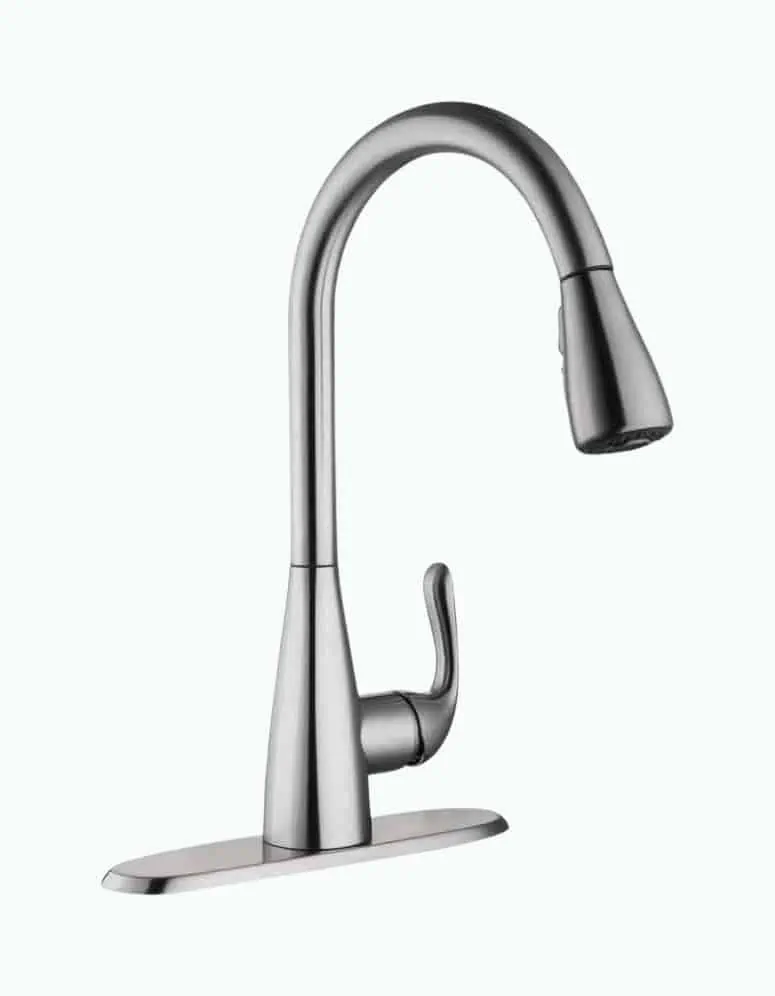
With a simple design and a pull-down sprayer, Glacier Bay’s Carla faucet is a great choice for a contemporary kitchen. It has a high arch design with an elegant stainless steel finish.
The sprayer head has two functions: an aerated spray and a powerful stream. The flow rate is kept at an effective yet water-saving rate of 1.8 gallons per minute.
One great feature is the pull-down hose, which reaches a decent length of 16 inches. This makes it perfect for deeper sinks.
Carla boasts Glacier Bay’s best construction quality — a metal body fitted with a ceramic valve — and it is protected by the brand’s limited lifetime warranty.
What We Like
Timeless Design
This faucet’s design is beautiful, from the sleek stainless steel finish to the subtle curve of the handle. It is ideal for a modern kitchen with a busy home cook. The 15.6-inch high arch is elegant without being too tall and is suitable for most kitchens.
Functional Pull-Down Sprayer
A good pull-down feature is very useful and Carla does not disappoint. The extendable hose reaches 16 inches in length — not the longest, but enough for a pull-down. If you have a deep sink, this will work for you.
The pull-down sprayer head offers two modes. The full spray is powerful but it still won’t exceed a 1.8 gallon per minute flow rate.
Glacier Bay fitted the mode switch on the back of the sprayer head. The timeless appearance of the stainless steel finish is maintained as there is no unsightly button in a different color.
Durable Body
Like most of Glacier Bay’s faucets, this one is made from metal with an attractive, hard-wearing finish. In this case, the finish is brushed nickel.
The ceramic cartridge provides protection against drips and leaks. Rather than merely suppressing the flow, it shuts it off completely, eliminating any risk of dripping.
Overall, this is a highly durable fitting that can comfortably keep up with the demands of a busy kitchen.
Effortless Installation
Installing this faucet is a breeze. Everything you need is included in the package, including the 33.6-inch supply line.
What We Don't Like
Weight Requires Adjustments
The pull-down hose uses a weighted retraction system, fitted under the sink. Some reviewers mentioned that it requires some adjustment to work properly. Ensure there are no obstructions and the weight is positioned correctly — it should be in the middle of the line.
Product Specs
| Material | Metal |
| Finish | Stainless steel |
| Flow rate | 1.8 gallons per minute |
| Faucet reach | 8.16 inches |
| Warranty | Limited lifetime warranty |
Our Ratings
User Experience
Dorset 2-Handle Bathroom Faucet By Glacier Bay
Best Glacier Bay Double-Handle Bathroom Faucet
This Dorset two-handle faucet is stunning yet versatile, and suitable for a range of decor styles. It is a sophisticated piece and coated in a sleek brushed nickel with a chic high-arch design.
Our example is the widespread model, which means the handles aren’t connected to the spout. It does require some space — 8 inches to be precise — but it is a great option if you have enough room.
It is WaterSense certified, with an ample flow rate of 1.2 gallons per minute, eliminating unnecessary water waste. Finally, it is straightforward to install.
What We Like
Sophisticated Design
Glacier Bay’s Dorset makes a great first impression. We admire the clean cut of the handles and the modern feel of the brushed nickel finish. The high arch spout adds to the overall appeal.
The Dorset is also available with center set double-handles, but we prefer the widespread look. The handles sit eight inches apart, which should fit most bathroom sinks.
If brushed nickel isn’t for you, don’t worry. Glacier Bay also offers oil-rubbed bronze and shiny chrome.
WaterSense Certified
Appearance aside, you might appreciate this faucets’ WaterSense certification. It keeps the flow rate at an optimal 1.2 gallons per minute. This means you will save water and reduce your utility bill.
Innovative Drain Assembly
If you are a DIYer, you will appreciate Glacier Bay’s ClickInstall drain assembly. It removes any risk of mistakes during the installation. It is a simple click-in procedure with everything you will need in the box.
What We Don't Like
Instructions Are Vague
Although Glacier Bay markets this as easy to install for DIYers, the included instructions are vague. For example, they fail to mention that you must cross the lines to fit them into the ClickInstall system.
Some information is also on different pages, so it’s easy to miss a step. If this is your first project, remember to read the instructions completely before you start.
Product Specs
| Material | N/A |
| Finish | Brushed nickel |
| Flow rate | 1.2 gallons per minute |
| Faucet reach | 6.49 inches |
| Warranty | Limited lifetime warranty |
Our Ratings
Personal Perspective
Kiso Single Hole Bathroom Faucet By Glacier Bay
Best Glacier Bay Bathroom Faucet for Modern Homes
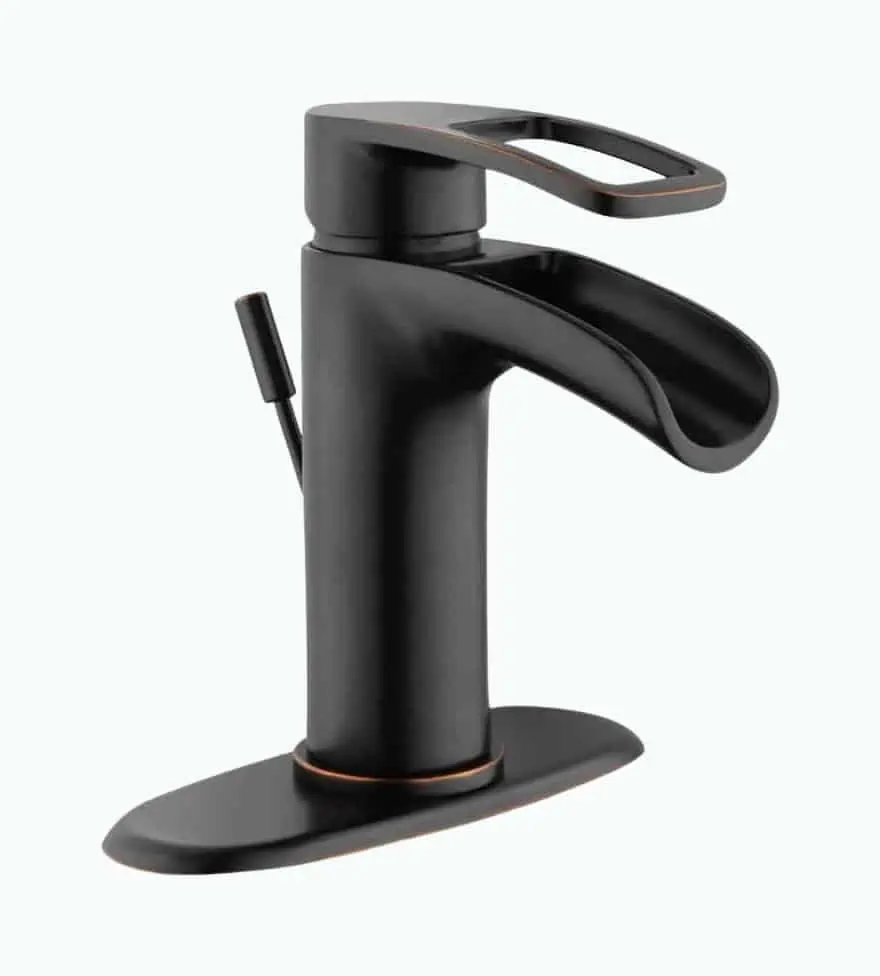
Glacier Bay’s Kiso has a stunning waterfall-inspired design with an open nozzle. It is very modern, yet the rich oil-rubbed bronze finish adds a rustic touch.
The Kiso has a single-hole, low arch design, occupying very little space on the vanity unit. It has a single handle on top to control the flow and temperature. We appreciate the WaterSense certification, which keeps the flow rate at 1.2 gallons per minute.
Installing this fixture requires a single-hole sink and about an hour of your time. Glacier Bay included its ClickInstall technology to make the process as straightforward as possible. The included faucet supply line size is 23.8 inches long, giving you some extra flexibility.
What We Like
Unique Design
This faucet is the perfect addition to a spa-inspired bathroom. The waterfall-modeled design adds a sense of zen to the room.
It is coated in a dark, rich, oil-rubbed bronze with some highlights around the base and the handle. If you don’t want a dark color, the Kiso is also available in brushed nickel and chrome.
Suitable for Small Vanities
As it’s a single-hole design, it doesn’t require much space on the sink. However, it does demand a deck no thicker than 1.44 inches.
The low arch is chic and functional. It measures just under 4 inches — compact and polished.
Efficient Water Flow
It may look like a waterfall, but it doesn’t waste water like one. Glacier Bay maintains a reduced flow rate of 1.2 gallons per minute, making it WaterSense certified. This is sufficient pressure for a bathtub, but still saves water.
Durable Construction
Although it is open at the top, it’s highly durable. The faucet is made of sturdy metal and has a zinc handle and ceramic valve. The oil-rubbed bronze coating adds a protective layer.
What We Don't Like
No Aerator
The faucet doesn’t have an aerator regulating the flow from the nozzle. As a result, the water may splash as it lands — something to consider if your sink is shallow.
Doesn’t Feel “High Quality”
Some customers reported that it doesn’t have a high-quality feel to it. However, it is still beautiful and functional.
Product Specs
| Material | Metal |
| Finish | Oil-rubbed bronze |
| Flow rate | 1.2 gallons per minute |
| Faucet reach | 4.5 inches |
| Warranty | Limited lifetime warranty |
Our Ratings
Community Feedback
Lyndhurst Bridge Kitchen Faucet By Glacier Bay
Best Glacier Bay Faucet for Classic Kitchens
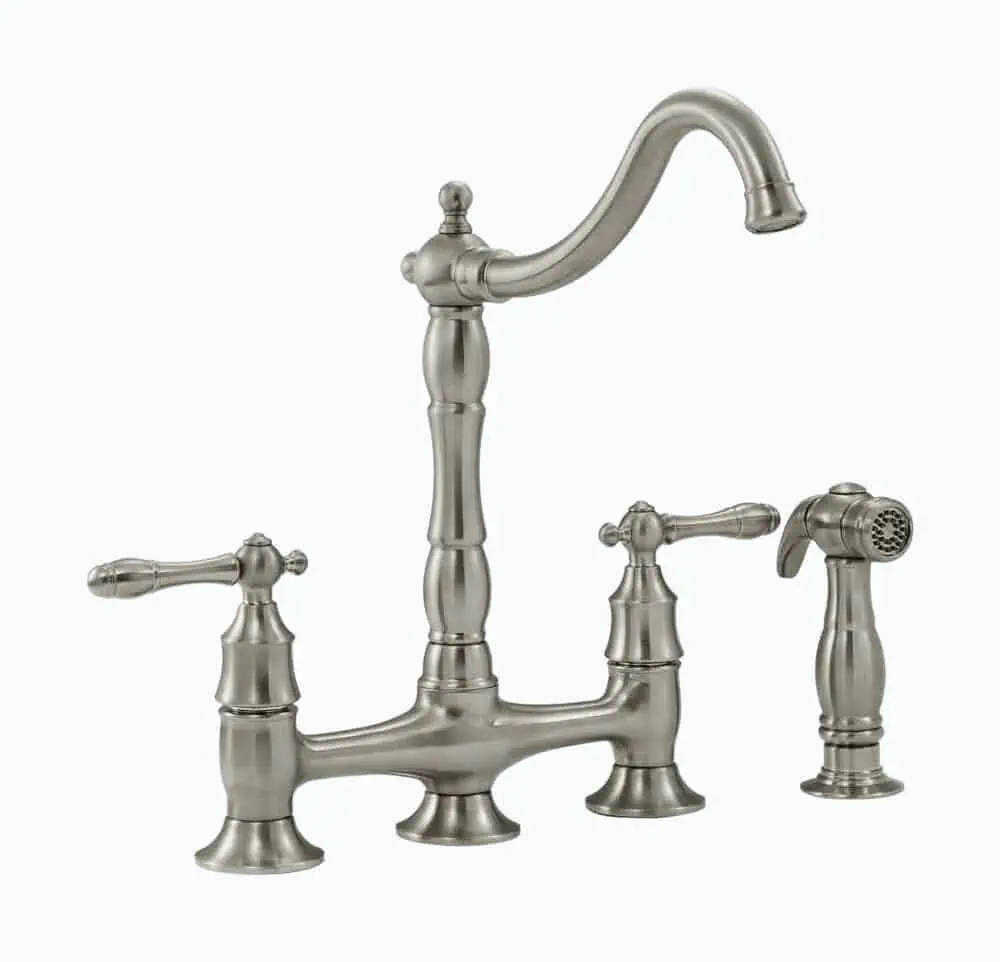
Glacier Bay’s Lyndhurst has a traditional look with modern features. It is an elegant double-handle “bridge” fixture.
With a beautiful brushed nickel finish and sporting a high arch design, it is ideal for a rustic or traditional kitchen. The arch reaches 13.38 inches in height. This will fit under even low-hanging cabinets, while still providing plenty of clearance from the sink.
The double handles are easy to control and are ADA compliant. To the side, you have a matching side sprayer that offers two settings to suit your daily needs. It has a controlled flow rate of 1.8 gallons per minute, which is optimal for the kitchen and water-efficient.
What We Like
Stunning and Durable
The Lyndhurst has a sturdy interior with an elegant exterior — the perfect combination. It is designed to last for years with its ceramic valve and metal structure. It’s coated with a durable brushed nickel, which looks great.
Visually, this faucet is very unique. Its tall neck and curved spout are unusual, combining traditional influences with modern technology and design.
Effective Side Sprayer
The side sprayer adds functionality, providing a concentrated stream for stubborn residue while keeping the flow rate at 1.8 gallons per minute. It has a matching brushed nickel finish, which adds to the visual appeal.
User-Friendly
As well as being designed to look great, Glacier Bay made sure this faucet was user-friendly. With its large, smooth double handles that are easy to grab, this faucet complies with ADA. You activate the flow by turning the levers toward yourself — one simple movement and you have water.
360-Degree Swivel
One useful feature is the 360-degree swivel spout. You can turn it to reach your double sink or the corners. It also has a long reach — approximately 9.6 inches — so it’s perfect for large sinks.
What We Don't Like
Side Sprayer Doesn’t Work While Fully Extended
Some users mentioned that the side sprayer doesn’t work well when fully extended. For some reason, extending the hose restricts the water pressure.
Not Ideal for Shallow Sinks
Although it’s great for large sinks, the 9.6-inch reach isn’t ideal in shallow basins. If your sink is on the small side, ensure you have enough room to avoid splashing water.
Product Specs
| Material | Metal |
| Finish | Brushed nickel |
| Flow rate | 1.8 gallons per minute |
| Faucet reach | 9.6 inches |
| Warranty | Limited lifetime warranty |
Our Ratings
First-Hand Impression
Market Pull-Out Kitchen Faucet By Glacier Bay
Best Glacier Bay Pull-Out Faucet
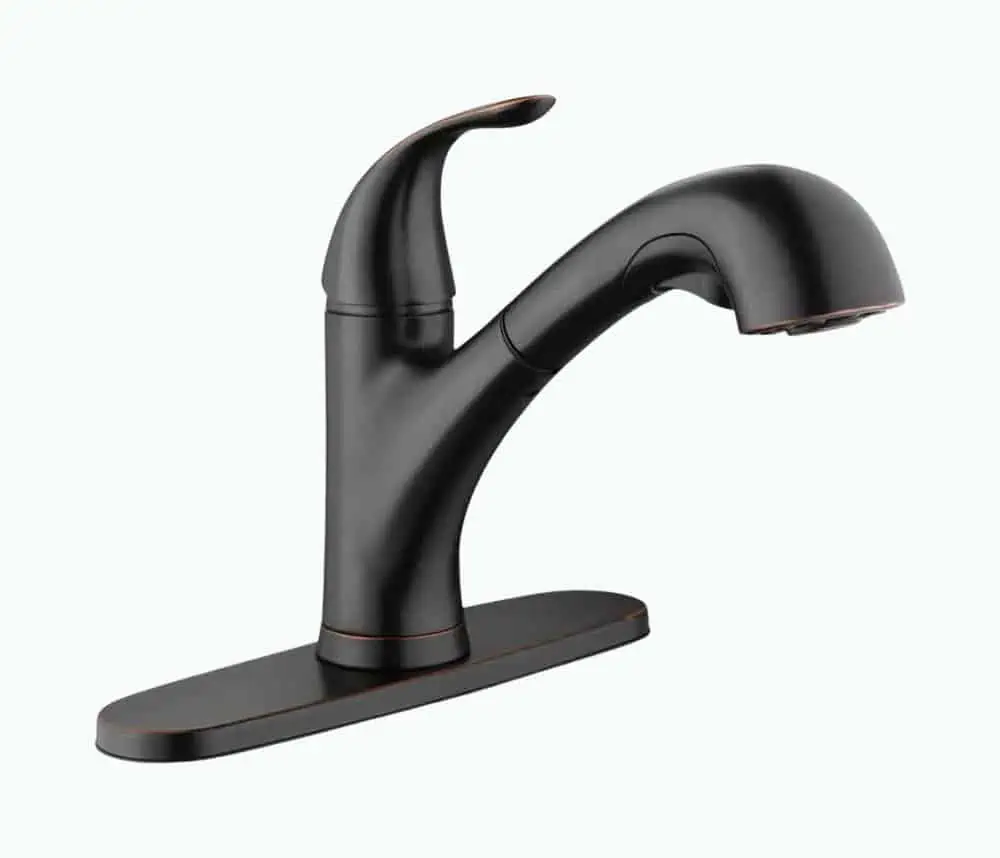
Glacier Bay’s Market pull-out faucet is both ADA compliant and small enough for a compact kitchen. It is simple, rustic, and very functional.
The spout has a low arch design, but you can pull out the sprayer head to gain an extra 50 inches of reach. On the nozzle, a switch controls the flow settings to be soft or pressurized. The stream benefits from Glacier Bay’s TurboSpray, giving you 30% more power than the average faucet.
We like the single-handle design and it is complemented by the oil-rubbed bronze finish. Under the surface, there is a solid metal base fitted with a ceramic valve.
What We Like
Rustic Style
The dark oil-rubbed bronze finish looks mysterious, with contrasting highlights around the nozzle and base. It adds a rustic touch, ideal for a farmhouse or an industrial-style kitchen.
The low arch is smooth and pleasant to look at. It measures 11.3 inches tall and has an effective reach of 8.9 inches. The single handle looks sleek, and it is ADA compliant.
Practical Pull-Out
A small kitchen or sink area limits your options when choosing a faucet. A pull-out faucet is designed to overcome these challenges, so you should choose a model with some length. Glacier Bay fitted a 50-inch hose to this model, giving you a great deal more range.
With the long hose, you also get Glacier Bay’s TurboSpray. This is a concentrated spray mode that increases the power by 30%. A gentle, aerated stream is also included for washing vegetables and your hands.
The switch on the nozzle is as user-friendly as it gets. It’s located on the back of the head, where it’s easy to use and won’t be an eyesore.
High Durability
With metal construction and a ceramic valve, the Market is very durable. Add the extra protection of the oil-rubbed finish and you have a very resilient faucet. It is also resistant to rust and abrasion.
FastMount System
This Market faucet includes Glacier Bay’s FastMount system. It allows you to connect the water supply lines to the deck quickly and with very little effort. You simply place the system over the shank and then twist it to tighten — there is no need to pay for a plumber.
What We Don't Like
Specifications Are Misleading
Some reviewers claimed that the specs described in Home Depot’s product description were misleading. For example, the height of the spout and the hose length were both incorrect, though Home Depot said it would correct this.
For accurate information, look at the tables below.
Product Specs
| Material | Metal |
| Finish | Oil-rubbed bronze |
| Flow rate | 1.8 gallons per minute |
| Faucet reach | 8.9 inches |
| Warranty | Limited lifetime warranty |
Our Ratings
User Experience
| Product | Award | Material | Finish | Flow rate | Faucet reach | Warranty |
|---|---|---|---|---|---|---|
| Glacier Bay Carla | Pull-Down | Metal | Stainless steel | 1.8 gpm | 8.16″ | Limited lifetime |
| Glacier Bay Dorset | Double-Handle | N/A | Brushed nickel | 1.2 gpm | 6.49″ | Limited lifetime |
| Glacier Bay Kiso | Modern Homes | Metal | Oil-rubbed bronze | 1.2 gpm | 4.5″ | Limited lifetime |
| Glacier Bay Lyndhurst | Classic Kitchens | Metal | Brushed nickel | 1.8 gpm | 9.6″ | Limited lifetime |
| Glacier Bay Market | Pull-Out | Metal | Oil-rubbed bronze | 1.8 gpm | 8.9″ | Limited lifetime |
Who Is Glacier Bay?
Glacier Bay is not a manufacturer — it is a brand that is owned and sold by Home Depot. Its products include everything from faucets for kitchens and tubs, to sinks, mirrors, and toilets.
The brand has enjoyed great success thanks to Home Depot’s widespread retail influence. It is a very popular option among DIY homeowners looking for quality on a budget.
Who Manufactures Glacier Bay?
Although Glacier Bay is owned and sold by Home Depot, production occurs overseas in Asia by a company called Globe Union (1). This relationship started in 1996 when Home Depot purchased a Chinese home improvement company called The Home Way (2).
This expansion continued and soon included another company called Your Other Warehouse — a former Home Depot vendor. By acquiring these two companies, Home Depot was able to manufacture and sell its own kitchen and bathroom products, under the Glacier Bay label.
Today, Glacier Bay is known as an affordable brand for homeowners. Even so, it doesn’t fall short in terms of quality. Glacier Bay faucets are manufactured with high-quality brass and ceramic cartridges, and the majority are ISO 9001 certified.
Glacier Bay Design and Innovation
Home Depot’s acquisitions have influenced Glacier Bay’s design philosophy. This includes finishes such as polished and regular chrome, variations of bronze, brushed nickel, and black faucets. There are also models with unusual features such as the waterfall-inspired Kiso.
Its kitchen faucets are compatible with various decor styles. For traditional kitchens, Glacier Bay has beautiful double-handle fixtures. For a more contemporary kitchen, the high arch pull-down is a popular choice.
Glacier Bay also offers numerous bathroom faucets, for both center set and widespread styles.
Where to Buy Glacier Bay Faucets
Although Glacier Bay is owned by Home Depot, you can also find its faucets on other sites such as eBay and Amazon. However, Home Depot is where you will usually find the best prices and the best warranties.
Be Cautious
Why Buy a Glacier Bay Faucet?
There are several reasons why you should choose a Glacier Bay faucet:
- Inexpensive: Glacier Bay fixtures are often available for less than $100, sometimes as little as $70.
- Quality: Despite the low price, the quality can compete with high-end brands.
- Simple installation: Most of their faucets include the FastMount system, which involves a modified nut going over the shank on the deck mount. It only requires a quick turn to tighten, and it’s ready to go.
- Included deck plates: Deck plates are included with many Glacier Bay faucets.
- Ceramic cartridges: To ensure a drip-free faucet, ceramic cartridges are a must (3). Thankfully, all Glacier Bay faucets have them.
- Swivel spouts: Most Glacier Bay spouts can rotate 360 degrees, rather than 180 degrees like many other faucets.
- Tech features: Despite its low prices, Glacier Bay offers some high-tech features such as motion detection. Another standard feature of the brand’s sprayer heads is its TurboSpray technology.
Glacier Bay Contact Information
As Glacier Bay belongs to Home Depot, one of the easiest ways to contact them about issues is by visiting your local store. If there isn’t a store near you, you can contact them by calling 1-866-863-9931.
What People Say About Glacier Bay
Overall, Glacier Bay receives positive reviews. Many customers mention being pleased with the low prices and extended warranties.
Reviews also mention that the fixtures are very easy to install and almost anyone can do it. The faucets include clear instructions.
One common complaint is poor customer service. This is because Home Depot only sells the products and does not directly manufacture them. This means they are sometimes unable to provide details of replacement parts and warranty issues on discontinued products.
In some cases, you will be unable to get replacement parts, which can be very frustrating.
FAQs

Is Glacier Bay a Good Faucet Brand?
Glacier Bay is a popular faucet brand that provides bathroom and kitchen fixtures at very reasonable prices. You can expect to pay about half of what you might for products from some of the brand’s competitors, without a significant loss of quality. Glacier Bay faucets also have many of the cutting-edge features of more expensive faucets, making them a great option if you want a modern bathroom or kitchen on a budget.

Who Makes Glacier Bay Faucets?
Glacier Bay is owned by Home Depot but its products are manufactured by Globe Union in Asia. Home Depot acquired Chinese company The Home Way in 1996 and later purchased Your Other Warehouse. By acquiring these two companies, Home Depot was able to manufacture its own bathroom and kitchen fixtures, which it sells under the Glacier Bay brand.

How Long Is a Glacier Bay Faucet Warranty?
Glacier Bay faucets are protected by a limited lifetime warranty, which entitles the owner to a replacement if there is a manufacturing defect. This doesn’t cover damage or the usual wear and tear that affects faucets over the course of their lives. In essence, you will always be protected against errors on Glacier Bay’s end, but you will have to deal with any damage caused during or after installation.

Are Glacier Bay Faucets Plastic?
It appears that most of the spray wands and handles of Glacier Bay faucets are plastic. Sadly, this is not an exceptional occurrence.
Plastic is the material of choice for spray wands across the board. Brass or stainless steel makes the faucets for the higher-end models.

Where Is the Model Number on a Glacier Bay Faucet?
The easiest way to find the model number on a Glacier Bay faucet is to look at the owner’s manual. You can also look at the faucet itself if you can’t find it.
The model number is either concealed in plain sight on the spout or affixed to the water supply pipe on a tag located below the sink. The model number may be listed on the component you want to replace, such as the cartridge.

How Long Do Glacier Bay Faucets Last?
Glacier Bay faucets are expected to last between 2 and 5 years because they are made partly from metal and partly from plastic.
Glacier Bay provides a limited lifetime guarantee, and customers can make a claim on it at any time so long as they can produce the original receipt as evidence of purchase.

Are Glacier Bay Faucets Repairable?
Glacier Bay faucets are repairable if you have some spare time and the right tools. Because of the consistent pressure of the water and the plumbing, it’s normal for faucet fittings to start leaking.
Most of the time, the cartridge in a Glacier Bay faucet will need to be replaced if it springs into a leak.
The cartridge, which may be found in the handle of the faucet, is what controls the movement of water through the fixture. The position of the handle determines whether the cartridge is open or closed since it is controlled by a nut that revolves around the handle of the faucet.
You will likely be able to fix your Glacier Bay faucet with only the most fundamental of tools, but if this turns out not to be the issue, you will likely need to get in touch with a qualified plumber.

How Much Should You Spend on a Glacier Bay Kitchen Faucet?
Expect to pay between $50 and $100 for a Glacier Bay kitchen faucet. The price varies depending on the model you choose. For example, the Glacier Bay McKenna faucet costs around $70, while a Glacier Bay touchless single-handle faucet costs around $120.
Is Glacier Bay Worth It?
Glacier Bay is not a manufacturer, it is a brand owned and marketed by Home Depot. Even so, the company is responsible for some excellent faucets.
It’s a popular name, known for very affordable prices, good quality, and ease of installation. In addition to owning Glacier Bay, Home Depot is also the best place to buy these faucets, generally offering the most competitive prices and always providing the most extensive warranties in comparison to resellers.
Despite the relatively low price of Glacier Bay faucets, their top-end faucets still feature cutting-edge technology such as motion sensors. If you are renovating or building a home with a tight budget, Glacier Bay products will provide quality beyond their prices.