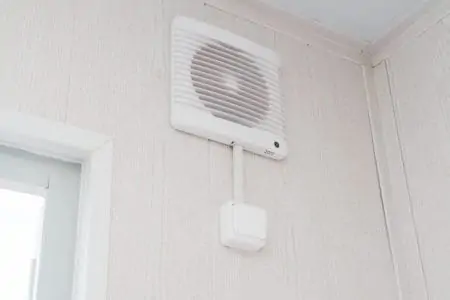
Okay, so what is so special about a bathroom exhaust fan with a humidity sensor? Well, for one thing, they take the hassle out of extracting moist air and odors from your bathroom. They also keep your inside space free of mold and mildew.
The best humidity sensing bathroom fans do this automatically. Let’s take a look at your options.
- Pick-a-flow speed selector
- So quiet at 0.3 sones
- Energy Star rated
- Smart programming feature
- Service life of 67,000 hours
- Accurate moisture & temp. reading
- Fan speed of 130 CFM
- Adjustable humidity levels
- Consumes less than 17 W of power
- Dimmable LED light
- Multi-function control switch
- 24-Watt motor
- Wall or ceiling installation
- Brushless motor
- Value for money
Review Methodology: At Sensible Digs, we provide thorough, hands-on analysis and professional assessments of the best humidity sensing bathroom fans on the market. Our experienced team evaluates every product from a user’s perspective, comparing and ranking them based on key decision-making factors like performance, design, and user experience. Our data-driven reviews include first-hand evidence and quantitative measurements of each product’s performance. We also highlight what sets each product apart from its competitors and the effect of its design choices on users. We believe in presenting facts and results to help you make the best choice for your bathroom.
- Our Top Picks
- Product Reviews & Ratings
- Product Comparison Chart
- How Do Humidity Sensing Bathroom Fans Work
- Benefits of a Humidity Sensing Bathroom Exhaust Fan
- What Humidity Should My Bathroom Fan Be Set At?
- How To Choose a Humidity Sensing Bathroom Exhaust Fan
- Humidity-sensing Bathroom Fan FAQs
- Are You a Fan of Fans?
The Best Humidity Sensing Bathroom Exhaust Fans of 2024
After much research, we bring you our top 5 humidity sensing bathroom fans.
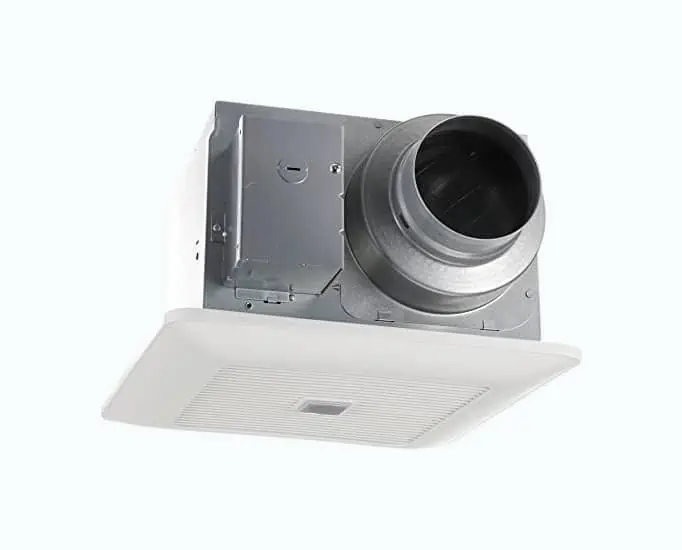
Panasonic FV-0511VQC1 WhisperSense Ventilation Fan
Best Quiet Humidity Sensing Bathroom Exhaust Fan
This Panasonic is so quiet that you will struggle to hear it. It operates at 0.3 sones, which is softer than rustling leaves. These fans are ideal when you have young children or older relatives that wake easily in the night.
It has a Pick-a-Flow speed selector that enables you to choose between 50, 80, and 110 CFM, depending on the occasion. It also comes with a Flex-Z easy bracket that makes connecting the 4 or 6-inch ducting a breeze.
It is Energy Star rated, so it will save you money on energy costs, and it has a low profile, meaning it sits almost flush with the ceiling.
What We Like
So Quiet
If you can find a quieter exhaust fan, we salute you. This model is barely audible, making it tricky to see if it’s actually working.
Easy Installation
Thanks to the Flex-Z bracket, connecting up the ducting takes less time than you think. It also accommodates 4 or 6-inch diameter ductwork.
Pick-a-Flow Speed Selector
Adjusting the CFM speed gives you more freedom and versatility to cater to light or heavy bathroom usage. It also helps in the fight against odors and mildew.
What We Don't Like
Quite Expensive
This Panasonic exhaust fan is not a budget option. It costs considerably more than other models featured in the list. That said, it is quiet and performs masterfully.
Product Specs
| Weight | 9.5 pounds |
| Dimensions | 13 x 13 x 7.38 inches |
| CFM | 50, 80, 110 |
| Sones | 0.3 |
| Energy Star rated | Yes |
| Price | $$$ |
Our Ratings
User Experience
AC Infinity AIRLIFT T10 Exhaust Fan
Best Wall-Mounted Humidity Sensing Bathroom Exhaust Fan
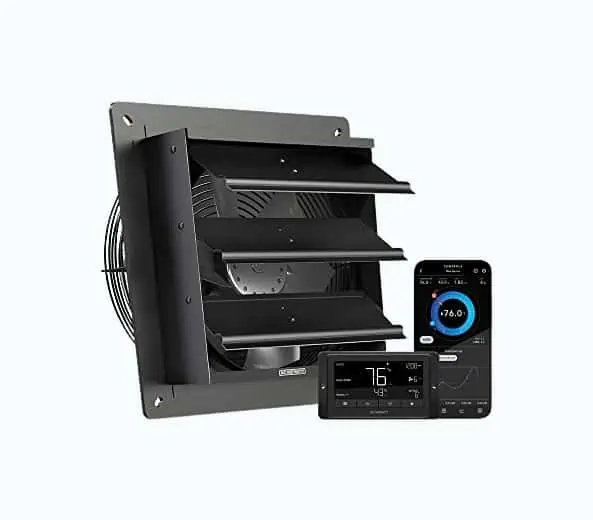
Sometimes the best location for the exhaust fan is in the wall. If you live in an apartment where the ceiling option is not available, a wall-mounted fan is the answer. This AC Infinity model is really powerful, with a smart programming feature that allows you to set the humidity levels.
You also get accurate moisture and temperature readings, as well as a saving of 40 percent in energy costs. They even give you speed control, a timer, and an alarm. This unit is robust, so it should last for years, thanks to the dual-ball bearings rated at 67,000 hours.
What We Like
Durable Construction
This model features galvanized steel shutters, aluminum fan blades, and dual-ball bearings that have a useful working life of 67,000 hours.
No Duct Work
Installing this fan is a breeze because it fits a hole in the wall rather than connecting to ducting in the ceiling. It makes it easy to mount.
Programmable
You can program the timer, the humidity settings, and the speed control to get the precise extraction performance you want. You can cater it to your family’s needs.
What We Don't Like
Noisy
This fan operates at 58 decibels, so while it isn’t super-loud, it is noisier than standard ceiling exhaust fans. Bear this in mind when you buy one as it may wake the family in the middle of the night.
Product Specs
| Weight | 9.78 pounds |
| Dimensions | 13 x 13 x 7.38 inches |
| CFM | N/A |
| Sones | 4.0 |
| Energy Star rated | No |
| Price | $$ |
Our Ratings
Personal Perspective
Delta BreezSmart SMT130H Exhaust Fan
Best Adjustable Humidity Sensing Bathroom Exhaust Fan
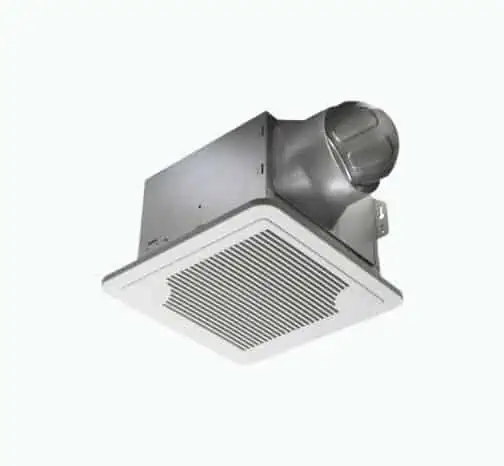
If you like being in control of your humidity levels, this fan will put a smile on your face. You can set the levels between -50 percent and +90 percent. That covers all eventualities without a doubt.
When the moisture levels exceed the highest set point, the fan runs at a speed of 130 CFM. When the levels drop, the fan moves at a slower pace of 50, 70 or 90 CFM.
It operates at 0.3 sones, so it rivals the Panasonic for volume levels, and because it is Energy Star rated, it consumes less than 17 watts of power.
What We Like
Super-Adjustable
This model gives you the flexibility to set the humidity levels across a vast range from -50 to +90 degrees. That covers all bathroom usage options and climates.
Super-Quiet
The volume this fan produces is barely audible to the human ear. It generates just 0.3 sones, which is quieter than rustling leaves.
Energy Star Rated
This fan consumes 17 watts of power, making it incredibly frugal and cheap to run. That’s why it is rightly Energy Star rated. You can save up to 67 percent on your energy costs.
What We Don't Like
Very Pricey
This fan is not cheap. You will spend double the cost of others on the list. That said, it is a quality exhaust fan and comes highly recommended.
Product Specs
| Weight | 1 pound |
| Dimensions | 14 x 14 x 7.68 inches |
| CFM | 50, 70, 90, 130 |
| Sones | 0.3 |
| Energy Star rated | Yes |
| Price | $$$ |
Our Ratings
Community Feedback
Homewerks Worldwide 7146-89-MS Bathroom Fan
Best Humidity Sensing Bathroom Exhaust Fan With a Light
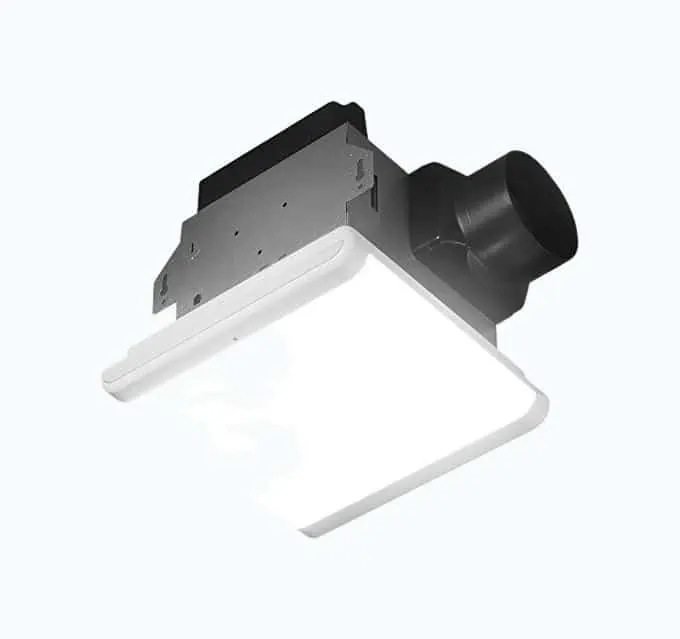
Not only does this exhaust fan have a humidity sensor, but it also has a soothing LED light with a dimmable feature to set the mood in the bathroom. It is a single-speed fan, so it only operates at 80 CFM but is quiet at just 1.5 sones.
You can set the humidity sensor to auto-on to kick in when the fan detects dampness in the air and cuts out when it drops below 60 percent. The light is also motion-activated, so when you walk into the room, it comes on automatically. That’s a real bonus if you have kids.
You also get an LED wall switch that lets you take complete control of the functions, even switching off the auto-humidity sensor if you so choose.
What We Like
Dimmable LED Light
Rather than switching on the bathroom light, using the motion sensor light is a super-convenient way to light the room. Kids and elderly relatives will love this feature.
Multi-Function Control Switch
The LED control panel allows you to choose the settings that best suit the way you use the bathroom. You can also select manual or auto-humidity detection.
24-Watt Motor
This fan copes well in bathrooms that are 80 square feet or less. The 24-watt motor generates enough power to operate the light and the fan, along with the humidity sensor.
What We Don't Like
Single-Speed
For such an advanced fan, it is disappointing that it only has one running speed. It means you always run at the maximum of 80 CFM regardless of the humidity levels.
Product Specs
| Weight | 8.8 pounds |
| Dimensions | 10.2 x 10.2 x 7 inches |
| CFM | 80 |
| Sones | 1.5 |
| Energy Star rated | No |
| Price | $$$ |
Our Ratings
First-Hand Impression
Delta Electronics Breezslim SLM70H Exhaust Fan
Best Budget Humidity Sensing Bathroom Exhaust Fan
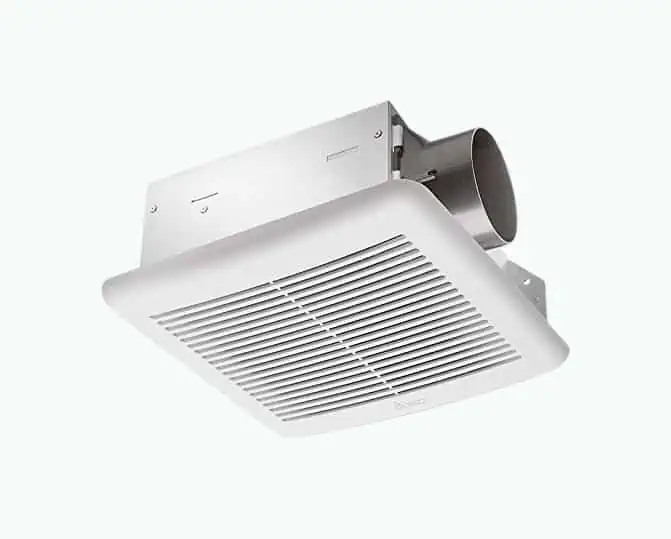
Now we reach the budget end of the spectrum. This exhaust fan costs far less than the competition, which makes it a great starter fan. It has a humidity sensor that kicks in when the moisture levels in the air exceed 60 percent and stops when it drops below.
It operates at 2.0 sones, so it isn’t the quietest, but for the price, what do you expect? This model is approved for wall and ceiling installation, so you get the flexibility, and the Energy Star qualified motor is brushless, giving you the latest in efficiency savings.
What We Like
Budget Pricing
Why spend big when you can get your hands on a budget model that seems to do all the things the premium fans can do?
Brushless Motor
Brushless motors are the latest in design, saving you money by increasing the energy efficiency of the fan. It also improves reliability, as the motor has no brushes. Brushes are notorious for needing replacing every few years.
Energy Star Qualified
The brushless motor certainly helps, but who would have thought a fan this cheap would be so frugal with electricity. It’s a win-win on price and running costs.
What We Don't Like
Loud Operation
This fan is a lot noisier than others that made the list. It is predictable given the price, but it is something to bear in mind when you make your purchase.
Product Specs
| Weight | 4 pounds |
| Dimensions | 7.2 x 7.5 x 3.9 inches |
| CFM | 70 |
| Sones | 2.0 |
| Energy Star rated | Yes |
| Price | $ |
Our Ratings
User Experience
| Product | Best | Weight | Dimensions | CFM | Sones | Energy Star rated |
|---|---|---|---|---|---|---|
| Panasonic WhisperSense Ventilation Fan | Quiet Fan | 9.5 lbs | 13 x 13 x 7.38″ | 50, 80, 110 | 0 | Yes |
| AC Infinity AIRLIFT T10 Exhaust Fan | Wall-Mounted | 9.78 lbs | 13 x 13 x 7.38″ | N/A | 4 | No |
| Delta BreezSmart SMT130H Exhaust Fan | Adjustable | 1 lb | 14 x 14 x 7.68″ | 50, 70, 90, 130 | 0 | Yes |
| Homewerks Worldwide Bathroom Fan | With Light | 8.8 lbs | 10.2 x 10.2 x 7″ | 80 | 2 | No |
| Delta Electronics Breezslim Exhaust | Budget Pick | 4 lbs | 7.2 x 7.5 x 3.9″ | 70 | 2 | Yes |
How Do Humidity Sensing Bathroom Fans Work
The fan is fitted with a humidity sensor, which is an electrical component that senses when the moisture content in the air reaches a set level before it kicks in. The sensor is combined with a thermometer to get an accurate reading of the temperature.
Some exhaust fans allow you to adjust the levels of humidity for when the fan turns on. The typical levels range between 25 and 75 percent.
There are 3 ways the fan works.
- No Switch: This method keeps the fan in a permanent operational state so that no one can turn it off. This is the best option for rental properties or when you have children.
- Independent Switch: This enables you to install the fan on separate switches so that you can keep the light, the fan, and any other features on independent controls.
- Same Switch: This is the most common installation method. When you switch once, it operates the humidity sensor, and flicking it a second time works the fan.
Benefits of a Humidity Sensing Bathroom Exhaust Fan
There are many advantages of installing a humidity-sensing bathroom fan.
Protection
The first and last purpose of a bathroom exhaust fan is to protect your space from moisture and odors. Excessive dampness in the air causes mold and mildew growth that leaves unsightly black marks and damages surfaces.

Automatic Usage
Humidity sensing fans switch on automatically when the moisture content of your bathroom reaches a specific level. It takes away the hassle of remembering to switch it on every time you take a shower.
This is ideal if you have children who regularly forget to switch the fan on, or tenants in a rental property who are less conscientious about moisture control. Damp air penetrates fixtures and fittings, even rusting metal door furniture and water pipes.
Auto Shut-Off
Forgetting to turn off the fan is just as bad as not switching it on. How many times have you showered and gone to work with the fan still running? Imagine the costs?
Not only does this waste electricity, but it also sucks warm or conditioned air from your home, extracting it to the outside. It’s a bit like putting the heating on and opening a few windows for the entire day.
It also prevents fire risks because the fan cuts out, unlike fans that continue to run, causing heat build-up and a potential fire.
What Humidity Should My Bathroom Fan Be Set At?
The recommended humidity levels in our homes should be about 50 to 60 percent, so you should set the percentage values between 25 and 75 percent inside your bathroom.
How To Choose a Humidity Sensing Bathroom Exhaust Fan
What are the important decisions you need to make when shopping for a new humidity sensor bathroom fan? Let’s take a look.

Adjustable Sensor
Adjusting the moisture reading sensor gives you the freedom to set your percentage values to cater to how you use the bathroom. You might have a large family, and the bathroom gets a lot of use. Or the reverse may be true and it only gets light use.
Most sensors get set between 25 and 75 percent. Remember to check if the sensor is customizable because not all fans have this ability.

Fan Strength
We’ve already mentioned CFM values, and the strength of your fan is judged on airflow. The higher the CFM, the more powerful the fan. This is important if you want to size your bathroom exhaust fan correctly.
If the CFM values are too low, you might struggle to extract the moisture from the room, causing mold and mildew to form.
When sizing your fan, the general rule of thumb is you should allocate 1 CFM to every square foot of floor space. It is a good idea to add 10 CFM to the final total for extreme moisture days and if you ever upgrade your bathroom fittings.

Single or Adjustable Fan Speed
Single-speed exhaust fans run at one speed only, so depending on the bathroom usage, your fan will always run at the maximum level. Adjustable models typically have 3 settings, enabling you to cater to light, medium, and heavy bathroom usage.
The most common settings are 50, 80 and 100 cubic feet per minute (CFM). Check the fan’s specifications to see if it has this feature.

Noise Levels
Bathroom fans are measured in sones when dealing with volume levels. Typically, fans operate at about 3 to 4 sones, but you can get whisper-quiet ones that barely produce more than a faint rush of air.
Quiet bathroom exhaust fans should have a sone value of less than 1.0, but some models are as quiet as 0.3 sones. This is the best fan when you have young children you want to avoid waking.

Shape and Size of Your Bathroom
If your bathroom has odd shapes and corners, it will affect how successful the fan is at removing moisture. And where you decide to place the fan is crucial too. If you have a large room and you situate the exhaust fan at the furthest point from the bath or shower, you will have damp air lingering for longer than it should.
It might be worth thinking about zoning the room so that you can place the fans effectively.
Humidity-sensing Bathroom Fan FAQs

Do I Need a Humidity Sensing Fan in a Bathroom?
A humidity-sensing fan can make a great bathroom purchase to help you stay on top of moisture levels in the room. You don’t need it, but it has many cool features and eliminates the need for an extra hygrometer.
When you take baths and showers, the moisture levels in your bathroom start to rise. This can result in unpleasant scents, and in rare instances, it might even create health issues.
These problems can be avoided entirely by installing a humidity monitoring fan, which will switch on when the relative humidity in the bathroom reaches a set threshold and will turn off once it has returned to a more comfortable level.

How Do I Know If My Humidity Sensing Bathroom Fan Is Working?
To determine if your humidity-sensing bathroom fan works, compare it with a hygrometer. This is a device that monitors the amounts of humidity in the air.
Put the hygrometer in the bathroom while you’re taking a shower. This will determine whether or not the humidity level rises and whether or not the fan kicks on by itself.
It could also be that your fan isn’t working overall. Once it reaches a certain threshold, the sensor should activate the fan automatically. If this doesn’t happen, you could have a faulty fan motor or other problems with the hardware.

How Do I Adjust the Humidity Sensor on My Bathroom Fan?
You must consult the user manual to adjust the humidity sensor on your bathroom fan. It’ll provide you with the exact steps to follow based on the model you have.
The first step usually implies locating the humidity sensor. It’s usually round and located on the front of your bathroom fan. Check the existing setting (you might have to look at the manual for this step).
Once you’ve set the sensor to the desired level, perform a test. Run a steaming shower to raise humidity and the bathroom and see if the sensor triggered the fan.

Where Should a Humidity Sensing Fan be Placed in a Bathroom?
You should place a humidity-sensing fan in a bathroom area that usually gathers much moisture, like close to your shower or bathtub. Some people install it in the center of the room to draw moisture from all bathroom areas.
Wherever you install your humidity-sensing fan, ensure nothing is obstructing it. Don’t place it behind a wall-mounted cabinet or close to the floor. It should be high enough to collect all rising steam.
Are You a Fan of Fans?
Humidity sensing exhaust fans are the ultimate in convenience and hassle-free moisture extraction. You don’t need to think about it or worry you have left the fan on all day and it is perfect for young children.
It’s like having an all-seeing eye watching over your bathroom, activating and deactivating the fan when needed, so you don’t have to. What could be better?