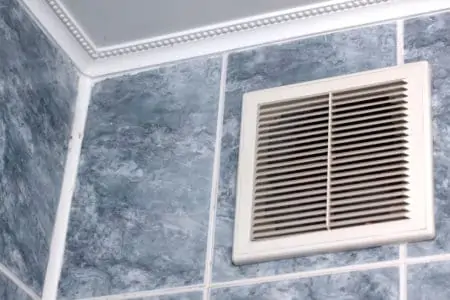
You know it’s time to replace your noisy bathroom exhaust fan when you have to shout to be heard. So, what are your options?
The good news is there are plenty of models available, so let’s take a look at the best quiet bathroom exhaust fans to see what your options are.
- Has a speed selector
- 10W dimmable LED panel
- Super-quiet at 0.3 sones
- Superior airflow at 110-150 CFM
- Flexible installation bracket
- Energy star rated
- Covers 75 sq ft bathroom
- Airflow of 80 CFM
- Air leakage reduction technology
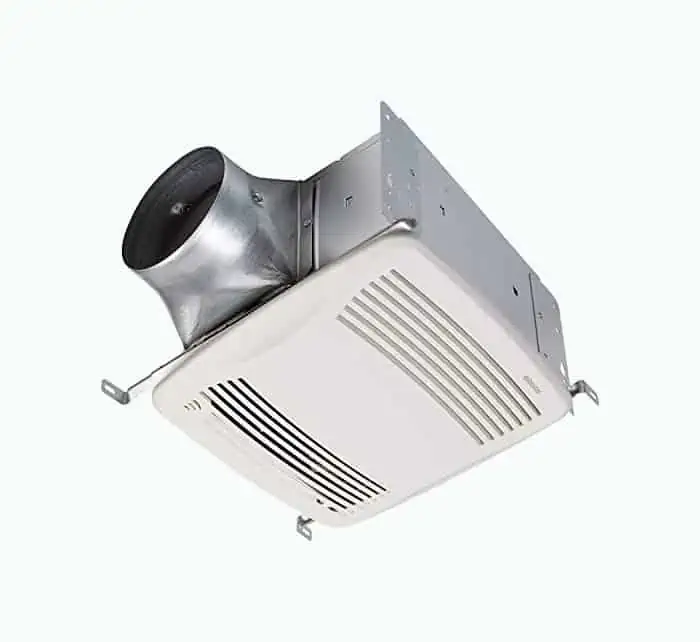
- Comes with humidity sensor
- Timer control
- Max coverage is a 105 sq ft
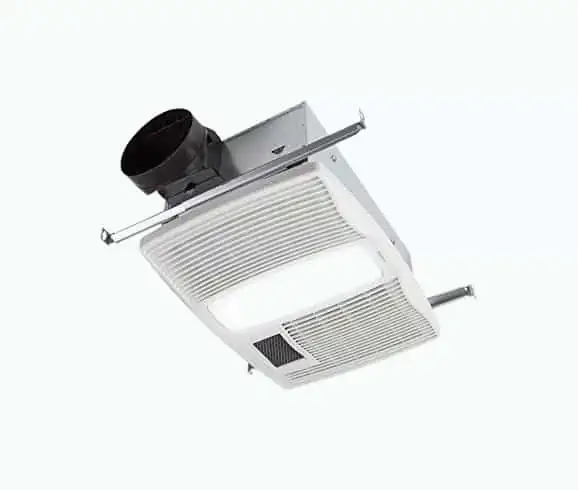
- Integrated 1,500-W heater
- Integrated light
- Covers 105 sq ft bathrooms
Review Methodology: At Sensible Digs, we’ve used our experience and expertise to analyze, assess, and compare the best quiet bathroom exhaust fans. Our professional evaluation includes hands-on testing, benchmarking performance, and tracking each fan’s criteria against a standard. We’ve compiled data, evidence, and facts from our research and reviews to help you make an informed decision. We examine key factors like noise level, energy efficiency, and user-friendly design. Our assessment also includes the ventilation power and moisture control capabilities. We believe in providing transparent and objective reviews, so you can trust our rankings and make a confident choice.
The Best Quiet Bathroom Exhaust Fans of 2024
Now it’s time to reveal our top 5 favorite bathroom exhaust fans to help you decide which is the best option for you.
Panasonic FV-0510VSL1 WhisperValue Ventilation Fan
Best Quiet Bathroom Exhaust Fan With Light
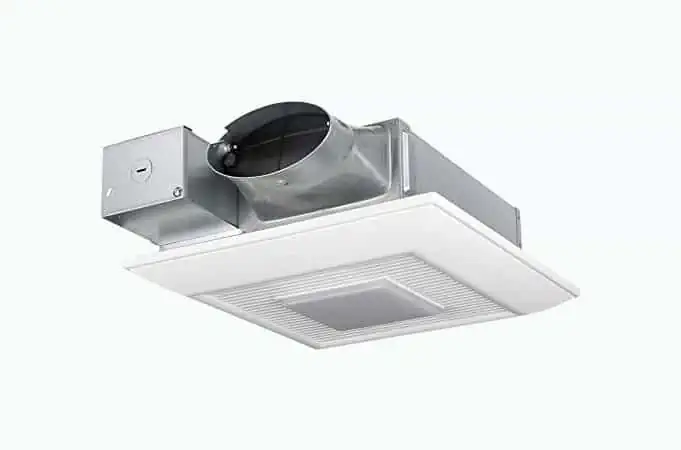
You will quickly realize that this review is dominated by 2 manufacturers, and Panasonic is one of them. This WhisperValue bathroom exhaust fan has a pick-a-flow speed selector to increase the airflow from 50 to 80 and then to 100 CFM. It means you can cater your fan to deal with changing moisture and odor levels.
It also has a 10W dimmable LED panel in the center of the fan to provide additional light. You also get one of the quietest running volumes available, at just 0.3 sones. This fan is low profile and comfortably fits in a ceiling space or wall.
Plus, the slimline design means the housing protrudes by just over 3 inches, making it less obtrusive than most exhaust fans, and thanks to an efficient motor, it gets an Energy Star rating.
What We Like
Super-Quiet
At just 0.3 sones, this Panasonic fan is one of the quietest on the market. It is barely audible to the human ear when it’s working. Rustling leaves make more noise.
LED Light
The LED in the center of the fan is a welcomed addition to the lighting in your bathroom. In some cases, it may be all the illumination you need when visiting the bathroom in the middle of the night.
Low Profile
When fitted, this fan sits proud on the wall or ceiling by just over 3 inches, making it one of the slimmest models available. Exhaust fans should be unobtrusive, and this model does just that.
What We Don't Like
Very Pricey
This Panasonic is not a budget option, that’s for sure. It costs more than most models, but we suppose the 0.3 sones is a good reason to spend the extra cash.
Product Specs
| Weight (pounds) | 7.94 |
| Dimensions (inches) | 13 x 13 x 3.38 |
| CFM | 50, 80, 100 |
| Sones | 0.3 |
| Features | LED light |
| Energy Star rated | Yes |
| Price | $$$$ |
| Warranty | 6-year motor |
Our Ratings
User Experience
Panasonic FV-1115VQ1 WhisperCeiling Ventilation Fan
Best Quiet Bathroom Exhaust Fan for Airflow
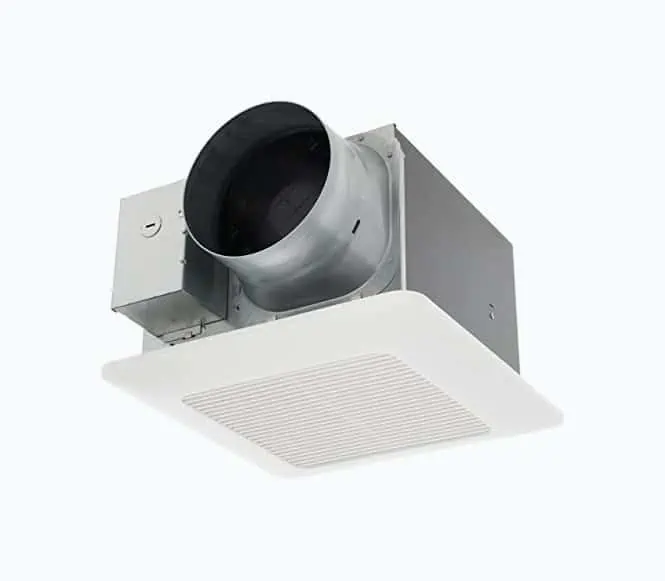
So, here we are again with another Panasonic exhaust fan. This model has the same whisper-quiet 0.3 sones of volume. However, it differs from the other model because it has a superior airflow.
You still get the same speed selector, but with increased CFM values. You can switch between 110, 130, and 150 CFM, meaning it works well in larger bathrooms where recirculated air is vital to remove odors and moisture.
This model comes with a flexible installation bracket called Flex-Z for easy and trouble-free fitting, and thanks to the SmartFlow technology and the super-efficient motor, it is also Energy Star rated.
What We Like
Superior Airflow
You get seriously impressive airflow values with this exhaust fan. The maximum rate is 150 CFM, which is over 40 CFM more than most of the competition. If you have a spacious bathroom, this could be the model to get.
Easy Installation
You can install this fan in either the ceiling or the wall. And thanks to the Flex-Z bracket, it can be achieved easily with minimum fuss.
Energy Star Rated
While this fan is super-quiet, it is also efficient. It is Energy Star rated, showing that you get the maximum performance without the burden of expensive energy costs.
What We Don't Like
Super Expensive
If you thought the previous Panasonic exhaust fan was expensive, wait until you see what this one costs. We are now in the realms of big bucks, so if you want this fan, dig deep.
Product Specs
| Weight (pounds) | 9.48 |
| Dimensions (inches) | 13 x 13 x 8.5 |
| CFM | 110, 130, 150 |
| Sones | 0.3 |
| Features | Airflow speed selector |
| Energy Star rated | Yes |
| Price | $$$$$ |
| Warranty | 6-year motor |
Our Ratings
Personal Perspective
Broan NuTone AE80 Single-Speed Ventilation Fan
Best Budget-Friendly Quiet Bathroom Exhaust Fan
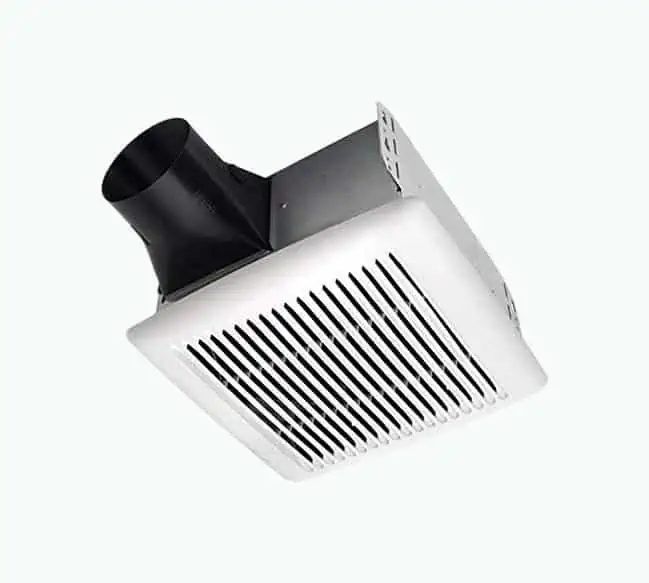
Broan-NuTone is the second maker to dominate this list. We feature 3 of their exhaust fans in the review, but let’s start with this one. We chose this as the budget model, so don’t expect the bells and whistles you get with more expensive fans. So, what has it got going for it?
First, there is the price. This model is more than half the cost of the most expensive Panasonic fan, so you are saving a considerable sum of money.
Second, it is still super-quiet, at just 0.8 sones, and it covers a 75 sq ft bathroom, with an airflow of 80 CFM. It comes with TrueSeal Damper technology to reduce air leakage by 50 percent compared to similar models.
It all adds up to a budget-friendly fan that performs well in small to medium-size bathrooms and reduces backdrafts and cold spots by a significant amount.
What We Like
Budget-Friendly Price
For not a lot of money, you get an exhaust fan that not only operates at 0.8 sones; it also reduces air leakage for better performance, reducing cold spots and backdrafts.
Easy Installation
If you are replacing an old bathroom fan for this model, installation should be a breeze. You can do it all from the bathroom side, without needing to access the attic. All you need to do is connect the ducting to the replacement fan.
Energy Star Rated
Energy Star ratings are the industry-accepted standard and recognized nationwide as a seal of efficiency and energy-saving performance. This model is rated as frugal with electricity usage.
What We Don't Like
One Speed
Unlike the other fans featured, this model operates at 80 CFM only. While it is sufficient at removing moisture and odors from small to medium-size bathrooms, it gives you less flexibility when you need it.
Product Specs
| Weight (pounds) | 8.38 |
| Dimensions (inches) | 10 x 5.75 x 9.25 |
| CFM | 80 |
| Sones | 0.8 |
| Features | TrueSeal damper technology |
| Energy Star rated | Yes |
| Price | $$ |
| Warranty | 3-year |
Our Ratings
Community Feedback
Broan NuTone QTXE110S Ultra-Silent Fan
Best Quiet Bathroom Exhaust Fan With Humidity Sensor
Humidity sensing exhaust fans are clever because they automatically kick in when the moisture levels in the room reach excessive levels. You can also program the fan to run from between 5 and 60 minutes continuously when it comes on.
The CFM rate is 110, and the maximum coverage is a 105 sq ft room, making it ideal for small to medium bathrooms. You even get a 6-inch diameter ducting connector to help with the installation.
This model runs at 0.7 sones, so it is well under the standard 3.0 to 4.0 sones of standard models.
What We Like
Humidity Sensor
Take all the hassle out of operating the exhaust fan by getting one with a humidity sensor. It kicks in when the humidity rises in the room and runs until the level drops.
Easy Installation
You even get a 6-inch diameter ducting connector with this model for easier installation in the ceiling. It makes fast work of fitting a new fan as well as swapping an old one to connect up the existing ducting.
Perfect for Medium-Size Bathrooms
The 110 CFM rating makes this the perfect exhaust fan for removing smells and moisture from 105 sq ft bathrooms. Given that most bathrooms are the smallest rooms in the house, it is the ideal size.
What We Don't Like
One Speed
Like the budget model, this one only operates at a single speed, making it a challenge to cater to increased levels of moisture and odors.
Product Specs
| Weight (pounds) | 11 |
| Dimensions (inches) | 11.4 x 10.5 x 7.6 |
| CFM | 110 |
| Sones | 0.7 |
| Features | Humidity sensor |
| Energy Star rated | Yes |
| Price | $$$$ |
| Warranty | 3-year |
Our Ratings
First-Hand Impression
Broan-NuTone QTX110HL Quiet Ceiling Fan
Best Quiet Exhaust Fan With Heater
It seems they think of everything when it comes to quiet bathroom exhaust fans. This model even has a 1,500-watt heater. It keeps the bathroom at a comfortable temperature and helps to minimize moisture and fogging.
This one also comes with a light for added convenience. The fan has a CFM value of 110, and it operates at just under the 1.0 sone mark, at 0.9. Like the previous model, this fan is suitable for 105 sq ft bathrooms.
It also comes with easy installation, thanks to the 6-inch hose connector and the anti-vibration mounting brackets that adjust up to 24 inches.
What We Like
Integrated Heater
The heater adds another level of comfort to this exhaust fan because it helps you combat moisture and fogging in the bathroom while keeping everything at a comfortable temperature.
Integrated Light
Not only do you get a built-in heater with this exhaust fan, but you also get an integrated light. So, it keeps you warm and it lights the room in the dead of night.
Perfect for Medium-Size Bathrooms
The 110 CFM rating makes this the perfect exhaust fan for removing smells and moisture from 105 sq ft bathrooms. Given that most bathrooms are the smallest rooms in the house, it is the ideal size.
What We Don't Like
Not as Energy-Efficient
Thanks to the 1,500-watt heater, you will use far more energy running this fan than the Energy Star-certified models featured previously. Keep that in mind before you make a purchase.
Very Pricey
Having a ceiling exhaust fan with an integrated heater and light ramps up the costs considerably. This is not a budget model.
Product Specs
| Weight (pounds) | 12.8 |
| Dimensions (inches) | 11.38 x 7.63 x 17.63 |
| CFM | 110 |
| Sones | 0.9 |
| Features | Integrated heater and light |
| Energy Star rated | No |
| Price | $$$$$ |
| Warranty | 1-year |
Our Ratings
User Experience
| Product | Best | Weight | Dimensions | CFM | Sones | Energy Star rated | Warranty |
|---|---|---|---|---|---|---|---|
| Panasonic WhisperValue Ventilation | With Light | 8 lbs | 13 x 13 x 3.38″ | 50, 80, 100 | 0 | Yes | 6-year motor |
| Panasonic WhisperCeiling Ventilation | Airflow | 9 lbs | 13 x 13 x 8.5″ | 110, 130, 150 | 0.3 | Yes | 6-year motor |
| Broan NuTone Single-Speed Vent | Budget-Friendly | 8 lbs | 10 x 5.75 x 9.25″ | 80 | 1 | Yes | 3-year |
| Broan NuTone Ultra-Silent Fan | Humidity Sensor | 11 lbs | 11.4 x 10.5 x 7.6″ | 110 | 1 | Yes | 3-year |
| Broan-NuTone Quiet Ceiling Fan | With Heater | 12.8 lbs | 11.38 x 7.63 x 17.63″ | 110 | 0.9 | No | 1-year |
How Many Sones Is a Quiet Bathroom Fan?
You should look for a super-quiet bathroom exhaust fan with 1.0 sone or less. It should almost be silent and you should struggle to hear it. It’s the reason why some models have an indicator light to tell you when it’s on.
1.0 sone is about the same volume as a refrigerator. 0.5 sones is the same noise as rustling leaves. When you compare quiet fans to standard models, you get a volume saving of 3.0 sones.
How To Choose the Best Quiet Bathroom Exhaust Fan
What are the important elements to consider when selecting the best quiet exhaust fan? Let’s run through the options.

How Loud?
It seems obvious to start with your fan’s volume, but it is the most crucial element. Bathroom exhaust fans are measured in sones, which is a standard unit of loudness. The more sones your fan has, the noisier it is.
Standard fans are at about 3.0 or 4.0 sones, whereas quiet models should be 1.0 sone or less.

What About Airflow?
Airflow is measured in cubic feet per minute (CFM), and the higher the rating, the healthier the flow of air through the fan. CFM is crucial when sizing a bathroom exhaust fan. If you have a small room, it is less important, but for large bathrooms, an underpowered fan will struggle.
Fans are rated on their ability to circulate air, and the airflow value tells you how effective your fan is at doing this task. A typical fan should replace the air in your bathroom roughly 8 times per hour to remove pollutants and odors.

How Big Is It?
Measuring the size of the bathroom fan before purchasing is crucial. You wouldn’t want to cut the hole and find it doesn’t fit your space. Also, you wouldn’t want the fan to become so obtrusive that it’s all you can see in the room when you are using the facilities.
Wall or Ceiling?
Some fans mount in the ceiling while others fit the wall. Both work in the same way and provide the same level of air circulation. However, wall fans are more straightforward to install because all you need to do is make a hole through the wall.
Ceiling fans involve cutting holes, ducting, and deciding whether to drill a hole through a gable wall or the roof. If you choose the roof, consider calling in a professional roofer to secure the vent, so it doesn’t leak.
How Can I Make My Bathroom Fan Quieter?
Before rushing out and getting a replacement fan, try some of these tricks to reduce the volume of your existing model.
Give It a Clean
Sounds simple, doesn’t it, but you would be shocked at how dirty exhaust fans get. Dust, moisture, mold, hair, and other debris clog the blades and motor reducing its performance. The more the motor struggles, the louder the fan gets.
Regular bathroom fan cleaning as part of a maintenance schedule will help reduce build-up, lowering the fan’s volume.
Check the Screws
Screws work loose over long periods, and if that happens, things start to vibrate. Grab a screwdriver and tighten all the screws as part of your regular maintenance.
Lubricate the Fan
Keep the moving parts well lubricated. If debris gets into the system, it could clog the mechanism, slowing the fan down. Again, as the fan struggles, it increases in volume.
Straighten Out the Ducting
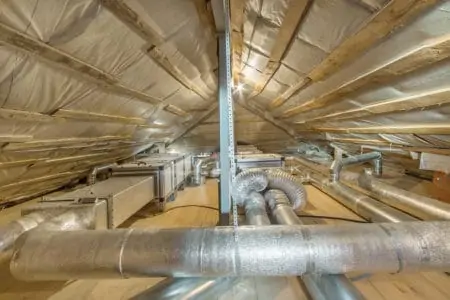
If you have a ceiling fan, you will also have ducting in the roof cavity. The air needs to flow freely for performance and efficiency, so if there are any kinks in the ducting inhibiting that free airflow, the system struggles.
Straightening the ducting opens up the channel to airflow, increasing the efficiency of the fan. It also makes it a lot quieter.
Use Larger Ducting
Similar to straightening the ducting, you increase the capacity for air to flow by using a larger diameter. Narrow channels squeeze the same amount of air into a smaller space, increasing the volume.
Quiet Bathroom Exhaust Fan FAQs

Do More Blades Make a Bathroom Exhaust Fan Quieter?
More blades make a bathroom exhaust fan quieter but can also be less efficient. That’s because more blades will circulate less air.

What Decibel Level Should a Bathroom Fan Be?
Bathroom fans shouldn’t be louder than 51.21 dB. The amount of noise produced by bathroom exhaust fans is measured in sones. The volume of all household appliances is subjected to the sones rating system to determine how loud they are.
Regarding volume, I would classify your bathroom exhaust fan as average and mediocre if it has a rating of between two and three sones. If the noise level of the bathroom fan is greater than four sones, it is deemed loud.

What Is the Difference Between a Bathroom Exhaust Fan and a Ventilation Fan?
An exhaust fan is designed to remove pollutants from the air inside a building, whether a residential or business space. A ventilation fan brings fresh air from the outside into an enclosed area.

Why Is My Bathroom Exhaust Fan So Loud?
Multiple reasons lead to a loud bathroom exhaust fan. One common reason is dirty fan blades. The fan may start making noise if it is old or broken. You should inspect the fan for signs of wear and tear.
The second reason is improper ducting. The air in the room is drawn out by a fan, which does so via ductwork. When a fan draws the air out of a room, it transports it via ducting. It vents that air to the outside of the building through a vent.
Using the appropriate duct length is necessary to have a silent operation. The ductwork should be as straight as possible since sharp curves or many turns will all contribute to a noisy fan.
The motor can also cause a bathroom exhaust fan to be louder. The element of the fan that rotates the fan blades is called the fan motor. The motor’s eventual wear and tear can result in increased noise production.
Take off the front cover of the fan and inspect it for any signs of wear or damage. If there are any visible signs of deterioration, consider replacing the motor or the fan.

What Is the Least Noisy Bathroom Exhaust Fan?
The Panasonic FV-1115VQ1 is the least noisy bathroom exhaust fan with an incredibly low volume of 0.3 sones. In addition to the standard speed selector, you can now access higher CFM settings.
This model comes with a flexible mounting bracket, Flex-Z, making the installation process simple and hassle-free. In addition, it has earned the Energy Star rating because of its SmartFlow technology and incredibly efficient motor.