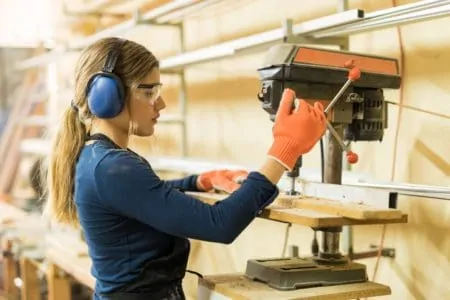
A drill press is a great addition to any workshop, helping you make holes in various materials with precision. However, a floor-standing model might occupy too much space, which is where a benchtop drill press will come in handy.
Benchtop drill presses are smaller and less expensive but still provide the same benefits that professionals enjoy with their industrial models. There are many of these drills to choose from, so it can be difficult to know which brands and models are the best.
To help you make the right decision, we have reviewed 10 of the best benchtop drill presses that are currently available. We chose these drills for their drilling power, versatility, weight, size, and any extra features they have.
- Tilting table
- 16 speeds
- Steel column diameter
- 360-degree swivel head
- 2 horsepower motor
- Heavy-duty
- Laser guide
- Built-in light
- Keyed chuck
- 580 to 3,200 RPM
- Table roller extension
- 0.75 horsepower motor
- Weighs just 34.2 pounds
- Easy to assemble
- Quiet operation
- Micro-drill
- Weighs just over 8 pounds
- Maximum 8,500 rpm
- 90-degree tilting table
- Converts into an oscillating sander
- 12 speeds
- Ideal for beginners
- Very light at 2.2 pounds
- Budget-friendly
- Radial capabilities
- Tilting headstock
- Excellent for repeat drilling
- 12 speeds
- Emergency shut-off
- Threaded depth gauge
Review Methodology: At Sensible Digs, we pride ourselves on our thorough analysis and hands-on examination of benchtop drill presses. Our team of professionals assess each product, comparing performance, design choices, and what sets each one apart from its competitors. Our results stem from strict benchmark tests, tracking the product’s performance under different criteria. We review and score based on key decision-making factors such as power, precision, durability, and user-friendliness. Our evaluation reveals first-hand facts and evidence to help you make an informed choice. Trust in our expertise and experience to guide you to the best benchtop drill press for your needs.
The Best Benchtop Drill Presses of 2024
Benchtop drill presses are a great option for reliably drilling holes quickly and accurately, but you might struggle to choose the best model from the many that are available. That is why we have reviewed 10 of the best benchtop drill presses you can buy, chosen for their speed, torque, size, weight, versatility, and extra features.
Jet J-2530 15-Inch Drill Press
Best Premium Benchtop Drill Press
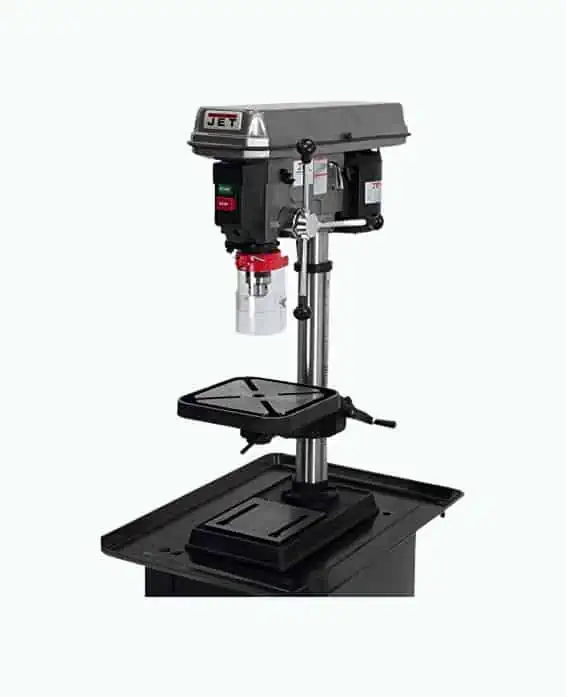
This Jet benchtop drill press is impressively large at 15 inches. It benefits from a lubricated ball-bearing spindle that contains 4 heavy-duty ball bearings in an encased quill for a longer lifespan. That size and durability mean this drill press is capable of tackling tough tasks such as drilling through metal.
The head is made of cast iron, as is the table, and the drill is powered by a 0.75 horsepower motor that makes it even more suitable for penetrating the most robust materials. There are 16 different speed settings, so this is a very versatile drill.
The table can be tilted 45 degrees in either direction, so it is ideal for making angled cuts. This is a premium drill that delivers professional-grade results, but that also means it has a premium price tag.
What We Like
Tilting Table
The table can be tilted 45 degrees on either side, which is ideal for making precise angled cuts.
16 Speeds
The greater the range of speeds a benchtop drill press offers, the more versatile it will be. This means you can use it at low speeds with high torque when drilling into metal, but you can also speed things up for softer materials such as wood.
Steel Column Diameter
This benchtop drill press has a thick steel column to provide greater support and stability. This makes it possible to work on larger or heavier projects.
What We Don't Like
Expensive Price
This drill is one of the more expensive on our list, so it is probably better suited to professionals and experienced DIYers. If you are looking for your first drill press and have a tight budget, you should turn elsewhere.
Big and Heavy
At 15 inches, this drill may be too large for the average home workshop. It is also quite heavy for a benchtop model at 157 pounds, so this isn’t a unit you will want to move around frequently.
Product Specs
| Table size (inches) | 15 x 15 |
| Dimensions (inches) | 22.5 x 12 x 32 |
| Weight (pounds) | 157 |
| Horsepower | 0.75 |
| Speed settings | 16 |
| Warranty | 2-year |
| Price | $$$$ |
Our Ratings
User Experience
Jet JMD-18 350018 Milling/Drilling Machine
Best Benchtop Drill Press for Metal
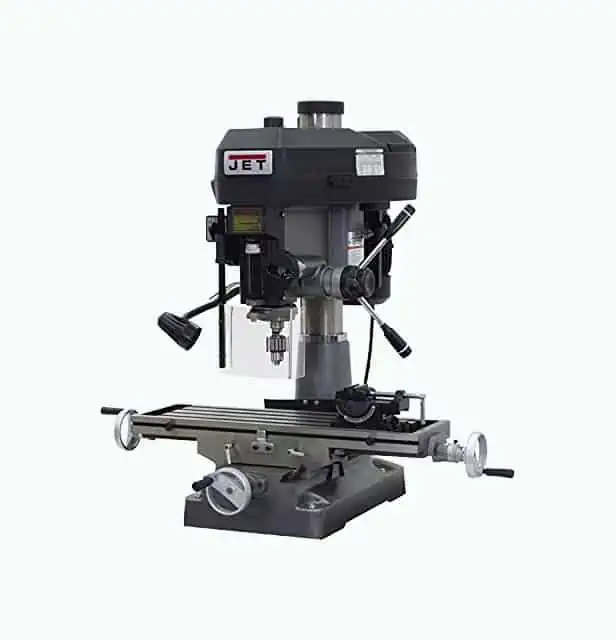
This Jet milling and drilling machine is an excellent tool for anyone who needs to work with metal. It has a 2-horsepower, 230-volt motor which means it can penetrate the toughest materials.
A hinged belt makes it easier to replace the belt and the work table measures 9.5 inches by 31.75 inches. It also has easy-to-read depth gauges and a 360-degree swivel head, so you will be able to drill various holes without having to reposition the stock.
What We Like
360-Degree Swivel Head
The ability to swivel your workpiece by 360 degrees makes it easier to drill various holes without having to remove and replace the stock.
2 Horsepower Motor
The average benchtop drill press has a 0.75-horsepower motor, so this 2-horsepower motor will enable you to drill into harder materials. This also makes it ideal for milling metal.
Large Work Table
The extra-large work table will allow you to drill large pieces without the need for additional support.
What We Don't Like
Expensive
This is an excellent drill press but its price means it will probably only appeal to professionals. If you only need to do occasional drilling, there are plenty of more affordable options out there.
Specialist Tool
This drill can be used for milling but doing so requires training and experience. A casual user might not be able to get the most out of its various features.
Extremely Heavy
At 739 pounds, this is not a machine you are going to want to move unless absolutely necessary. It will probably take 3 people to lift it safely.
Product Specs
| Table size (inches) | 9.5 x 31.75 |
| Dimensions (inches) | 42.5 x 39.75 x 43.5 |
| Weight (pounds) | 739 |
| Horsepower | 2 |
| Speed settings | 12 |
| Warranty | 2-year |
| Price | $$$$ |
Our Ratings
Personal Perspective
WEN 4210T 10-Inch Drill Press
Best Benchtop Drill Press for Beginners
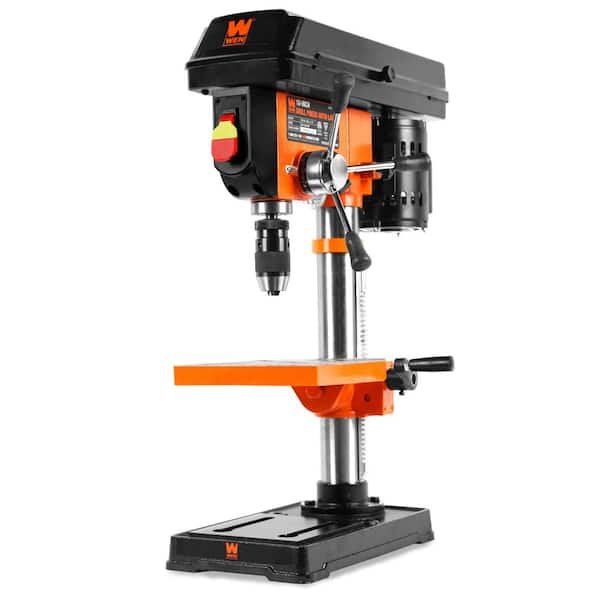
This WEN drill press has a laser guide, which will help you drill quickly and accurately. This makes it very user-friendly for beginners and anyone else, as does the drill’s onboard light.
It has 5 different speed settings, ranging from 600 to 1,300 RPM. You will be able to tackle a variety of different materials as a result.
A keyed chuck means the drill bit will be held very securely. The sturdy cast iron table bevels to 45 degrees, enabling you to make accurately angled holes.
What We Like
Competitively Priced
While it isn’t always the best policy to choose the cheapest power tool you can find, you also don’t want to waste money. This benchtop model is competitively priced, so it is a great option for anyone looking to buy their first drill press.
Laser Guide
If you want to drill precise holes with minimal effort, a laser guide is a must-have feature. This also means you will be able to work at a quicker pace without a loss of accuracy.
Onboard Light
The onboard light will help you see clearly, even if there is a shadow over your drill. When this is combined with the laser guide, you will have all the tools needed to work accurately.
What We Don't Like
Quality Issues
Some users have reported that their laser stopped working and that the table support is made from inferior aluminum.
Light-Duty
As a budget-friendly product, this is not a heavy-duty drill press. If you want to drill into harder materials, you might need to spend more to get a stronger unit.
Product Specs
| Table size (inches) | 7.58 x 7.58 |
| Dimensions (inches) | 21.4 x 14.5 x 9.5 |
| Weight (pounds) | 51 |
| Horsepower | 0.75 |
| Speed settings | 5 |
| Warranty | 2-year limited |
| Price | $$ |
Our Ratings
Community Feedback
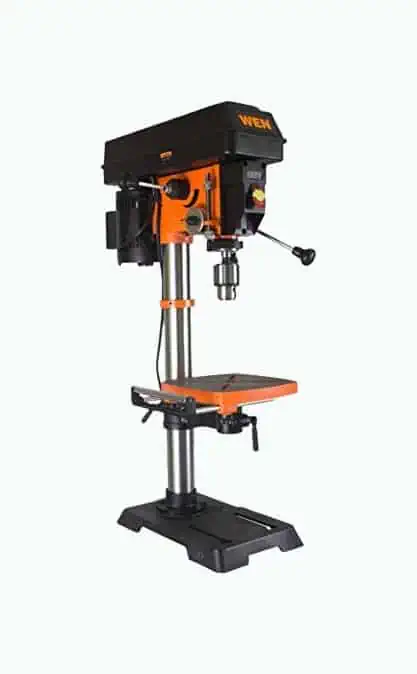
WEN 4214 12-Inch Variable Speed Drill Press
Best Variable Speed Benchtop Press
The greater the speed range of a drill press, the more versatile it will be. This WEN variable speed press is a great example, with speeds ranging from 580 to 3,200 RPM, so you will be able to drill into various materials.
It has a 0.75 horsepower motor and the spindle travels 3.18 inches. The table is cast iron with a rack and pinion operating system for easy, accurate adjustments. It also has a light, a laser guide, and a digital speed gauge, so you can trust it to drill accurately at your ideal pace.
An extension system is included that will allow you to work on larger pieces without needing to add extra support yourself.
What We Like
Variable Speeds
This WEN drill’s variable speed is its standout quality, ranging from 580 to 3,200 RPM. This should be plenty to cater to any material.
Table Roller Extension
The table roller extension increases the capacity of your table by five inches and is easily adjusted. This means you won’t need to add additional supports for larger pieces.
Reasonably Priced
This isn’t the cheapest benchtop drill press you will see but its various features mean it still offers good value for money.
What We Don't Like
Build Quality Issues
This drill press offers a lot of features for how much it costs. However, this means compromises have been made in other areas, with the build quality seemingly suffering as a result.
Customer Service Lacking
Some buyers have complained about a lack of customer service when issues arose with their WEN drill. This is something to keep in mind when buying one of the company’s power tools.
Product Specs
| Table size (inches) | 12 x 12 (extends to 17 with extension roller) |
| Dimensions (inches) | 13.5 x 36.63 x 16.75 |
| Weight (pounds) | 89 |
| Horsepower | 0.75 |
| Speeds | Variable |
| Warranty | 2-year |
| Price | $$$ |
Our Ratings
First-Hand Impression
WEN 4208T Cast Iron Benchtop Drill Press
Best Lightweight Benchtop Drill Press
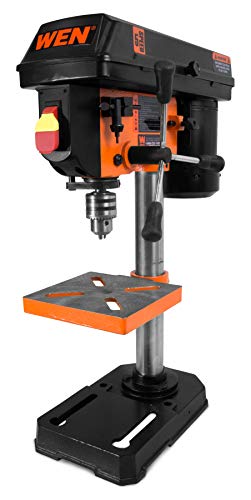
If you want a drill press that is lightweight and easy to move, this WEN 4208T model is an excellent option. It weighs just 34.2 pounds, making it one of the lightest standard-sized drill presses we have discovered during our research.
It has a powerful 2.3-amp motor that generates 3,140 RPM. It also has 5 operating speeds, with the lowest at 740 RPM, making it suitable for drilling wood, plastics, and soft metals.
The cast iron table bevels left and right by 45 degrees. It includes bolt holes to mount the drill to a benchtop and has a keyed chuck to ensure you drill safely at your chosen speed.
Weight
A lightweight tabletop drill press can be a disadvantage when it comes to heavy-duty tasks but you are unlikely to buy a 34.2-pound drill for that purpose. This drill is easy to move around, so it is great if you are working with limited space.
2.3-Amp Motor
Even if this drill is lightweight, its motor still packs a punch. At 2.6 amps, it can tackle wood, lighter metals, and plastics.
Easy to Assemble
You can assemble this drill within 30 minutes and the process is very straightforward. It includes detailed, illustrated instructions that will help you do it easily.
Quiet operation
The induction motor makes this drill work smoothly and quietly at each of its 5 different speeds.
What We Don't Like
Weight
As we mentioned, this lightweight drill press will limit the tasks you can use it for. It won’t be suitable for heavy-duty work.
Product Specs
| Table size (inches) | 6.5 x 6.5 |
| Dimensions (inches) | 22.9 x 7.5 x 11 |
| Weight (pounds) | 34.2 |
| Horsepower | Not specified |
| Speeds | 5 |
| Warranty | Not specified |
| Price | $ |
Our Ratings
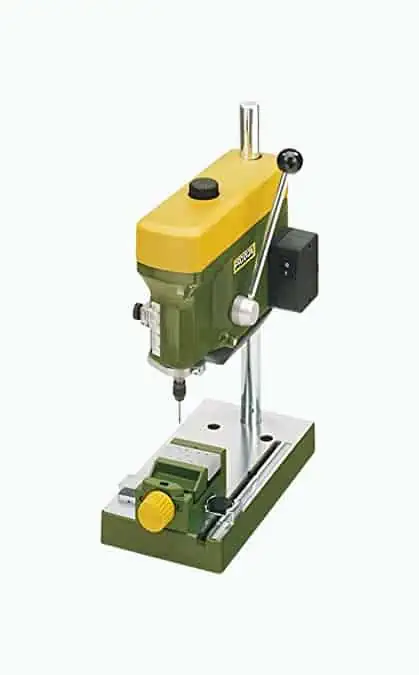
Proxxon 38128 TBM Bench Drill Machine
Best Small Benchtop Drill Press
Proxxon may not be a household name like Delta and WEN, but that doesn’t mean you should overlook this impressive little drill press.
As it is a micro-drill, it is designed for small bits and excels at drilling tiny holes. This makes it an excellent option for anyone who works with jewelry and other intricate or delicate items.
It offers 3 speeds and has an 8.5 x 4.75-inch table with an adjustable fence that provides stability and helps you work accurately.
What We Like
Portable
This drill press weighs just over 8 pounds, so you can easily take it to wherever you need to work.
Maximum 8,500 RPM
This drill may be very compact but it still packs a punch. It offers 3 different speed settings: 1,800 RPM, 4,700 RPM, and 8,500 RPM, so there should be one for any task you are working on.
Precise
This is a micro-drill press, which means it is ideal for working on small, intricate jobs where a larger unit would be cumbersome.
What We Don't Like
Limited Size
This drill’s small size can be both a positive and a negative. At just over twelve inches, it is excellent for precision work but won’t be suitable for anything using larger material or that requires a large bit.
Price
This isn’t one of the more expensive drill presses we have seen, but it is still quite costly, especially for a compact unit. Expect to pay more for this micro-drill than some full-sized models.
Product Specs
| Table size (inches) | 8.5 x 4.75 |
| Dimensions (inches) | 12.6 x 9.45 x 5.12 |
| Weight (pounds) | 8.05 |
| Horsepower | 0.115 |
| Speeds | 3 |
| Warranty | 2-year |
| Price | $$$ |
Our Ratings
Personal Perspective
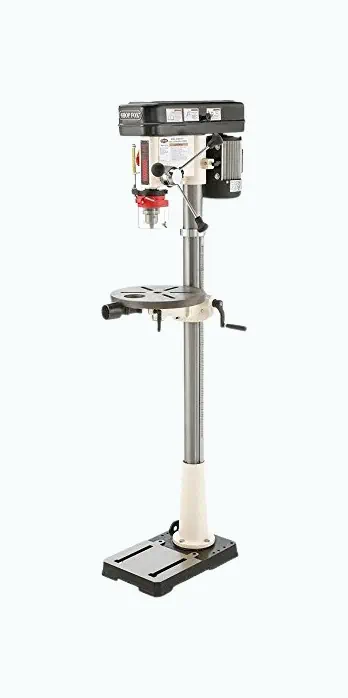
Shop Fox W1848 Oscillating Drill
Best Benchtop Drill Press for Woodworking
This Shop Fox oscillating drill press is ideal for woodworkers because it will allow you to attach sanding equipment to give your holes a much smoother finish. All you need to do is attach the 80-grit sanding drum and the drill will be ready.
If you are working on a project and want the neatest finish possible, this is the right drill press for you. Its 0.75 horsepower motor offers 12 speeds that range from 250 RPM to 3050 RPM, so it is also very versatile.
This versatility is enhanced further by its tilting table, which will enable you to consistently make precise angled holes.
What We Like
90-Degree Tilting Table
Standard drill press tables can tilt by 45 degrees but this Shop Fox takes it further and can be tilted to 90 degrees. This gives you a far greater range when drilling at an angle.
Sander
When you have finished drilling, you can attach the sanding drum to quickly convert your drill press into an oscillating sander. This is very useful for achieving a smooth finish without needing another tool.
12 Speeds
With 12 speeds, this drill is very versatile and can be used at a pace that is suitable for whichever material you are working on. You can work at low speed with increased torque when drilling through hard materials such as metals.
What We Don't Like
Damage on Delivery
We have seen multiple complaints that this drill press is not packaged well enough, which allows the parts to rattle and cause damage.
Build Quality Issues
Shop Fox drill presses are not cheap, yet there are complaints of loosely-fitted or poorly-made parts. This tool is made overseas, presumably to save on costs.
Product Specs
| Table size (inches) | 12.38 diameter |
| Dimensions (inches) | 24 x 15 x 63 |
| Weight (pounds) | 122 |
| Horsepower | 0.75 |
| Speeds | 12 |
| Warranty | 2-year |
| Price | $$$ |
Our Ratings
Community Feedback
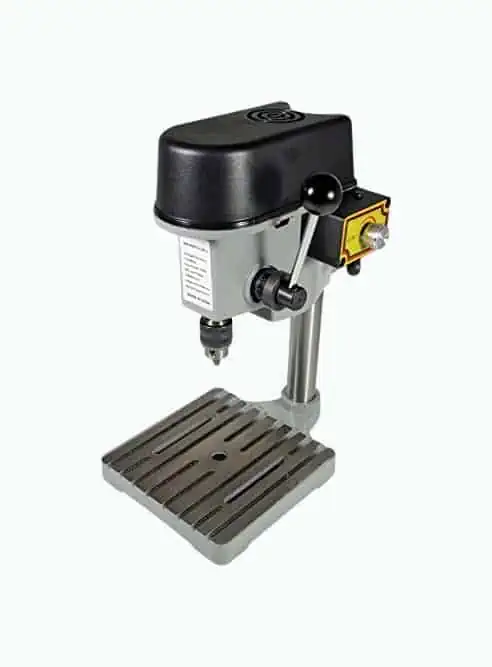
SE 3-Speed Mini Drill Press
Best Budget Drill Press
If you have a tight budget and want a simple, effective drill press, this SE model is well worth considering. It costs many times less than the most expensive drill presses we have looked at. It is quite basic but that isn’t necessarily a bad thing.
This SE is a mini drill press with a work table size of 9.56 by 9.56 inches. It has three speed settings of 5,000 RPM, 6,500 RPM, and 8,000 RPM.
If you need precision drilling on small pieces such as jewelry and miniatures, this will be a very useful option.
What We Like
Ideal for Beginners
This drill is easy to learn and simple to operate, which makes it a great option for inexperienced users who want a tool for small-scale drilling tasks.
Portable
Weighing just 2.2 pounds, you can easily pick this drill press up and carry it wherever you need it, so you won’t be limited to always working in the same place.
Very Affordable
This is one of the cheapest drill presses we have seen. If you want an entry-level mini drill, this is among the least expensive you will find.
What We Don't Like
Limited Size
This drill’s limited size means it is very portable but it will also restrict you in terms of the projects it is suitable for.
Build Quality Issues
It is usually safe to assume that if a product is cheap, it is for a reason. This is not a particularly high-quality drill press.
Product Specs
| Table size (inches) | 9.56 x 9.56 |
| Dimensions (inches) | 20.5 x 13.1 x 17.1 |
| Weight (pounds) | 2.2 |
| Horsepower | 0.125 |
| Speeds | 3 |
| Warranty | 3-year (includes 1-year extension if registered) |
| Price | $ |
Our Ratings
First-Hand Impression
Shop Fox W1669 Radial Drill Press
Best Benchtop Radial Drill Press
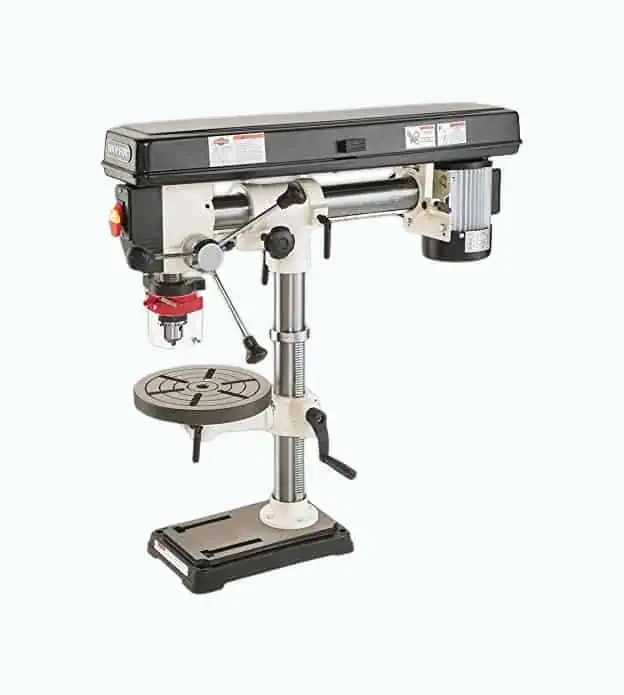
This Shop Fox radial arm drill press can bore holes in the center of workpieces that are 34 inches wide.
It is an ideal tool if you are working on furniture or a bespoke kitchen and need some extra reach. It has a 0.50 horsepower motor and can be used at 5 speeds, ranging from 550 to 3,470 RPM.
It has a threaded depth stop and a table with a diameter of 9.75 inches. The table also swings 360 degrees, so it will be easy to maneuver your workpiece.
What We Like
Extra Reach
This drill’s reach of 34 inches significantly increases the scope of the projects you can work on. If you need to drill holes in sheet material, this is the ideal tool for the job.
Tilting Headstock
You can adjust the angle of the headstock to 45 degrees clockwise and 90 degrees counterclockwise, enabling you to drill precisely angled holes.
Repeat Drilling
Once the drill is aligned, you can use it to bore multiple straight or angled holes without needing to readjust it. This can greatly speed up your work, especially if you are making several of the same items.
What We Don't Like
Expensive
This drill press is a specialist, versatile tool, which is why it is one of the most expensive drill presses we have looked at.
Lacks Power
The motor is 0.50 horsepower, so it is lacking in power. This means you might struggle to drill into harder materials such as metal.
Product Specs
| Table size (inches) | 9.75 diameter |
| Dimensions (inches) | 35.7 x 18 x 12.7 |
| Weight (pounds) | 96.6 |
| Horsepower | 0.50 |
| Speeds | 5 |
| Warranty | 2-year |
| Price | $$$ |
Our Ratings
User Experience
Grizzly Industrial G7943 14-Inch Drill Press
Best Heavy-Duty Drill Press
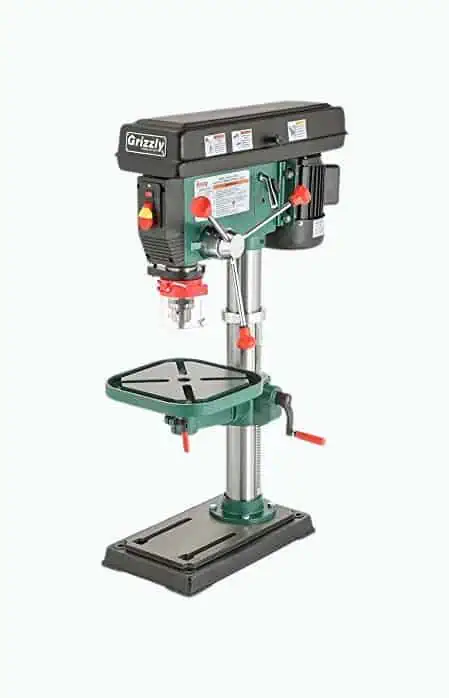
Sometimes you need a tool that has the grit and power to overcome the toughest drilling jobs. That is where this Grizzly drill press will prove its worth.
It has a tilting table that can pivot 90 degrees to the left or right. It also has a 14-inch swing and a steel drilling capacity of 0.75 inches with 12 different speed settings, so it is a versatile drill.
The drill unit features a built-in work light to ensure you can see what you are doing. However, you will need to purchase a bulb for it separately.
What We Like
12 Speeds
The speeds range from a leisurely 104 RPM up to 3,050 RPM. The more speeds you have to choose from, the more versatile your drill will be.
Emergency Shut-Off
The shut-off button sits front and center, so it will be obvious and easy to reach during an emergency.
Threaded Depth Gauge
A threaded depth gauge can be set to your required drilling depth and secured with the locking nuts. This will prevent you from accidentally drilling too deep.
What We Don't Like
No Mount Holes
The table has no mount holes, which will restrict your ability to use clamps, vices, and fences.
Expensive
For a tabletop drill press, this model is not cheap. It is made of robust materials, but it is still expensive for what it is.
Product Specs
| Table size (inches) | 11.38 x 11.38 |
| Dimensions (inches) | 33 x 20 x 12 |
| Weight | 142 pounds |
| Horsepower | 0.75 |
| Speeds | 12 |
| Warranty | 1-year limited |
| Price | $$$ |
Our Ratings
Personal Perspective
| Product | Best | Table size (inches) | Dimensions (inches) | Weight (lbs) | Horsepower | Speed settings | Warranty |
|---|---|---|---|---|---|---|---|
| Jet J-2530 15-Inch Drill Press | Premium Choice | 15 x 15 | 22.5 x 12 x 32 | 157 | 1 | 16 | 2-year |
| Jet JMD-18 350018 Drilling Machine | Metal | 9.5 x 31.75 | 42.5 x 39.75 x 43.5 | 739 | 2 | 12 | 2-year |
| WEN 4210T Drill Press | Beginners | 7.58 x 7.58 | 21.4 x 14.5 x 9.5 | 51 | 1 | 5 | 2-year limited |
| WEN 4214 Variable Speed Drill Press | Variable Speed | 12 x 12 | 13.5 x 36.63 x 16.75 | 89 | 1 | Variable | 2-year |
| WEN 4208T Drill Press | Lightweight | 6.5 x 6.5 | 22.9 x 7.5 x 11 | 34.2 | N/A | 5 | N/A |
| Proxxon 38128 TBM Drill Machine | Small | 8.5 x 4.75 | 12.6 x 9.45 x 5.12 | 8 | 0 | 3 | 2-year |
| Shop Fox W1848 Oscillating Drill | Woodworking | 12.38 D | 24 x 15 x 63 | 122 | 0.75 | 12 | 2-year |
| SE 3-SpeedMini Drill Press | Budget Pick | 9.56 x 9.56 | 20.5 x 13.1 x 17.1 | 2.2 | 0.125 | 3 | 3-year |
| Shop Fox W1669 Radial Drill Press | Radial | 9.75 D | 35.7 x 18 x 12.7 | 96.6 | 0.5 | 5 | 2-year |
| Grizzly Industrial G7943 Drill Press | Heavy-Duty | 11.38 x 11.38 | 33 x 20 x 12 | 142 lbs | 0.75 | 12 | 1-year limited |
What Is a Benchtop Drill Press Used For?
A benchtop drill press is designed to help you make holes more quickly and accurately than if you used a standard handheld power drill. You can set the depth, angle, and width before drilling, making it easy to drill dozens of the same type of hole without needing to adjust the drill press each time.
This makes the drill press an ideal tool for large-scale projects that require precision and a high-quality finish. Drill presses are widely used used in professional workshops, production lines, and factories around the world.
Benchtop drill presses can drill, cut, ream, tap, countersink, and bore holes in a variety of different materials.
How to Choose a Drill Press
Like any power tool, there are some important things you should consider if you want to choose the right drill press for your specific requirements. Taking the time to think about these points will also help you narrow your search.

Speed
When looking at speed, it is important to not only consider the top speed but also the range of different speeds that are offered. Drilling through harder materials such as steel and cast iron requires greater torque and less speed. This is why it is always better to choose a drill that offers various speeds where possible.
Speed is measured in revolutions per minute (RPM), which is the number of times the drill rotates each minute. Typically, benchtop drill presses operate at between 250 and 3,500 RPM.

Torque
Torque is the force the drill turns with, rather than the speed at which it turns, and it is crucial when drilling hard materials at low speeds. Torque is measured in pound-force-inch (lbf-in) or Newton-meter (Nm), and the higher the number, the more powerful your drill will be.

Table Tilt
Most drill presses have a table that can be tilted 45 degrees to the left or right. This is useful when you need to drill angled holes. Some high-end models can even tilt to 90 degrees or more. Alternatively, there are some models where the head of the drill tilts to achieve the same results.

Laser Guide
A laser guide will help you drill with pinpoint accuracy and can speed up your work significantly. This also makes your drill far more user-friendly, especially if you don’t have much experience with using a drill press.
Laser guides are increasingly popular on new power tools but they are still something of a luxury feature. If you are looking for a budget-friendly drill, this might be a feature you need to do without.

Light
If your drill press is in the corner of your workshop, the lighting could be poor. This is especially true when you stand in front of the drill and cast a shadow over it.
With this in mind, many drill presses feature a built-in light to ensure you can see your work clearly. When combined with a laser guide, you should be able to use your machine with great accuracy.
Weight
If you anticipate moving your benchtop drill press from place to place occasionally, you will need to consider its weight. Although benchtop models are lighter than floor-standing drill presses, they are still substantial machines.
Even these lighter drills can weigh between 50 and 150 pounds. Ideally, you should always try to decide on a long-term location and bolt the drill press to the table to keep it secure and stable.

Size
Your available space will determine the maximum size of your drill press. Compared to standing presses, benchtop models are smaller and more manageable, which is why they are better suited to home workshops. Most tabletop drill presses measure between 30 and 35 inches in height.
Work Table Dimensions
Your workshop isn’t the only thing that will limit the size of your drill. You will also need a large enough work table to accommodate it. You should place your benchtop drill press on a table that is as generously sized as possible. If the table is too small, your drill press could essentially become unusable.

Safety Features
Most power tools can be dangerous and need to be used with care. A benchtop drill press is no different. Look for features such as safety guards that will shield your face and eyes against fragments or shards of metal.
You should also try to get a bump switch or another safety cut-out mechanism. Hopefully, you won’t have any accidents but it is important to be able to shut the drill off quickly just in case.
FAQs
Are Benchtop Drill Presses Better Than Hand Drills?
Whether you should choose a benchtop drill press or a hand drill depends on the task you are working on and how often you will use it. Drill presses are better for bulk projects that require multiple precise holes. A hand drill is best suited to smaller projects or tasks where you need to drill into stationary objects or in tight spaces.
Benchtop drill presses are better suited to workshops and garages, whereas a hand drill can go anywhere, especially if it is cordless.

How Tall Should a Benchtop Drill Press Be?
Benchtop drill presses are typically 30 to 35 inches tall. You will need to factor in the height of the bench if you want your drill to be at a comfortable height. The best way to check the height is to measure how high a drill will be when placed in your desired location. It is important to get this right before you bolt or clamp it to the table.

What Does Swing Mean on a Drill Press?
A drill’s swing is an important measurement. It is defined as twice the throat distance, which is the gap between the center of the spindle and the column’s closest edge. For example, a 15-inch drill press will have a 7.5-inch throat distance. This is the most excessive diameter stock the drill press can handle.
Can I Use a Drill Press as a Milling Machine?
A drill press lacks the capabilities of a milling machine, but milling machines can usually double as a drill press. The key difference between the two tools is that a drill press drills holes into the stock vertically, whereas a milling machine can cut with the side of the cutting tools.
A drill press doesn’t have the bearings to cope with the side-load demands of milling and it would rattle and potentially even break.

What Does Spindle Travel Mean on a Drill Press?
Spindle travel refers to the distance the spindle will travel and the depth of the holes you can drill. If the spindle travels 2 inches, you can drill a hole to a depth of 2 inches.
Most drill presses have a spindle travel of about 3 to 4 inches. This is an important factor if you are going to drill thicker pieces of material. The only way to compensate for low spindle travel is to reverse the stock and drill it from the other side but this is not ideal as it will be very difficult to line the two holes up.

What Does 10 Inch Drill Press Mean?
This is the opposite of a drill’s swing. The 10 inches here refers to the distance from the center of the spindle to the edge of the column times two. If you have a 10-inch drill press, then you have a 5-inch swing.

Is a Benchtop Drill Press Worth It?
The benchtop drill press is a useful tool for many woodworking and metalworking projects, providing a level of precision for cutting holes and driving screws that handheld tools are simply not capable of.
It’s also a great asset when drilling multiple holes in the same material, as it can save time and effort by reducing any need to reposition the workpiece.
The main drawback to this type of drill press is the cost; however, it is often well worth investing in one if the projects you work on require accuracy and uniformity in results.
If your budget allows and you need consistent results with your drilling, then a benchtop drill press could be the right choice for you.

What Is a Good Horsepower for a Benchtop Drill Press?
A 3/4 Horsepower (HP) benchtop drill press is a good fit for most small tasks such as drilling through soft materials, drilling shallow holes and counterboring.
On the other hand, those who need to drill thicker, harder materials or already have a large workbench might find 1/2 HP more suitable for their purpose.
Professionals, in particular, will appreciate the extra power these smaller drill presses can deliver despite having a smaller overall footprint.

How Much Runout Should a Benchtop Drill Press Have?
When buying a benchtop drill press for your shop, it’s important to consider a key factor: allowable runout. Runout is the difference between the chuck’s actual center axis and its true center axis and should never exceed 0.001″ when measured one inch from the chuck.
Generally, you want a drill press that has very little runout – ideally less than 0.001″. A drill press with too much runout can result in irregular drilling and poor bit life, which is why manufacturers strive to produce models with excellent accuracy and low runouts.

Does Powermatic Make a Benchtop Drill Press?
Yes, Powermatic does make a benchtop drill press, which has earned it a reputation for being one of the most reliable and powerful devices on the market.
The company designates its drill presses based on what type of job it can handle, and there are several different versions designed for general home use or intense industrial applications.
Each version has been extensively tested under harsh conditions to ensure that users receive superior performance and long-term reliability. What’s more, Powermatic also provides numerous accessories and tools so customers can create an ideal workspace.
With its top-notch craftsmanship and robust dependability, Powermatic’s benchtop drill press is sure to live up to expectations.

What Is the Best Budget Benchtop Drill Press?
The SE 97511MDP Benchtop Drill Press is a great choice for an accessible yet powerful drill press. This 3-speed device can operate at 3,200 RPM and offers 100 watts of power to create precise and consistent holes without breaking the bank.
Also, its impressive construction allows it to weigh only 2.2 pounds, which makes it portable and convenient.
With a reasonable price point and capabilities comparable to more expensive models, the SE 97511MDP is undoubtedly the best budget benchtop drill press on the market today.