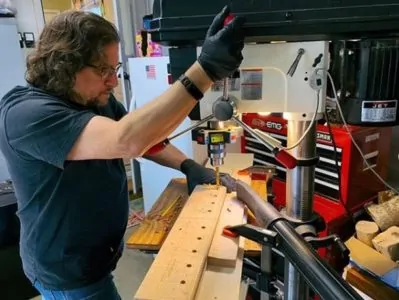
Floor-standing drill presses are large, powerful machines that can make precise holes in tough materials. They are superior to benchtop drills in every way other than their lack of mobility.
If you have a workshop with enough space to accommodate one, a floor-standing drill will be a great addition to your tool collection. However, it will be a significant investment, which is why it is important to ensure you choose the right one.
To help you find your ideal drill unit, we have reviewed seven of the best floor drill presses that are currently available. We chose these drills for their drilling power, size, how adjustable their tables are, and extra features such as lighting and laser guides.
- 1.5-horsepower motor
- 12 speed settings
- 20-inch swing
- ¾-horsepower motor
- Rotating and pivoting table
- 16 speeds with easy adjustment
- Oscillation feature
- 250 to 3,050 RPM
- Budget-friendly
- 90-degree table tilt
- Spindle guard
- 1,720 max RPM
- Twin laser guide
- 16 speed settings
- 5-year warranty
- Tilting head for angled drilling
- Radial head increases capacity
- 32.5-inch swing
- 90-degree table tilt
- 1.5-horsepower motor
- Weighs 350 lbs
Review Methodology: At Sensible Digs, we employ hands-on experience, professional evaluation, and thorough research to analyze and measure the performance of the best floor drill presses. Our criteria consider key decision-making factors such as ease of use, durability, power, speed, and design. We meticulously check and compare each drill press, scoring them based on these standards. Our detailed assessments provide you with evidence-backed facts and results, demonstrating our expertise in this field. We identify what sets each product apart, giving you a clear ranking to aid in your selection. Trust our findings for an informed choice.
The Best Floor Drill Presses of 2024
A floor drill press will likely be among the largest (and most expensive) tools in your workshop, so it is important to choose one carefully. This is why we have reviewed seven of the best floor drill presses that are currently available, chosen for their speed and torque, size, and extra features such as laser guides and lighting.
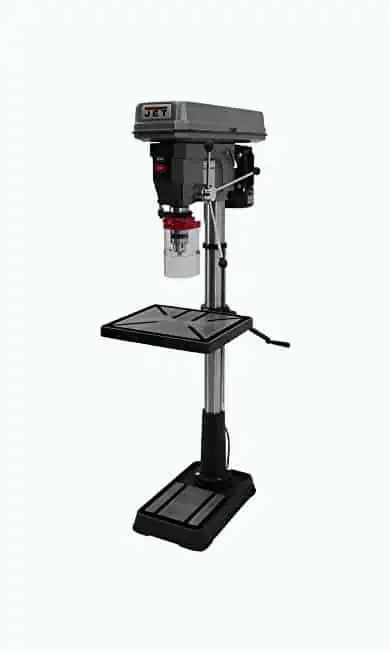
JET JDP-20MF 20-Inch Floor Drill Press
Best Floor Drill Press for Woodworking
This JET drill press has a 1.5-horsepower motor, providing enough power to tackle the toughest drilling jobs and materials. It has a 0.75-inch keyed chuck and 12-speed settings ranging from 150 to 4,200 RPM, so it is equally capable of cutting fragile materials and
It has a depth stop with dual locking nuts for quicker adjustment. The table can be tilted to make angled cuts and a built-in light will ensure you have a clear view of your work at all times.
What We Like
Powerful Motor
With 1.5 horsepower at its disposal, this floor drill press is capable of penetrating the toughest materials you are likely to encounter, including steel and cast iron.
12 Speed Settings
The lowest speed setting of 150 RPM provides high torque for drilling metals and other hard materials. For cutting softer pieces of wood, you can increase the speed up to 4,200 RPM, so this is a very versatile tool.
20-Inch Swing
The unit has a swing of 20 inches, so it can drill to the center of stock that is 10 inches in diameter.
What We Don't Like
Build Quality Issues
Some customers have complained of design faults and build quality issues, particularly relating to the depth stop.
Expensive
This is one of the more expensive drill presses we have looked at. Its price probably makes it an unrealistic option for anyone other than professionals.
Product Specs
| Swing (inches) | 20 |
| Chuck size (inches) | 0.75 |
| Weight (pounds) | 268 |
| Dimensions (inches) | 58 x 27 x 13 |
| Table tilt | 45 degrees |
| Price | $$$$ |
| Warranty | 2-year |
Our Ratings
User Experience
Sunex 5000A 16-Speed Floor Drill Press
Best Variable Speed Floor Drill Press
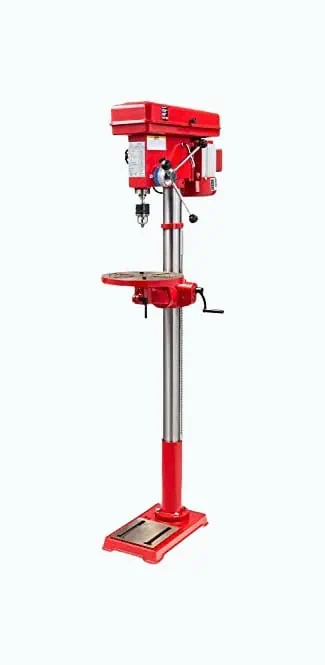
If versatility is a priority, the Sunex 5000A is an excellent choice. It has 16 different speed settings, ranging from 200 to 3850 RPM. The belt tension lever enables you to switch speeds quickly and easily.
Other notable features include a rotating and pivoting table, a ¾-horsepower motor, and enough capacity for large pieces of material. This is a powerful, versatile drill press that will be suitable for the majority of drilling tasks.
What We Like
¾ HP Motor
This is a heavy-duty drill press with a ¾-horsepower motor, providing enough strength to penetrate tough materials.
Rotating and Pivoting Table
This drill press has a 360-degree rotating table for greater flexibility. It also pivots up to 45 degrees on each side. An indicator shows the current angle so you can drill precise holes for joints and other tasks.
16 Speeds and Easy Adjustment
A wide range of speeds is good but it is also helpful to have multiple settings within that range. With 16 speed settings, ranging from 200 RPM to 3850 RPM, this drill is versatile enough for any material. It is easy to change speeds thanks to the tension lever.
What We Don't Like
Vague Instructions
The instruction manual is brief and doesn’t provide a detailed walkthrough for setting up the tool. If you don’t have much experience with drill presses, this can make it challenging to install.
Flimsy Construction
This is one of the cheaper drill presses we have seen and customer reviews suggest that the build quality reflects this. If you want a tough drill for heavy-duty work, it is worth spending more for a better-quality model.
Product Specs
| Swing (inches) | Not specified |
| Chuck size (inches) | 0.625 |
| Weight (pounds) | 138 |
| Dimensions (inches) | 45.13 x 18.5 x 10.88 |
| Table tilt | 45 degrees on both sides |
| Price | $$ |
| Warranty | 1-year |
Our Ratings
Personal Perspective
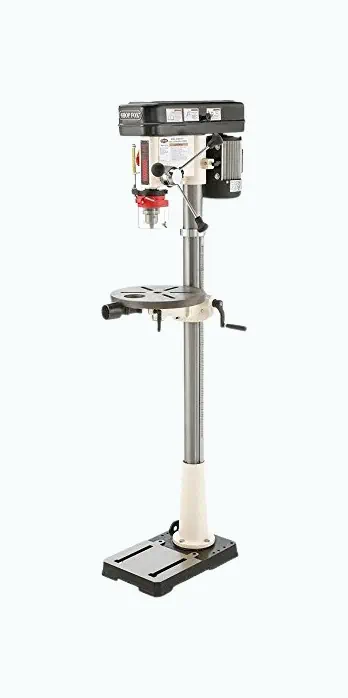
Shop Fox W1848 Oscillating Floor Drill Press
Best Oscillating Floor Drill Press
This is an oscillating Shop Fox floor drill press, which means it not only rotates but also moves back and forth. With the right attachment, it can also be used as an oscillating sander to give the holes you drill a smoother finish.
Your purchase includes a set of sanding drums that fit the 0.625-inch chuck, so you can start using the sander immediately. The motor is 0.75 horsepower, so it is the most powerful, but it is excellent for woodworking.
What We Like
Oscillation Feature
The oscillation feature makes this drill press very versatile. It means you can use the drill as a sander to make smoother holes.
Adjustable Speed Range
A wide range of speeds from 250 to 3,050 RPM makes this tool suitable for various materials. Slower speeds suit harder stock while higher speeds cut softer materials quickly.
Low Price
Despite its extra ability to oscillate, this Shop Fox drill press is still surprisingly affordable. It is among the cheaper units we have seen during our research.
What We Don't Like
Weighs Just 122 lbs
This drill press weighs just 122 pounds. Unlike handheld power tools where lighter weights are preferable, it can be a drawback for stationary tools. This is because light drill presses can become unstable when heavy pieces are placed on their tables.
Product Specs
| Swing (inches) | 13.75 inches |
| Chuck size (inches) | 0.625 |
| Weight (pounds) | 122 |
| Dimensions (inches) | 24 x 15 x 63 |
| Table tilt | 90 degrees left and right |
| Price | $$ |
| Warranty | 2-year |
Our Ratings
Community Feedback
Shop Fox W1680 1-Horsepower Floor Drill Press
Best Floor Drill Press for Metal
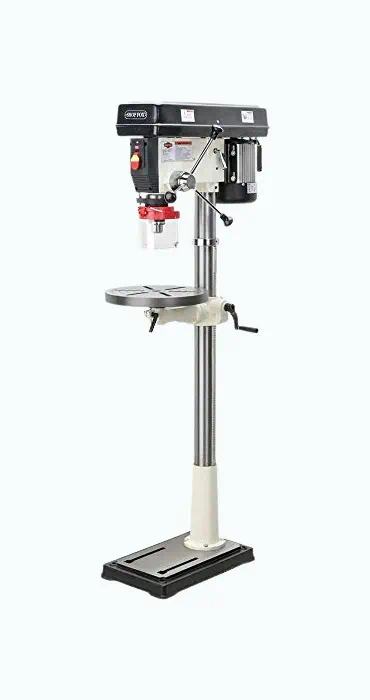
Shop Fox is one of the most popular names in drill presses and it is easy to see why. This is a 17-inch model that has a slower maximum speed of 1,720 RPM, making it more suitable for harder materials. When drilling into metal, it is best to work at low speeds to generate greater torque.
This unit also has a tilting table that measures 14 inches in diameter and can swing up to 90 degrees for a wider range of drilling angles.
What We Like
Reasonably Priced
While there are cheaper Shop Fox models available, this one is still reasonably priced, especially compared to some of its more expensive competitors.
90-Degree Table Tilt
A 45-degree tilt is the industry standard but this table is more versatile, with a tilt of 90 degrees. This makes it great for drilling angled holes for joints and other purposes.
Enhanced Safety Features
This model has a spindle guard to protect you during use and an oversized cut-off switch to ensure the drill can be turned off quickly during an emergency.
What We Don't Like
Build Quality
To make this drill as affordable as possible, Shop Fox has had to make some compromises with the quality of its components.
Delivery Issues
We have seen multiple reports of customers receiving damaged drills. It isn’t clear whether this is due to careless delivery or inadequate packaging.
Product Specs
| Swing (inches) | 17 |
| Chuck size (inches) | 0.625 |
| Weight (pounds) | 178.1 |
| Dimensions (inches) | 56.5 x 21 x 10 |
| Table tilt | 90 degrees |
| Price | $$$ |
| Warranty | 2-year |
Our Ratings
First-Hand Impression
Delta 18-900L Laser Drill Press
Best Floor Drill Press With Laser
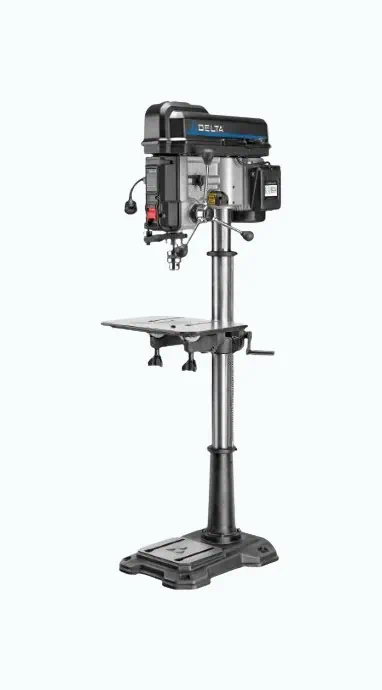
This Delta drill press has a laser guide to help you drill holes with pinpoint accuracy. It uses two lasers to highlight the exact drilling spot, removing any guesswork. This is a very helpful feature, especially if you don’t have much experience in using a drill press.
It has a 0.75-horsepower motor with 16 speed settings, a work light, and an oversized table that pivots 90 degrees left and right and tilts forward to 48 degrees. This makes it a versatile, user-friendly drill that is great for beginners.
What We Like
Twin Lasers
If you want to drill as accurately as possible, a twin laser guide will help you significantly. You will be able to drill holes quickly and accurately, without any guesswork.
16 Speeds
The more speed settings a drill has, the greater its versatility will be. Slower speeds are better for hard stock and quicker speeds will make short work of softer materials such as wood and plastic.
5-Year Warranty
Delta guarantees this drill with a generous 5-year warranty, which is as long as you are likely to find on a power tool. This is a very expensive drill press, so receiving a generous warranty is even more important.
What We Don't Like
Very Expensive
This floor drill press is one of the most expensive we have seen during our research. Unless you are a professional, you should be fine with a more affordable model, and even then you should consider whether it is a necessary investment.
Poor Customer Service
We have seen multiple accounts of people being dissatisfied with the customer service they received when encountering issues with this drill press.
Product Specs
| Swing (inches) | 18 |
| Chuck size (inches) | 0.50 |
| Weight (pounds) | 240 |
| Dimensions (inches) | 59 x 30.5 x 13 |
| Table tilt | 90 degrees left and right |
| Price | $$$$ |
| Warranty | 5-year |
Our Ratings
User Experience
Shop Fox W1670 0.50-Horsepower Radial Drill Press
Best Radial Floor Drill Press
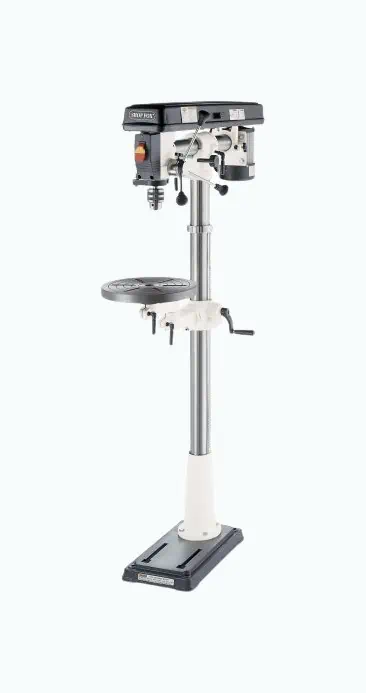
Radial drill presses are specialist tools. They have a head that extends out over your stock to increase the maximum size of your workpiece. This Shop Fox model has a swing of 32.5 inches, giving it a superior reach to the majority of other floor drill presses out there.
This unit has a 0.50-horsepower motor, so despite having a higher capacity, it probably won’t be suitable for heavy-duty drilling. Another unique aspect of this model is that the drill head tilts as well as the table, so you have even more freedom to create angled holes.
What We Like
Tilting Head
The tilting head makes this tool suitable for sanding and it provides a wider range of drilling angles. When combined with its tilting table, you will have a multitude of different options.
Radial Head
The radial head increases this tool’s stock capacity significantly and means you will be able to drill the centers of larger pieces of material.
Reasonable Price
Despite its extra features, this drill is still reasonably priced and is not one of the most expensive we have looked at during our research.
What We Don't Like
Build Quality Issues
For this drill to be reasonably priced, even with its extra features, compromises have been made in other areas. This drill’s build quality is questionable, based on the customer reviews we have read.
Do You Need One
Ask yourself if you need this tool’s extended capacity. If you don’t, you can find a better-quality floor drill press for the same amount of money.
Product Specs
| Swing (inches) | 32.5 |
| Chuck size (inches) | 0.625 |
| Weight (pounds) | 138 |
| Dimensions (inches) | 54.5 x 20 x 10 |
| Table tilt | 90 degrees left and right |
| Price | $$ |
| Warranty | 2-year |
Our Ratings
Personal Perspective
Grizzly Industrial G7948-20-Inch Floor Drill Press
Best Industrial Floor Drill Press
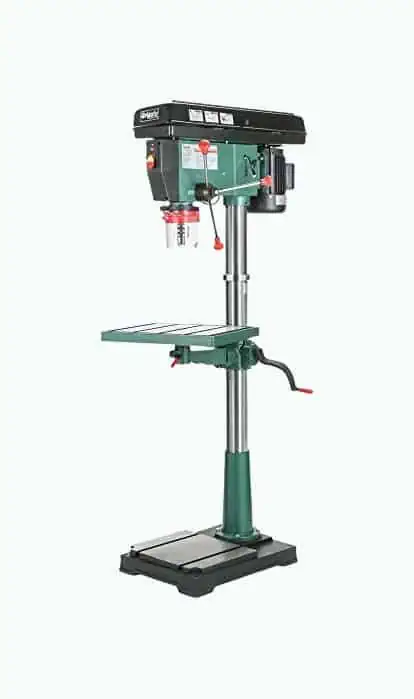
This Grizzly drill press is designed for industrial use, so it will tackle heavy-duty drilling tasks. It has a 1.5-horsepower motor and a table that can swing left and right by 90 degrees.
This is a heavy unit, weighing 350 pounds, so you won’t want to move it again once it is in position. This weight has the advantage of making the unit very stable, so it can hold heavier pieces of material without a loss of stability. It is an ideal tool for production lines and other commercial applications.
What We Like
Durable and Sturdy
This tool is built to last and is intended for heavy-duty use. Its weight means it is very stable, so you won’t have to worry about it potentially tipping over if you place heavy pieces of material on it.
1.5-Horsepower Motor
1.5 horsepower places this among the most powerful drills we have looked at and means it will be more than strong enough for any task you ask of it.
Weighs 350 lbs
The more weight you place on the table, the heavier the unit should be to hold it safely. It weighs 350 pounds, which is more than enough to cope with the most substantial pieces of material.
What We Don't Like
Expensive
This is a professional-grade drill press with a price to match, so you should consider whether or not you need such a high-end model. If you only need a drill press for occasional use, you can save money by looking elsewhere.
Size Concerns
Make sure you have a space suitable to accommodate a large, heavy drill press. Ideally, this means placing it on a concrete floor. If you need to put it on a wooden floor, make sure the boards can hold the weight safely.
Product Specs
| Swing (inches) | 20 |
| Chuck size (inches) | 1.25 |
| Weight (pounds) | 350 |
| Dimensions (inches) | 26 x 62 x 14 |
| Table tilt | 90 degrees left and right |
| Price | $$$$ |
| Warranty | 1-year |
Our Ratings
Community Feedback
| Product | Best | Swing | Chuck size | Weight | Dimensions | Table tilt | Warranty |
|---|---|---|---|---|---|---|---|
| JET JDP-20MF Floor Drill Press | Woodworking | 20″ | 1″ | 268 lbs | 58 x 27 x 13″ | 45 deg | 2-year |
| Sunex 5000A Drill Press | Variable Speed | N/A | 0.625″ | 138 lbs | 45.13 x 18.5 x 10.88″ | 45 deg | 1-year |
| Shop Fox W1848 Floor Drill Press | Oscillating | 13.75″ | 1″ | 122 lbs | 24 x 15 x 63″ | 90 deg | 2-year |
| Shop Fox W1680 Floor Drill Press | Metal | 17″ | 1″ | 178 lbs | 56.5 x 21 x 10″ | 90 deg | 2-year |
| Delta 18-900L Laser Drill Press | Laser | 18″ | 0.5″ | 240 lbs | 59 x 30.5 x 13″ | 90 deg | 5-year |
| Shop Fox W1670 Radial Drill Press | Radial | 32.5″ | 1″ | 138 lbs | 54.5 x 20 x 10″ | 90 deg | 2-year |
| Grizzly Industrial G7948 Floor Drill Press | Industrial | 20″ | 1.25″ | 350 lbs | 26 x 62 x 14″ | 90 deg | 1-year |
When to Use a Floor Drill Press
A floor drill press is the best tool for heavy-duty drilling tasks. Drill presses are primarily used to drill cylindrical holes but there is much more to them than simple brute force. They can also bore, countersink, ream, and tap.
The main advantages of floor drill presses are that they provide excellent accuracy and power. They can be used to drill numerous holes to the same depth, by setting a simple depth stop. This means you won’t need to manually measure or adjust the drill each time you need to make a hole.
It is the perfect tool for woodshops, factories, and other production lines.
What Size Floor Drill Press Should You Choose?
The right floor drill press size to choose will depend on the type of stock you work with. The maximum size will unavoidably be limited by how much space you have in your workshop. If you have a large workpiece with a wide diameter, you will need to consider the “swing” of the drill press.
A drill’s swing is twice the throat distance (the measurement from the center of the spindle to the nearest side of the column). An 18-inch drill press will have a swing of 9 inches, which means it can drill holes 9 inches from the edge of a piece of material. Most floor drill presses are 16, 18, or 20 inches.
What to Look for in a Floor Drill Press
At a glance, most floor drill presses look quite similar but there will be some important differences from model to model. When trying to find the right one, take the time to think about these features and it should help narrow your search.

Intended Purpose
Before you buy a drill press, think about why you want one and which tasks you are likely to use it for. If you are only working on small projects, such as making wooden toys, the drill’s swing is unlikely to be a major issue. On the other hand, if you are making larger pieces such as wooden furniture, you will need a large enough swing to accommodate them.
If you have enough space and a sufficient budget, it is usually best to get as large a drill press as you can. It is better to buy one that is oversized instead of undersized, so you don’t find yourself unable to complete a task.

Power
A drill’s power is measured in horsepower. Drill presses are typically 0.50 to 1.5 horsepower, which is plenty for drilling through metal or hardwood. This power is transferred from the motor via the drill’s spindle.
The faster the spindle turns, measured in revolutions per minute (RPM), the less torque is generated. The slower it turns, the higher the torque will be. Higher torque is better for harder materials, whereas higher RPM is better for softer, more delicate materials.

Chuck
In most cases, keyless chucks are more convenient and secure enough for small-scale drilling jobs. While this is true of modern hand drills, drill presses still have keyed chucks. A keyed chuck will ensure that the bit is held securely and won’t slip free during drilling.
As drill presses are heavy-duty tools, it is worth foregoing the convenience of a keyless chuck to gain some extra security. Make sure the chuck is made using high-quality materials and machining as this part of the drill press needs to endure the most punishment during use.

Speed
The ability to alter a drill’s speed during use means it can be adapted to various materials. You will want to drill hard materials such as metals more slowly as they require greater torque. Less dense materials such as softwood can be cut at a higher speed as they don’t require as much torque.
The speed of drills is measured in revolutions per minute (RPM) and usually ranges from 250 to 4,000 RPM.

Tilting Table
Tilting tables enable you to accurately drill angled holes. Many tables can tilt up to 45 degrees, ideal for drilling joints, while some can tilt to 90 degrees. Some can only tilt in one direction while high-end models might be able to tilt left and right or forward and back.
If you need to drill holes at an angle, especially multiple holes at the same angle, a tilting table is a must-have feature for achieving precise results.

Depth Stop
The tool’s depth stop lets you set how far the drill can penetrate before it stops, so you won’t have to check the depth of each hole manually. This is invaluable if you want to drill numerous holes to the same depth and will speed up your work significantly. A depth stop is one of the most important features for use on production lines, which is why floor drill presses are so popular for professional work.

Laser
A laser guide shows you exactly where the drill bit will go, removing any guesswork during the drilling process. If you don’t have much experience in using a drill press, this should help you reliably achieve precise results.

Lighting
Drill presses can sometimes be left in the dark, especially if they are placed in corners and your body is blocking the light. Many drill press units feature built-in lighting to overcome this, ensuring you have a clear view of your work at all times.

Warranty
Floor drill presses are expensive tools, so a long warranty serves as reassurance that you are not wasting your money. The length of a warranty is usually a good indicator of how much confidence the manufacturer has in its products. After all, a company won’t protect a tool for five years if they believe it will only continue working for three.
FAQs

How to Mount a Drill Press on a Concrete Floor
A drill press is a top-heavy tool, so it is essential to make sure it is stable and secure before using it. If you want to mount it on a concrete floor, you will need a masonry drill bit, a hammer drill, and masonry screws.
Start by placing the drill unit and mark the holes using the base as a template. Use your hammer drill to make pilot holes with a masonry bit. Once you have reached the required depth, use a larger drill bit to enlarge the holes.
Do this until you have reached the correct size for your chosen fixings. Then, insert anchors to grip the screws and position the base over the holes. Drive the screws into place using your power drill’s screwdriver mode.

What Lubricant to Use on a Floor Drill Press
Consult your owner’s manual to find out which parts of a drill press require lubrication. You should wipe down the table with a cloth soaked in light machine oil. This will discourage rust from appearing if moisture gets onto the surface.
Regular auto grease should do the trick. For the drill’s gear bearings and other moving parts, a drop of gear oil will keep things moving smoothly.

How to Safely Move a Floor Drill Press
There are two main ways to move a drill press safely. The first is to wrap the drill press in a protective cloth and ask someone to help you move it in one piece. This is a fine option as long as the drill is well-constructed and you carry it carefully.
The other option is to remove the head, stand, and table, then transport it in multiple pieces. This method means you will need to reassemble the drill after moving it, but it is the safer method if you are doing it alone.

How to Choose Spindle Speed on a Floor Drill Press
A couple of factors determine the correct spindle speed. The material you are cutting will influence how quickly you should drill, as will the drill bit you use. Most manufacturers publish a chart that tells you which speed to use for different materials.
Some modern drill presses have a digital RPM display that tells you the speed of the spindle. This will help you avoid drilling too slowly or quickly.

Is a Floor Drill Press Worth It?
A floor drill press is perfect for jobs that absolutely need accuracy and precision, like home improvement projects or professional craftsmanship. It’s definitely worth it if you do frequent projects that need exact measurements.
Floor drill presses come in different sizes and prices, too, so you can find one that meets your needs and budget.

What Size Floor Drill Press Is Best for Woodworking?
When determining what size floor drill press is best for your woodworking projects, it’s important to consider the size of the materials you’ll be working with.
Generally, a mid-sized model between 16 and 20 inches is good for most woodworking tasks. This size will give you enough power to drill through thick pieces of wood without taking up too much space in your workshop.
If you plan on drilling through metal or larger materials, an industrial-grade model with a 24-inch capacity might be more suitable. Ultimately, the best drill press size depends on the project you plan to tackle.

Do You Need Gloves for a Floor Drill Press?
When operating a drill press, it is important to not wear gloves. Gloves can reduce your grip strength and may cause you to slip while holding the workpiece or tool. This could result in injury or damage to the machinery.
Wearing gloves can impede your control of the drill press as your fine motor skills will be hindered. If the glove’s fabric gets stuck in the spinning chuck jaws, it can quickly become dangerous.
Always keep your hands bare and use protective eyewear instead for optimum safety and accuracy when using a drill press.

How Do You Make a Floor Drill Press Deeper?
Making a floor drill press deeper is quick and easy. The first step is to adjust the depth stop on the headstock of the drill press. This can be done by loosening the locknut, adjusting the depth stop to the desired depth, and then tightening the locknut back in place.
Once this has been done, carefully lower your drill bit into the material you are cutting slowly until it reaches the desired depth. Always ensure you use the right speed and pressure to prevent damage or accidents while drilling.

What is the Best Cheap Floor Drill Press?
The combination of features and a low price point make the Sunex 5000A one of the best floor drill presses on the market.
It features 16 distinct speeds ranging from 200 to 3850 revolutions per minute (RPM). The belt tension lever makes it possible for you to switch between gears brisk and hassle-free.
With this heavy-duty drill press that features a motor rated at 3/4 horsepower, you will have sufficient power and strength at your disposal. You will have complete freedom of movement with this drill press thanks to its table that can rotate a full 360 degrees.