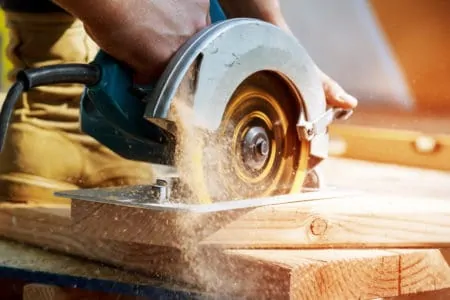
Power saws have transformed the way woodworkers and carpenters complete their tasks, enabling them to make accurate cuts and add detail with much greater speed and efficiency.
Worm drive saws are one of the most widely-used types of power saws, cutting at lower speeds but with greater torque. With so many worm drive saws to choose from, you might struggle to single out the best ones.
To help you find the right saw for your needs, we have reviewed seven of the best worm drive saws that are currently available. We chose these saws based on their power, cutting depth, and how heavy they are.
- Leading brand
- Magnesium construction
- Electric brake
- Heat-treated hypoid gears
- Extra configuration options
- Push-button spindle lock
- Magnesium construction
- Dual-field motor reduces heat
- 11.5 pounds
- 16-inch blade
- Magnesium construction
- Powerful motor
- Cordless
- 11.69 pounds
- True worm drive saw
- Steel bevel
- 5,300 RPM
- Lock-on button
- Heavy-duty composite shoe
- High torque
- 5-year warranty
Review Methodology: At Sensible Digs, we take pride in our hands-on experience and professional approach when analyzing the best worm drive saws. Our criteria involve a meticulous assessment of each product’s performance, design, and unique features. We compare and rank each saw, using quantitative measurements to evaluate the product from a user’s perspective. Our reviews reflect our expertise, and we track each product’s performance, highlighting the key decision-making factors. Our findings are based on facts and evidence, providing you a trusted, objective review. We go beyond the standard approach to help you understand what sets each product apart from its competition. Trust us to guide you to the best worm drive saw based on your needs.
The Best Worm Drive Saws of 2024
There are numerous worm drive saws to choose from, including many from some of the top power tool brands in the world. After looking at dozens of models, we have narrowed them down to seven of the best worm drive saws that you can buy today, chosen for their cutting depth, ease of use, power, and reliability.
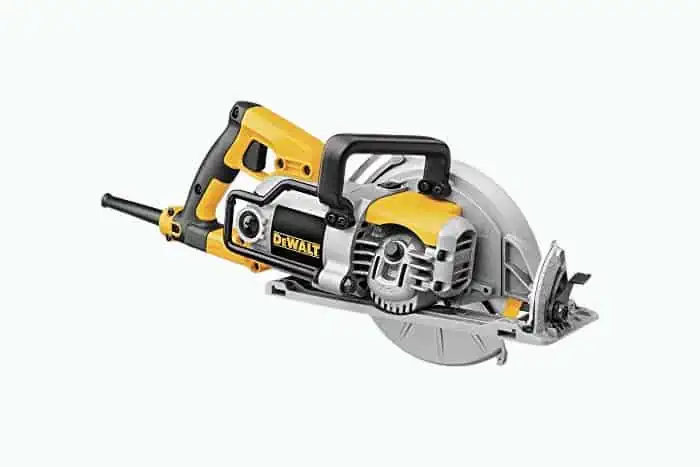
DeWALT DWS535S Worm Drive Saw
Best Quality Worm Drive Saw
This DeWALT worm drive circular saw provides elite quality and durability. It has a lightweight magnesium footplate and a mixture of aluminum and magnesium in its construction.
Its stable block construction reduces vibrations, extending the saw’s service life. There is also an additional handle that enables you to hold the saw with both hands for greater control and security.
The saw weighs 13.8 pounds, which is exactly what you would expect from a worm drive saw. It is designed to meet the demands of amateur and professional users, with an electric brake that can stop the blade in case of an emergency. The power cord is four times stronger than a standard cable, making it harder to slice through accidentally.
What We Like
Leading Brand
DeWALT is a brand name that is well-known and highly regarded around the world. The company is known for its precision, reliability, and high quality. This saw lives up to that reputation.
Magnesium Construction
Magnesium is a third less dense than aluminum and 75% lighter than steel, yet it is still very robust. This combination of being lightweight and durable makes it the ideal material for power tools.
Great Price
Given the high quality of this saw, you might expect it to be one of the more expensive models we have reviewed. However, it is available at a very reasonable price, making it a great option for woodworkers on a budget.
What We Don't Like
Weight
At 13.8 pounds, this tool is relatively lightweight thanks to its magnesium components. However, it could be a lot lighter. It weighs as much as three pounds more than the lightest worm drive saws we have reviewed.
Product Specs
| Weight | 13.8 pounds |
| Blade size | 7.25 inches |
| Depth cut | 1.88 inches at 45 degrees and 2.43 inches at 90 degrees |
| Housing | Magnesium and aluminum |
| Motor | 15 amp/4,800 RPM |
Our Ratings
User Experience
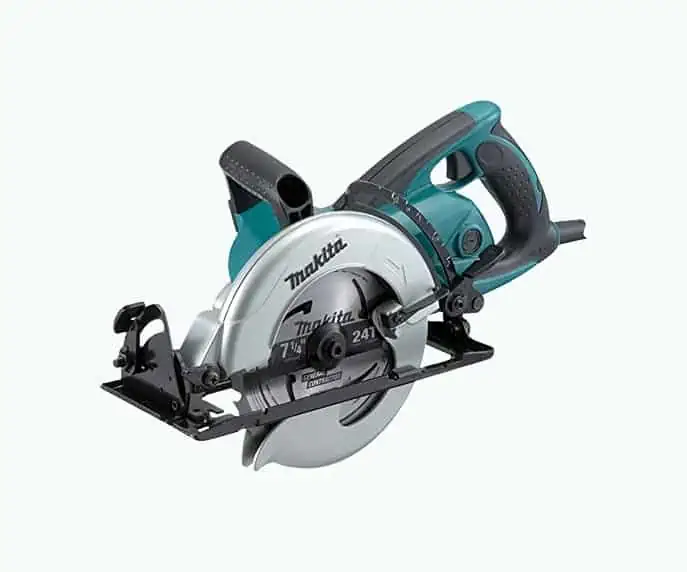
Makita 5477NB Hypoid Saw
Best Budget Worm Drive Saw
Makita is a leading Japanese manufacturer of power tools, and this model lives up to its high reputation. Despite its high quality, it is available at a very budget-friendly price, making it an accessible option for beginners and more experienced woodworkers alike.
This saw has heat-treated hypoid gears, which are a fusion of worm drive gears and bevel gears to provide improved performance and increased cutting capacity. It also has a push-button spindle lock for quick, safe blade replacement.
What We Like
Hypoid Gears
This combination of a worm drive and conical bevel gears provides an increased load capacity and a greater range of configuration settings.
Low Price
The price of this saw is probably the first thing that will catch your eye. You could buy it multiple times for the money you would spend on similar saws from some other top brands. It is an excellent option for beginners.
What We Don't Like
Steel Housing
Given this saw’s budget-friendly price, it won’t have every benefit of more expensive models. Materials are an area where money can be saved, which is why this saw is made using steel rather than magnesium or aluminum.
Weight
Due to the steel construction, this Makita saw weighs 14.3 pounds, which places it at the upper end of worm drive saws.
Product Specs
| Weight | 13.9 pounds |
| Blade size | 7.25 inches |
| Depth cut | 1.75 inches at 45 degrees and 2.38 inches at 90 degrees |
| Housing | Rust-proof steel |
| Motor | 15 amp/ 4,500 RPM |
Our Ratings
Personal Perspective
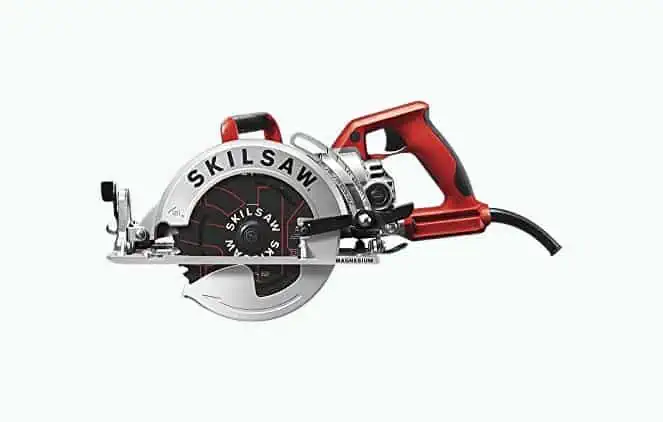
Skilsaw SPT77WML-01 Worm Drive Saw
Best Lightweight Worm Drive Saw
Skilsaw is the originator of the circular power saw. Without them, it is also unlikely that we would have worm drive gears today. The company remains an industry leader in power saw design and manufacturing.
This model is an excellent example of a lightweight worm drive saw that benefits from magnesium housing and construction. At just 11.5 pounds, it is barely heavier than direct-drive circular saws, which is rare.
Your purchase is even protected by a 180-day customer satisfaction guarantee. If you aren’t happy with how your saw functions, Skilsaw will refund your money.
What We Like
Innovative Brand
Skilsaw created the original circular power saw and its products are still among the best you can buy. This saw benefits from Skilsaw’s expertise having made power tools for a century.
Dual-Field Motor
The majority of power saw motors use single copper windings. Skilsaw motors utilize dual copper windings that increase the copper surface area by 40%, which helps keep the motor cool during operation.
Lightweight
This saw is one of the lightest we have seen, weighing just 11.5 pounds. This makes it almost as light as direct-drive models.
What We Don't Like
Build Quality Issues
Skilsaw has placed so much emphasis on reducing the weight of this saw that certain components, such as the mag plate, are less durable than some other models. Some users report it flexing during use.
Product Specs
| Weight | 11.5 pounds |
| Blade size | 7.25 inches |
| Depth cut | 2.38 inches at 90 degrees (depth not stated at 45 degrees) |
| Housing | Magnesium |
| Motor | 15 amp dual-field |
Our Ratings
Community Feedback
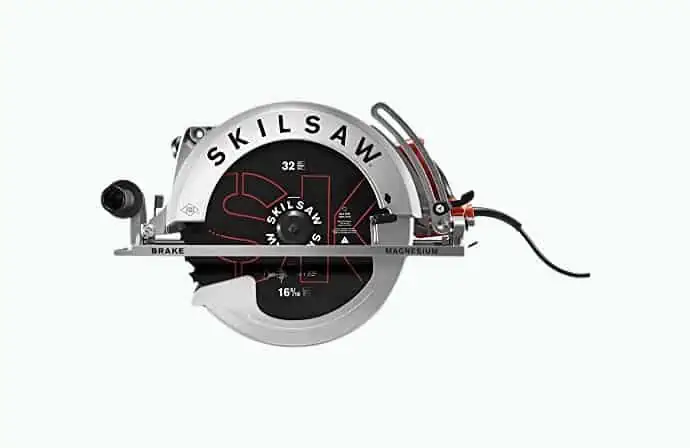
Skilsaw SPT70V -11 Super Sawsquatch Worm Drive Saw
Best Premium Worm Drive Saw
The Skilsaw Sawsquatch is a mighty worm drive saw. It has magnesium housing and a footplate to increase durability but reduce its weight. At over 27 pounds, this saw is still far from lightweight, so it requires a strong arm and experience to use properly.
Despite being quite heavy, the weight is evenly distributed throughout the unit, balancing this saw and making it surprisingly easy to handle.
If you are a professional and want a saw that can rip through 6.25-inch thick lumber, this is the model for you. It also benefits from a dual-field motor that helps it run cooler when cutting substantial pieces of material.
What We Like
Large Cutting Capacity
With a 16-inch blade, this saw can rip through lumber up to 6.25 inches thick. This means improved productivity as you will make short work of bulky stock.
Magnesium Construction
The all-magnesium construction means this saw is as lightweight as possible without compromising its durability. Magnesium is less dense than aluminum but also more durable than steel.
Powerful Motor
The motor is 15 amps and generates 1,800 watts of power. Combined with its high torque, you have a relentless cutting machine that will not stop until it has completed its task.
What We Don't Like
Weight
Skilsaw has branded this model as lightweight and portable. While it is certainly compact, it is a stretch to call it lightweight. At over 27 pounds, this unit weighs twice as much as the average worm drive saw.
High Price
This saw is of excellent quality, which is reflected in its high price. It costs three times more than some worm drive saws from top brands, but it is a worthwhile investment for a professional woodworker.
Product Specs
| Weight | 27.3 pounds |
| Blade size | 16 inches |
| Depth cut | 4.31 inches at 45 degrees and 6.25 inches at 90 degrees |
| Housing | Magnesium |
| Motor | 15 amp dual-field |
Our Ratings
First-Hand Impression
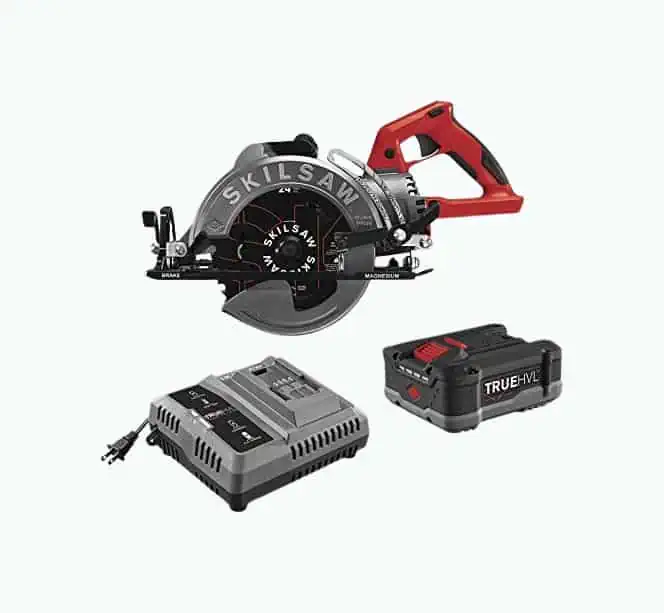
Skilsaw SPTH77M-11 Cordless Worm Drive Saw
Best Cordless Worm Drive Saw
It is no surprise to see a Skilsaw product on any list of top power saws. This cordless worm drive saw should get you through the entire day on a fully charged battery and takes an hour to recharge completely when flat. The batteries are Lithium-ion and have a built-in management system that monitors and optimizes each cell.
This innovative battery design spreads the heat evenly throughout to maximize its runtime. As this saw is cordless, you can use it anywhere rather than having to stay close to an electrical outlet. It is also lightweight, weighing 11.69 pounds, which enhances its portability.
What We Like
Cordless
This saw has a battery management system that delivers 425 cuts per charge. On a full charge, you should have more than enough power to get you through an entire day of work. When you do run out of power, it will only take an hour to fully charge the battery again.
Lightweight
This saw is one of the most portable worm drive models we have seen. Once charged, it doesn’t require an external power source, allowing you to use it anywhere. At 11.69 pounds, it is less than half the weight of Skilsaw’s more heavyweight Sawsquatch model.
True Worm Drive Saw
Unlike some other cordless circular saws, this is a true worm drive saw. It handles and cuts the same as its corded equivalent but provides much greater freedom.
What We Don't Like
High Cost
Unsurprisingly, this cordless model is more expensive than its corded equivalent. If you won’t need to move around much while working, you could save some money by choosing the plug-in version.
Lithium Limitations
Lithium-ion batteries retain their power for longer and recharge quickly, but they don’t like extreme temperatures. If the temperature drops below 32 degrees Fahrenheit, they can suffer a loss of performance. They also struggle above 80 degrees Fahrenheit, so they won’t be suitable for every location.
Product Specs
| Weight | 11.69 pounds |
| Blade size | 7.25 inches |
| Depth cut | 1.94 inches at 45 degrees and 2.25 inches at 90 degrees |
| Housing | Magnesium |
| Motor | 15 amp dual-field |
Our Ratings
User Experience
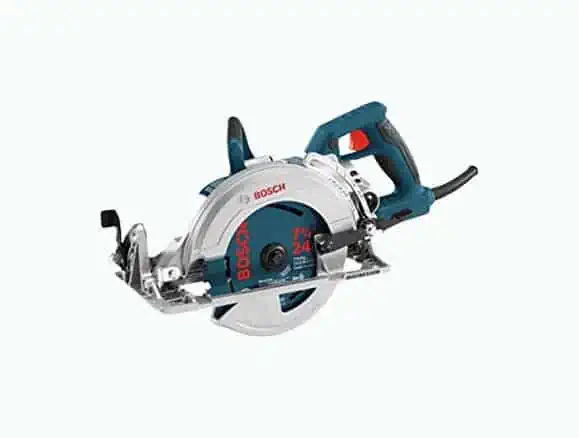
Bosch CSW41 Worm Drive Circular Saw
Best Worm Drive Saw for Power
This Bosch saw produces a no-load RPM of 5,300. This is unusual for a worm drive saw as they usually provide higher torque but lower RPM, so this model gives you the best of both worlds.
This saw is capable of making 3,100 strokes per minute. It also has a steel bevel and depth adjustment levers for improved control and versatility. There is also a lock-on button, which means it is well-suited to use with either hand.
What We Like
Low Price
This saw is very reasonably priced in comparison to some similar models from other brands. It is an excellent option if you want a saw that will provide serious power without breaking the bank.
High RPM
A worm drive saw that produces 5,300 RPM is remarkable. This means you will be able to cut through even the toughest materials relatively quickly.
Suitable for Both Hands
This saw has a lock-on button that makes it suitable for use with either hand, ideal for ambidextrous users who want greater freedom when cutting.
What We Don't Like
Weight
Weighing 15 pounds, this unit is at the upper end of what we expect from a worm drive saw.
Product Specs
| Weight | 15 pounds |
| Blade size | 7 inches |
| Depth cut | Not specified |
| Housing | Magnesium |
| Motor | 15 amp/5,300 RPM |
Our Ratings
Personal Perspective
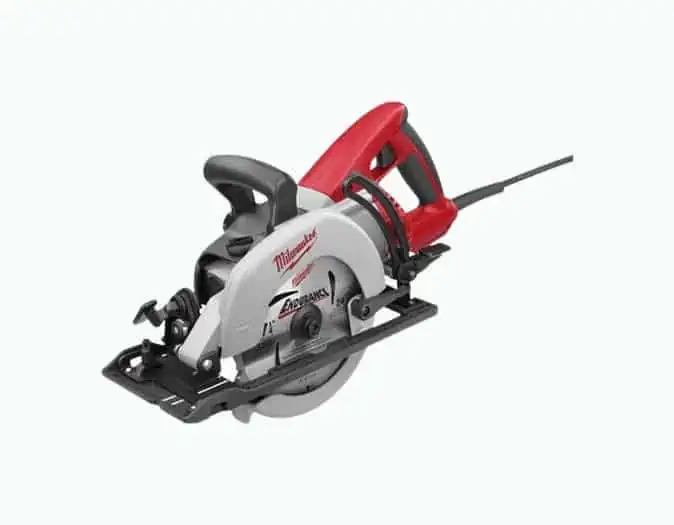
Milwaukee 6477-20 Worm Drive Saw
Best Worm Drive Saw for Warranty
Milwaukee is a brand that has stood the test of time, combining about a century of experience with constant innovation.
This excellent saw has magnesium housing for improved durability while reducing its weight. It has a 15 amp motor that produces 4,400 RPM, so you can cut very tough materials without worrying about the blade getting stuck.
This saw has an oil viewing glass that enables you to easily monitor the oil level and top it up when necessary. It also has an industry-leading five-year warranty, so you can buy it with confidence that you will be able to depend on it for at least half a decade.
What We Like
Warranty
We hope any new power tool will be reliable but issues can always occur. Thankfully, Milwaukee has protected this saw with a very generous five-year warranty, providing absolute peace of mind.
Heavy-Duty Shoe
The heavy-duty composite shoe won’t warp, bend, or kick up a burr.
Torque
The 15 amp motor generates 4,400 RPM and high torque for the hardest materials. This saw is unlikely to get bogged down, even during heavy-duty tasks.
What We Don't Like
High Weight
Although this saw has magnesium housing to decrease its weight, it still weighs 15 pounds, which makes it one of the heavier worm drive saws.
Product Specs
| Weight | 15 pounds |
| Blade size | 7.25 inches |
| Depth cut | 1.78 inches at 45 degrees and 2.43 inches at 90 degrees |
| Housing | Magnesium |
| Motor | 15 amp/4,400 RPM |
Our Ratings
Community Feedback
| Product | Best | Weight | Blade size | Depth cut (45:90 deg) | Housing | Motor |
|---|---|---|---|---|---|---|
| DeWALT DWS535S Worm Drive Saw | Quality | 13.8 lbs | 7.25″ | 1.88″:2.43″ | Magnesium & aluminum | 15 amp/4,800 RPM |
| Makita 5477NB Hypoid Saw | Budget | 13.9 lbs | 7.25″ | 1.75″:2.38″ | Rust-proof steel | 15 amp/ 4,500 RPM |
| Skilsaw SPT77WML-01 Worm Drive Saw | Lightweight | 11.5 lbs | 7.25″ | 0:2.38″ | Magnesium | 15 amp dual-field |
| Skilsaw SPT70V -11 Sawsquatch | Premium | 27.3 lbs | 16″ | 4.31″:6.25″ | Magnesium | 15 amp dual-field |
| Skilsaw SPTH77M-11 | Cordless | 11.69 lbs | 7.25″ | 1.94″:2.25″ | Magnesium | 15 amp dual-field |
| Bosch CSW41 Worm Drive | Power | 15 lbs | 7″ | Not specified | Magnesium | 15 amp/5,300 RPM |
| Milwaukee 6477-20 Worm Drive Saw | Warranty | 15 lbs | 7.25″ | 1.78″:2.43″ | Magnesium | 15 amp/4,400 RPM |
What are Worm Drive Saws Used For?
Worm drive saws are widely used in construction and woodworking. They have a narrow profile because the centerline of the motor is parallel to the saw blade. This means they are more suitable for working in confined spaces than other power saws.
Their gears also have larger teeth, which increases their load-bearing capacity. In practical terms, this means higher power and torque, making them the tool of choice for heavy-duty use.
Advantages of a Worm Drive Saw
There are several reasons to consider a worm drive saw over a traditional direct-drive sidewinder saw:
Quiet and Smooth
Worm drive motors are quieter and run more smoothly than sidewinder saws. This makes them easier to handle while cutting. It also means the motor suffers less wear and tear and reduces the amount of maintenance.
Longer Reach
The distance between the saw blade and the handle is longer, giving you greater reach when making cuts. This is useful when cutting large sheets of material that require a larger range of movement.
More Power
The gear system of a worm drive saw means it can handle a greater burden, thanks to its larger teeth. As such, it can cope with the rigors of very tough jobs such as cutting through concrete or even sheet metal.
Better for Right-Handed People
The blade on a worm drive circular saw is on the left side, giving right-handed people a clearer line of sight while cutting. In contrast, a direct-drive saw has its blade on the right, benefitting left-handed people instead.
Given that about 87% of the United States population is right-handed (1), a worm drive saw will be the more user-friendly saw for the majority of people.
Professional Use
A worm drive saw is generally the better tool for professional woodworkers as it has the torque and cutting power required to complete the majority of tasks. These saws are a few pounds heavier than sidewinder saws, which can make them more difficult to use for extended periods, especially if you aren’t used to them.
The average sidewinder or direct drive saw weighs nine or ten pounds. A worm drive circular saw typically weighs 13 to 15 pounds.
Longer Life
As the gears are larger, worm drive units generally last longer than sidewinder saws. With proper maintenance and care, they might even work for decades. Direct drive saws wear out far more quickly and require more maintenance than worm drives.
Why Is It Called a Worm Drive?
Worm drive saws are named for the two components that comprise the gear system: the worm screw and worm wheel. The worm screw combines with the worm wheel, which is similar to a standard spur gear.
This system provides a higher load capacity and torque but usually decreases the revolutions per minute (RPM) of the blade.
The electric motor provides rotational power to the worm, which engages with the wheel and causes it to turn. The spinning blade is then pressed against the material to cut it.
What Is the Difference Between a Hypoid Saw and a Worm Drive Saw?
The difference between the two gear systems can be compared to how a car steers. A worm drive gear system is similar to a car’s steering column and axle. The worm screw engages with the worm wheel to turn the gear and generate rotation.
A hypoid gear is a hybrid of the two. Hypoid systems use spiral bevel gears whose axis is not in line with the meshing gear. In other words, the two gears do not intersect. This allows for more varied configurations and can accommodate a wider shaft.
Who Makes the Best Worm Drive Saw?
Worm drive saws are among the most popular power tools in the world, so it is no surprise that the world’s top brands have each created their own. Let’s take a closer look at some of the companies that are currently making the best worm drive saws.

Milwaukee
Milwaukee can trace its history back to the end of the First World War. Henry Ford needed a portable, lightweight power drill for his production line, and a young Wisconsin man named A.H. Peterson rose to the challenge.
After joining forces with business partner Albert F. Seibert, the A.H.Peterson Company was founded in 1922. Tragically, a fire destroyed the company’s factory a year later but the company was reborn by Seibert as the Milwaukee Electric Tool Corporation in 1924 (2).
Since that time, they have dedicated themselves to producing high-quality, industrial-strength power tools. Milwaukee has become one of the most respected names in power saws.

DeWALT
In 1922, Raymond E. DeWalt invented the first radial arm power saw (3). He was the superintendent of a sawmill and wanted to increase productivity without having to add to his workforce.
From there, DeWALT expanded to become one of the most trusted tool brands in the world. They are known for constant innovation and cutting-edge design and are responsible for many of the power tools we see in workshops and construction sites today.

Skilsaw
The 1920s were pivotal years in the development of power tool manufacturing. In 1924, Skilsaw was founded, announcing its arrival with the first circular saw (4). It remains one of the leaders in power saws.
Edmond Michel’s invention of the circular power saw fuelled the development of worm drive gears. The company recognized the growing DIY market and began designing power tools that were suitable for the general public as well as professionals.

Makita
Makita was founded in Nagoya, Japan in 1915. It started life as an electric motor sales and repair business but gradually moved towards manufacturing. It took until 1958 for Makita to produce its first power tool, an electric planer (5).
From there, the company has grown into one of the biggest names in power tools around the world. With a long history and Japanese expertise in design and manufacturing, Makita is an industry leader.
How to Choose the Best Worm Drive Saws
Worm drive saws are staples of any woodworker’s tool collection, so it is essential that you choose one that will do what you require of it. Let’s look at some of the most important features a worm drive saw should have.

Motor
A worm drive saw will be expected to cut through tough material, which it won’t be able to do with an underpowered motor. Most worm drive motors are 15 amps and capable of providing 4,500 to 5,000 RPM, which should be more than enough power to complete the toughest jobs.

Cutting Depth
It is important to know the cut depth of your saw at its standard 90-degree angle but also at 45 degrees, as this will differ. If the saw lacks sufficient cut depth, it might not be able to cut through some sheet material.

Bevel Capacity
Your saw’s bevel capacity will dictate the type of cuts it can make. The higher the capacity, the more versatile the saw will be. Choosing a saw with preset bevel stops will make your work much quicker if you regularly need to cut angled pieces such as door frames.

Weight
The weight of your saw might seem unimportant at first, but if you are a professional and need to use it for several hours per day, a few pounds can make a big difference. At 13 to 15 pounds, most worm-drive circular saws are a few pounds heavier than their direct-drive counterparts.
Remember

Dust Blower
Maintaining a clear line of sight is vital if you want to make accurate cuts. A dust blower will keep any debris off the cutting line, ensuring you can always have your eyes on your work.

Blade Replacement
Given the hard work they need to do, worm drive saw blades will inevitably blunt and need to be replaced. A quick-change system on your saw will allow you to remove the blade by releasing one simple lock, which could save you a great deal of time if you use your saw frequently.

Saw Housing
The saw housing contributes to the weight, which will affect the way the saw handles. Magnesium is both lightweight and durable, so it provides the best balance. You should avoid any saw with plastic housing as this will have very low durability.

Warranty
Ideally, you will never need your saw’s warranty but issues can always occur, especially if you are completing heavy-duty work. Warranties usually range from one to five years, depending on the brand. The longer the warranty, the more confidence the manufacturer has in its products.

Are Worm Drive Saws Worth It?
A worm drive is a circular saw that uses a worm gear to transfer power from motor to blade. The advantage of this type of drive over conventional spur gear is that it allows for a smaller and more compact saw.
Additionally, the larger gear teeth on a worm drive saw help it to cut through crosscutting sheet goods more easily.
Finally, the worm drive provides more torque than the spur gear, making it ideal for use with abrasive blades. As a result, worm drive saws offer numerous advantages over other types of circular saws, making them a valuable tool for any woodworker.

Why Are Worm Drive Saws More Expensive?
Worm drive saws are more powerful than traditional circular saws, making them a favorite among most professionals and even DIYers. The extra power comes from the larger gear teeth, providing extra loading capacity.
So, worm drive saws can handle more demanding jobs than their traditional counterparts. Also, the design of the gear system makes worm drive saws more durable, meaning they can withstand heavy use without needing frequent repairs.
But, the added power and durability come at a cost, as worm drive saws can be more expensive than traditional circular saws. However, the extra cost may be well worth for consumers who need a high-performance tool for occasional use.

Do Worm Drive Saws Kick Back?
Worm drive saws kick back more than conventional circular saws because they have more torque. That’s the simple answer, but it’s worth taking a closer look at what that means. To understand why worm drive saws kick back more, it’s helpful to know how they work.
Unlike conventional circular saws, which have their motors aligned with the blade, worm drive saws have their motors positioned perpendicular to the blade.
This configuration gives them more power but makes them more susceptible to kickback. That’s because the extra torque generated by the motor can cause the blade to bind in the cut, causing the saw to lurch backward.
For this reason, it’s important to exercise caution when using a worm drive saw. Ensure you’re using the right blade for whatever material you’re cutting, and keep the blade sharp and clean.

Do Worm Drive Saws Need Oil?
Worm drive saws need gear oil to lubricate the gears and prevent them from overheating. The amount of gear oil you’ll need will vary depending on the model of the saw. Still, it’s recommended that the oil be changed every few months.
Also, the oil should be checked regularly to ensure it’s at the correct level. If oil levels are too low, it can cause the gears to overheat and fail. Just like in a car or truck.
Too much oil can also cause problems, leading to leaks and spills. So, check the owner’s manual for specific instructions on changing and maintaining the gear oil in a worm drive saw.

Is Worm Drive or Sidewinder Better?
Both have advantages and disadvantages, so it’s important to get the best one for whatever projects you have on hand.
Worm drive saws are more powerful than sidewinder saws, making them better suited for cutting through thick materials.
They’re also more durable and have a longer lifespan. But, they’re also heavier and more expensive.
Sidewinder saws are lighter and less expensive. They’re easier to maneuver, making them a great for tight spaces or small jobs. But, they don’t have the same power or cutting capacity as worm drive saws.

What Is the Best Worm Drive Saw You Can Buy?
The DWS535B DEWALT worm drive saw is currently the best that money can buy. The saw is lightweight and easy to use, with a durable foot plate. The corded circular saw can accept wider materials than other models. It has a ToughCord protection system for jerk protection.
You can adjust the bevel to 53 degrees, with 22.5- and 45-degrees detents. An electric brake will stop the blade fast when you release the trigger.