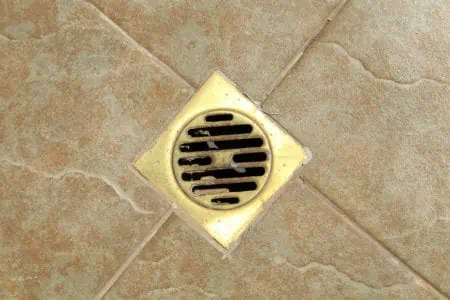
But why does my shower drain smell, you ask? If there is a foul odor leaching from the bathroom, it could be coming from down the shower drain.
Whether it smells like a perm solution or you’re dealing with something more rotten, a smelly shower drain requires immediate action.
Key Takeaways
- Mold, mildew, sewer issues, and clogged P-traps are common causes of smelly shower drains.
- To fix the odor, clean the shower drain with boiling water, baking soda, and vinegar.
- Cleaning or replacing the P-trap may also help eliminate the smell.
- Call a professional plumber if the smell persists or if you suspect a more serious issue.
Why Does My Shower Drain Smell?
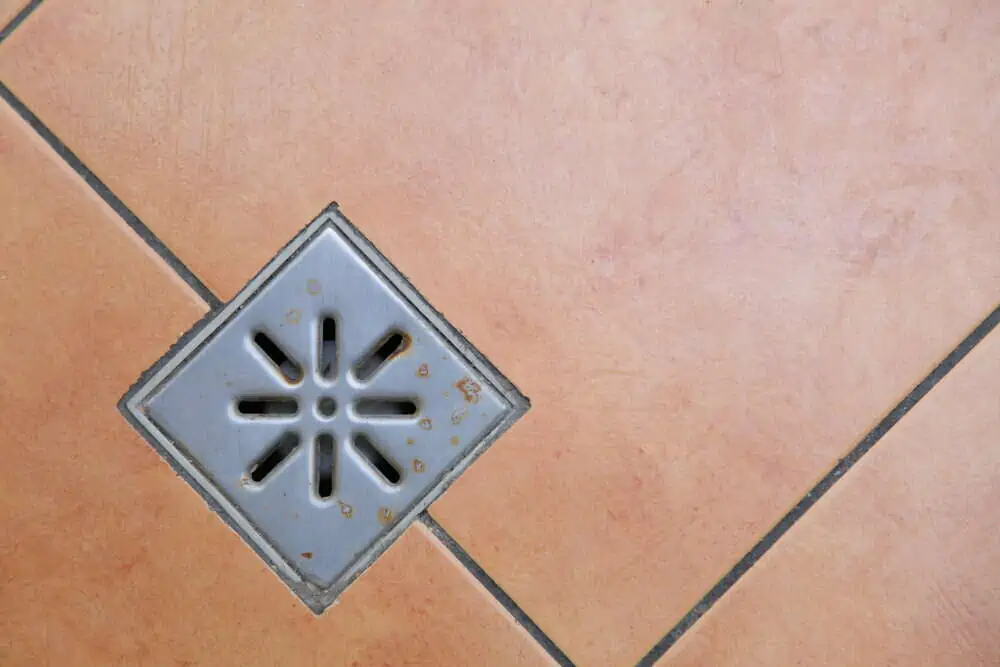
Before showing you some tips and tricks for odor remedy, I want to answer the question that’s on your mind right now: why does my shower drain stink?
If there is a foul odor coming from your shower drain, a thorough cleaning might often suffice. But before you call in a professional, try to identify the potential cause of the smell. It might be something you could handle by yourself.
Biofilm Build-Up
In addition to organic materials (such as old skin cells), bacteria are also found in biofilms. It has a slimy texture (similar to algae) and shows up in most showers as a “pinkish mold,” even though it’s not even mold. Some claim it smells like mildew.
A thorough shower cleaning can remove biofilm, but it can also accumulate in places that are not visible, such as the p-trap, the pipes, or the drain.
Take Note
What some people don’t know is that biofilm has the potential to be quite harmful to your health. When cleaning your shower, it is critical to clean your tub drain at the same time to avoid these threats and odors.
If you did your best, but your shower drain still smells like mildew, it’s time to have it professionally cleaned.
Sewer Gas
Does your drain smell like poop or like urine? Then you might be dealing with a more complicated plumbing issue. If your shower drain smells like sewage, that’s because it’s coming from the actual sewage.
Identifying this problem is easy because sewer smells are not easily mistaken. Some people claim sewer gas smells like cabbage or like rotten eggs. This is usually caused by bacteria growth and stagnant waters.
Important To Know
Sewer gases are hazardous to your health, so immediately addressing this issue is required. In most cases, you have to call in a professional because they have the tools to deal with this.
Clogged Pipe
Even if you’re not dealing with clogged pipes very often, it is still important to clean your shower drain regularly. People naturally shed a certain amount of hair every day, even if they’re unaware of it. And a lot of that hair goes down the drain.
As you take more showers, debris, bacteria, or scum will eventually get mixed with that hair, leading to quite the clog. You might find the stench to be stronger after a shower, too. Clogged pipes usually smell like sulfur or have a musty smell.
If water isn’t flowing down the drain as it used to, then you’re likely dealing with a clogged pipe. To solve this issue, you typically need a few tools and some cleaning solutions.
Leaky Pipe
This is a serious issue because it can lead to sewer gas being released into the house. Pipes are constructed to keep sewer gas in check. That means that if the pipes leak, pressure is released, and gases will likely escape.
Discovering leaky pipes usually requires a diagnosis of the plumbing system, so you likely need to ask for professional help here. If the pipes are concealed in the walls or under the floor, things are even more complicated.
Checking the P-Trap
The P-trap is that curved portion of the pipe located under the drain. Because of its shape, the P-trap never drains completely, but it serves an essential purpose. The standing water that always sits in the P-trap will prevent sewer fumes and small organisms from creeping up the drain and into the house.
Several issues can arise with the P-trap. It could be broken, clogged, covered in biofilm, or dirty.
Checking a sink P-trap is easy because you have easy access to the space underneath the sink. However, checking the P-trap under the shower is a little more complicated. Unclogging a shower P-trap is usually done with the help of a drain snake.
How to Get Rid of Smelly Drain In Shower
Now that you know what causes a smelly shower drain, let’s take a look at some quick fixes.
Clean the Shower
Sometimes, you might think that your shower drain is smelly when it could be your actual shower. Weekly shower and bathtub cleaning (along with cleaning the drain, of course) can help prevent a lot of odor-related problems in the long run.
Give surfaces a good scrub and use either homemade cleaning solutions or store-bought mixtures that are suitable for the surfaces you have to clean.
Check the Toilet
Is it common for you to notice that there is a puddle on the floor even after you have cleaned it up? Then you might be dealing with toilet leaks or, even worse, a broken toilet.
Water on the floor is the easiest way to tell if you’re dealing with a broken or leaking toilet. You might need a plumber to fix the pipes or replace the toilet bowl completely.
Clean the Shower Drain
Cleaning the shower drain is easily done by pouring some boiling water down the drain, then pouring a mixture made of baking soda and vinegar. Allow the mixture to fizz for about 15 minutes, then rinse with more boiling water.
Clean the P-Trap
If you want to clean your shower P-trap, make a mixture of half a cup of vinegar and half a cup of baking soda.
Pour this mixture down the drain, place a cover on top and allow it to fizz for an hour max. Remove the cover and pour hot water down the drain.
Fix or Replace the P-Trap
Things are complicated when you have to fix or replace the shower P-trap because you have to gain access to it first. With basements and crawl spaces, chances are the pipes are uncovered. Other times, they might be concealed by an access door.
You have to locate the slip joint nut that connects the tailpiece extension and the P-trap. Remove that nut by turning it counterclockwise. Unscrew the nut located on the P-trap’s extension side.
Grab a hacksaw and cut the pipes if there’s PVC cement holding them together. Make another cut at the other end of the P-trap. You should now be able to remove it and replace it.
Unblock Plumbing Vents
The air pressure that’s part of your house’s plumbing system is controlled by a plumbing vent, also known as a vent stack. The role of these vents is to get rid of odors and gas from your home.
If you want to try and unblock the plumbing vents yourself, begin by clearing away any debris from the area around the pipeline.
Use a flashlight to look into the vent pipe and check for any additional obstruction. If you can see the problem but are unable to reach it, try running a plumber’s snake down the pipe.
Drain the Septic Tank
Septic tanks are drained by specialized trucks designed for waste, and it’s not needed unless a specialist recommends it.
When To Call In a Professional
Sometimes, bad shower drain odors indicate a more serious problem that necessitates the costly services of a professional plumber.
- You need to access certain pipes or parts but don’t have the tools to do so.
- You’ve tried cleaning the shower drain, but the smell is still there.
- The odor smells more toxic than usual, making the matter more urgent.
- Some parts need to be replaced.
FAQs

Can I Put Bleach Down My Shower Drain?
Pouring bleach down the drain is never a solution. As a result of its ability to react with other compounds in plumbing and pipes, bleach may lead to additional blockage of the system.

How Much Does a New Shower P-trap Cost?
The costs for a new shower P-trap vary depending on the region where you live. Usually, you can expect to pay between $200 and $325.
Bottom Line
Hopefully, you’re no longer wondering, “why does my shower drain smell?” Any problems that lead to a smelly shower drain need to be fixed because they could pose a serious health issue. Don’t let ‘just a smelly drain’ impact your family’s health in the long run.