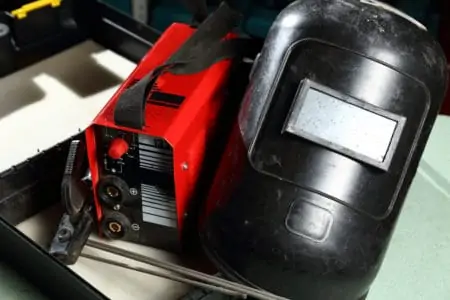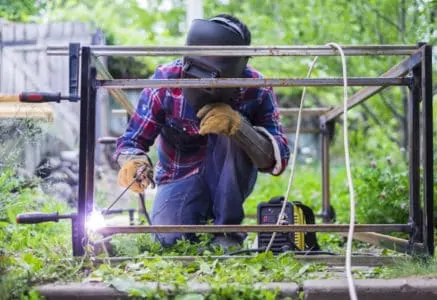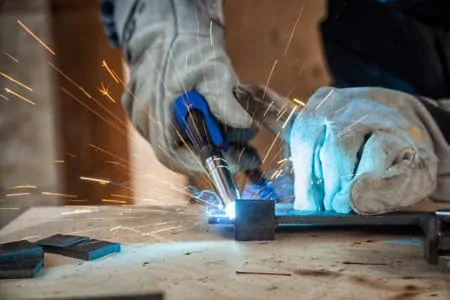
Welding is hot and dangerous work, so having the best welding gloves to protect your hands is vital if you value your safety. They should be comfortable, easy to wear, and above all, flame and heat-resistant.
We look at 10 of the best welding gloves money can buy.
- 5-inch cuff
- Kevlar stitching
- Reinforced palm & fingers
- Extra-long cuff
- Aluminum foil layer
- Heat resistance of 500° celsius
- Kevlar double-reinforced padding
- 15mm thick cowhide
- Aluminum foil layer
- Reinforced thumb strap
- High-quality leather
- Multi-use applications
- Pigskin & cowhide
- Fully lined & reinforced palm
- Small sizes
- High-quality cowhide
- Reinforced thumb strap
- Thermocore foam padding
- Hard-wearing goatskin material
- Reinforced thumb strap
- High of dexterity
- Double kevlar stitching
- Denim-style sleeve
- Cotton lined & cushioned palm
- Leather reinforced seams
- Forearm protection
- Top quality leather with cotton liner
- Give excellent grip
- Elongated sleeves
- Reinforced wear points
Review Methodology: At Sensible Digs, we pride ourselves on our thorough and professional approach to assessing products. Our articles are built on extensive research, data analysis, and hands-on experiences. When it comes to determining the best welding gloves, we scrutinize a variety of key decision-making factors. We evaluate the performance, comfort, durability, heat-resistance, and design of each pair of gloves. We compare and rank them based on these criteria, providing you with clear, evidence-backed results. We aim to deliver the most accurate and helpful information, giving you the confidence to make the best choice for your welding needs.
The Best Welding Gloves of 2024
Choosing the 10 best welding gloves was a tricky task, but we think we’ve come up with a definitive list of the 10 best welding gloves.
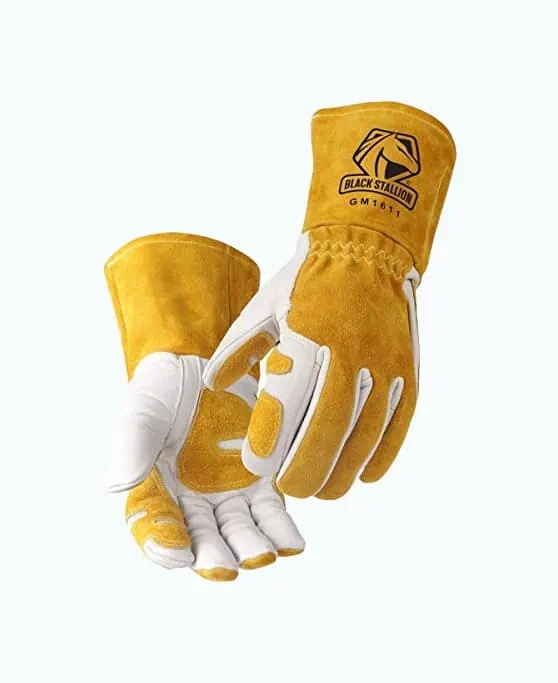
Revco GM1611 Cowhide MIG Welding Gloves
Best MIG Welding Gloves
As far as MIG welding gloves go, these Revco gloves are excellent. They are top-grain cowhide, have reinforced palms, thumb and index finger supports and seamless forefingers.
This is all designed to increase the user’s dexterity while wearing the gloves, giving them better control. It also includes drag patches for side padding and a padded wrist patch for resting. Plus, they have Kevlar stitching to increase flame and heat resistance.
They come in 5 sizes, ranging from small to XX-large, and they have a 5-inch cuff for added protection.
Pros
- 5-inch cuff.
- Kevlar stitching.
- Available in 5 sizes.
- Reinforced palm, thumb and index finger.
Cons
- Some heat gets through.
Product Specs
| Weight (ounces) | 10.4 |
| Dimensions (inches) | 13.9 x 7.3 x 2.4 |
| Size range | Small to XX-large |
| Material | Split cowhide |
| Kevlar stitching | Yes |
| Cuff | 5 inches |
| Welding suitability | MIG, stick |
| Price | $$ |
Our Ratings
User Experience
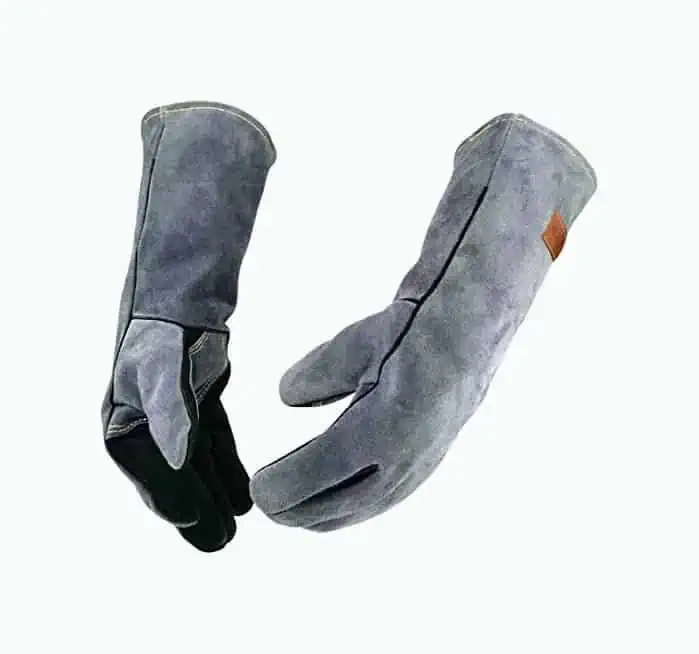
WZQH Leather Forge Heat-resistant Welding Gloves
Best Heat Resistant Welding Gloves
These gloves have universal usage thanks to their high-heat tolerance. They can withstand temperatures topping 500 degrees Celsius (932 degrees Fahrenheit). They have Kevlar stitching, which is fire-resistant and hard to snap, and beneath the cowhide is an air-isolated aluminum foil layer that protects against heat penetration.
The cowhide is 1.2mm thick, soft shoulder split cowhide, so it is extremely good at dealing with spatters and sparks, as well as protecting against electric shocks. The inside of the glove is lined with cotton, which is sweat-absorbent and breathable.
The cuff is extra-long, at 7.5 inches, which provides extra protection against slag from stick and MIG welding.
Pros
- Extra-long cuff.
- Aluminum foil layer.
- Heat resistance of 500 degrees Celsius.
- Kevlar stitching.
Cons
- Large size only.
- Quality control issues.
Product Specs
| Weight (ounces) | 14.4 |
| Dimensions (inches) | 8.39 x 0.67 x 0.43 |
| Size range | One size fits all |
| Material | Split cowhide and aluminum foil |
| Kevlar stitching | Yes |
| Cuff | 7.5 inches |
| Welding suitability | MIG, stick |
| Price | $$ |
Our Ratings
Personal Perspective
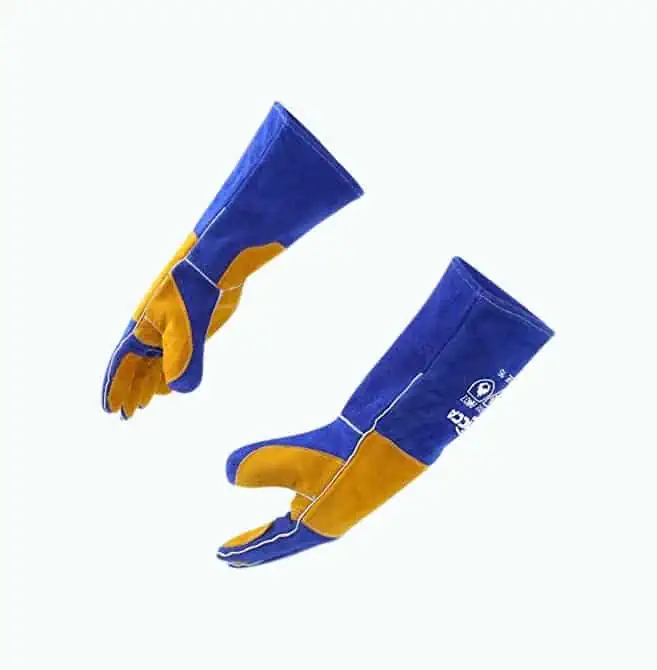
RAPICCA Leather Forge Glove
Best All-Around Welding Gloves
These RAPICCA gloves have Kevlar double-reinforced padding on the palms, fingers, elbows and the back of the hand. Like the previous gloves, these also benefit from a layer of air-isolated aluminum foil to increase the glove’s insulation qualities.
The Kevlar padding protects you against spatters of molten metal, and the extra-long cuffs keep your wrists and lower arms covered too. These gloves are not designed for long-term contact with flames and heat, but they do resist temperatures of 500 degrees Celsius.
The material is soft shoulder cowhide, which is heat and wear-resistant, and the inside is lined with cotton.
Pros
- Kevlar padding.
- 1.5mm thick cowhide.
- Aluminum foil layer.
- Resists 500 degrees Celsius heat.
Cons
- Heavy.
- Restricted movement.
- One size.
Product Specs
| Weight (ounces) | 1.06 pounds |
| Dimensions (inches) | 9.45 x 6.3 x 1.89 |
| Size range | One size fits all |
| Material | Split cowhide and aluminum foil plus Kevlar padding |
| Kevlar stitching | No |
| Cuff | 7.5 inches |
| Welding suitability | MIG, stick |
| Price | $$ |
Our Ratings
Community Feedback
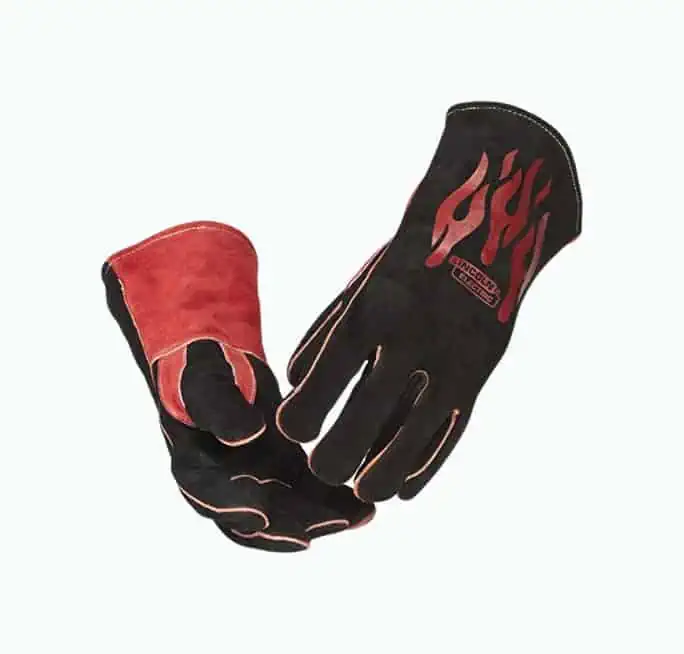
Lincoln Electric Traditional Stick Welding Gloves
Best Stick Welding Glove
Lincoln Electric is a well-respected name in welding, so it is only fitting to include one of their welding gloves in the review. These gloves are constructed from the highest quality leather and have a soft cotton lining and Kevlar stitching.
The seams are reinforced with leather to avoid splitting and tearing, and the cuffs protect your wrists as well as absorbing moisture. This glove is favored by the professionals thanks to its multi-use applications. It is ideal for MIG, stick and flux-core welding.
Not only is this glove a great brand named product, but it is also excellent value for money.
Pros
- Reinforced thumb strap.
- Kevlar stitching.
- Ideal for MIG, stick and flux-core welding.
- Split leather.
Cons
- One size only.
Product Specs
| Weight (ounces) | 12.2 |
| Dimensions (inches) | 13 x 7 x 1 |
| Size range | One size fits all |
| Material | Split cowhide |
| Kevlar stitching | Yes |
| Cuff | Not stated (Glove 13 inches in length) |
| Welding suitability | MIG, stick, flux-core |
| Price | $ |
Our Ratings
First-Hand Impression
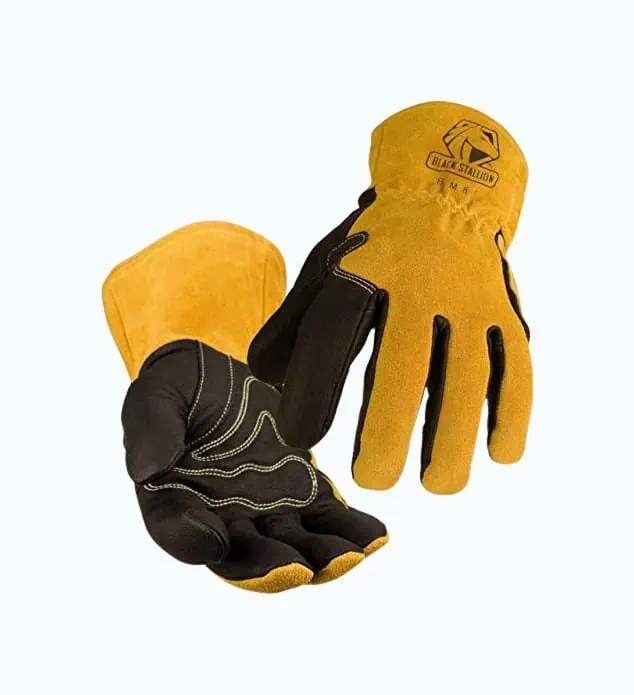
Black Stallion BSX BM88 Small Pigskin Welding Gloves
Best Welding Gloves for Small Hands
Not all welders have big hands, so a glove with a “one size fits all” approach won’t work if you have smaller hands. This Black Stallion welding glove caters to those people. This is the first pigskin and cowhide combination of materials to appear on the list, making it the ideal glove for TIG, MIG and stick welding.
Like the Revco gloves, you also get a drag patch and a rest patch, including a fully lined and reinforced palm. The index finger and thumb are constructed of fine-grade pigskin to increase the dexterity of the wearer.
Pros
- Pigskin and cowhide.
- Kevlar stitching.
- Ideal for MIG, stick and TIG.
- Small sizes.
Cons
- Quality control issues.
- A little stiff.
Product Specs
| Weight (ounces) | 9.91 |
| Dimensions (inches) | 6 x 1 x 1 |
| Size range | Small to XXL |
| Material | Cowhide and pigskin |
| Kevlar stitching | Yes |
| Cuff | 4.5 inches |
| Welding suitability | MIG, stick, TIG |
| Price | $$ |
Our Ratings
User Experience
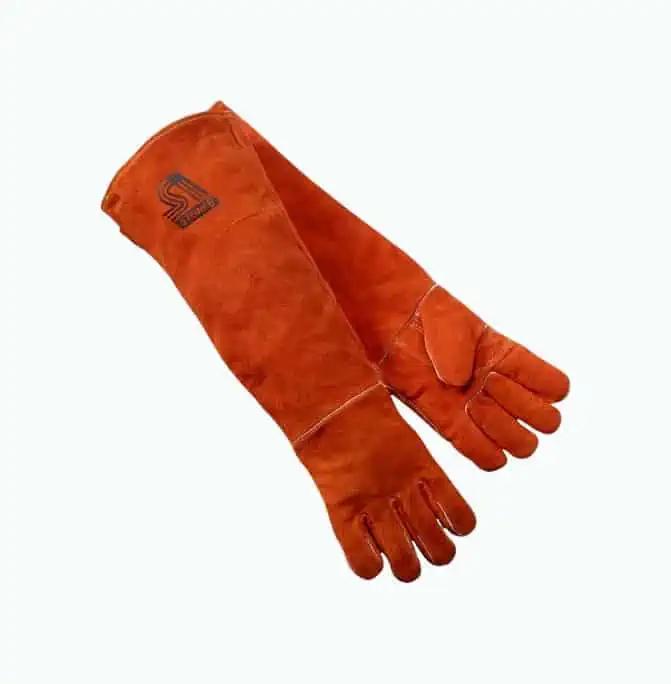
Steiner 21923-L Welding Gloves
Best Long-Sleeved Welding Gloves
The construction quality of these gloves is very high. The cowhide provides heat and durability, as well as increased user dexterity. A ThermoCore foam insulated back panel gives extra heat resistance, and the cotton lining absorbs sweat and moisture to improve the wearer’s experience.
These gloves also feature a reinforced palm and welted seams to reduce fraying and tearing. The longer sleeve means these gloves are 23 inches in length, and you also get a reinforced thumb strap for better support and grip.
They are heavy, weighing in at 1.15 pounds, so you might suffer from hand fatigue after prolonged spells of use.
Pros
- High-quality cowhide.
- Reinforced thumb strap.
- ThermoCore foam padding.
- Long sleeves.
Cons
- Heavy.
- Gloves soil easily.
Product Specs
| Weight (ounces) | 1.15 pounds |
| Dimensions (inches) | 6 x 1 x 1 |
| Size range | One size fits all |
| Material | Cowhide |
| Kevlar stitching | No |
| Cuff | Not stated (Glove 23 inches in length) |
| Welding suitability | MIG, stick |
| Price | $$$ |
Our Ratings
Personal Perspective
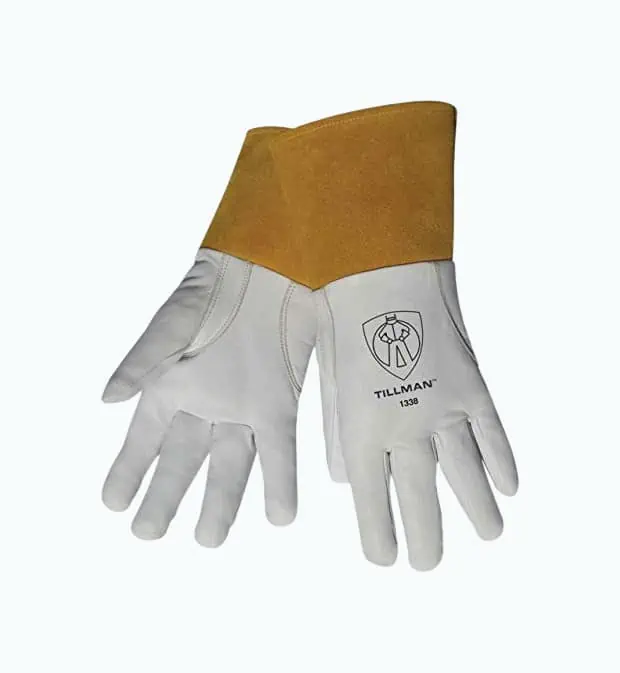
Tillman 1338 Goatskin TIG Welding Gloves
Best TIG Welding Gloves
These Tillman gloves are constructed from goatskin, so they are hard-wearing and soft to the touch. They also offer the wearer a higher level of dexterity, making them perfect for TIG welding. TIG is notoriously tricky to master, and controlling the filler, the gun and the pedal all require a welding glove that gives you the freedom to do it.
These gloves have a glide patch to ease the movement when dragging a welding gun, and the reinforced thumb strap adds to the grip and improves key stress areas. It has a straight thumb for better gun control, and the Kevlar stitching adds to the durability.
Pros
- Kevlar stitching.
- Reinforced thumb strap.
- Ideal for TIG welding.
- Goatskin.
Cons
- Not ideal for MIG or stick.
Product Specs
| Weight (ounces) | 2.08 |
| Dimensions (inches) | 11.5 x 5.5 x 0.8 |
| Size range | Small, large and XL |
| Material | Goatskin |
| Kevlar stitching | Yes |
| Cuff | 4 inches |
| Welding suitability | TIG |
| Price | $ |
Our Ratings
Community Feedback
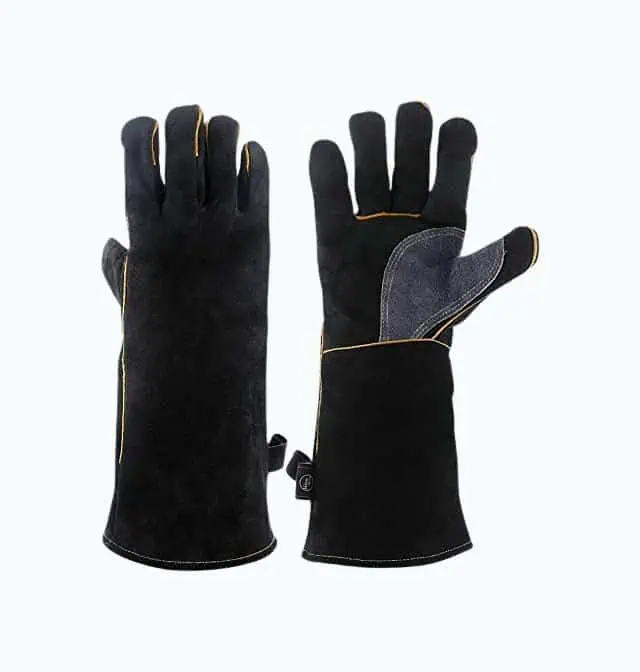
KIM YUAN Fire-Resistant Leather Gloves
Best Flame-Resistant Welding Glove
These gloves are high quality, constructed from cow leather, which is fire retardant. The inside of the glove is made of cotton, increasing the wearer’s comfort and these gloves also resist cuts and punctures.
They are also double-stitched with Kevlar thread, and the palm is cushioned for comfort and increased grip. These gloves are ideal for industrial, heavy-duty tasks and the perfect choice when you are stick and MIG welding, especially as they have an elongated sleeve to protect your skin against spatters and sparks.
They are also moderately resistant to oil and grease, and thanks to the handy hooks, they hang up easily at the end of the project.
Pros
- Double Kevlar stitching.
- Cotton lined.
- Denim-style sleeve.
- Cushioned palm.
Cons
- Very sharp objects may still puncture.
- Higher price.
Product Specs
| Weight (ounces) | 10.5 |
| Dimensions (inches) | 14 x 7 x 1.3 |
| Size range | One size fits all |
| Material | Cowhide |
| Kevlar stitching | Yes |
| Cuff | Not stated (Glove length 14 inches) |
| Welding suitability | MIG, stick |
| Price | $$$ |
Our Ratings
First-Hand Impression
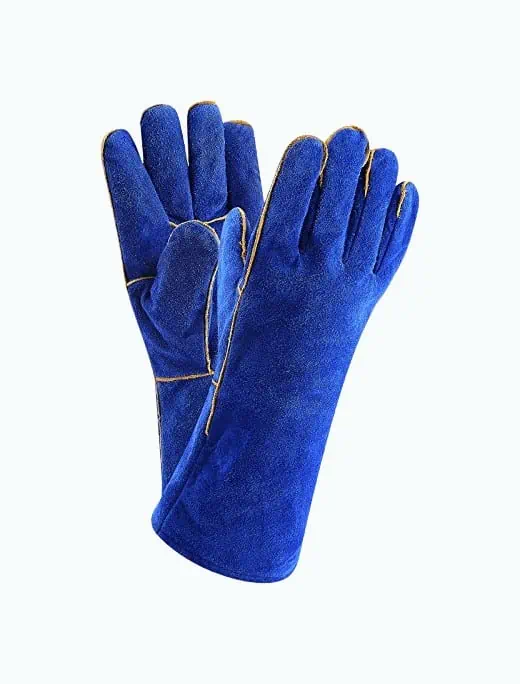
DEKO Leather Welding Glove
Best Budget Welding Glove
If you have a limited budget but still want a quality pair of welding gloves, these DEKO gloves might be ideal. Even though the pricing is competitive, you still get top quality leather, a cotton liner that helps to absorb sweat and keep your hands dry, and reinforced stress positions for a comfortable grip.
The leather is heat resistant to protect you from spatter and sparks, and the 14-inch long design protects your wrists and lower arms from injury. The glove is designed with a gun cut palm for added grip and comfort, and the leather reinforced seams guard against fraying and tearing.
Pros
- Affordable.
- Leather reinforced seams.
- Forearm protection.
- Cotton liner.
Cons
- No Kevlar.
- One size fits all.
Product Specs
| Weight (ounces) | 12.3 |
| Dimensions (inches) | 13.39 x 0.71 x 6.69 |
| Size range | One size fits all |
| Material | Cowhide |
| Kevlar stitching | No |
| Cuff | Not stated (Glove length 14 inches) |
| Welding suitability | MIG, stick |
| Price | $ |
Our Ratings
User Experience
DeWALT Premium Leather Welding Gloves
Best Premium Welding Glove
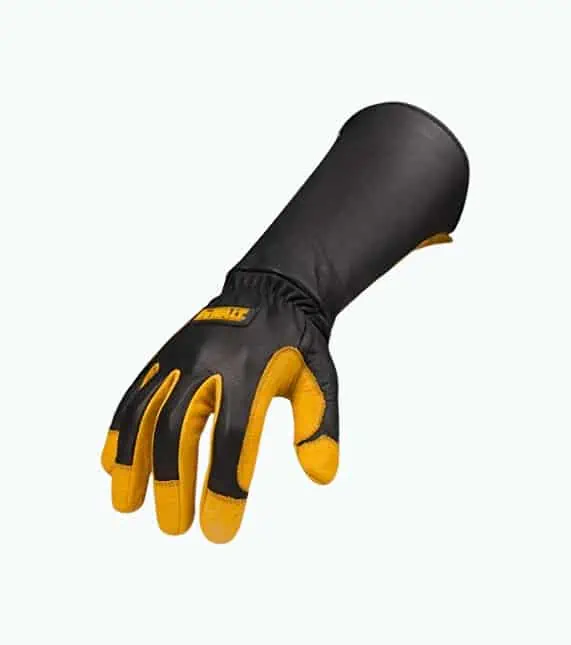
You can’t argue with the reputation that DeWALT has in the commercial world, so to include them as the best premium glove winner is only fitting. A-grade buffalo leather palms give excellent grip, abrasion resistance and enhanced user dexterity.
The elongated sleeves add protection to the forearms and wrists, and the elasticated cuffs stop any rogue sparks from getting inside. The entire glove is Kevlar stitched for increased fire resistance, and the reinforced wear points like the thumb, palm and finger caps increase the glove’s longevity.
Pros
- Kevlar stitching.
- Sizes range from small to XXXL.
- Elongated sleeves.
- Reinforced wear points.
Cons
- Expensive.
- Stick and MIG welding only.
Product Specs
| Weight (ounces) | 8 |
| Dimensions (inches) | 19 x 6 x 1 |
| Size range | Small to XXXL |
| Material | Buffalo hide |
| Kevlar stitching | Yes |
| Cuff | Not stated (Glove length 19 inches) |
| Welding suitability | MIG, stick |
| Price | $$$ |
Our Ratings
Personal Perspective
| Product | Best | Weight | Dimensions | Size | Material | Kevlar stitching | Welding Style |
|---|---|---|---|---|---|---|---|
| Revco Cowhide Gloves | MIG Welding | 10 oz | 13.9 x 7.3 x 2.4″ | S to XXL | Split cowhide | Yes | MIG, stick |
| WZQH Leather Forge HR | Heat Resistant | 14 oz | 8.39 x 0.67 x 0.43″ | One size | Split cowhide & aluminum foil | Yes | MIG, stick |
| RAPICCA Forge Glove | All-Around | 1.06 lbs | 9.45 x 6.3 x 1.89″ | One size | Split cowhide & aluminum foil, Kevlar padding | No | MIG, stick |
| Lincoln Electric Gloves | Stick Welding | 12 oz | 13 x 7 x 1″ | One size | Split cowhide | Yes | MIG, stick, flux-core |
| Black Stallion Pigskin | Small Hands | 9.91 oz | 6 x 1 x 1″ | S to XXL | Cowhide & pigskin | Yes | MIG, stick, TIG |
| Steiner 21923-L Gloves | Long-Sleeved | 1.15 lbs | 6 x 1 x 1″ | One size | Cowhide | No | MIG, stick |
| Tillman Goatskin Gloves | TIG Welding | 2.08 oz | 11.5 x 5.5 x 0.8″ | S, L, XL | Goatskin | Yes | TIG |
| KIM YUAN FR Gloves | Flame-Resistant | 11 oz | 14 x 7 x 1.3″ | One size | Cowhide | Yes | MIG, stick |
| DEKO Leather Glove | Budget Glove | 12.3 oz | 13.39 x 0.71 x 6.69″ | One size | Cowhide | No | MIG, stick |
| DeWALT Leather Gloves | Premium Glove | 8 oz | 19 x 6 x 1″ | S to XXXL | Buffalo hide | Yes | MIG, stick |
Do You Need Gloves for Welding?
Yes! Yes, and yes again. Never undertake a welding project without suitable hand protection. You risk burns, skin damage, and even melting your fingers. Welding machines produce UV rays and radiation, which is damaging to the skin, and welding gloves offer protection.
They also stop your hands from sweating, which reduces the chances of moisture. Moisture is a bad thing when you are so close to an electrically-generated arc. Shocks happen when water and electricity mix and welding gloves prevent this from happening.
Types of Welding Glove Material
Welding gloves come in all materials, from cowhide to goatskin. Each has qualities that match specific requirements.

Cowhide
This is the most popular choice of material used in welding gloves. It is hard-wearing, and it offers a high degree of protection. It hardens as it makes contact with heat, which might increase hand fatigue.

Deerskin
Deerskin is supple and soft to the touch, making it a favorite with TIG welders who require a higher degree of dexterity.

Pigskin
Pigskin is useful when you are working in greasy or wet conditions. This tough hide weathers it all and is suitable for MIG, stick and TIG welding, making it a great all-rounder.

Horsehide
Horsehide is robust and sturdy while still feeling comfortable to wear. It doesn’t garner the same popularity as cowhide, and there are ethical issues to contend with. It is favored by TIG welders thanks to its enhanced dexterity.

Goatskin
Goatskin gloves offer excellent tensile strength and abrasion resistance. They feel supple, giving the wearer maximum freedom of movement. Goatskin is one of the most commonly used materials for TIG, stick and MIG welding.

Elkskin
Elkskin is similar in feel to cowhide, but it doesn’t harden with exposure to heat like cowhide. This material is suited to stick and MIG welding thanks to its high-temperature tolerance.
How To Choose the Best Welding Gloves
Welding gloves are part of your protective clothing. They are there purely to keep your hands from extreme harm. Let’s look at what you should consider when choosing a pair of welding gloves.

Do They Protect?
This seems like an obvious point, but not all welding gloves offer the same levels of security. Here is an at-a-glance guide to the protective qualities your gloves should have:
- Heat insulation and resistance.
- Electrical insulation.
- Moisture resistance and absorption.
- Cut, tear and puncture resistance.
- Burn resistance.
- Flame retardant.
Burns are the most common danger that welders face. Molten metal can spit onto your hands at temperatures of 5,000 to 8,000 degrees Celsius. That’s hot enough to melt straight through your hand!

Finger Dexterity
Operating a welding machine is tricky enough, so the gloves need to offer a high degree of finger dexterity. Imagine trying to paint a picture wearing thick mittens, and you get an idea of the challenges faced by welders wearing inappropriate gloves.
Also, TIG welding requires skill and a detailed approach, so having a pair of gloves that are lightweight and non-restrictive is crucial.

Are They Comfortable?
When you wear welding gloves all day, comfort is a big concern. They should keep you safe while not impeding your ability to carry out your welding tasks. They should not feel heavy or stiff, which increases hand fatigue.
You’ve likely heard the term “second skin,” and welding gloves should feel like a welder’s second skin.

Which Material Suits Which Method?
As we already touched on the different materials of welding gloves, which method of welding suits which type of glove?
| Material | Welding Technique |
| Cowhide | MIG and stick |
| Pigskin | MIG, TIG and stick |
| Goatskin | MIG, TIG and stick |
| Deerskin | TIG |
| Horsehide | TIG |
| Elkskin | MIG and stick |
Some TIG-specific gloves have additional padding on the palm and the outside of the hand to cater to the precise nature of this welding technique. When you TIG weld, sometimes you need to rest your hand on hot surfaces, and the additional padding protects you from burns.
Stick welding gloves require less finger dexterity thanks to the simplified welding process. Cowhide, elkskin and goatskin are all ideal materials because they are thicker and more robust against spatters.

How Much Do They Cost?
Cowhide is the most common and the cheapest. Specialized gloves made from more exotic materials like deerskin and elkskin are more expensive. Buying on a budget should never be the principal issue when shopping for protective equipment, so try not to get hung up on getting the cheapest pair.
Welding Gloves FAQs

Are Welding Gloves Electrically Insulated?
Welding gloves do not conduct electricity and are considered shockproof.
What Temperature Can Welding Gloves Withstand?
Welding gloves can withstand temperatures up to 2,000 degrees Fahrenheit. For longer periods of heat contact, they should protect against temperatures of 600 degrees Fahrenheit.

How Long Should Welding Gloves Last?
Welding gloves should last between 1 and 8 weeks, depending on what punishment they get and what welding technique you undertake. MIG and stick are the dirtiest methods because they spatter larger amounts of molten metal.

What Is the Difference Between MIG And TIG Welding Gloves?
It all boils down to dexterity and protection. TIG gloves are more supple and offer better hand control. They often have padding on the palms and outside of the hand, whereas MIG and stick gloves are thicker to protect against the spatters associated with this style of welding. They also have a looser fit because finger dexterity is less important.

Can You Use Leather Gloves for Welding?
You can use leather gloves for welding because they offer good heat resistance and withstand spatters and flames. Leather is the most commonly used type of glove in the welding world.

Can Welding Gloves be Washed?
While it’s possible to wash welding gloves, the exact maintenance process depends on the material used to make them; but leather is probably what you’re dealing with.
Before you start cleaning your welding gloves, you want to remove any potential debris from the glove’s surface. Welding gloves typically have metal residue that should be removed with either a toothbrush or wire brush with soft bristles.
You don’t have to be very meticulous in the step as you mainly need to remove debris that can easily come off.
The next step is to find a saddle soap designed for leather products. Put on the gloves, dip them in cold water, and rub some saddle soap.
Rub gloves so the soap covers the entire surface and wash them just as you would wash your hands. If parts of the glove are dirtier than others, apply some soap and allow it to sit for a little under a minute.
After washing your gloves, rinse any dirty water and soap residue, and wipe them with a clean towel.

How Tight Should Welding Gloves Be?
Welding gloves should provide a snug fit, but they shouldn’t be too tight around your hands because you want to be able to remove them quickly in case you need to.
Don’t use tight gloves because they can restrict your finger movement and make your welding sloppy and potentially dangerous.

Can You Weld Without Welding Gloves?
You should never weld without welding gloves because they are an essential part of your protective gear and help keep your hands safe. Welding is a process that generates a lot of heat and sparks, and your hands are the body part that comes closest to the welding point.

Can You Handle Dry Ice with Welding Gloves?
Some welding gloves can be suitable for handling dry ice, but there are a few things to consider first. Since dry ice irritates the skin, you want the gloves to be made of thick, waterproof, and highly insulating materials.
Handling dry ice without protective gloves can cause frostbite as it burns the skin cells. Don’t handle dry ice without protective gear, even for a second.

Can Bats Bite Through Welding Gloves?
Bats cannot usually buy through welding gloves but are likely to puncture surgical ones. A bat’s teeth are not strong or long enough to penetrate the thick leather typically used to make welding gloves.
According to Surrey Bats, thick leather gloves usually found in gardening stores can also be a protective measure when working with bats.

What Are the Best Welding Gloves?
The WZQH gloves are the best welding gloves because they are durable, made with quality materials, and can protect your hands when welding.
The extra-long cuff covered more than just your wrists, leaving no room for flying sparks to touch your hands. They can withstand temperatures and have an aluminum foil layer to keep the heat at bay.
Designed with quality cowhide, they offer that extra touch of stylishness, even though some welders don’t really care about looks when doing their job. Sadly, they are only available in a larger size, but if they fit your hands, they are a game-changer.
Love the Glove
Welding gloves come in various materials, but they all keep you safe when welding. Get the glove that suits the welding you are undertaking, especially if you are TIG welding. Having the dexterity and freedom of movement is crucial if you want the best results.
And remember that they have to feel comfortable because you could be wearing them all day.