What on earth can you say about toilets? Surely there’s nothing that interesting about the common commode? Wrong!
There is a world of fascinating toilet facts and statistics. So much so that this article might be the most riveting thing you read this week.
So, strap in for a whirlwind tour of toilet facts and data as we reveal the history of toilets, including funny, scary, and downright bizarre truths.
Key Takeaways
- John Harrington invented the first flushing toilet in 1596, and Thomas Crapper developed the modern toilet we know today.
- 1.7 billion people lack access to a decent toilet, and 771 million people don’t have access to clean water.
- Every time you flush, germs can travel up to six feet in the air, and 20% of people don’t wash their hands after using the toilet.
- Interesting facts: NASA spent $23 million on a toilet for the International Space Station, and Americans use 443 million miles of toilet paper every year.
Top Twenty Toilet Facts and Statistics
- Sir John Hamilton invented the first flushing toilet in 1596.
- Thomas Crapper invented the modern toilet we know today.
- Romans used a sponge on a stick to wipe their backside (it was a communal stick!).
- King George II died after falling off the toilet in 1760.
- One in ten people lacks access to clean water. That’s 771 million people!
- Four hundred and forty-three million school days are lost every year due to poor sanitation.
- 1.7 billion people lack access to a decent toilet of their own.
- Every dollar spent on water investment generates over $4 in returns.
- One in three schools worldwide lacks adequate toilet facilities.
- Every time you flush, germs can travel up to six feet in the air.
- Twenty percent of people don’t wash their hands after they flush.
- Your cell phone has more germs than your toilet seat.
- Eight hundred and ninety-two million people still defecate in the open.
- Some countries use their left hand to wipe rather than toilet paper.
- NASA spent $23 million developing a toilet for the International Space Station.
- The average westerner spends up to three years on the toilet in their lifetime.
- Most American toilets flush in the key of E-flat.
- Americans use 443 million miles of toilet paper every year.
- The world’s largest toilet museum is in Kyiv, Ukraine.
- Over 40,000 Americans injure themselves on the toilet every year.
History of Toilets
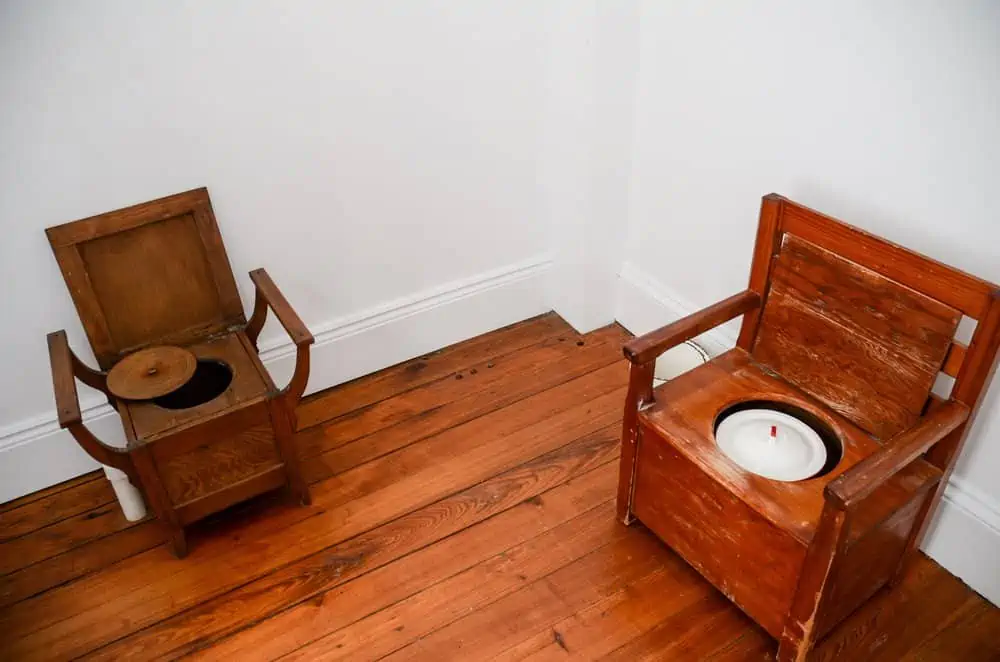
Every civilization has had its methods of separating its poop from its living and eating quarters. Trying to untangle the inventor of the toilet is a bit like trying to unknot a drawer full of old phone charger cables. Here’s a little history trivia:
Royal Approval
Whether through gravity or manual disposal (think chamber pots), the toilet has existed for millennia. The inventor of the flushing toilet was Sir John Harrington in 1596, but the advent of sewers in Victorian London changed the game.
He installed his first flushing toilet in Queen Elizabeth’s palace. So, not content with owning one throne, she now had two.
Crapper by Name
John Crapper (yes, he has coined a few colorful nicknames) invented the flushing toilet that many of us recognize today. It was all thanks to the sewer system installed by Joseph Bazalgette, based on the old Roman sewer systems.
The Thames had become a floating cesspit, and disease was rife at the time, so the government invested millions in a sewer network to safely carry waste away from the city.
Pass the Stick
In ancient Rome, toilets were communal, with an open sewer to carry the dirty stuff away. There was no toilet paper (that would take another couple of hundred years), so they used a sea sponge on a stick.
The stick was dipped in brine to sanitize it, and you guessed it, was passed from person to person. Imagine being the last in the line! Is it any wonder that diseases spread like wildfire?
The King Killer
Two kings have met their fate sitting on the toilet. The first was King George II, who fell off his toilet in 1760 and died from his injuries. Elvis was on the toilet when he fell and was rushed to the hospital. He died shortly after.
Other prominent people found dead on their toilet:
- Judy Garland.
- Lenny Bruce.
- King Edmund II.
Clean Water and Sanitation
Don’t take clean water and sanitized toilets for granted because the stats show that 2.6 billion people worldwide lack access to a modern toilet. Many are in developing countries where diseases that America has eradicated are still rife.
Here are some other shocking facts from around the world.
No Access to Clean Water
The next time you run your faucet and fill a glass with water, spare a thought for the one in ten people in the world without access to clean water. This is more likely to impact their education, health, and opportunities.
To put that in numbers, that’s 771 million people. That’s double the population of the United States!
The Sad Facts
Across the world, children lose out on more than 443 million school days due to water-related illnesses. Diarrhea is the biggest culprit, caused by dirty drinking water and unhygienic toilet sanitation.
Sadly, a child under five dies from diarrhea every two minutes. Every minute of the day, a newborn child dies due to a lack of clean water and an unclean environment.
No Decent Toilets
According to the World Health Organization, 1.7 billion people lack access to a decent toilet of their own. Most of these people are in the developing world.
Positive Return
For every $1 spent on improving water and toilets, it generates an average return of $4 in productivity. The WHO states that good hygiene promotion is one of the most effective ways to cut disease and improve health.
Schools Out
One in three schools worldwide lacks adequate toilet facilities, with 23 percent having no toilet facilities whatsoever. This is crucial because it hampers girls’ education through missed school days during their menstrual cycles.
Help Is Coming
Non-governmental charity Water-Aid has been operating in poorer parts of the world for decades to try and bring clean water to the masses. It is an international charity operating in 27 countries in the developing world.
Scary Toilet Facts
Some toilet facts are funny, others concerning, but this section will highlight the downright scary truths around toilets.
Germ Explosion
Every time you flush your toilet, it propels germs up to six feet in the air. These germs can travel around your bathroom, coating surfaces, including your toothbrush.
It seems that women have always been right about lowering the toilet seat. It’s better for hygiene, preventing the spread of fecal germs.
Keep It Clean
The next time you shake hands with someone, stop to consider whether they have washed their hands after going to the toilet. A massive 20 percent of people don’t wash after they flush, and 30 percent of those that do, admit to not using soap!
Smell the Cell
Your cell phone carries more germs than your toilet seat. This is because most people search the internet or check emails while sitting on the loo. It’s also because your toilet seat gets cleaned more regularly than your smartphone.
So, the next time you take a call, stop and think about the germs pressed to your ear and mouth.
Out In the Open
Surprisingly, 892 million people still defecate in the open. The side of the road, rubbish dumps, and bushes are the spots of choice to relieve themselves. The danger is that open defecation leads to contaminated land, and water and it increases the spread of disease.
Rural communities are more likely to openly defecate due to a lack of toilet facilities. As many as 90 percent admit they have no choice but to go outside.
Leave the Left
In India, it is still the custom to cook, eat, and shake hands with the right hand and leave the left for toilet usage. It is not uncommon for people to carry a jar of water to the toilet rather than use toilet paper.
Using your left hand for anything other than toilet duties in these cultures is considered rude, so you have to feel for left-handed people!
Interesting Toilet Facts
So, we’ve dealt with the scary facts and the sad news that so many people have poor access to hygiene and sanitation. Now it’s time to talk about fun, unusual, and downright bizarre facts.
How Much?
NASA invested $23 million in a high-powered suction toilet for the International Space Station. It can suck 850 liters of airflow per minute, defying gravity. That has to make it the most expensive toilet in the world.
Three Years On the Toilet
Westerners use the toilet roughly 2,500 times every year. That’s six to eight trips to the toilet every day. When you add it all up, that’s the equivalent of three years on the toilet.
Imagine your biggest regret on your deathbed, wishing you had eaten fewer spicy curries. You might have had another three years!
Play That Toilet Like an Instrument
Who would have thought that the toilet could win a place in an orchestra? Most American commodes flush in the key of E-flat. “Voodoo Child” by Jimi Hendrix, “The Boxer” by Simon and Garfunkel, and “Patience” by Guns ‘n’ Roses all start in E-flat.
Just imagine how famous Hendrix could have been with a toilet strapped around his neck instead of a guitar. Repeat after me, “I’m standing next to a mountain,” and flush.
Miles and Miles
Americans are in love with toilet paper. So much so that they use 433 million miles of the stuff every year. That’s enough to stretch from the earth to the sun and back.
Toilet Museums
There are several toilet museums around the world. The largest is in Kyiv, Ukraine. It contains the largest collection of toilet-related items and was started in 2006 by a couple who worked in plumbing.
It draws over 1,000 visitors every month, who flock to see toilets from ancient civilizations to more modern exhibits. The collection contains more than 580 items in the permanent collection.
Bathroom Injuries
Sitting on the toilet is pretty easy, right. What could possibly go wrong? Over 40,000 Americans are injured every year as a result of toilet accidents.
Interesting Toilet Names
Everyone has an affectionate name for their toilet, especially by country. Some cultures are more prolific at giving their lavatories a nickname than others. The Brits love a jolly alternative and have some colorful terms (that we won’t list here as it’s a family site).
Let’s list some of the clean ones. Who knows, you may use these terms already?
- Outhouse (UK).
- Brick outhouse (UK).
- Big white telephone (UK, USA, and Australia).
- Dunny (Australia).
- John (USA).
- The can (USA).
- Crapper (USA).
- WC (UK).
- Privy (UK).
- Throne (UK, USA).
- Khazi (UK).
- Chamber pot (UK).
- Loo (UK).
- Little boy’s or girl’s rooms (UK and USA).
- Point Percy at the porcelain (UK).
- Restroom (USA).
- Gents (UK and USA).
- Latrine (USA).
- Depository (USA).
- Bog (UK).
- Lavie (UK).
Access to Clean Water Statistics by Country
Not everyone has the same access to clean water and sanitation. The west has had the benefit of hygienic toilets and clean water for years, but it’s a different picture in the developing world.
In countries like Nigeria, shockingly, only 25 percent of the population has clean water access. It’s even worse in Ethiopia, where as little as 11.44 percent have the same access to clean water.
However, these stats pale when compared to the worst performer, Uganda, which scrapes in just above seven percent.
It is no surprise that countries in the western world top the league for clean water access. Liechtenstein, Gibraltar, and Hong Kong score 100 percent, the UK comes in at 99.99 percent, and the USA 99 percent.
Eastern nations, like Russia and Georgia, come halfway down the list scoring 76.03 and 79.99 percent, respectively.
Who Knew Toilets Were So Interesting
When you peel away the layers of toilet trivia, you discover just how important they are. We take them for granted (those with one) and never stop to appreciate what life without a toilet would be like.
So, the next time you sit on the can, spare a thought for the millions who would love to do what you are doing right now. And wipe!