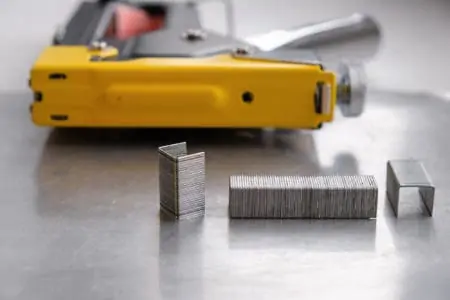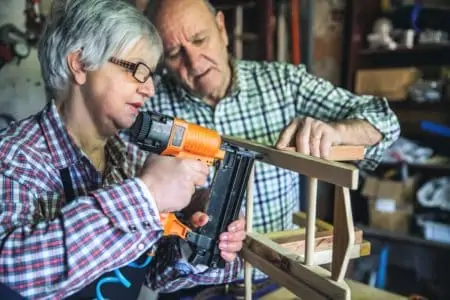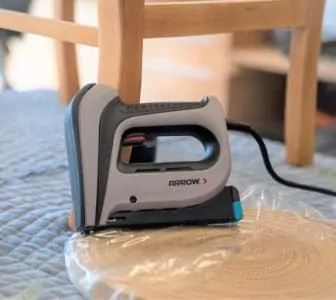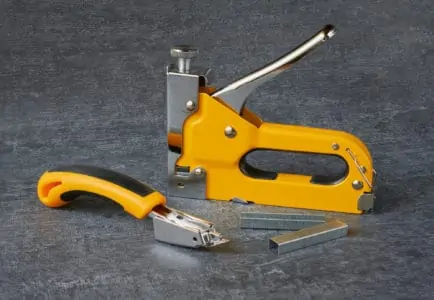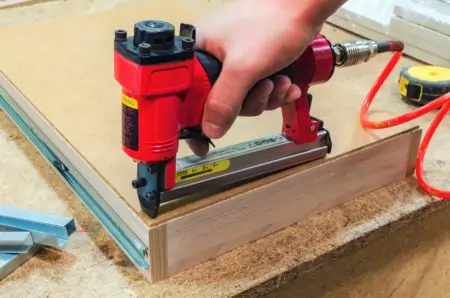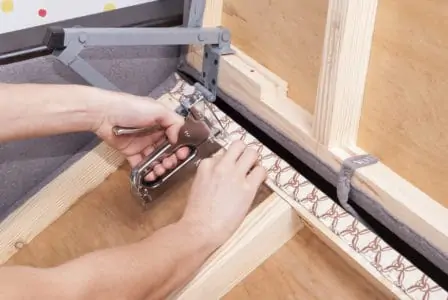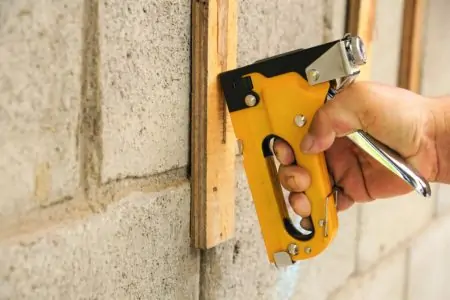
Staple guns are a staple (Excuse the pun) of any crafter or woodworker’s toolbox. Whether it’s for reupholstering your mother’s favorite antique chair or making a frame for your prized family photograph, a staple gun is a useful tool.
We take a look at the best staple guns to bring you our 7 best choices.
- Comes with 5 different staples
- Comfort rubberized handle
- Quick-release connector
- Lightweight at 2.3 lbs
- Has a depth adjuster
- Ergonomically designed flip switch
- Requires no power source
- Takes D, T, U-type staples
- Comes with a removing tool
- 500 shots per full charge
- USB charging socket
- Comes with LED indicator
- Patented easy-squeeze mechanism
- Anti-jam technology
- Easy-squeeze handle
- Flush nose for tight spots
- Dual power lever
- Comfortable contoured grip
- 4-in-1 tool
- Mode selector
- Quick-release loading mechanism
Review Methodology: At Sensible Digs, we believe in providing you with the most comprehensive, hands-on analysis of the best staple guns on the market. Our professional team conducts rigorous testing and evaluation, measuring each product’s performance based on a set criteria, ranging from durability, ease of use, to safety features. We then rank and compare the staple guns, providing you with clear, factual data to help you make informed decisions. Our findings are based on real-life experiences and backed up by quantitative evidence, helping you understand what sets one staple gun apart from another. By highlighting key decision-making factors and detailing the design choices of each staple gun, we give you a full picture of what to expect from each product. Trust us when we say, we’ve got your staple gun needs covered!
The Best Staple Guns of 2024
Choosing the right staple gun is a challenge. Each one is different, and matching a staple gun to a specific task is tricky. We bring you the 7 best staple guns to help make your selection easier.
Surebonder 9600AK Pneumatic Heavy-Duty Stapler Kit
Best Heavy-Duty Staple Gun
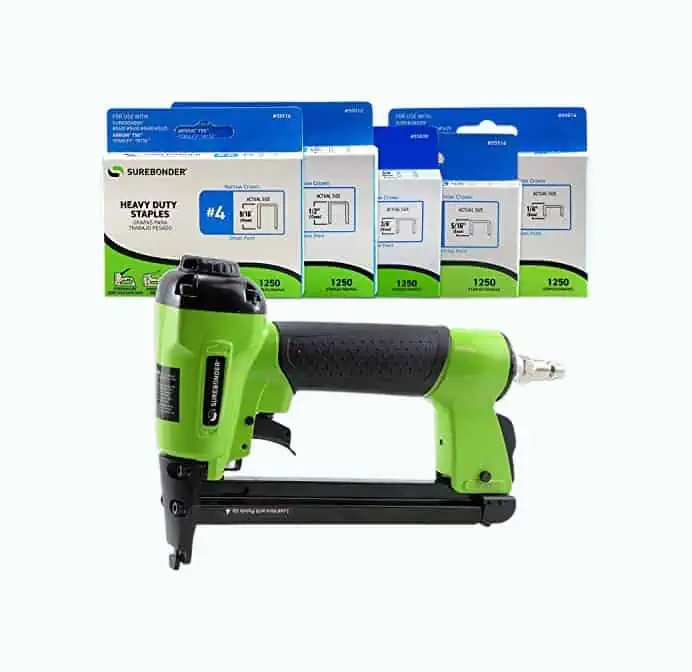
If you want a heavy-duty staple gun, you have to look at the pneumatic models. This kit comes with 5 different staples of varying lengths and sizes.
It is the best tool for multi-use home and semi-professional applications. It works with wood, plastic, and furniture. It has a comfort grip handle, a quick-release magazine feature and an adjustable air exhaust.
The kit includes 1,250 additional staples in each size range from 0.25 inches to 0.563 inches. Each magazine holds 50 fasteners, and thanks to the quick-release mechanism, swapping sizes is a breeze.
Pros
- Pneumatic power.
- 5 packs of additional staples.
- Rubberized handle.
- Quick-release connector.
- Quick-release magazine.
Cons
- Requires an air compressor.
- Noisy.
- Heavy.
Product Specs
| Weight (pounds) | 5.59 |
| Dimensions (inches) | 10 x 2 x 6.75 |
| Staple gauge | Not stated |
| Magazine size | 50 |
| Power source | Compressed air |
| Price | $$ |
| Warranty | 90-day |
Our Ratings
User Experience
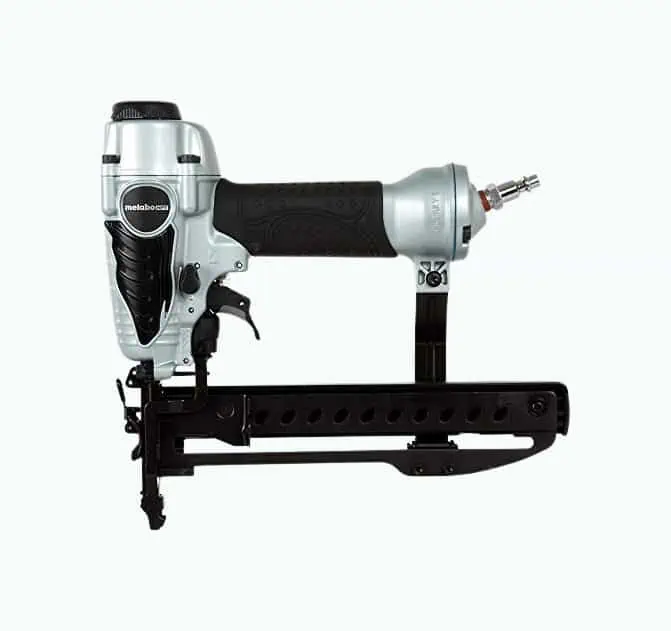
Metabo HPT-N3804AB3M Finish Stapler
Best Pneumatic Staple Gun
This pneumatic staple gun accepts 18-gauge crown staples measuring in length from 0.50 inches to 1.5 inches. It is the ideal tool to use for internal and external trim work, as well as furniture, cabinetry and fine finishing work.
It is lightweight, weighing just 2.3 pounds, it has a depth adjuster so you can achieve a superb finish on several materials, and the magazine holds 130 staples. It also has a tool-less, easy to clear nose, a 360-degree adjustable nose, and an ergonomically designed flip switch.
The only downside to this tool is that you need an air compressor, which adds to the costs of what is an already pricey staple gun. When you compare it to an electric version, it looks like an expensive option.
Pros
- Powerful.
- Ideal for heavy-duty tasks.
- Lightweight.
- Suitable for internal and external trim.
- 5-year warranty.
Cons
- Requires an air compressor.
- Noisy.
- Expensive.
Product Specs
| Weight (pounds) | 2.3 |
| Dimensions (inches) | 10.1 x 2.2 x 9.25 |
| Staple gauge | 18 |
| Magazine size | 130 |
| Power source | Compressed air |
| Price | $$$$ |
| Warranty | 5-year |
Our Ratings
Personal Perspective
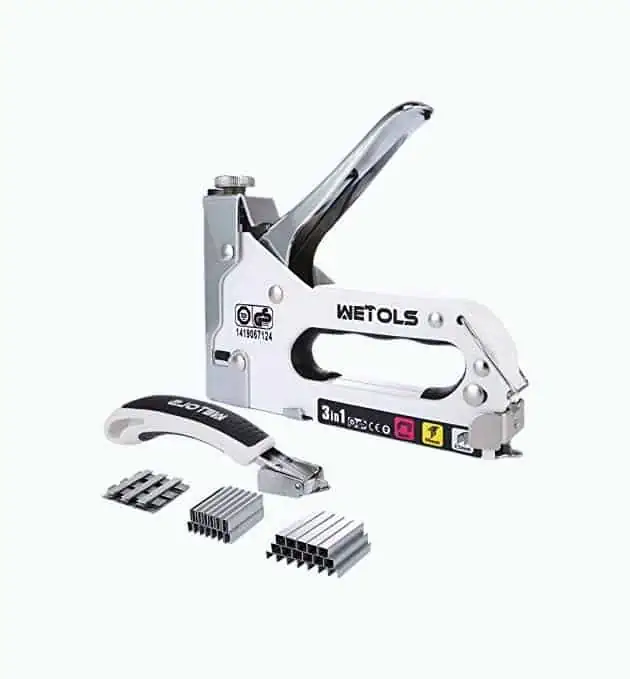
WETOLS Staple Gun with Remover
Best Manual Staple Gun
This manual staple gun is a 3-in-1 tool because it takes D, T, and U-type staples ranging in size from 8, 10, and 12mm, respectively. Because it is a manual tool, it can go anywhere and requires nothing more than a bit of elbow grease to make it work.
It has a pressure knob that allows you to decide on the depth of the staple and the magazine’s load from the bottom at the rear. It comes with 3,000 D-style staples and 1,000 of both the T and U-shaped varieties.
It also comes with a removing tool, should you make an error and need to act swiftly to rectify it.
Pros
- Requires no power source.
- Easy to use.
- 3-in-1 tool.
- Ideal for upholstery and wood.
- Cheaper than powered staple guns.
- Ideal for hobbyists and beginners.
Cons
- Requires brute strength.
- Fatigues your hands and wrists.
- Slower progress.
Product Specs
| Weight (pounds) | 2.35 |
| Dimensions (inches) | 9.7 x 6.6 x 1.7 |
| Staple gauge | Not stated |
| Magazine size | Not stated |
| Power source | Manual |
| Price | $ |
| Warranty | Not stated |
Our Ratings
Community Feedback
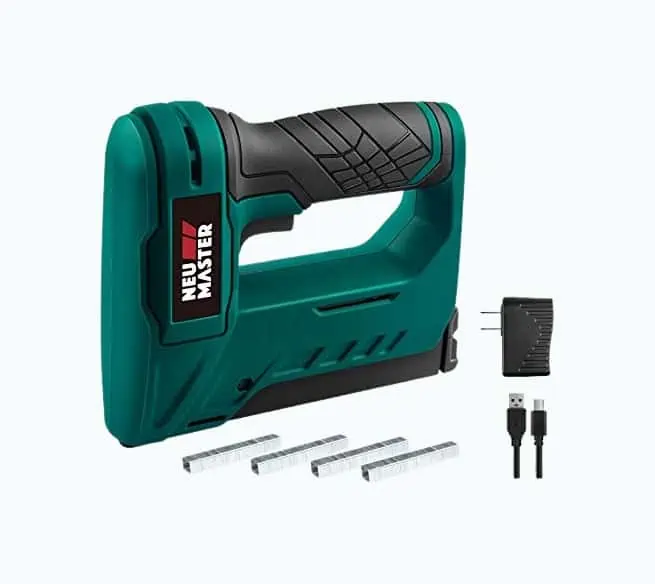
NEU MASTER Cordless Staple Gun
Best Cordless Staple Gun
Cordless staple guns offer all the freedom of a manual version with all the power of an electric model. You can go anywhere with this tool. This stapler has a built-in 3.6V lithium-ion battery that delivers up to 500 shots on a full charge.
It comes with an LED indicator that tells you when the magazine is running low, and it has a labor-saving anti-skid feature. Couple that with the advanced impact drive technology and the safety switch setting, and you have a powerful and safe tool.
This is the perfect tool for installing insulation sheets, carpet, internal and external trim, and a host of other DIY projects.
Pros
- 500 shots per full charge.
- Easy to use.
- Lithium-ion battery.
- Ideal for upholstery and trim.
- USB charging socket.
- Ideal for hobbyists and upholsterers.
Cons
- Requires a power source.
- Not suitable for heavier tasks.
- Wait while it charges.
Product Specs
| Weight (pounds) | 2.46 |
| Dimensions (inches) | 9 x 2.62 x 8.5 |
| Staple gauge | 18 |
| Magazine size | 50 |
| Power source | Electric |
| Price | $$ |
| Warranty | Not stated |
Our Ratings
First-Hand Impression
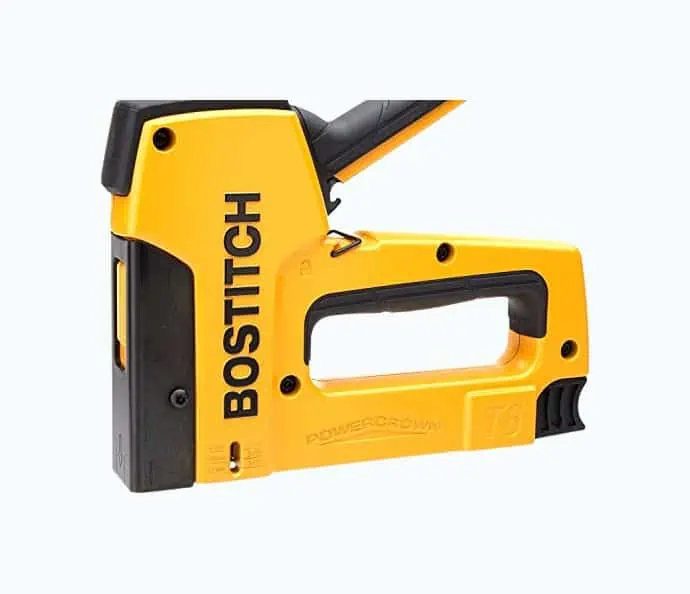
Bostitch Upholstery Stapler/Tacker
Best Staple Gun for Upholstery
This is another manual staple gun, but it has a patented easy-squeeze mechanism to alleviate stress on your hands and wrists. It is constructed from lightweight, die-cast aluminum, and it has a steel handle with rubber overmolds for comfort and grip.
The patented anti-jam magazine ensures that it rarely has a blockage, though it will happen from time to time. This is the ideal tool for upholsterers because it is lightweight, easy to use, and always delivers a neat finish.
On the downside, you don’t get any accessories with this model. The staples are sold separately.
Pros
- Lightweight.
- Anti-jam technology.
- Easy-squeeze handle.
- Die-cast aluminum.
Cons
- Manual operation.
- Tool only.
- Only uses Bostitch staples.
Product Specs
| Weight (pounds) | 16 ounces |
| Dimensions (inches) | 8.9 x 6.9 x 1.5 |
| Staple gauge | Not stated |
| Magazine size | 84 |
| Power source | Manual |
| Price | $ |
| Warranty | 7-year |
Our Ratings
User Experience
Stanley Nail and Staple Gun
Best Electric Staple Gun
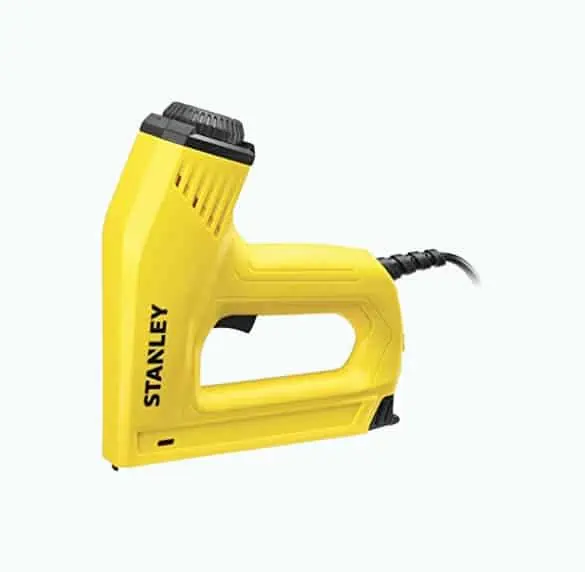
We can say with certainty that this staple gun is popular. It comes with a flush nose for better control and easier access to tight spots.
It also has a dual power lever that allows you to switch strengths between soft and hard materials. The anti-jam technology reduces downtime clearing blockages, and because this is a stapler and nail gun, you get 2 tools for the price of one.
The low Brad indicator tells you when you are running low, and the contoured grip gives you better comfort and control.
Pros
- Lightweight.
- Anti-jam technology.
- Flush nose for tight spots.
- 2-in-1 tool.
- Heavy-duty.
Cons
- Limited power cord length.
- Possibly too light.
Product Specs
| Weight (pounds) | 1.41 ounces |
| Dimensions (inches) | 5.9 x 3 x 3.6 |
| Staple gauge | 18 |
| Magazine size | 50 |
| Power source | Electric |
| Price | $$ |
| Warranty | Limited lifetime |
Our Ratings
Personal Perspective
WORKPRO Heavy-Duty Staple Gun
Best Staple Gun for Wood
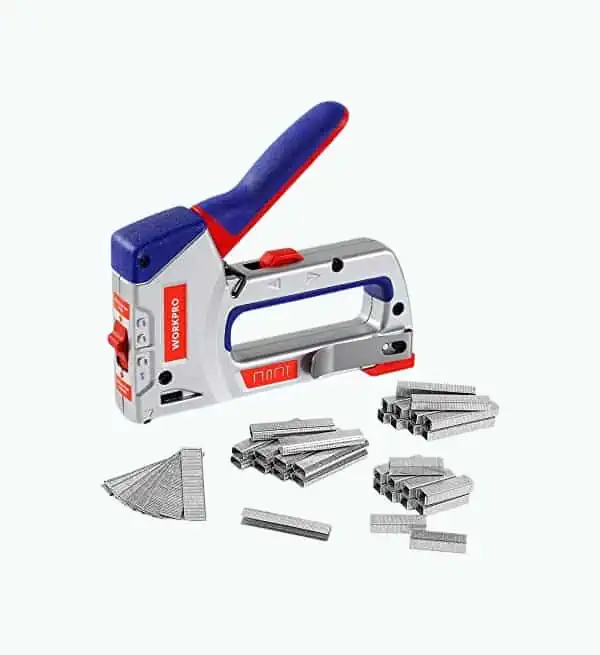
This Workpro heavy-duty staple gun is a 4-in-1 tool. Not only does it take a heavy-duty D-shaped staple it also accepts the lighter D version. And that’s not all, it accommodates U-type staples, and it also acts as a Brad nailer.
It has a quick-release loading mechanism located at the bottom of the gun for convenience and a high/low power switch for hard and softwood.
The handle is ergonomic, with a rubberized grip to minimize hand and wrist fatigue and give you better control. You also get a loading window so you can see when the staples are running low.
The mode selector allows you to switch between the heavy-duty U and D-shaped staples or the light-duty D-type and Brad nails.
Pros
- Ergonomic handle.
- 4-in-1 tool.
- Heavy-duty.
- Mode selector.
- Great price.
Cons
- Manual staple gun.
- Slower work rate.
Product Specs
| Weight (pounds) | 2.54 |
| Dimensions (inches) | 11.42 x 5.31 x 1.57 |
| Staple gauge | 18 |
| Magazine size | Not stated |
| Power source | Manual |
| Price | $ |
| Warranty | 1-year |
Our Ratings
Community Feedback
| Product | Best | Weight | Dimensions | Staple gauge | Magazine size | Power source | Warranty |
|---|---|---|---|---|---|---|---|
| Surebonder 9600AKPneumatic Stapler | Heavy-Duty | 6 lbs | 10 x 2 x 6.75″ | N/A | 50 | Compressed air | 90-day |
| Metabo Finish Stapler | Pneumatic | 2 lbs | 10.1 x 2.2 x 9.25″ | 18 | 130 | Compressed air | 5-year |
| WETOLS Staple Gun with Remover | Manual | 2 lbs | 9.7 x 6.6 x 1.7″ | N/A | N/A | Manual | N/A |
| NEU MASTER Cordless Staple Gun | Cordless | 2 lbs | 9 x 2.62 x 8.5″ | 18 | 50 | Electric | N/A |
| Bostitch Upholstery Stapler/Tacker | Upholstery | 16 oz | 8.9 x 6.9 x 1.5″ | N/A | 84 | Manual | 7-year |
| Stanley Nail and Staple Gun | Electric | 1.41 oz | 5.9 x 3 x 3.6″ | 18 | 50 | Electric | Limited lifetime |
| WORKPRO Heavy-Duty Staple Gun | Wood | 3 lbs | 11.42 x 5.31 x 1.57″ | 18 | N/A | Manual | 1-year |
What Can Staple Guns Be Used For?
Staple guns drive metal staples into all manner of materials. They are handy tools when laying insulation because they secure the board really well, and you don’t have to stop to reload the gun. This speeds up the process.
Plus, electricians use staple guns to secure wiring, while roofers staple roofing and waterproof membranes to wooden rafters.
You can use a staple gun to drive fasteners into wood, plastic, and even masonry if you have a heavy-duty model. Upholsterers and bespoke furniture makers rely on the benefits of staple guns to produce wonderful creations.
Hobbyists and crafters use staple guns to indulge their creativity, producing leatherwork, fabric and wooden designs.
Types of Staple Guns
Essentially there are 3 types of staple guns: manual, electric and pneumatic, but what are their merits?
Manual Staple Gun
If you are a hobbyist, you are probably familiar with a manual staple gun. As the name suggests, you squeeze the handle to create downward pressure to release the staple. All you need is some good old fashioned brute strength.
The advantage of a manual staple gun is it can operate anywhere. Unlike the electric or pneumatic versions, which rely on a power source, a manual staple gun is entirely independent.
The second plus is the price. Compared to more expensive, powered models, you can pick up a decent manual staple gun for a small amount of money.
You can also store them away easily, thanks to their compact size, and loading staples is quick and straightforward. The downside is you have to apply force, which has a toll on your hands and wrists, so it restricts the size and length of the tasks you can undertake.
Electric Staple Gun
Electric staple guns are a common sight, especially in workshops and hobby rooms across the country. Simply load the staples, plug it in, press the nose of the gun on your project, and a fastener gets released.
It requires zero effort from you, saving hand and wrist fatigue further down the line. The advantage is you can work for longer on more substantial projects. They are also easy to handle.
The downside is you need an electrical supply, and they are more costly than manual versions. Plus, because this staple gun discharges so easily, the chances of an injury increases, so take care when using it.
Pneumatic Staple Gun
Now we get to the powerful staple gun. However, the grunt comes from an air compressor and not the tool itself. There are some key advantages to owning a pneumatic staple gun. First, they are extremely light. This is good if you are concerned about hand and wrist fatigue.
It also means they are comfortable to use for longer periods. Second, these guns are adjustable, so you can vary the power to accommodate different materials. You can also choose different types of fasteners.
The disadvantage is that this type of tool is more expensive, and then you need an air compressor, which ramps up the costs further. Plus, dragging around an air compressor is inconvenient.
Another downside is the noise these tools make. You will need earplugs when operating most air compressors, and if you work from home, the neighbors might not like the interruptions.
How To Choose the Best Staple Gun
Getting the best staple gun for your money takes careful planning and research. Here are some pointers to look for when selecting the right model.
Staple Gauge and Size
Staple thickness is measured in gauges, and the lower the gauge, the thicker the staple. A 16-gauge fastener is thicker than a 20-gauge, with most ranging between 16, 18 and 20-gauge.
That said, some upholstery guns can fire 22-gauge fasteners.

How Comfortable Is It To Use?
Manual staple guns are far less comfortable to use compared to electric and pneumatic varieties. If you have small hands or a weak grip, a manual staple gun is unlikely to suit. It may be a better option to use a powered model.
All you need to do to fire a staple from an electric or pneumatic gun is depress the nozzle while pressing the trigger. Forget all that manual effort.
Type of Staple Gun
As we’ve said previously, the 3 main types of staple guns have their advantages and disadvantages. Manual guns are cheaper, but they require brute force to work them. Hand and wrist fatigue is a real danger.
Electric models need an electrical supply that hampers your mobility with the tool. They are also more expensive. However, they are easy to use and require zero effort on your part.
Pneumatic guns are the lightest of them all and are extremely powerful. This is ideal when working on a construction site, but they also have the added burden of an air compressor, which increases the cost base considerably.
How Easy Is It To Use?
If you are an occasional user of staple guns, this might not be an important factor. Still, for those using them every day in a semi or professional way, this is one of the crucial deciding factors.
You should spend more time working and less time loading the staple gun, grappling with the trigger, or sorting out blockages.

What Are You Using It For?
For occasional and light hobby use, a manual or electric staple gun should suffice. They are manageable, quiet and compact. They store away easily and are the simplest to set up and use.
A pneumatic stapler is better suited to heavy-duty tasks like construction and carpentry. They need an air compressor, which is both noisy and expensive.
Do All Staple Guns Use the Same Staples?
The simple answer is no; not all staple guns use the same fasteners. Staples vary in size for different applications. Most guns take 16 to 20-gauge fasteners. However, some tasks need smaller and less industrial-size pins.
Upholstery requires a smaller 22-gauge staple because it is a more refined skill. This is also true for other textiles and leatherwork. You need the fasteners to be more discreet and not leave large holes or splits in the wood.
For laying carpet or insulation, a broad-backed staple is better. You want something with a thicker gauge that holds the material firm. For paneling, trim and other carpentry, the staple needs to have longer legs and a narrow back to maximize the grip.
How To Safely Use a Staple Gun
The first thing you should do is read the operating manual. It tells you the do’s and don’ts of staple gun use relating to your specific model. Most of the rules surrounding safe use are common sense.
- Never leave the staple gun unattended. If it fell into the wrong hands, it could cause injury, especially if children are present.
- Get a gun with a safety lock, so you minimize the chances of accidental operation. Again, with children, this is a must.
- Never point the staple gun at yourself or any other person.
- When carrying a staple gun, make sure your hands are nowhere near the trigger.
- Don’t fire one staple on top of another. It could lead to ricochets and injury.
Staple Guns FAQs

What Is Standard Staple Size for a Staple Gun?
There are various staple gun sizes, depending on the brand and what you want to use it for. People usually turn to a ¼-inch staple gun to attach thin plastic pieces, cloth, and paper.
Other standard staple gun sizes are ⅜, ½, and ⅝ inches. These are designed to tackle more difficult stapling.

What Is the Difference Between a Brad Nailer and a Staple Gun?
A staple gun is designed to drive staples into materials, while a brad nailer will disperse small and thin nails (that have almost no head). This main difference generates several other characteristics that make each tool good for something else.
For example, brad nailers are better at attaching trim and baseboards, while staple guns are better if you want to reupholster that old dining room chair.
Staple guns are also believed to be more efficient at holding things together because the U shape of the staples offers two legs for fastening (whereas a brad nailer only has one).

Is an Electric Staple Gun Better Than a Manual One?
Electric staple guns are usually more versatile and easier to work with. You don’t need a lot of elbow grease with electric staple guns, as they will easily drive staples through the material you’re working with. They are also faster.
Also, consider that electric staple guns will deliver consistent pressure. This means that your staples will be placed correctly every time.

Can You Use a Regular Staple Gun for a Carpet?
You should avoid using a regular staple gun for a carpet because it can lead to incorrect installation. The carpet won’t be properly secured when you use an improper gun. This leads to a potential tripping hazard and even carpet damage.
A regular staple gun might not be compatible with the staples needed to install a carpet. You need broad-backed staples for carpet installation.

Why Is My Staple Gun Not Shooting Staples?
If your staple gun is not shooting staples, it’s likely jammed. To unjam it, follow the manufacturer’s instructions and remove the staple compartment to clear the jam.
Staple gun jams can also occur when debris gets stuck in the gun. You should clean it before each use to make sure it functions properly.
Another potential problem could be the use of incorrect staples. The manufacturer’s instructions will help you again, telling you the correct size and type of staples needed.
If you’ve had a staple gun for a long time, parts of it might be damaged or warped. As this happens, the gun will not shoot staples as it did when it was brand new.
Pneumatic staple guns might not shoot staples properly if you’re using low air pressure. Ensure your air compressor is set to the recommended pressure for a staple gun. Also, check the hose for any air leaks.
Anything Is Possible With a Staple Gun
Staple guns speed up your work rate and open up a world of possibilities when you work with wood and plastic. They are easy to load, lightweight, and relatively inexpensive, for the most part.
A staple gun is a wise investment if you want a multi-use tool that will see you through countless tasks.