Snow roof rakes are a no-brainer, but which one is best for your roof? With so many styles and models available, it can be a challenge knowing which one is best.
We review the best snow roof rakes, determining why they are so good and how well they perform. We listen to the experts and take into account the views of the public when reaching our conclusions.
No products found.
- Push-button feature
- 17 feet extension
- 24-inch poly blade width
- Bends in the middle
- Has 15-inch wheels
- 49 inche extension
No products found.
- Snap-together fixings
- 24-inch clearance width
- 21 feet extension
- Maximum reach of 15 feet
- 24-inch clearance width
- Polyethylene blade head
- 21 feet extension
- 25 inch clearance width
- Twist-and-lock feature
Review Methodology: At Sensible Digs, we rely on a comprehensive analysis and evaluation process to bring you the most accurate and reliable information about the best snow roof rakes on the market. Our professional team conducts hands-on testing, compares performance and design choices, and uses strict criteria to rank each product. We evaluate each rake from a user’s perspective, taking into account key decision-making factors such as durability, ease of use, and effectiveness in heavy snow conditions. Our assessment is based on empirical data, first-hand experience, and thorough research, allowing us to provide you with clear, fact-based recommendations. Trust in our expertise and let us guide you to the right snow roof rake for your needs.
The Best Snow Roof Rakes of 2024
We take finding the best roof rakes seriously. It’s the reason why we conduct extensive research online to get the best public and expert opinions to bring you our top 5 rakes.
True Temper 193055510 Telescoping Roof Rake
Best Telescoping Snow Roof Rake
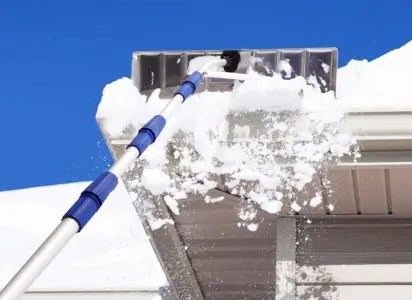
Telescoping roof rakes are the most convenient to use. Unlike sectional models, you simply twist or push the release button and extend the pole, locking it into place when you reach the desired length.
A telescoping rake is the ideal tool if you have a collection of roofs of different sizes and heights, and you can even use them to clear snow from vehicles. This model has a 24-inch poly blade and can extend to 17 feet in length.
This rake has a push-button extending pole and a poly end with a hanging hole to make storage a breeze.
Pros
- Push-button extending pole adds to the convenience.
- Extends to a massive 17 feet in length.
- Ideal for different size roofs and applications.
- 24-inch width is ideal for removing heavy drifts of snow in one go.
Cons
- When fully extended, it could place undue pressure on your back and arms.
- It might damage shingle roofs because the head lacks wheels.
Product Specs
| Weight | 1.6 ounces |
| Dimensions (inches) | 6 x 24 x 72 |
| Width (inches) | 24 |
| Depth (inches) | 6 |
| Pole type | Telescoping |
| Extending length (feet) | 17 |
| Price | $$ |
Our Ratings
User Experience
Avalanche Snow Roof Rake for Flat Roofs
Best Snow Roof Rake for Flat Roofs
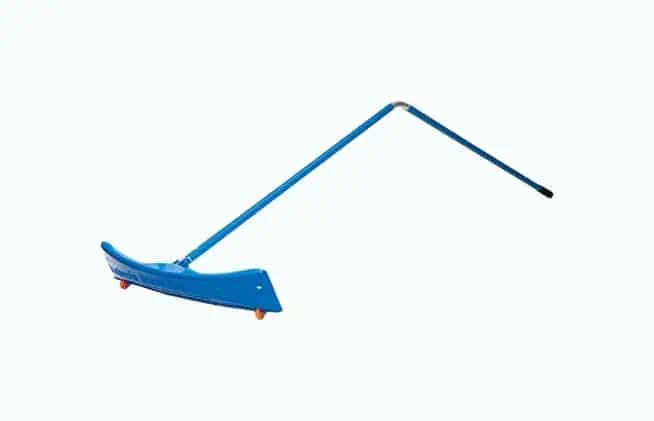
If you have a flat roof, you will need a rake that can cope. This Avalanche is specially designed with a bend in the pole, to enable you to reach the furthest parts of the roof. It also lends itself to RVs, trucks, mobile homes, and other flat roofs.
The 1.5-inch wheels prevent damage to your flat roof, and the 8-inch head makes light work of clearing the snow. It also has a 5-inch depth, so while the head isn’t the largest, it copes admirably with most flat roofs.
The only thing to bear in mind is the weight of the pole. It weighs 7.98 pounds, which is significantly more than some other models. This increases the chance of back and arm fatigue.
Pros
- Bends in the middle to get at the furthest parts of the flat roof.
- 1.5-inch wheels reduce the wear and tear on your asphalt roof.
- Extends to a length of 49 inches.
Cons
- Smaller head width means that you’ll have to make a couple of sweeps.
- This rake weighs almost 8 pounds, which is significantly more than other models.
- This is expensive, even by the standards of snow roof rakes.
Product Specs
| Weight | 7.98 pounds |
| Dimensions (inches) | 49 x 8 x 5 |
| Width (inches) | 8 |
| Depth (inches) | 5 |
| Pole type | Sectional |
| Extending length (feet) | Each pole section is 49 inches |
| Price | $$$$$ |
Our Ratings
Personal Perspective
Garelick 89421 21- Foot Aluminum Snow Rake
Best Snow Roof Rake for Metal Roofs
This Garelick aluminum snow rake has a clearance width of 24 inches, matching the True Temper model, giving it enough capacity to remove snow quickly. It also has small wheels, which means the head never comes into contact with the roof, making it ideal for metal and shingle roofs.
What is impressive is the maximum reach. The pole comes in sections, with a reach of 21 feet. The advantage of a sectional pole is its infinite length by adding additional sections.
This is an aluminum rake, so while it may be slightly heavier than some, it is a robust tool designed to give you years of use.
Pros
- Aluminum construction ensures that it is durable and lasts the distance.
- Sectional pole with snap-together fixings.
- 24-inch head width for better snow clearing capability.
- Extends to an impressive 21 feet.
Cons
- Aluminum rakes are heavier than other models.
- Sectional pole is less convenient than a telescoping model.
Product Specs
| Weight | 5.75 pounds |
| Dimensions (inches) | 62 x 7 x 2 |
| Width (inches) | 24 |
| Depth (inches) | 7 |
| Pole type | Sectional |
| Extending length (feet) | 21 |
| Price | $$ |
Our Ratings
Community Feedback
Garant GPRR24 Yukon Poly Blade Snow Roof Rake
Best Sectional Snow Roof Rake
The distinct advantage of sectional poles is that you can keep adding sections to extend the rake’s reach. Compare this to a telescoping model, with its finite maximum length, and you can see why some people prefer them.
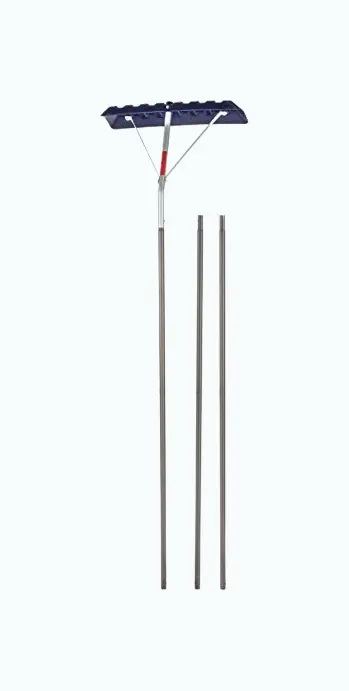
This Garant Yukon model has a clearance width of 24 inches, plus the polyethylene blade won’t damage the roof. Each pole section is 5 ft in length, so combined, you get a total reach of 15 feet.
You also get an anti-slip grip, and thanks to the wide-angled head, snow clearance is made easier.
Pros
- It comes in 3 sections to achieve a maximum reach of 15 feet.
- 24-inch clearance width for faster snow removal.
- Polyethylene blade reduces the impact on the roof.
- Ideal for conservatories, awnings, and skylights.
Cons
- Pole sections are not as convenient as telescoping poles.
Product Specs
| Weight | 4.2 pounds |
| Dimensions (inches) | 2.5 x 6.5 x 60.75 |
| Width (inches) | 24 |
| Depth (inches) | 6.5 |
| Pole type | Sectional |
| Extending length (feet) | 15 |
| Price | $$ |
Our Ratings
First-Hand Impression
Snow Joe RJ250M Telescoping Snow Rake
Best Budget Snow Roof Rake
If you have a lot of snow on your roof but a limited budget, this Snow Joe telescoping rake could be the solution. The first thing you notice is the attractive price. It costs a fraction of the Avalanche model, making it incredible value for money.
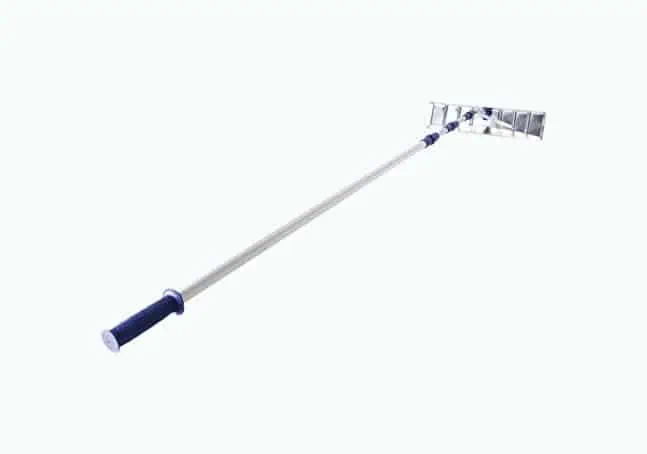
It has a twist-and-lock telescoping pole that extends to an impressive 21 feet, and when you want to store it away, it shrinks to 6.2 feet.
You get a superior clearance width with this Snow Joe, despite the low price. The head measures 25 inches by 6 inches, so you can sweep away a substantial amount of snow in one motion.
For a budget model, it feels like a quality rake. You even get an aluminum head.
Pros
- Extends to 21 feet, giving you the reach to clear the most extensive roof surfaces.
- The width clearance is 25 inches, making it one of the widest to feature on the list.
- Twist-and-lock telescoping is super-convenient and easy to adjust to any length.
- Unbelievable price when compared to other snow roof rakes.
Cons
- This snow rake is heavy, weighing in at 7.94 pounds.
Product Specs
| Weight | 7.94 pounds |
| Dimensions (inches) | 21 x 24.8 x 6 |
| Width (inches) | 25 |
| Depth (inches) | 6 |
| Pole type | Telescoping |
| Extending length (feet) | 21 |
| Price | $ |
Our Ratings
User Experience
| Product | Best | Weight | Dimensions | Width | Depth | Pole type | Extending length |
|---|---|---|---|---|---|---|---|
| True Temper Telescoping Roof Rake | Telescoping | 1.6 oz | 6 x 24 x 72″ | 24″ | 6″ | Telescoping | 17′ |
| Avalanche Snow Roof Rake | Flat Roofs | 7.98 lbs | 49 x 8 x 5″ | 8″ | 5″ | Sectional | 12′ |
| Garelick 89421 Aluminum Snow Rake | Metal Roofs | 5.75 lbs | 62 x 7 x 2″ | 24″ | 7″ | Sectional | 21′ |
| Garant Yukon Poly Blade Snow Roof Rake | Sectional Rake | 4.2 lbs | 2.5 x 6.5 x 60.75″ | 24″ | 6.5″ | Sectional | 15′ |
| Snow Joe Telescoping Snow Rake | Budget Pick | 7.94 lbs | 21 x 24.8 x 6″ | 25″ | 6″ | Telescoping | 21′ |
How To Choose the Best Snow Roof Rake
So, what should you be looking for when shopping for a new snow roof rake? Not sure where to start? Here are some pointers.

Pole Length
Snow roof rakes come in 3 pole designs: a fixed pole, a telescoping pole, and a sectional pole. Deciding which is the best for you depends on the type of roof you have. The most versatile models are the telescoping and sectional rakes.
These models can extend great distances, sometimes up to 20 feet plus, to tackle the largest roofs. Adjustable poles enable the maximum reach but also make them easier to store away.
Top Tip

Type of Rake Head
Snow roof rakes vary in depth and width. Some are better for narrow spaces, thanks to a 12-inch width, while others span 24 inches. Depths range from 3 inches to 10 inches, so thicker snow shouldn’t be an issue.
The bigger the rake head, the more snow it clears in one sweep. Some rake heads are curved and scoop the snow, while others have a slicing action and wheels to tackle heavier coverings.

Rake Weight
Most rakes range in weight between 4 and 14 pounds. If you want to minimize the strain on your arms and back, the weight of the rake is crucial. For heavy snowfall, you will need a rake that is heavy enough to sink into the snow. Lighter rakes are better for minimal snowfall.

Rake Material
Most rakes are constructed from aluminum because it is both lightweight and durable. The heads are formed from heavy-duty plastic, aluminum, or molded polyethylene. The material of the head adds weight to the rake, with aluminum being the heaviest.

Rake Budget
Rakes range in price from about $35 to $180. At the cheaper end, you are likely to get a lower quality tool, while at the premium end, you should expect something that is better quality, with aluminum poles and heads. If you are spending about $50 to $100, you are probably in the right ballpark.
Snow Roof Rake FAQs

When Should I Rake Snow Off My Roof?
You should always rake your roof when you have a dump of heavy snow. It adds an enormous amount of pressure to the structure, and in some cases, it can cause structural damage. The best rule of thumb is to aim to clear the roof every 6 inches.

Do Roof Rakes Damage Shingles?
Roof rakes can cause damage to shingles if they are not used following the manufacturer’s instructions. Also, it is better to pull rather than push, as this reduces the risks of catching a shingle or two.
Or you could get a roof rake with wheels to stop you from lifting shingles as you scrape off the snow.

Does Roof Raking Prevent Ice Dams?
It does if you rake the lower 4 feet of the roof. Ideally, you will have a roof rake long enough to clear the entire surface to prevent any ice dams from forming.

Are Snow Roof Rakes Worth It?
Snow roof rakes are worth it if you often experience heavy snowfall in your region. When snow builds up on the roof, it can cause structural damage that could eventually lead to collapse.
Melted and frosted snow can lead to ice dams that can cause flooding within a building. Using a snow rake to remove said snow will help reduce the likelihood of ice dams forming.
When snow accumulates on the roof, it can clog ventilation ducts in the attic, making the heating system work harder than it needs to. Clearing the snow can help keep the place well-ventilated and minimize heating and cooling costs.
Plus, hiring a professional to clean the roof can cost you a lot of money, so why not do it yourself for cheaper?

Can You Use a Snow Roof Rake for Leaves?
Snow roof rakes have a specific shape that doesn’t make them ideal for raking leaves, but they can be used for such a purpose.
You can remove leaves from your roof with the help of a snow roof rake, some of which have flat or slightly bent blades. Some variations have a gentle brush accessory that can be used to sweep away dust and crumbs without causing any damage to the device.

Can a Roof Rake Damage Your Roof?
A roof rake can damage the shingles if you don’t use it properly. Using a roof rake to remove snow or debris might cause damage to the roofing or shingles if you aren’t careful.
This may cause the roofing materials to become dislodged or loose, leaving the roof more susceptible to future damage.
Aside from mastering different techniques for proper roof raking, consider investing in a tool compatible with a roof. Some roof rakes are made from plastic that can’t scratch or damage the roof’s surface.

Are Metal Rakes Better Than Plastic?
Metal rakes are usually better than plastic ones when you use them on the ground, but the story is a bit different when it comes to roofs.
A metal rake is great when removing a lot of snow. It’s also studier, considering it’s made with more durable materials. However, you risk damaging the roof when you use a metal rake.
Plastic rakes, while lower in quality, are better for snow removal. They are lightweight, easy to manipulate, and most have convenient aluminum handles.
They are also less expensive compared to their metal brethren. But the most important feature is that they are unlikely to scratch your roof shingles. However, they might not be as durable.

Which Snow Roof Rake Is Best?
The True Temper rake might be a real winner because it has an adjustable handle, a reasonable price, and plenty of features worth mentioning. This model features a poly blade that is 24 inches long and can expand to a total length of 17 feet.
Like all good roof rakes, this also features an aluminum pole and is relatively lightweight, with less than 5 pounds for you to carry around.