When you decide to replace your old water heater, it’s easy to be overwhelmed by the huge number of different brands.
One brand worth taking the time to consider is Richmond. Who is Richmond and what sets its water heaters apart from the competition? Most importantly, are Richmond water heaters good?
In this article, we have provided three Richmond water heater reviews. They will teach you more about the brand and why one of Richmond’s heaters might be right for you.

- 36,000 BTU unit
- First-hour rating of 80
- Flammable vapor detection sensor
- Fitted with 2,000-W heating element.
- Pre-installed automatic thermostat
- Meets the NAECA requirements
- Multi-port electric connections
- Glass lining & brass construction
- Features over-temperature protector
Review Methodology: At Sensible Digs, we meticulously analyze and assess Richmond water heaters to provide you with reliable and trustworthy information. Our team of professionals conducts hands-on testing, comparing performance, efficiency, and design choices to help you make the best decision for your home. We evaluate products from a user’s perspective, utilizing our experience and expertise to identify key decision-making factors such as energy efficiency, capacity, warranty, installation, and maintenance. Through careful research, data-driven results, and first-hand evidence, we rank and review each Richmond water heater based on these criteria, so you can confidently choose the perfect heater for your needs.
The Best Richmond Water Heaters of 2024
To narrow down the range and find the best Richmond water heaters, we compared the main qualities we look for in Rheem’s heaters with Richmond’s. After reading a lot of user feedback, we settled on our top three.
Richmond Short Natural Gas Water Heater
Best Richmond Gas Water Heater
This Richmond 50-gallon power vent water heater has 36,000 BTU and is powered by natural gas. It’s a great choice for a three to five-person household.
It has a respectable first-hour rating of 80 gallons and a recovery rate of 36.4 gallons per hour. Although it isn’t Energy Star rated, it does have eco-friendly low NOx burners.
Richmond emphasizes that the unit offers flexible venting options. It is compatible with PVC, CPVC, or ABS vents that you can install vertically or horizontally.
We appreciate the new and improved quiet blower motor and the pre-installed temperature and pressure relief valve. Our favorite feature is the flammable vapor detection sensor. This disables the unit if it senses an accumulation of dangerous vapor.
Something to be aware of is the rating of the low NOx burners. The unit doesn’t meet the Ultra-Low NOx emission requirements and can’t be used in an air quality district. California and Utah residents should keep this in mind.
Pros
- High efficiency and Energy Star qualified.
- Flexible venting options.
- Includes a new quiet blower motor.
- Features a flammable vapor detection sensor.
Cons
- Doesn’t meet the Ultra-Low NOx emission requirements.
Product Specs
| Tank capacity | 48 gallons |
| Fuel type | Natural gas |
| Max. temperature | 160 degrees Fahrenheit |
| Weight | 175 pounds |
| Measurements | 51.25 inches by 23.75 inches by 23.75 inches |
Our Ratings
User Experience
Richmond Electric Point-of-Use Water Heater
Best Richmond Electric Water Heater
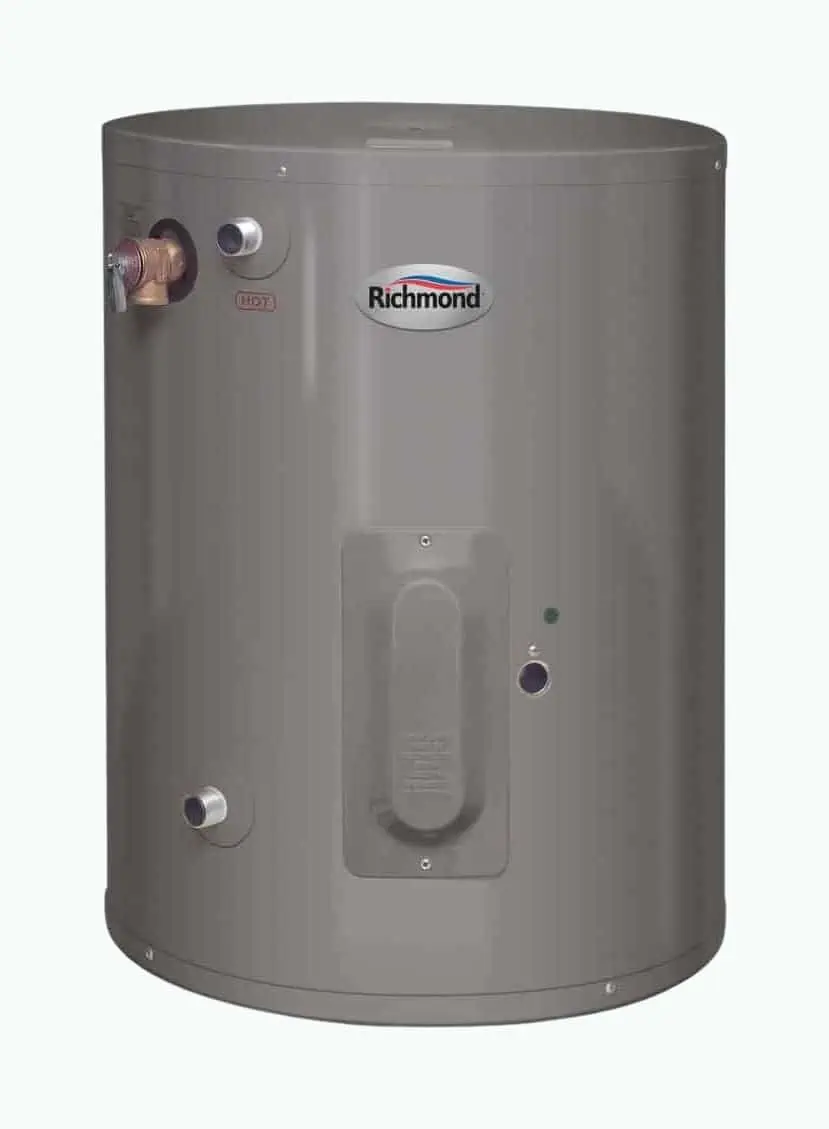
For Richmond’s best electric water heater we chose its space-saving, point-of-use unit. With a 15-gallon tank, this is great for providing hot water to one outlet such as the kitchen or bathroom sink.
Richmond outfitted the water heater with a 2,000-watt heating element. It also has a pre-installed temperature and pressure relief valve. An automatic thermostat ensures the temperature stays exactly as you need it.
This unit also includes some additional useful features. One of these is the over-temperature protector which automatically shuts off the power if the temperature rises excessively.
Richmond didn’t exclude this heater from a signature glass-lined tank. It’s constructed with a specially formulated lining, preventing corrosion and rust. This extends the service life of the unit.
This heater meets, and exceeds, the requirements of the National Appliance Energy Conservation Act (NAECA). It also includes a six-year warranty on the tank and parts.
Richmond claims it designed this unit as a simple replacement for an old heater. As such, you will need a 120-volt electrical source and a sturdy wall to mount it on.
Pros
- Excellent for point-of-use application.
- Fitted with a pre-installed automatic thermostat.
- Features an over-temperature protector.
- Meets the NAECA requirements.
Cons
- Some users complained that no light or other indicator shows when the unit is active.
Product Specs
| Tank capacity | 15 gallons |
| Fuel type | Electric |
| Max. temperature | 150 degrees Fahrenheit |
| Weight | 54 pounds |
| Measurements | 24.25 inches by 17.75 inches by 17.75 inches |
Our Ratings
Personal Perspective
Solar Richmond Universal Connect Water Heater
Best Richmond Solar Water Heater
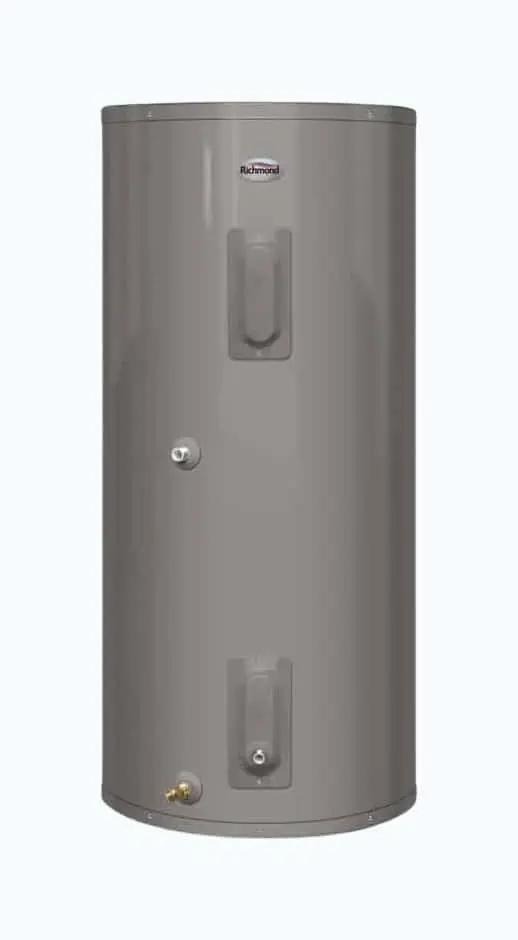
This is Richmond’s universal connect solar water heater. The heater features multi-port electrical connections that you can use as a backup in case the sun is hidden. It is a suitable water heater for households of five to seven people.
The unit consists of an 80-gallon tank and is compatible with single and double collector closed-loop glycol systems. It is intended as a replacement unit for a previous solar heater. There are multiple connection ports on the top and both sides, allowing for easier installation.
The tank is also quite easy to maintain. It is constructed with the company’s standard glass-lined material as well as durable brass drain valves. It’s resistant to rust and corrosion and should have a long lifespan.
It is also quite efficient. As the cold water enters the storage tank, it is forced to the bottom. This encourages minimal influence on the already heated water, ensuring that less energy is used.
Similar to the brand’s electric water heaters, this one also features an over-temperature protector. Richmond includes a six-year warranty.
Pros
- Suitable for a five to seven people household.
- Fitted with multi-port electric connections.
- Constructed with glass lining and durable brass.
- Features an over-temperature protector.
Cons
- There is no resistor included but the unit is prewired for one.
Product Specs
| Tank capacity | 80 gallons |
| Fuel type | Electric/Solar |
| Max. temperature | 140 degrees Fahrenheit |
| Weight | 192 pounds |
| Measurements | 58.75 inches by 24.5 inches by 24.5 inches |
Our Ratings
Community Feedback
| Product | Award | Tank capacity | Fuel type | Max. temp | Weight | Measurements |
|---|---|---|---|---|---|---|
| Richmond Short Natural Gas | Best Gas Water Heater | 48 gal | Natural gas | 160 F | 175 lbs | 51.25″ x 23.75″ x 23.75″ |
| Richmond Electric Point-of-Use | Best Electric Water Heater | 15 gal | Electric | 150 F | 54 lbs | 24.25″ x 17.75″ x 17.75″ |
| Solar Richmond Universal | Best Solar Water Heater | 80 gal | Electric/Solar | 140 | 192 lbs | 58.75″ x 24.5″ x 24.5″ |
Why Choose Richmond?
Richmond water heaters are manufactured by Rheem, so you can be confident that the company’s heaters will have high-quality construction and materials.
There are several smart design features on most of Richmond’s models. These are designed to provide maximum efficiency while also protecting the tank.
Where to Buy Richmond Water Heaters
You can buy Richmond water heaters via local distributors. You can also buy their products from Home Depot, where you can find some great deals.
Which Richmond Water Heater Is Best for You?
Gas/Propane
Richmond has a small line of gas-powered water heaters. These include the Encore, Essential, and Essential Plus series.
Gas and propane-fueled water heaters are often said to be the most efficient types. However, their Uniform Energy Factor (UEF) is lower than electric heaters. They do run at a significantly lower cost over time than their tankless electric counterparts.
When it comes to gas-powered heaters, Richmond emphasizes longevity and efficiency. Their longest warranties last up to 12 years.
All their lines boast durable foam insulation and other useful features to minimize heat loss and extend the service life of each product.
Some other benefits of their gas-powered heaters include a low emission burner design and easy maintenance. The units don’t have filters, which means less cleaning. If something does go wrong, they use standardized parts that are easy to replace.
Most also have Richmond’s signature feature, EverKleen, which is a self-cleaning system. It combats the build-up of sediment and lime, prolonging service life. All 12-year warranty models have heat traps that prevent heat loss, reducing operating costs.
Richmond’s gas-powered water heaters are great for households that are looking to cut down on water heating expenditure.
Electric
Richmond’s range of electric water heaters contains four different lines: Encore, Essential, Essential Plus, and Marathon. Electric heaters are common in homes and usually have a higher UEF than gas-powered units.
They also tend to have tougher requirements for Energy Star and LEED compliance. Even so, that doesn’t mean they aren’t energy efficient. Most of Richmond’s electric heaters operate at a lower cost while decreasing your carbon footprint.
Richmond’s electric series, like their gas-powered units, have a variety of different features, including the EverKleen system. They also have stainless steel “Lifeguard” heating elements. These are said to be more efficient and last longer, while reducing the risk of a dry-fire burnout.
All their units feature Richmond’s signature 2-inch foam insulation and durable construction. Warranties can last up to 12 years, depending on the size of the boiler
Richmond’s electric water heaters are perfect for households trying to reduce their impact on the environment. If you don’t have preinstalled vents and gas pipes, electricity is the way to go.
Keep in mind that an electric heater’s performance could decrease in colder regions. You can counter this by choosing a more powerful unit.
Solar
Richmond has stayed innovative when it comes to the solar market. The company currently offers two different solar models: the Solaraide HE and Solpak systems.
These two models are designed to target different buyers. The Solaraide HE is for the homeowner who already has a pre-installed residential direct solar system. The product includes resistor heating elements with a capacity of 4500 watts that are highly efficient.
The Solpak system is a complete package for homeowners without previous experience in the solar market. It includes double collector systems, a multi-speed pump, a storage tank, a thermal expansion tank, a controller, and a glycol solution.
To ensure you still have hot water on overcast days, the Solpak also includes a 4500-watt heating element.
About Richmond
Richmond is a subsidiary of Rheem, established in 1983. As such, all Richmond water heaters are manufactured by Rheem. This also means the quality of Richmond’s build is among the industry’s best (1).
Richmond focuses on making water heaters that will be able to keep up with a high demand for hot water.
While Richmond water heaters are manufactured by Rheem, Richmond is more than just a name. The brand is continually developing new features for its water heater systems:
- EverKleen: This is a self-cleaning system that helps prevent the buildup of limescale and other negative influences. It helps to extend tank life and maintain maximum efficiency. The system runs water through an inlet tube which makes the water spiral through the tank, preventing sediments from settling.
- Fast recovery: The system helps replace used hot water much faster compared to models without this feature.
- High-temperature dip tube: The dip tube delivers the cold water to the bottom of the tank before it gets heated. All Richmond units feature an extra durable dip tube that meets the strictest plumbing codes.
- Porcelain tank protection: All Richmond tanks are created using a durable porcelain lining. The porcelain lining further prolongs the tank’s life.
- Rigid foam insulation: Richmond units feature strong insulation to reduce standby heat loss. The 12-year models also have pipe insulation.
- Lifeguard: These are stainless steel heating elements included with the 9 and 12-year units. The elements are resistant to sediment buildup as well as dry-fire burn-out.
Richmond Water Heater Customer Service
All the contact information you need is on Richmond’s official website. There is also a form you can fill out if you have a comment, question or complaint (2). Overall, Richmond customers are very pleased with the quality and functionality of the units.
However, one recurring complaint was units arriving with dents in the tank. This might just be transport damage and not due to the manufacturing process. In any case, Richmond was quick to replace any such unit.
FAQs

Who Makes Richmond Water Heaters?
Richmond is a subsidiary of Rheem, one of the leading names in water heaters. Rheem manufactures Richmond’s heaters, ensuring they meet very high standards in both materials and construction. Richmond’s heaters are not identical to Rheem’s, as they have different designs, but Richmond benefits from Rheem’s vast experience in heater manufacturing.

Is Richmond as Good as Rheem?
As Rheem manufactures both their own heaters and Richmond’s, there is not much difference in their manufacturing quality. The two brands have different focuses, making them each suitable for different purposes. Richmond’s priority is on developing heaters that can provide hot water for larger residential properties, such as those with five or more people. If you live in such a household, Richmond might be the ideal choice.

How Long Do Richmond Water Heaters Last?
Longevity is a major focus of Richmond’s heater design, something that is supported by their generous warranties. The company offers six-year warranties on many products, which is a standard length for heaters, but they also go far beyond this in other cases. Many of their heaters are protected by a 12-year warranty. Their non-metallic electric Marathon water heaters are protected by a lifetime warranty, which is very rare.

Where is Richmond Hot Water Heaters Made?
Richmond Water Heaters are made in facilities across the southeast U.S., California, Mexico, Canada, and Australia.
Rheem Manufacturing Company is responsible for producing both gas and electric water heaters under the Richmond brand name. They are manufactured for usage in both business and residential settings.

Do Richmond Water Heaters Have Anode Rods?
Yes, Richmond water heaters have anode rods that may be found at the very top of the tank.
When looking at the front of your water heater, the aluminum and magnesium sacrificial anode will be behind the vent pipe on the opposite side of the appliance. Please see the owner’s manual that came with your water heater for further information.

How Do You Adjust a Richmond Water Heater?
To adjust a Richmond water heater, you must adjust its thermostat. Turn the power to the heater off first. Take off the two screws securing the upper cover to the water heater tank’s side. To access the thermostat, you need to move the insulation out of the way.
Using a little screwdriver with a flat head, turn the temperature knob until it reaches the required temperature. Simply replace the lid or covers, and then use the screws that were previously removed to attach them. Bring the water heater back online with the power.
Summing It Up
Richmond might be a branch of Rheem but, over the years, it has excelled in its own right. They continue to add new features to improve the user experience and to help their customers save more energy. Several of their units have earned an Energy Star, so their hard work is paying off.
Today, there are numerous Richmond water heaters you can choose from, including the Encore hybrid range and solar models.