Hard water is far more widespread than you might realize. In fact, about 85% of homes in the United States receive a water supply that contains large amounts of minerals such as calcium and magnesium (1).
Given how common hard water is, it is likely that you will need to use it at some point if you are traveling in an RV. You can minimize the effects of hard water by using a portable water softener designed for RV use, but you might not know what to look for if this is your first time buying one.
To help you find your ideal model, we have reviewed what we consider the best portable RV water softeners available today. We chose these products based on their size, type, and required maintenance.
- Uses garden hose connectors
- 22-inch height
- Carry handle
- Removes heavy metals
- Reinforced plastic tank
- Durable nylon fittings
- Double filtration
- Stable metal stand
- Weighs just 17 pounds
- 19.5 inches tall
- 15-minute regeneration
- Includes hose & fittings
- Intermediate size
- Low maintenance
- 4 GPM flow rate
Review Methodology: At Sensible Digs, we understand the importance of quality evaluation and hands-on experience when recommending the best portable RV water softeners. Our professional team conducts thorough research, employs rigorous benchmarks and criteria, and utilizes quantifiable data to measure performance, compare features, and rank products. We delve into key decision-making factors such as efficiency, capacity, regeneration process, and ease of installation, among others. Our analysis not only tracks the products’ results but also evaluates design choices and their effect on users. We strive to provide objective reviews, backed by facts and evidence, to help you make the most informed choice about your RV water softener needs.
Best Portable RV Water Softeners of 2024
As water softening technology has been refined, it has allowed smaller units to be created. This means there are now more softeners that will fit into your RV than ever before. After conducting extensive research, we have reviewed our five favorite portable RV water softeners available today.
On The Go 16,000-Grain Portable Water Softener
Best 16,000-Grain Softener
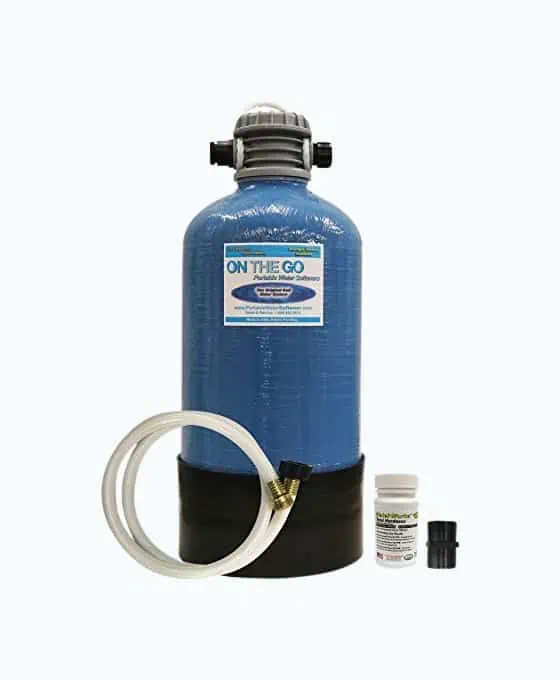
The compact design of this water softener from On The Go means it is ideal for the limited space available in an RV. Despite being relatively small, this top-rated unit can soften twice as much water as similar products, in the same amount of time.
Setting up the water softener is a simple process as it uses standard garden hose connections. It also includes a few intuitive design features to make it even easier to transport and prepare.
What We Like
Easy Setup
Preparing this powerful softener is very straightforward. Simply connect one end to your water source and the other to your RV’s mainline as you fill the tank.
Each of this unit’s hoses uses garden hose connections, so it is easy to connect and disconnect without requiring any tools. The box contains everything you need, including the hose and adapters.
Compact Design
If you are a keen RV user, you know that space is at a premium. Measuring just 22 inches in height and 9.50 inches in diameter, this water softener is compact and easy to store.
As it will occupy about the same amount of space as a suitcase, this softener can easily be kept in your RV’s storage bay or dockside locker.
Design Features
It’s clear that special care has been given to the physical design of this unit. Its extra features include a carry handle at the top and a large opening to allow you to add salt more easily.
Inside the tank, there are high-grade premium resins that effectively exchange hardness ions for salt ions. The top of the tank swivels 360 degrees to allow it to face any inlet hose.
The tank can be fitted with a cap and plug to prevent spills as you drive on uneven roads. This keeps the lid on securely and ensures there are no leaks.
Efficient
On The Go claims this water softener will provide 40% more soft water than standard models. Adding two boxes of regular table salt will generate soft water in less than 30 minutes. It will give you up to 1,600 gallons of soft water and will last up to 40 days.
What We Don't Like
Heavy
At 32 pounds, this water softener will be too heavy for some people to carry. It will also add to your RV’s overall load and could be too much if it is already carrying a lot of weight.
Product Specs
| Capacity | 16,000 grains |
| Flow Rate | Not specified |
| Dimensions | 22 x 9.5 inches |
| Weight | 32 pounds |
| Salt Required | Two boxes of table salt |
Our Ratings
User Experience
Mobile-Soft-Water Portable 16,000 Grain Tank
Best Tank Softener
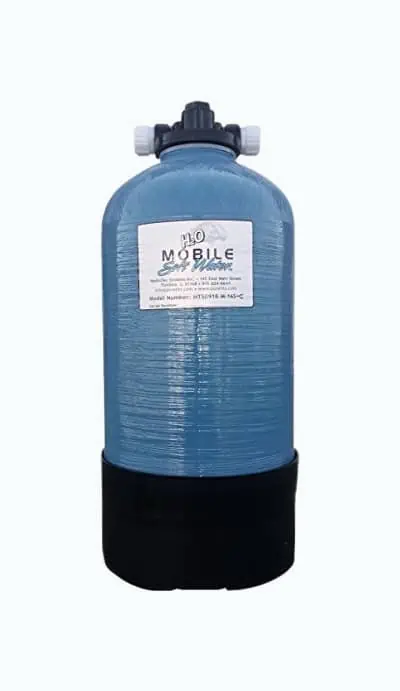
The Mobile-Soft-Water tank is a favorite of many RVers as it not only softens water but also removes contaminants. It connects easily to an RV tank and its water source using garden hose connections.
This top-rated model features a reinforced vessel that is designed to withstand high pressure. The compact design is easy to store in an RV alongside your other travel items. This product contains everything you need to set it up, including a detailed manual to walk you through the process.
The manufacturer states that this unit will effectively soften up to 1,600 gallons of water due to it being filled with high-quality resin.
What We Like
Removes Contaminants
In addition to removing minerals, this water softener also eliminates contaminants. Impurities such as lead and other heavy metals pose a significant health hazard if present in your water supply (2). These contaminants can be found in both well and municipal water, so it is always good to have a way to remove them (3).
Heavy-Duty Tank
The tank is made of plastic reinforced with fiberglass, enabling it to withstand high pressure (4). The vessel also provides a high water flow rate of up to 5 GPM (gallons per minute) — so you won’t have to wait hours to fill your tank with softened water.
Compact
At just 9.2 inches in diameter and 21.6 inches tall, this softener is an excellent size for RVs. It will fit comfortably into a storage unit or cabinet without needing to remove other items to accommodate it.
Sturdy Fittings
This softener is sturdy even when water pressure builds, as it is equipped with male nylon fittings. Nylon fittings are durable and can withstand high pressure, which ensures no damage is done when you refill your tank.
As this softener uses nylon fittings, you can be confident that it is free of lead and other contaminants. In fact, this tank has been certified by the NSF as lead-free.
What We Don't Like
Doesn’t Include All Necessary Parts
This product doesn’t include every part required to install it, such as a hose. This means you will need to source a hose from elsewhere and ensure that it can be connected to the softener.
Product Specs
| Capacity | 16,000 grains |
| Flow Rate | 5 GPM |
| Dimensions | 9.2 x 9.2 x 21.6 inches |
| Weight | 33 pounds |
| Salt Required | Two boxes of table salt |
Our Ratings
Personal Perspective
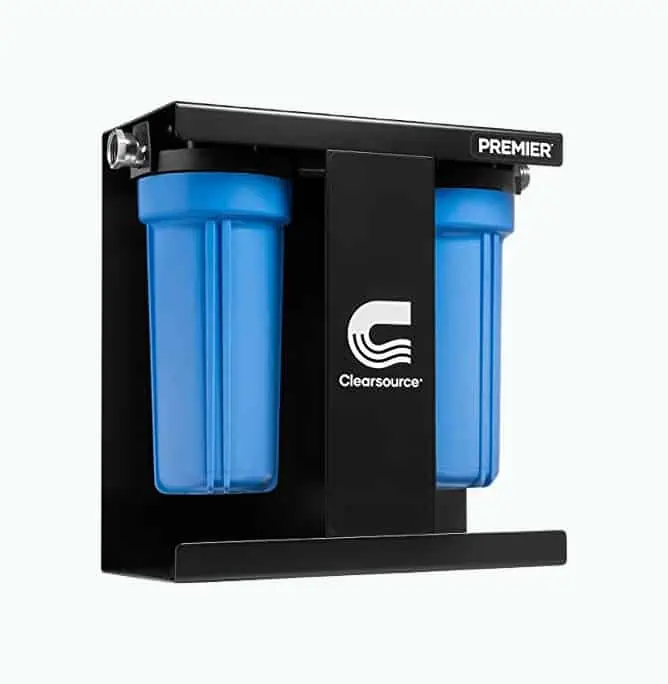
ClearSource Premium RV Water Filter
Best Hard Water Filter
If you want to soften your water and remove various contaminants, this ClearSource unit is an excellent option. It will effectively remove sediment, as well as chemicals and other impurities.
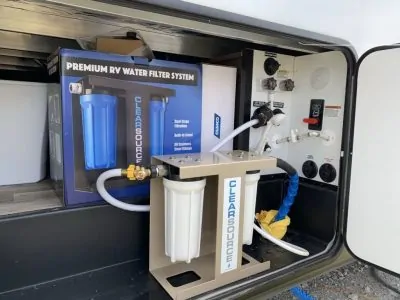
ClearSource’s water filter was featured in TrailerLife Magazine’s 2018 “Essential Equipment for RV Camping” guide. The system consists of two filters with different pore sizes to remove numerous contaminants. To prevent any spills or other issues, the two filters are supplied with a metal chassis that keeps them stable on the ground.
What We Like
Double Filtration
The water will be purified more effectively thanks to the unit’s two filters. It first flows through a 5.0-micron filter that removes sediment such as calcium, iron, and magnesium. Next, the water passes through a tiny 0.5-micron filter; this removes chemicals and volatile organic compounds.
This dual filtration process results in water that is far cleaner than standard water filters. Many campers prefer not to drink tap water from their RV but, as this filter system is so thorough, you can be confident that your water will be safe.
Stable Stand
To protect the filters and your RV, this ClearSource unit features a sturdy, powder-coated metal chassis. This keeps the filters stable as water passes through them. It is easy to attach the filters to the frame using the included tool.
Small and Lightweight
This unit is lighter than you might expect as it doesn’t hold a full tank of resin beads. This makes it even more versatile for campers who enjoy clean, soft water while on the road.
The two filters weigh about 17 pounds, which is far less than resin tanks that are usually close to or over 30 pounds. In addition, the compact size makes it easy to store anywhere inside your camper or RV.
Durable fittings
The filters are equipped with stainless steel fittings that are durable and can withstand great pressure (5). This means you can easily connect the filters to the RV and water source without worrying about damaging the unit.
What We Don't Like
Not as Effective
This filter will remove a significant amount of sediment and scale from your water. However, it is less effective than a resin tank.
Resin tanks use the same technique as an ion exchange system, which replaces hardness ions with salt ions. This eliminates any trace of hard water. As this is a filter, it will only reduce the symptoms of hard water, such as limescale and dry skin.
Product Specs
| Capacity | N/A |
| Flow Rate | Not specified |
| Dimensions | 15 x 7 x 14 inches |
| Weight | 17 pounds |
| Salt Required | N/A |
Our Ratings
Community Feedback
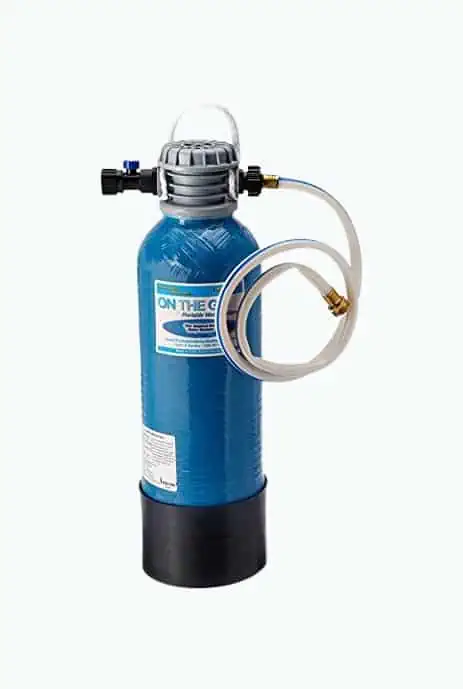
On The Go OTG3NTP3M Water Softener
Best RV Softener For Campers
This On The Go water softener is a great option for campers, as it is even more compact than standard RV softeners. With a similar design to the leading 16,000-grain On The Go model but half the capacity, this is a softener that you can take almost anywhere.
Despite being very compact, its 8,000-grain capacity will still be enough for a couple of travelers or a small family.
Its smaller size also has other benefits, as it will regenerate more quickly. You also won’t need as much salt to recharge the system.
What We Like
Compact
Measuring just 7 x 19.5 x 7.3 inches, this water softener is one of the most portable models we have seen. You can easily store it anywhere in your RV or camper without it occupying much space.
The softener weighs about 18 pounds, so it won’t make much of a difference to your overall load.
Quick Regeneration
Regenerating a water softener can take a long time. However, as this model is smaller than average, it will be ready in about 15 minutes. You won’t need to add more than one box of regular table salt.
All Parts Included
A major benefit of this product is that it comes with every part you will need. This includes a hose and the correct fittings, so there will be no need to make any additional purchases.
What We Don't Like
Low Water Flow
Compared to larger units, this camper water softener has a significantly reduced water flow rate. This means it will take longer to fill a large RV tank.
Consider this softener if you don’t anticipate needing a large volume of water. If you think the reduced flow rate will be a problem, you should choose the 16,000-grain model instead.
Product Specs
| Capacity | 8,000 grains |
| Flow Rate | Not specified |
| Dimensions | 6.75 x 22 inches |
| Weight | 18 pounds |
| Salt Required | One box of table salt |
Our Ratings
First-Hand Impression
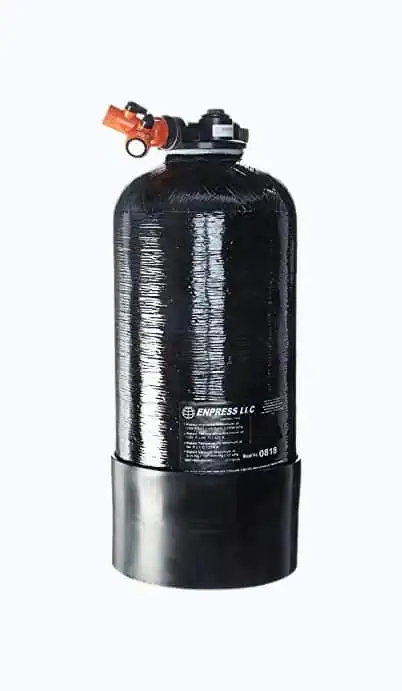
Watts Water Quality/Condition Softener
Best 10,000-Grain Water Softener
If you want a water softener that strikes a good balance between capacity and compactness, this Watts unit is ideal. Its capacity of 10,000 grains places it between the other models we have featured in our other RV water softener reviews.
One standout feature of this unit is its high water flow rate of 4 gallons per minute. There is also a built-in drain line flow restrictor. This significantly increases the unit’s regeneration capacity.
The tank has a wide base to ensure it stays stable on the ground as you fill it with water.
What We Like
Excellent Size
If you want an RV water softener system that isn’t too big or small, this softener is a great option. It has a compact, lightweight tank that will fit easily into an RV.
Low Maintenance
This unit is very low maintenance. It doesn’t require rinsing or cleaning; your only maintenance task is to fill it with salt when it needs to be regenerated.
High Flow Rate
Filling your RV tank via a water softener can be a slow process. Some units are also prone to damage as they are unable to withstand high pressure or water flow. Thankfully, this softener provides a flow rate of up to 4 GPM, so it won’t take long to fill your RV tank.
What We Don't Like
Leaks
Some customer reviews mention leaks around the unit’s connectors. One way to overcome this is by using different connectors to ensure they are watertight.
Product Specs
| Capacity | 10,000 grains |
| Flow Rate | 4 GPM |
| Dimensions | 22 x 10 x 10 inches |
| Weight | 9 pounds |
| Salt Required | Not specified |
Our Ratings
User Experience
| Product | Best | Capacity | Flow Rate | Dimensions | Weight | Salt Required |
|---|---|---|---|---|---|---|
| On The Go RV Water Softener | 16,000-Grain Softener | 16,000 grains | N/A | 22″ x 9.5″ | 32 lbs | Two boxes of table salt |
| Mobile-Soft-Water Portable Tank | Tank Softener | 16,000 grains | 5 GPM | 9.2″ x 9.2″ x 21.6″ | 33 lbs | Two boxes of table salt |
| ClearSource RV Water Filter | Hard Water Filter | N/A | N/A | 15″ x 7″ x 14″ | 17 lbs | N/A |
| On The Go Portable Water Softener | RV Softener For Campers | 8,000 grains | N/A | 6.75″ x 22″ | 18 lbs | One box of table salt |
| Watts Water M7002 Softener | 10,000-Grain Water Softener | 10,000 grains | 4 GPM | 22″ x 10″ x 10″ | 9 lbs | N/A |
Why Use an RV Water Softener?
A portable water softener for your RV is an excellent way to combat hard water issues while on the road. These units are easy to set up and usually don’t even require any tools.
The most common water softeners for RVs are salt-based units. These work similarly to ion-exchange systems but only have one tank.
Having a water softener aboard your RV is useful for more than just drinking and cooking. It will also provide soft water to clean your vehicle, without creating white mineral deposits when the water dries (6).
Soap doesn’t lather as well in hard water because the calcium reacts with it, creating soap scum (7). This means softening your water will allow you to enjoy more relaxing and effective showers while on vacation.
Choosing the Best Portable RV Water Softener
Finding a water softener for your RV is more complicated than choosing one for your home. Even if you have a small home, there will usually be considerably less space in an RV or camper. You also need to think about the extra weight that a softener adds to the RV, especially if you take a lot with you on trips.
Here are some key points to consider when looking for an RV softener:

Size and Weight
The size and weight of the water softener are the critical factors when searching for a unit. You will have a limited amount of space in your RV and, depending on how many people you are traveling with, a large softener might be unnecessary anyway.
Consider how many people you will travel with and how much water you are likely to drink, use for cooking, and clean yourselves with. This will give you a better estimate of how large the unit should be.
Keep In Mind

Type of RV Water Softener
You have a few types of RV water softeners to choose from. The most popular and effective systems are portable ion exchange softeners. Other types include magnetic, electronic, and filtration softeners, but these are less common in RVs.
- Ion-exchange: Residential ion-exchange systems normally consist of two tanks: resin and brine. However, portable systems only have one tank and are installed between the water source and your RV. As you fill your freshwater tank, the water will run through the resin tank, and hardness ions will be exchanged with salt ions (9).
- Electric and magnetic: These systems are salt-free. They use electrical currents or magnetic forces to alter the molecular structure of the hard water. This results in the molecules being unable to attach themselves to any surfaces, thus they are unable to create scale.
- Filters: Many people choose to soften RV water using a filter. Although this is less effective than using a softener, it can still remove a significant amount of minerals. A major benefit of filters is that they will also remove contaminants such as metals and chemicals (10).

Easy Regeneration
Regenerating a water softener is a process that occurs when you refill it with salt. The system will require a certain amount of time to regenerate — or recharge — after a refill.
How long it takes a softener to regenerate depends on the size of the unit and the amount of salt added (11). A large unit (16,000 grains) can take about 30 minutes, whereas a small softener (8,000 grains) could be ready in 15 minutes.
You should also look for a large mouth opening. This will make it much easier to access when regeneration is needed. It should also be easy to open and close, and shouldn’t require any disassembly.
FAQs
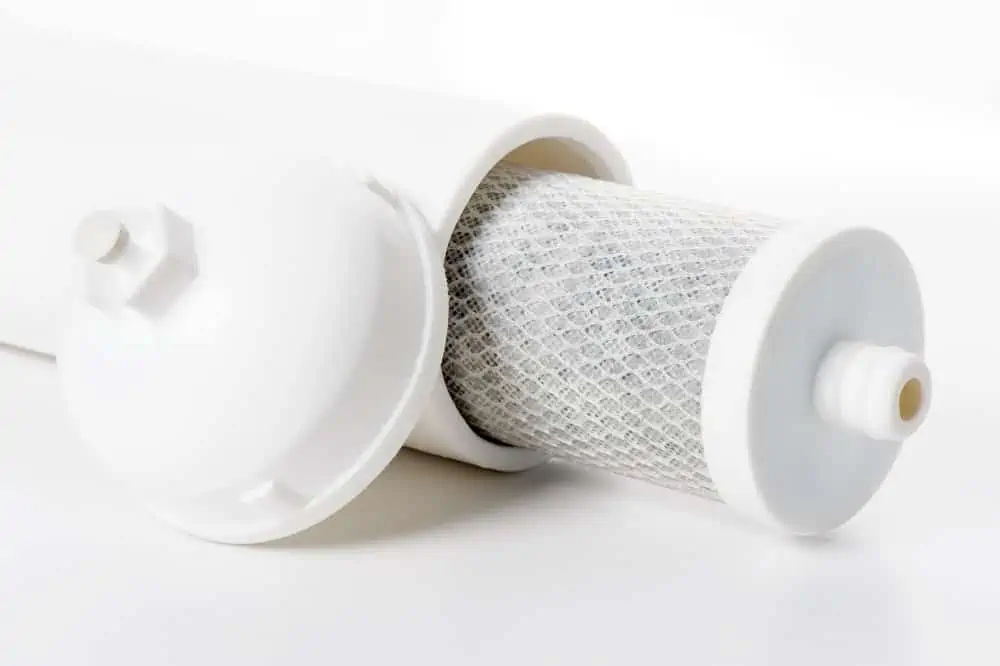
Do RV Water Filters Help with Hard Water?
RV water filters will remove sediment, but if you’re dealing with hard water, you might want to consider an RV water softener. Drinking water filtered by even the best RV water filters may not be completely free of all contaminants.
It is important to note that the type of water supply you use will determine whether or not this function is required of your recreational vehicle filter. However, there are RV water filters that do both.

How Long Do RV Water Softeners Last?
A portable water softener for RVs can last between five and 15 years. The lifespan depends on how much water has to filter and the hardness of the water in question.

How Often Do You Add Salt to an RV Water Softener?
This usually depends on the quality of the water softener. Still, newer models require adding salt once every six to eight weeks.

What Is the Best Water Softener for an RV?
The On The Go OTG3NTP3M Portable Water Softener goes a long way toward guaranteeing that you have ready access to soft water consistently. Also, it comes with a handful of characteristics that will make it worthwhile to consider purchasing this device.
The design of this product has been meticulously developed with one specific objective in mind: to deliver a water softener that’s easy to operate.
Despite its low weight, it can provide a sufficient supply of soft water for anywhere between one and two weeks. That’s a solid 300 to 700 gallons of water on a single charge.