Have you ever seen your car in full sunlight only to discover infinite scratches and imperfections? If they annoy you, it’s time for some paint correction.
But how much is it going to set you back? If you take the car to a professional, paint correction costs can be pretty expensive, but it should be worth every penny. Keep reading for an in-depth assessment.
Key Takeaways
- Paint correction cost ranges from $500 to $2500, depending on factors like car condition, size, and detailer’s experience.
- There are three stages of paint correction: Stage 1 for minor flaws ($400), Stage 2 for swirl marks and mild scratches ($600), and Stage 3 for extensive scratches and swirls ($900).
- DIY paint correction costs between $65 and $120 for supplies if you have essential tools, but can go up to $1000 if you invest in premium equipment.
- Professional paint correction can increase your car’s resale value, extend paint lifespan, and improve its appearance, but it may not fix severe damage or rust issues.
What is Paint Correction?
Paint correction is the process of physically removing swirl marks, flaws, and scratches from the paintwork to produce a gloss comparable to that of a mirror.
It entails carefully rubbing away the fine, uppermost layer of clear coat on a vehicle’s paintwork, leaving the paintwork spotless after the process is complete.
Sadly, paint correction isn’t always the best solution, so here is what you should know:
- You need to remove rust before attempting paint correction.
- Paint correction works for scratches and nicks.
- It can take care of small dents, but not large ones that need more repairs first.
- Severely cracked paint can’t be corrected and might need a new paint job.
Paint Correction Before and After
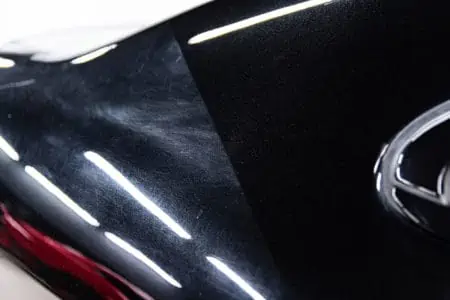
A great way to determine if a paint correction is worth it is by looking exactly at what it can achieve. Here is a before and after example of a black vehicle, just to give you an idea of the results.
How Much Does Paint Correction Cost?
It depends on whether you do the job yourself or turn to a professional detailer. For professional work, you can expect to pay between $400 and $2,500, an average of $1,500.
Breakdown of Costs
Take all of this into consideration before proceeding with any paint correction project.
Labor
When hiring a professional, you may expect to pay approximately the same amount, if not less, for the materials.
On the other hand, they have a lot more expenses for running the business than you have at home. The labor charge will make up the vast majority of your total bill. The labor fee at most detailing shops ranges from $20 to $30 per hour.
A perk of going to the pros is that the price of paint restoration frequently includes a comprehensive cleaning of the inside. Who doesn’t want to walk away with a car that’s spick and span?
Before you get out of the car, ensure you have all the information you need and are familiar with what to anticipate.
Materials
Not all paint correction jobs cost the same because different workshops may use different materials. Detailers don’t always use the same brand of polisher, and some are more expensive than others. Let’s exemplify with an essential piece of equipment for peeling off the topmost layer of paint.
A tiny automobile buffing tool can be purchased for between $35 and $50, making it an affordable option. But you do have the option of buying a powerful buffer, which can cost more than 200 dollars.
Factors Affecting Paint Correction Costs
These can vastly alter the end cost. So, keep them all in mind when setting a budget.
Size of Vehicle
A huge car that needs significant maintenance will also have a significant price tag. Your bill for paint correction will not be as large for a small car with very few imperfections.
The average cost for each square foot of your car is between $0.65 and $1.20 for a DIY job. It’s between $2 and $10 per square foot of paint correction if done by a professional.
Condition of Vehicle
Naturally, the amount of damage or corrections that need to be made will influence the end price of the paint correction. For instance, cars with rust or heavy dents will require rust-removal or damage repair before the paint correction.
Detailer’s Experience
The detailer’s experience goes hand-in-hand with what you expect the result to look like. If you want a car that looks brand new, you need to turn to an experienced dealer. Naturally, this will cost you more than a light paint correction job that any detailer can handle.
Paint Correction Cost Per Stage
It’s not as simple as it may seem. There are several factors and stages to completing a project like this.
Stage 1 Paint Correction Cost
Paint in reasonably good condition but with tiny flaws may be corrected using a stage 1 paint correction process. This is also referred to as single-stage paint enhancement, meaning the work can be completed in one step.
The process involves using a finishing polish and a finishing pad, and is completed with wax or paint sealant to preserve the paint’s appearance. On average, this process takes roughly four hours and will usually cost around $400.
Stage 2 Paint Correction Cost
Vehicles with swirl marks and/or mild scratches need a stage 2 paint correction process. This requires using two different mixes of polish and pad.
The imperfections in the paint are first removed using an abrasive polish. To refine the paintwork, professionals use a finishing polish and a pad. Once again, a paint sealer or wax is applied on top of it for more protection.
On average, this can take roughly eight hours to complete and will cost around $600.
Stage 3 Paint Correction Cost
Vehicles with extensive scratches and swirls require turning to stage 3 paint correction.
The first thing done in stage 3 correction is eliminating imperfections using a heavy cutting compound and a pad. If there are deep scratches, this may require wet-sanding certain areas. After that, a finishing polish and pad are used to enhance the surface, and finally, wax or sealer is applied.
These corrections can take up to 12 hours, and you can expect to pay around $900.
DIY vs. Hiring a Professional
How much is paint correction? It depends on whether you’re doing it on your own or taking the car to a professional.
The total cost of your paint correction supplies will range from $65 to $120 if you already have the essential tools and equipment needed.
The total price will go up if you choose to use any of the optional supplies or invest in a premium buffer. If you go all out with your paint correction mission, you can spend up to $1,000.
If you’re particularly picky about how the outside of your vehicle looks, you might want to consider having a reputable automotive technician repair your vehicle’s paint.
Make sure you spend some time looking after your car’s exterior to keep the paint in good condition after investing money in a high-end paint correction.
How Long Does Paint Correction Last?
Paint correction does not merely cover up the dings and dents that are already there on your vehicle; rather, it eliminates them.
The paint treatment will remain effective until fresh scratches are made in the vehicle’s paint. Unfortunately, it’s impossible to predict when someone may hit your vehicle, scratch it, or drop something on it. If you take care of your car, the paint repair you had done could endure for five years or even longer.
Is a Paint Correction Worth It?
Drawing the line, is the paint correction cost worth it? The answer is subjective and requires a closer analysis of the advantages and drawbacks.
Longer Car Paint Lifespan
There are various things, such as exterior barriers and environmental conditions, that can put strain on a vehicle’s paint job.
People risk being scratched or dented by road debris daily, especially if they are involved in accidents or brush-ups. Because of this, your vehicle is more likely to sustain long-term harm from elements such as pollution and corrosion.
The paint on your vehicle will retain its luster for longer when you have it professionally corrected.
Higher Resale Value
Your vehicle’s worth will be affected proportionately. A dingy vehicle covered in scratches will not fetch the same price as one in pristine condition.
Can’t Do Wonders
Paint repair is a great way to improve the look of your vehicle, but it can’t solve all of your issues. When facing something more complex (like rust), you’ll have to repair it before attempting paint correction.
FAQs

Is it Worth Fixing Scratches on a Car?
Scratches on the paintwork of your vehicle generate points of weakness. Ignoring small damage or postponing the repair could result in the damage worsening to the point where it needs more extensive attention.
Your car’s paint protects the metal underneath from environmental factors such as precipitation, hail, and grime, which could otherwise degrade the metal’s quality.

What is the Cost to Ceramic Coat a Car?
Be prepared to pay between $1,500 and $1,700. The factors that influence the exact cost include the quality of the ceramic coating, the size, and the condition of your car.

How Easy is it to Do Paint Correction Yourself?
It is possible to fix paint by yourself if you use a microfiber pad, but doing so will take far more time and work than using an orbital buffer. In addition, producing the same results will be more difficult, albeit not impossible.
Bottom Line
It’s ultimately up to you to decide if paint correction costs are worth the expense.
Remember that paint correction isn’t always possible, as severely damaged cars require repairs before attempting to restore the paint. Sometimes, a new paint job might be the only solution to restore the color.