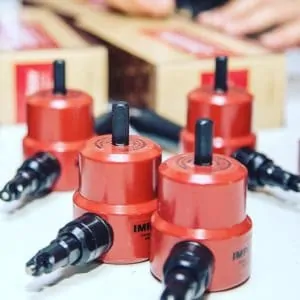
Many of you won’t be familiar with a sheet metal nibbler, but the best nibbler drill attachments make life a lot easier when it comes to cutting through sheet metal. For those creative types, or anyone looking to work in detail on sheet materials, this is the best tool to use.
We rundown the best nibbler drill attachments to see which is the best.
- High-speed steel
- 360-degree head
- Burr-free edge
- 14-gauge depth
- Cuts in any direction
- Burr-free edges
- Double heads
- Cuts straight & complex lines
- 114-inch diameter holes
- Cuts 360-degrees & complex curves
- Spare cutting head
- 5-piece set
- Fixed handle for better grip
- Cuts super-straight lines
- 1,200 cuts between blades
Review Methodology: At Sensible Digs, we apply a meticulous evaluation process to compare and rank the best nibbler drill attachments. Leveraging our hands-on experience and professional expertise, we conduct in-depth analysis and tests to measure the performance of each product. Our criteria consider key decision-making factors like functionality, durability, ease of use, and design. We provide a detailed assessment, backed by concrete data and first-hand findings. We highlight what sets each product apart in our reviews, helping you make an informed choice. Trust our results-driven research for a sensible approach to your drilling needs.
The Best Nibbler Drill Attachments of 2024
We have conducted a thorough search of the available nibbler drill attachments to bring you the pick of the crop. Here are our 5 best nibbler drill attachments.
Rexbeti Double Head Sheet Nibbler Cutter
Best Sheet Metal Nibbler Drill Attachment
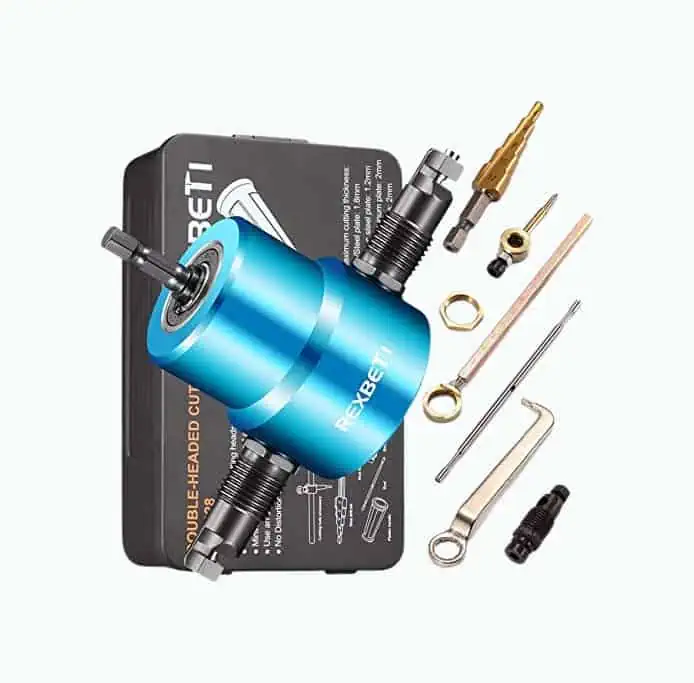
This Rexbeti nibbler attachment cuts 14-gauge sheet metal and leaves a clean, burr-free edge. It also has a 360-degree double cutting head to cut straight lines, curved lines and circles.
The high-speed steel cutting edge handles corrugated metal, pipes, plastic, formica, and complex profiles. It also cuts powder-coated metal, steel and copper.
This nibbler fits any drill that generates between 1,500 and 3,000 RPM, and it can cut holes to a diameter of just over 11 inches. It even comes with a stepped drill bit to get your pilot hole started.
This nibbler attachment also scores well with the online buying community. It has the highest favorable ratings on Amazon, which is one of the reasons we crowned this our best pick.
Pros
- High-speed steel.
- 360-degree head.
- Cuts 11.4-inch diameter holes.
- Works on almost all sheet metal.
- Burr-free edge.
Cons
- Straight edges are more difficult.
- Some filing may be required.
Product Specs
| Weight (pounds) | 2.2 |
| Dimensions (inches) | 7.6 x 4.6 x 2.3 |
| Double head | Yes |
| Diameter hole (inches) | 11.4 |
| Price | $$ |
| Warranty | 4-year home use |
Our Ratings
User Experience
Double Headed Sheet Metal Nibbler
Best Nibbler Drill Attachment for Car Repair
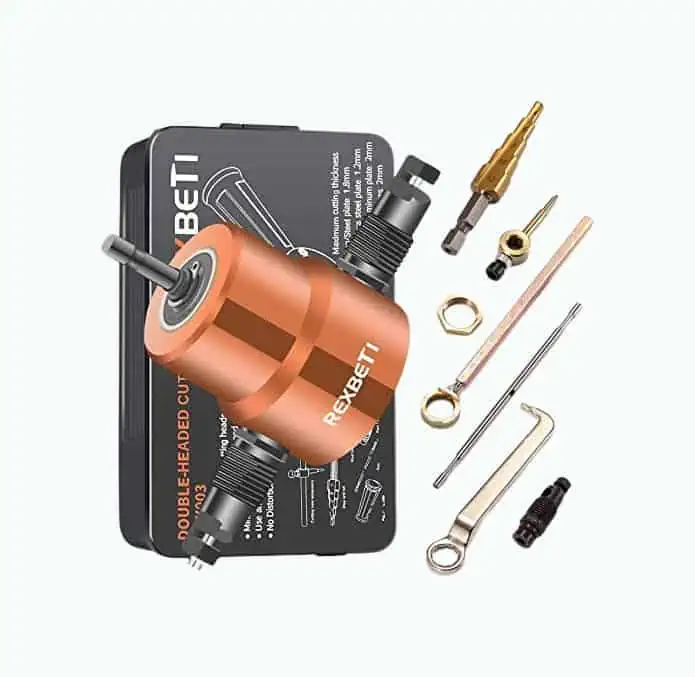
This nibbler fits any standard drill and can glide through metal up to 2 mm thick, or 14 gauge. It creates burr-free edges, saving time on aftercare and reworking, and it cuts in any direction. It cuts complex profiles, as well as circles and straight cuts.
It is effective when working with corrugated materials, pipes, sheet metal, plastic, stainless steel, fiberglass and copper.
Pros
- 14-gauge depth.
- Cuts in any direction.
- Great value for money.
- Burr-free edges.
Cons
- Dulls easily.
- Hard to get replacement parts.
Product Specs
| Weight (pounds) | 2.2 |
| Dimensions (inches) | 7.55 x 4.51 x 2.22 |
| Double head | Yes |
| Diameter hole (inches) | Not specified |
| Price | $ |
| Warranty | Not specified |
Our Ratings
Personal Perspective
Dicfeos Double Head Sheet Metal Nibbler
Best Double-Headed Nibbler Drill Attachment
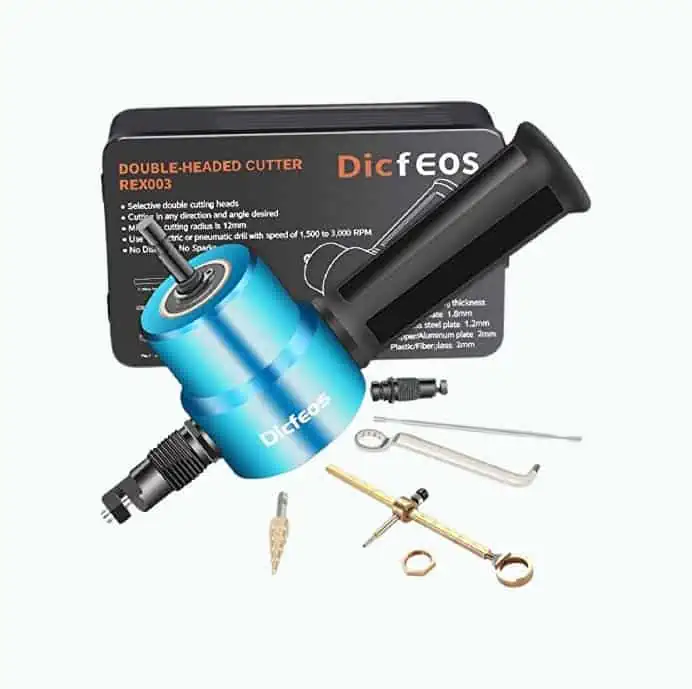
Like the Rexbeti, this drill nibbler works best with drills that produce an RPM of 1,500 to 3,000. It can cut in any direction, and for straight lines, you can even use the wrench as a guide.
This nibbler drill attachment is also excellent at making 11.4-inch diameter holes using the circular cutting accessories supplied with the tool. It has a spare cutting blade and a sturdy black handle that slots over the extra head to give you additional support when cutting.
It cuts 14-gauge sheet steel and a host of other metals, including gutters, pipes and corrugated sheet metal.
Pros
- Versatile.
- Double heads.
- Cuts straight and complex lines.
- 11.4-inch diameter holes.
Cons
- Some edges suffer burrs.
- Build quality issues.
Product Specs
| Weight (pounds) | 2 |
| Dimensions (inches) | 7 x 2 x 3.11 |
| Double head | Yes |
| Diameter hole (inches) | 11.4 |
| Price | $$ |
| Warranty | 2-year |
Our Ratings
Community Feedback
Lichamp Double Head Sheet Metal Nibbler
Best Nibbler Drill Attachment for Curves Cutting
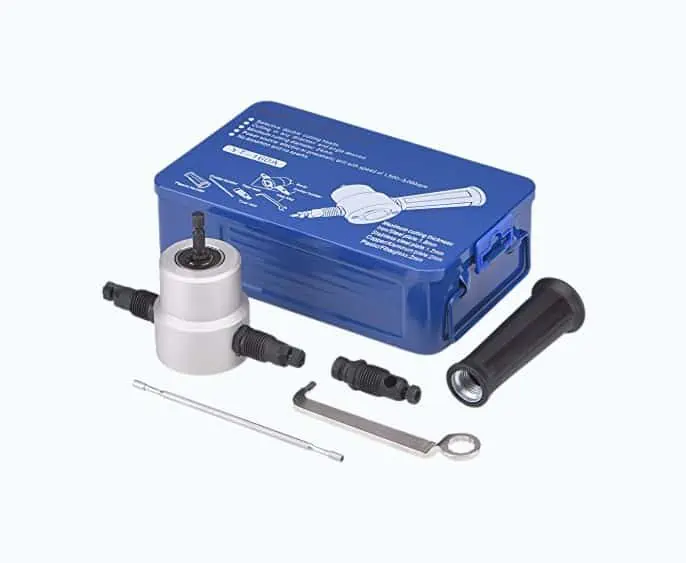
This 5-piece tool set comes with a wrench, a hole cutting attachment and spare blades. It even comes with a replacement cutting head. It cuts everything from 18-gauge stainless steel, 15-gauge steel plate and 14-gauge copper or aluminum plate.
It works well, cutting all manner of curves and circles, thanks to the accessories and the robust handle that slots on to the spare cutting head for extra grip. Like the others, it fits any standard drill that generates between 1,500 and 3,000 RPM.
What also stands out about this attachment nibbler is the price. It retails at less than others included on the list.
Pros
- Great price.
- Cuts 360-degrees and complex curves.
- Spare cutting head.
- 5-piece set.
Cons
- Feels cheaply made.
- Cutting blades dull quickly.
Product Specs
| Weight (pounds) | 2.11 |
| Dimensions (inches) | 8.86 x 2.56 x 4.92 |
| Double head | Yes |
| Diameter hole (inches) | Not stated |
| Price | $ |
| Warranty | 1-year |
Our Ratings
First-Hand Impression
CaNibbler Professional Nibbler
Best Nibbler Drill Attachment for Straight Cutting
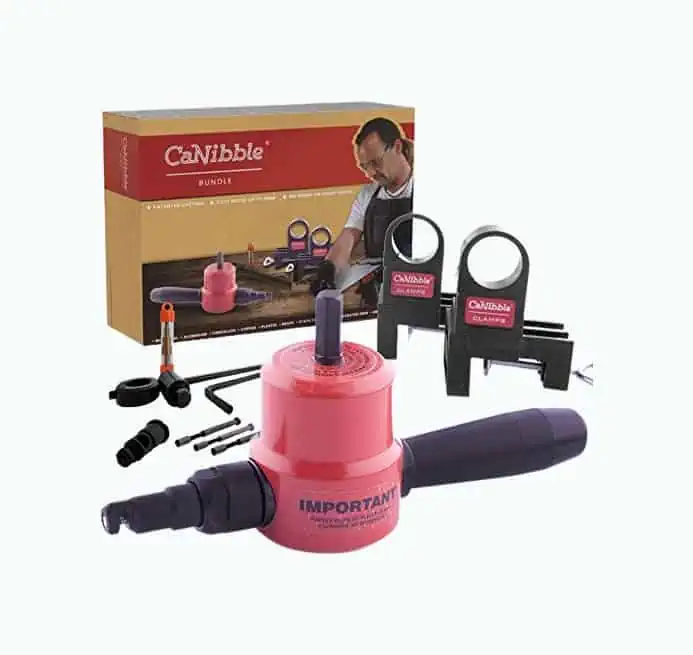
This CaNibbler drill attachment is the original and still one of the best. What sets this apart is the fixed handle, making it easier to cut straight lines without any wobble or movement. The patented cutting edge easily chews through sheet metal, formica and even chicken wire.
The CaNibbler cuts 1,200 feet of material before the blade dulls, so you will get a lot of use out of this attachment. It cuts up to 14-gauge material with a maximum depth of 2 mm.
This nibbler is serviceable with replacement parts available, so when the blade dulls, simply replace it with a new one. The only downside with this tool is the price. It retails at double the cost of others on the list, but the makers are confident that it is robust and worth the money.
Pros
- Fixed handle for better grip.
- Cuts super-straight lines.
- Replacement parts are available.
- 1,200 cuts between blades.
Cons
- Only one head.
- Costs double the price.
Product Specs
| Weight (pounds) | 1.1 |
| Dimensions (inches) | 7.48 x 4.33 x 2.36 |
| Double head | No |
| Diameter hole (inches) | Not stated |
| Price | $$$ |
| Warranty | 5-year |
Our Ratings
User Experience
| Product | Best | Weight | Dimensions | Double head | Diameter hole | Warranty |
|---|---|---|---|---|---|---|
| Rexbeti Double Head Sheet Nibbler Cutter | Sheet Metal | 2 lbs | 7.6 x 4.6 x 2.3″ | Yes | 11″ | 4-year |
| Double Headed Sheet Metal Nibbler | Car Repair | 2.2 lbs | 7.55 x 4.51 x 2.22 | Yes | N/A | Not specified |
| Dicfeos Double Head Sheet Metal Nibbler | Double-Headed | 2 lbs | 7 x 2 x 3.11″ | Yes | 11″ | 2-year |
| Lichamp Double Head Sheet Metal Nibbler | Curves Cutting | 2 lbs | 8.86 x 2.56 x 4.92″ | Yes | N/A | 1-year |
| CaNibbler Professional Nibbler | Straight Cutting | 1 lbs | 7.48 x 4.33 x 2.36″ | No | N/A | 5-year |
What Is a Nibbler?
A nibbler is a tool for cutting sheet metals with minimum distortion. It works by a die and punch oscillating at about 2,000 strokes per minute, as it cuts through your sheet material. You can use it to cut straight and curved lines, as well as circles in the sheet material.
When To Use a Nibbler?
Whenever you are working on bodywork, tanks, or sheet metal, a nibbler cutter devours steel, making it the ideal tool for the auto shop for repairs. Nibblers are also effective when cutting fiberglass, aluminum, or other sheet metal. If you like detailed and neat results, a nibbler cutter is the tool for you.
How Thick Can a Nibbler Cut?
The cutting depth of a nibbler depends on the material.
- Stainless steel plates 1.2 mm in thickness.
- Iron and steel plates 1.8 mm in thickness.
- Aluminum or copper plates 2 mm in thickness.
- Fiberglass or plastic board 2 mm in thickness.
Main Types of Nibblers
There are two main types of nibblers.
- Electric nibblers are driven by an electric current.
- Pneumatic nibblers use a compressor and are sometimes called air nibblers.
What To Look for in a Nibbler Drill Attachment
As with all attachments for your power drill, a nibbler cutter should have specific attributes.
Cutting Depth
Most nibbler cutting attachments can vary the depth they cut depending on the material. Sheet steel and iron generally have a thickness of 1.8 mm, while aluminum and fiberglass have a depth of 2 mm.
The bare minimum your nibbler should cut is 1.2 mm for stainless steel plates.

Electric
Electric nibblers are more crafting friendly because they are more convenient and have less heavy-duty tasks to fulfill. You will find that most hobbyist nibbler users will own an electric variety.
Pneumatic
Pneumatic nibbler cutters are better suited to sheet metal workshops and auto shops where their heavy-duty capabilities are put to good use. Pneumatic nibblers are far better placed to complete industrial-type uses.

Price
Price is always a limiting factor when shopping for a new nibbler cutter. They range in value, but you should still be able to get a decent nibbler for an affordable price.
How To Use a Nibbler Drill Attachment
Using a nibbler attachment is simplicity itself. Attach the shank into the drill chuck and tighten until it is locked in place. Power up the drill, and grip the handle of the nibbler. Start the drill going so the nibbler works at full speed and press it against the edge of the sheet metal.
As the die and punch make contact with the surface, it starts to nibble along the metal, throwing out shards of material. Apply gentle pressure when guiding the nibbler, but be firm with the grip, the nibbler does like to move about a lot.
When you reach the end, allow the nibbler to work free of the metal before releasing the trigger on the drill.
FAQs

Can a Nibbler Cut Curved Lines?
Nibblers are potent tools that are perfect for cutting curved lines. Due to their nibbling action, they can easily cut curves of various radii and shapes. Thanks to their compact design, they also work very efficiently in tight spaces such as automotive interiors.
A nibbler is an excellent option for making clean and precise curves when precision and accuracy are critical criteria for the job.

What Is the Difference Between a Shear and a Nibbler?
A shear is typically used for larger-scale projects, like when cutting heavy-duty steel; its mechanical components allow it to easily cut through without producing heat or causing too much wear and tear.
Nibblers are excellent for smaller projects, like making intricate cuts or getting into tight spaces that shears could not fit into. They can handle thinner metals but take a bit longer to complete the job than a shear does.
The downside of a nibbler is that it’s more likely to produce chips of metal which pilots have to sweep up afterward. But a shearing tool creates less waste and makes the cleanup process after the cutting much simpler.

What Safety Equipment Must You Wear When You Work with a Nibbler?
When working with a nibbler, wear approved safety glasses to protect your eyes from the flying metal chips produced by the tool. Long-sleeved shirts and pants are also recommended to protect your arms and legs from flying debris.
For extra protection, you should wear thick leather gloves, preferably with reinforced fingertips and palms. As a final measure, tie loose hair and secure clothing or jewelry away from the worksite.

Will an Air Nibbler Cut Stainless Steel?
The Air Nibbler is an ideal tool for cutting through plastic, aluminum, tin, and various other metals with up to 18-gauge rolled steel. This is because of the precise motion and speed that it provides to make smooth cuts.
As for whether or not it will cut stainless steel, the answer is usually no. Steel has a much higher density than the other materials the Air Nibbler works well on, so it’s generally not recommended if you are trying to cut this material.
You’ll need to seek out a tool that is better suited for hard metals, such as stainless steel instead.

What Is the Best Nibbler Tool?
The REXBETI Nibbler Tool is a powerhouse tool that is an absolute must-have for any metalworker. It’s designed with the highest quality, durable high-speed steel that will last through years of use.
For greater versatility in cutting and shaping, the 360-degree head rotates to make completing different tasks easier.
It cuts holes up to 11.4 inches in diameter and works on almost every type of sheet metal imaginable. Best of all, it leaves a burr-free edge finish!
Get To Know Your Nibbler
There are those among you who have never heard of a nibbler, but we bet you will be making a bee-line for the stores to buy one after reading this.
They are useful attachments and reasonably affordable, and yet they give you such an array of options when cutting sheet material. And if you like crafting and creating works of art in sheet metal, you have to get one of these tools in your life.