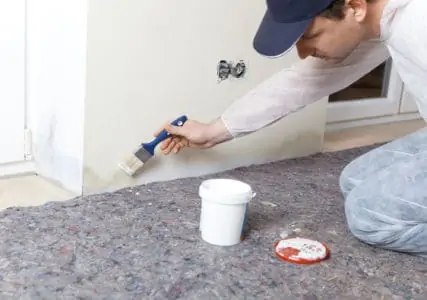
Mold is unsightly and, if left unchecked, could damage your property and your health. The best mold-resistant paints help stop the spread of mold, especially in rooms like your kitchen and bathroom, where moisture is more of an issue.
We look at mildew-resistant paints, rating them for ease of application, anti-mold qualities, and cost.
- Nanotechnology resists water and is also alkali-resistant
- Touch dry in 1-hour, recoats in 4 hours
- Low VOCs and kind to the environment
- Mildew-resistant even on exterior wood
- Up to 500 square feet coverage
- Dries in 3 hours, recoats in 6 to 8 hours
- It dries in a satin finish
- Mold-resistant for 5 years
- Covers up to 400 square feet
- Covers up to 400 square feet
- Dries to the touch in 30 minutes
- Water-based, thus, kinder to the environment
- Fade resistant
- Multifarious color options
- Oil-based formula
Review Methodology: At Sensible Digs, we believe in providing thorough, hands-on analysis and comparisons of products. Our professional team conducts extensive research and testing on mold resistant paints, focusing on key factors such as performance, durability, and efficacy in preventing mold growth. We evaluate each product from a user’s perspective, measuring its performance based on a defined set of criteria and standards. Our reviews are grounded in experience and backed by facts, allowing us to rank products and share our findings. We provide in-depth assessments of design choices, their impact on the user, and what sets a product apart from its competitors. We are committed to giving you the best, most trustworthy advice for your home improvement needs.
The Best Mold Resistant Paints of 2024
We spent hours gauging the opinions of the public and professionals to bring you our definitive list of the top mold-resistant paints.
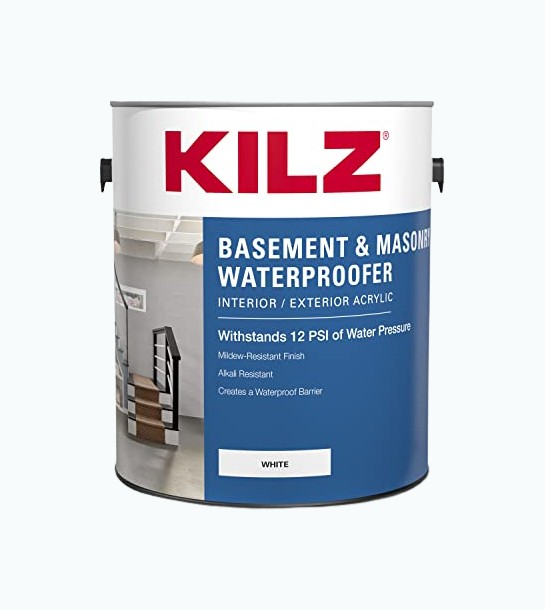
Kilz Interior/Exterior Basement Paint
Best Mold Resistant Paint for Basement
This Kilz mold-resistant paint is ideal for exterior and interior use. It is specially formulated to resist mold growth on basement floors, where higher moisture levels are present in the sub-floor level.
It uses nanotechnology to form a seal to prevent water infiltration, while the alkali-resistant coating provides long-lasting protection.
This 1-gallon can cover 75 to 125 square feet depending on the porosity of the surface. You need a minimum of 2 coats, and it dries to the touch after 1-hour and is ready for recoats after 4 hours.
It withstands water pressure of 12 PSI, and because it is a water-based paint, it is kind to the environment, and the VOCs (volatile organic compounds) are low.
However, if your basement gets a lot of foot traffic, you might be better using an epoxy.
Pros
- Nanotechnology resists water and is also alkali-resistant.
- Touch dry in 1-hour and recoats in 4 hours.
- Low VOCs and kind to the environment.
- Withstands water pressure up to 12 PSI.
Cons
- Epoxy paint is more robust for high-traffic areas.
Product Specs
| Quantity | 1-gallon |
| Type | Water-based |
| Coverage | 75 to 125 square feet |
| Drying time | 4 hours |
| Value for money | $$ |
Our Ratings
User Experience
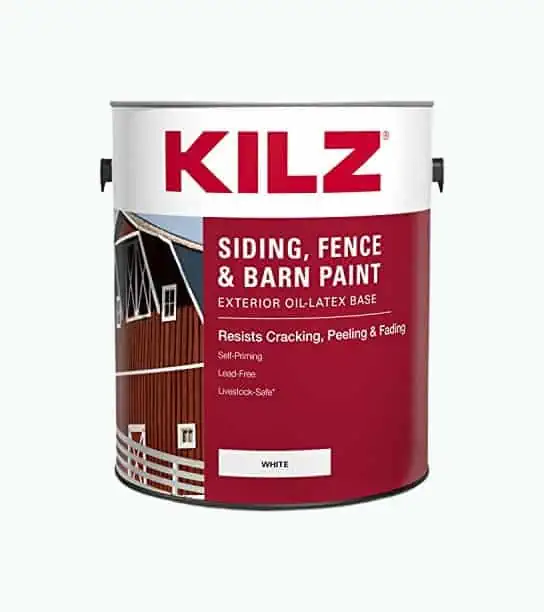
Kilz Exterior Fence, Patio and Siding Paint
Best Exterior Mold Resistant Paint
This is the second Kilz mold-resistant paint to feature, but this one is a dedicated exterior formula. It covers decking, siding, and fences, providing a mildew-resistant coating that soaks deep into the wood fibers.
It is an oil-based product, so you do get stronger odors and VOCs as the paint dries. It’s also damaging to the environment, and you need mineral spirits to clean your tools when the task is complete.
This one dries in 3 hours to a matte finish, and you can recoat after 6 to 8 hours. You also get 200 square feet of coverage on porous surfaces and up to 500 square feet on non-porous surfaces.
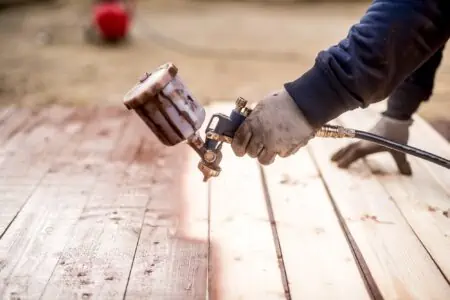
You can spray this paint, roll, or brush it on, although you might need a thinner to dilute the formula if you are spraying.
Pros
- Mildew-resistant even on your exterior wood.
- Up to 500 square feet coverage.
- Dries in 3 hours and recoats in 6 to 8 hours.
- Spray, roll, or brush this paint on.
Cons
- High VOCs and strong odors.
- Oil-based paint is damaging to the environment.
Product Specs
| Quantity | 1-gallon |
| Type | Oil-based |
| Coverage | 200 to 500 square feet depending on porosity |
| Drying time | 6 to 8 hours |
| Value for money | $$$ |
Our Ratings
Personal Perspective
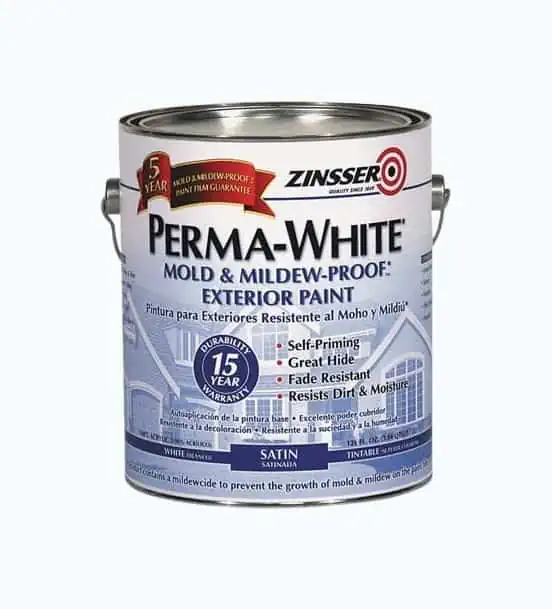
Zinsser Mold-Resistant Satin Paint
Best Long-Lasting Mold-Resistant Paint
This Zinsser mold-resistant paint is ideal for interior and exterior and is intended for use on metal and wood. It gives you up to 5 years of protection from condensation, keeping black mold at bay.
It dries with a sating finish and 4-quarts covers between 300 to 400 square feet, depending on the surface quality and porosity. The drying time is relatively quick at 30 minutes, with recoats possible after two hours or more.
This paint comes in brilliant white, so it will leave your newly-painted surface looking fresh and clean, and it is also washable, so if you notice any staining, you can scrub it clean with a damp cloth.
The only downside is that it only comes with a single white shade which is a bit restricting for those who wants to paint their walls aside from white.
Pros
- It dries in a satin finish.
- Washable and mold-resistant for 5 years.
- Ideal for both exteriors and interiors.
- Covers up to 400 square feet.
Cons
- It only comes in a single color.
Product Specs
| Quantity | 1-gallon |
| Type | Water-based |
| Coverage | 400 square feet |
| Drying time | 30 minutes |
| Value for money | $ |
Our Ratings
Community Feedback
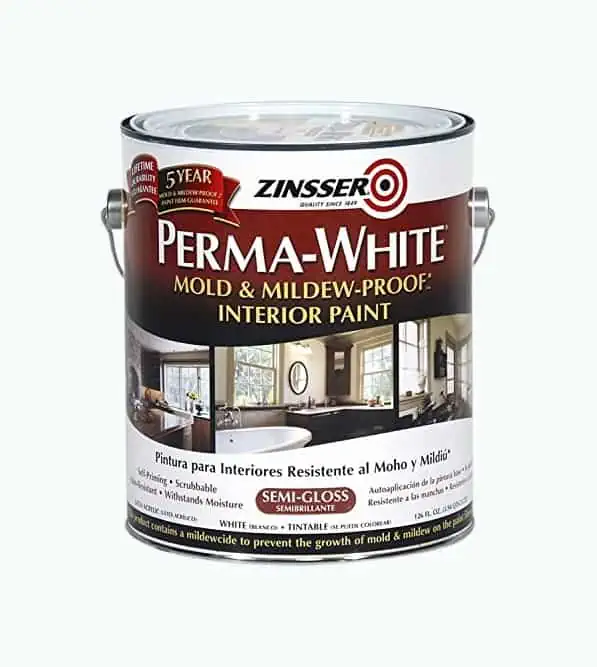
Rust-Oleum PermaWhite Mold and Mildew Paint
Best Self-Priming-Mold-Resistant Paint
This is the first of two Rust-Oleum products to feature in the review. We chose this one because it is a self-priming paint. So, rather than spending more money on a separate primer, this one does it all in one.
Rust-Oleum is so confident you will love this paint that they warrant the mold resistance for 5 years and give you a lifetime durability guarantee.
This semi-gloss paint is wipeable and withstands stains, plus it is moisture-resistant to deter mold from growing. It is fade-resistant, water-based and kind to the environment, and low VOCs, so you can avoid headaches, sore eyes, and throat.
One can cover about 400 square meters, although that depends on the porosity of the surface, and it dries to the touch in about 30 minutes to an hour. Recoats are possible after 6 to 8 hours.
This isn’t the cheapest product you can buy. It costs almost 3 times the price of other similar paints, but you are paying for a well-known brand.
Pros
- Covers up to 400 square feet.
- Dries to the touch in 30 minutes.
- Water-based, so it is kinder to the environment.
- 5-year guarantee against mold growth.
Cons
- Expensive compared to other similar paints.
Product Specs
| Quantity | 1-gallon |
| Type | Water-based |
| Coverage | 400 square feet depending on porosity |
| Drying time | 6 to 8 hours |
| Value for money | $$$$ |
Our Ratings
First-Hand Impression
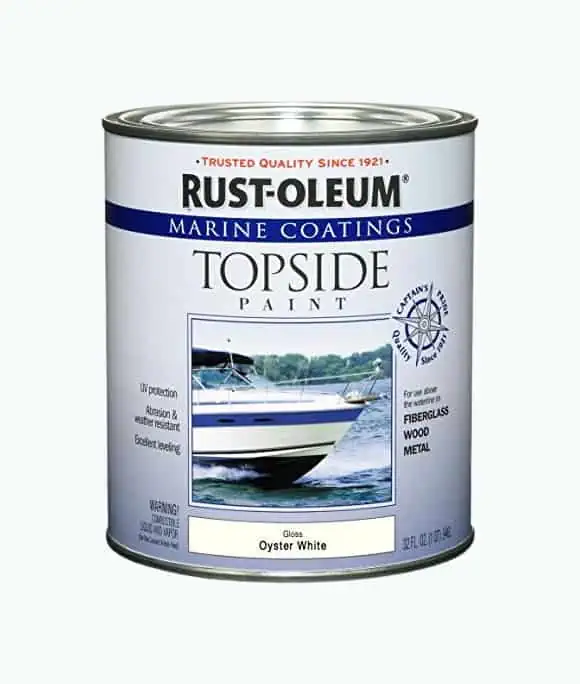
Rust-Oleum 207001 Marine Coatings
Best Mold Resistant Paint for Bathrooms
This superior gloss paint has a mildew-resistant barrier and the formulation is made from oil-based paint thus it can withstand low temperatures. Furthermore, it requires minimal application and covers large areas.
It can withstand cracking, fading, peeling, and blistering, perfect when you want a new look for your bathroom.
All this protection is thanks to a mildewcide in the formula. The only downside of using this product is that it takes three full days for a complete cure.
It covers roughly 100 square feet, depending on the surface quality. This paint comes in 32 fluid-ounce containers, so if you plan on painting the walls of your bathroom, you will need quite a few cans at a considerable cost.
Pros
- US-made product.
- Withstands cracking, peeling, fading, and blistering.
- Multifarious color options.
- Oil-based formula.
Cons
- Comes in small cans, so better for small tasks.
- It costs a lot if you need multiple cans.
Product Specs
| Quantity | 32 fluid ounces |
| Type | Oil-based |
| Coverage | 100 square feet depending on porosity |
| Drying time | 2 hours |
| Value for money | $$$$ |
Our Ratings
User Experience
| Product | Best | Quantity | Type | Coverage | Drying time | Value for money |
|---|---|---|---|---|---|---|
| Kilz Interior/Exterior Basement Paint | Best for Basements | 1-gallon | Water-based | 75 – 125 square feet | 4 hours | $$ |
| Kilz Exterior Fence, Patio and Siding Paint | Best Exterior | 1-gallon | Oil-based | 200 – 500 square feet depending on porosity | 6 – 8 hours | $$$ |
| Zinsser Mold-Resistant Satin Paint | Best Long-Lasting | 1-gallon | Water-based | 400 square feet | 30 minutes | $ |
| Rust-Oleum PermaWhite Mold and Mildew Paint | Best Self-Priming | 1-gallon | Water-based | 400 square feet depending on porosity | 6 – 8 hours | $$$$ |
| Rust-Oleum Marine Coatings | Best for Bathrooms | 32 fluid ounces | Oil-based | 100 square feet depending on porosity | 2 hours | $$$$ |
Does Mold-Resistant Paint Really Work?
Mold-resistant paint helps to stop mold from spreading thanks to its antimicrobial qualities. Mold loves damp and dark spaces. Any area of your home that has poor ventilation, and a combination of humidity and heat, will take hold and grow.
Mold-resistant paint kills mold spores and slows the spread of the nasty black fungus. However, it will not entirely banish mold and mildew. Over time, they slowly start to grow back.
Types of Mold-Resistant Paint
Choice is a wonderful thing, but unless you know which mildew-resistant paint works for you, how do you decide? Here are some pointers:
Matte
Matte paint has no reflective qualities. It has between 0 and 10 percent gloss, and it dries flat, so if you have a room that gets almost no natural light, you might want to consider a gloss finish.
Matte is better for low impact, drier areas of the house like ceilings and high walls. And because it is a matte finish, it isn’t as robust as other types and harder to clean. You can use it in bedrooms and living spaces, as well as kid’s bedrooms.
You might get away with using matte paint when painting bathroom ceiling, but that’s about it for water resistance.
Eggshell
Eggshell has many of the same qualities as matte paint. The gloss quantities are slightly higher at 10 to 25 percent but still dries with a soft reflective sheen. It is more durable than flat paint, but it is still better for areas with low moisture content.
It’s also easier to clean because there is slightly more of a sheen.
Satin
Satin paint has a slightly more vibrant luster than eggshell, with about 20 to 35 percent gloss. It is more hard-wearing than eggshell, but there is very little to differentiate the finish.
Satin is a good middle-ground option, with better cleaning qualities without the high gloss sheen. You can use satin paint in high-traffic areas, but don’t expect it to hide imperfections and blemishes like matte and eggshell.
Low or Semi-Gloss
This is a popular choice among homeowners because it is used in high-traffic and moisture-rich rooms like kitchens and bathrooms. Thanks to its 35 to 70 percent gloss content, it reflects light to brighten up low light areas. It can also be used in indoor and outdoor situations, and it is easy to clean.
High Gloss
With a gloss content of 70 to 100 percent, high gloss paint is the most hard-wearing and reflective of all the paint options. It reflects light in low-light rooms and is super easy to clean.
You can apply it to just about anywhere and to any surface. You can use it on window frames, door trims, woodwork, and moldings.
How To Choose the Best Mold Resistant Paint
What are the key things you should be looking for when shopping for mold-resistant paint? Here’s a rundown of the key considerations before you commit to a purchase.

Paint Durability
Once it’s down, how long will it stay down between fresh coats? The mold and mildew repelling features of the paint probably won’t last as long as the paint will stay looking good, but at least you still get a nice-looking coat of paint.
Of course, if you want to boost the moisture resistance, you could always paint on a fresh layer.

Paint Coverage
How far will the paint spread? Most cans of paint come in 1-gallon tins, so the amount of coverage you get is important to determine your costs.
You can expect anywhere between 250 and 400 square feet, depending on the quality and porosity of the surface.

Oil-Based vs. Water-Based
The formula of the paint makes a difference in coverage, cost, and drying times.
Oil-Based
Oil-based paints are made up of solvents and other chemical compounds that evaporate when they dry. This gives off VOCs (volatile organic compounds), which can be harmful to your health.
Oil-based paints are also damaging to the environment because when you wash your brushes or roller clean, the solvents drain into the water system, poisoning the planet. However, oil-based paints have greater resistance to wear and tear.
You also get a higher sheen, although this does fade over time.
Water-Based
Water-based paints consist mainly of water, so they have a lower environmental impact and fewer VOCs. It means that there are lower health risks because you don’t have to breathe in vapors as the paint dries.
These paints are often referred to as acrylic paints, and they last longer because they have a lower sheen. They also offer more flexibility when they dry, reducing cracks.

Water Resistance
Mold and mildew-resistant paint should repel water because it is the primary food source that causes black mold spores to grow. You need the paint to have that special resilience, otherwise, it would just be ordinary paint.
Higher gloss paint has the best waterproofing because the sheen has more luster, meaning the water beads on the surface, ready to be wiped dry.
FAQs

Can I Paint Over the Existing Mold?
The simple answer is no; you cannot paint over existing mold. It keeps growing under the paint, and eventually, it breaks through the surface.

How Do You Get Rid of Mold Before Painting?
Mix up a solution of 2 parts bleach to 10 parts of water and fill a spray bottle. Apply it to the surface of the mold and let it sit for 10 minutes. Then, wipe it clean with a dry cloth. Repeat as necessary until the mold is gone.

Where Are the Best Places To Use Mold-Resistant Paint?
The best places to use mold-resistant paint are the bathroom and the kitchen. They have the highest moisture content of any room in the house.

How Long Does Mold Resistant Paint Last?
Most mold-resistant paint will give you up to 6 years of protection. It depends on where the paint is applied and the conditions that allow mold to grow. If you have a damp environment, you might find your resistance to mold reduced to no more than 2 or 3 years.