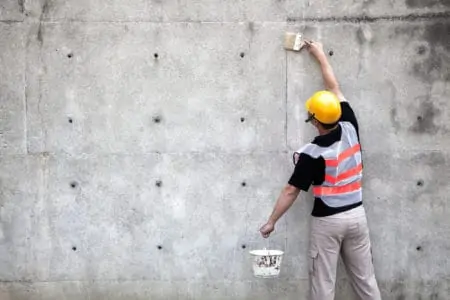
Aside from the fact that concrete can be unsightly in its bare state, it’s also challenging to paint. Concrete expands and contracts with heat and cold, so the best concrete paints need to have a degree of elasticity.
We researched hundreds of paint products, garnering public and professional opinion to bring you our definitive list of the 6 best concrete paints.
- Suitable for indoor and outdoor use
- Covers up to 125 square feet, depending on the surface porosity
- Withstands 12 PSI of water pressure
- Covers up to 120 square feet, depending on the surface porosity
- Comes in 7 vibrant color options to suit any taste
- Dries ready for the second coat within 8 hours
- Resists oil, staining, grease, detergents, and vigorous scrubbing
- Comes in 5 color choices to match your design
- Covers up to 400 square feet, depending on the surface quality
- Gives up to 500 square feet of coverage from 1 gallon
- Touch-dries in 2 hours and recoats in 4
- Ideal for garages and driveways
- Water submersible, including saltwater
- An impressive 300 to 400 square feet of coverage
- Suitable for most masonry and concrete surfaces
- Ideal for hot tire surfaces like driveways
- The non-slip texture is also ideal for pool decks and pathways
- Recoats in just 3 to 4 hours
Review Methodology: At Sensible Digs, we don’t just review products, we delve deep into the heart of what sets them apart. We assess and compare concrete paints based on criteria such as durability, finish, drying time, and ease of application. Our professional team conducts hands-on tests and ranks products based on their performance. We track and measure every minute detail, from the texture and color consistency to the way each paint reacts to different weather conditions. Our analysis is thorough, utilizing our extensive experience and the latest data. We then present these findings to you, offering a comprehensive review and score, helping you make the best decision for your needs. Our evaluations are always grounded on facts and evidence. Trust in our expertise and in the quality of our reviews.
The Best Concrete Paints of 2024
Concrete paint comes in all sizes, types, and colors, so choosing the right one takes research and consideration. We have done the hard work and sourced the best concrete paints money can buy.
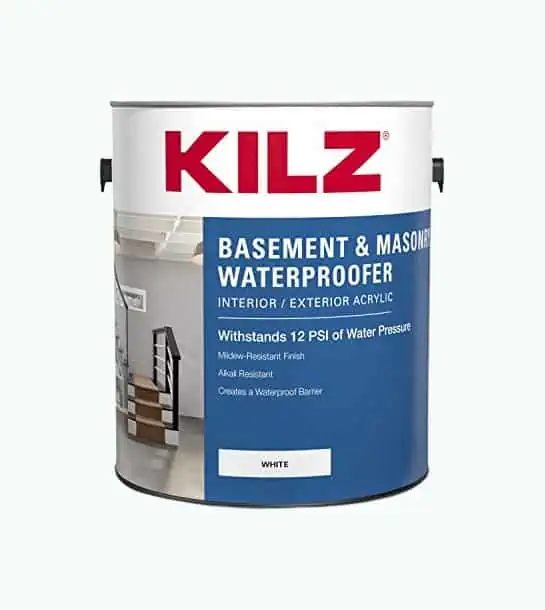
KILZ Basement and Masonry Waterproofing Paint
Best Concrete Paint for Basement Floors
You will notice that KILZ products feature heavily in this review because they are a market leader and produce many great concrete paints.
This basement and masonry paint is suitable for indoor and outdoor use, thanks to the formula that seals porous surfaces, making them waterproof. You get the best results with KILZ primer, so make sure that all untreated areas have been primed for a long-lasting finish.
This is a water-based paint, so it is better for the environment, and it washes clean with soap and water; plus, it can withstand 12 PSI of water pressure, and it’s also alkali-resistant. A 1-gallon can gets you about 75 to 125 square feet of coverage, depending on the porosity of the concrete.
It also touch-dries within 1 hour, and you can apply additional coats within 4 hours, so you can get your concrete patio finished in double-quick time.
The only downside is this latex paint will need repainting sooner than epoxy paint because it is less robust. The upside is you can apply it with a brush, roller, or sprayer.
Pros
- Suitable for indoor and outdoor use.
- Covers up to 125 square feet, depending on the surface porosity.
- Withstands 12 PSI of water pressure.
- Dries to the touch in 1-hour and recoats in 4 hours.
Cons
- Not as robust as epoxy paint.
Product Specs
| Quantity | 1-gallon |
| Type | Latex |
| Uses | Indoors and out |
| Coverage | 125 sq ft |
| Drying time | 4 hours |
| Price | $$ |
Our Ratings
User Experience
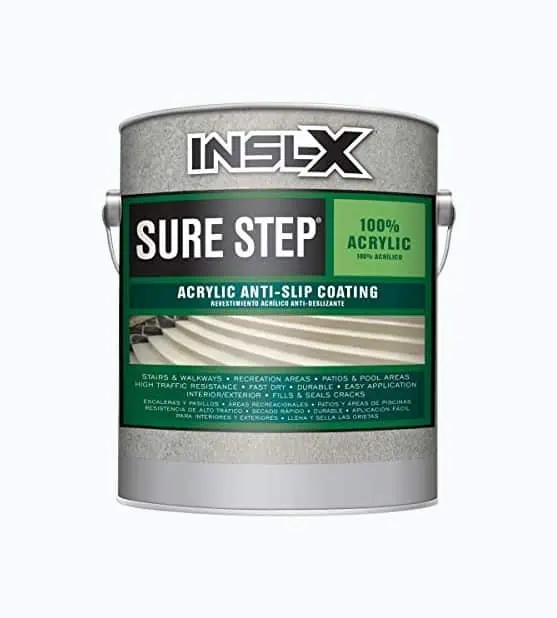
INSL-X Sure Step Acrylic Anti-Slip Paint
Best Anti-Slip Concrete Paint
This is the first of 3 INSL concrete paints to feature in the review. You can use this paint on walkways and stairways to add extra grip. It is ideal if you live in a cold part of the country and snow and ice are an issue. Paint it indoors and out on your pool deck, driveway, and footpath to ensure maximum grip during the winter.
This paint has excellent abrasion resistance and also repels ponding water. It is fast drying, and a 1-gallon can cover up to 120 square feet depending on the surface quality and the number of coats needed.
And speaking of coats, it is ready for the second layer within 8 hours, so while it isn’t as quick-drying as the KILZ product, it is still pretty swift.
It comes in 7 vibrant colors, and you can use it on wood and metal too. INSL recommends you roll it on using a 0.5 to 0.75-inch roller cover for the best results, so it does limit your application options. The only downside with this paint is it is specifically used for making surfaces non-slip, so once that task is done, it has limited uses.
Pros
- Covers up to 120 square feet, depending on the surface porosity.
- Comes in 7 vibrant color options to suit any taste.
- Dries ready for the second coat within 8 hours.
- Excellent abrasion and ponding water resistance.
Cons
- Can only be applied with a 0.5 to 0.75-inch roller.
- Designed for one specific use, so it lacks versatility.
Product Specs
| Quantity | 1-gallon |
| Type | Acrylic |
| Uses | Indoors and out |
| Coverage | 120 sq ft |
| Drying time | 8 hours |
| Price | $$ |
Our Ratings
Personal Perspective
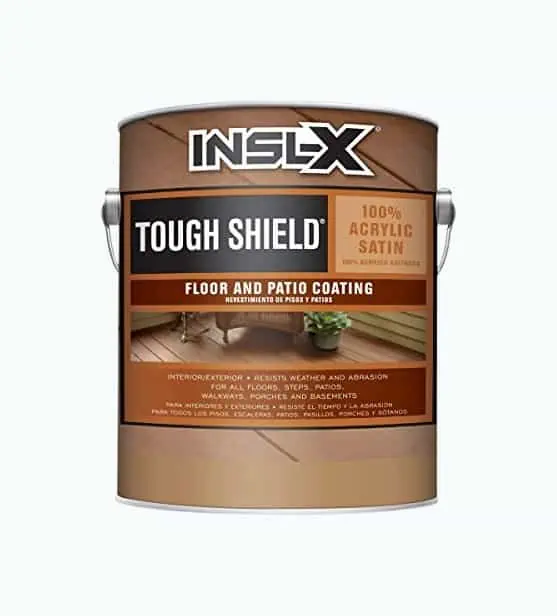
INSL-X Tough Shield Patio Paint
Best Concrete Paint for Patios
This Tough-Shield paint is the perfect choice for indoor and exterior surfaces like patios and pathways. It has a waterborne formula with a rugged acrylic enamel that waterproofs and stops ponding water. It also withstands detergents, grease, oil, and vigorous scrubbing.
It comes in 5 colors to suit whatever design you want, and it covers 350 to 400 square feet per gallon, making it one of the most impressive for spread. This paint also resists abrasion and the weather, so it should keep your patio in tip-top condition no matter what the elements throw at it.
The only negative is this paint is not suitable for garage floors and driveways, and you can only apply it when the surface temperature exceeds 50 degrees Fahrenheit.
Pros
- Resists oil, staining, grease, detergents, and vigorous scrubbing.
- Comes in 5 color choices to match your design.
- Covers up to 400 square feet, depending on the surface quality.
- The acrylic enamel waterproofs and stops ponding water.
Cons
- Not suitable for garage floors and driveways.
- Can only be applied above 50 degrees Fahrenheit.
Product Specs
| Quantity | 1-gallon |
| Type | Acrylic |
| Uses | Indoors and out |
| Coverage | 400 sq ft |
| Drying time | Not stated |
| Price | $$$ |
Our Ratings
Community Feedback
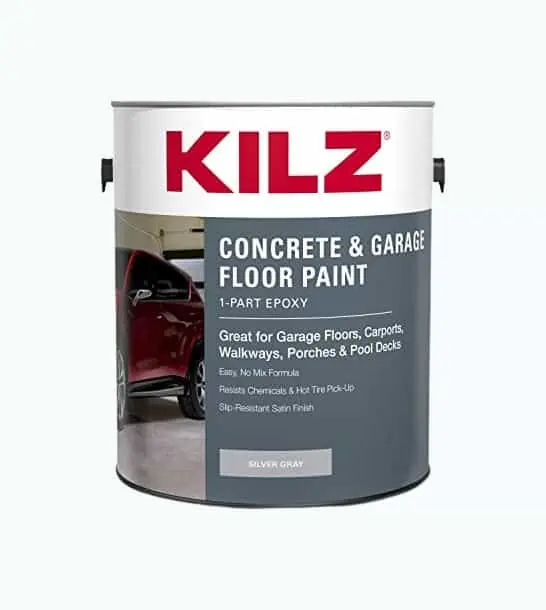
KILZ 1-Part Epoxy Acrylic Garage Floor Paint
Best Concrete Paint for Garages
Nothing seals a garage floor better than epoxy paint. This KILZ epoxy paint is a 1-part water-based formula, so there is no mixing with hardener required. It dries rock hard, and it is easy to clean and won’t fade, crack or peel, making it perfect for environments with hot tires.
This paint dries to the touch in 2 hours, and you can recoat in 4, so it is super quick to help you get the job done in a single day. You can use it on new and old concrete as well as painted surfaces.
Just 1-gallon will cover up to 500 square feet on smooth concrete and 400 square feet on rougher concrete. However, this epoxy paint is unsuitable for vertical surfaces, so you can only use it on floors and driveways, which might limit its use.
Plus, this paint is double the price of other similar products, so while it gives a better return on the coverage, it does cost you more money.
Pros
- Gives up to 500 square feet of coverage from 1 gallon.
- Touch-dries in 2 hours and recoats in 4.
- Ideal for garages and driveways.
- Won’t fade, crack or peel.
Cons
- Not suitable for vertical surfaces.
- Double the price of other similar paints.
Product Specs
| Quantity | 1-gallon |
| Type | Acrylic |
| Uses | Indoors and out |
| Coverage | 500 sq ft |
| Drying time | 4 hours |
| Price | $$$$ |
Our Ratings
First-Hand Impression
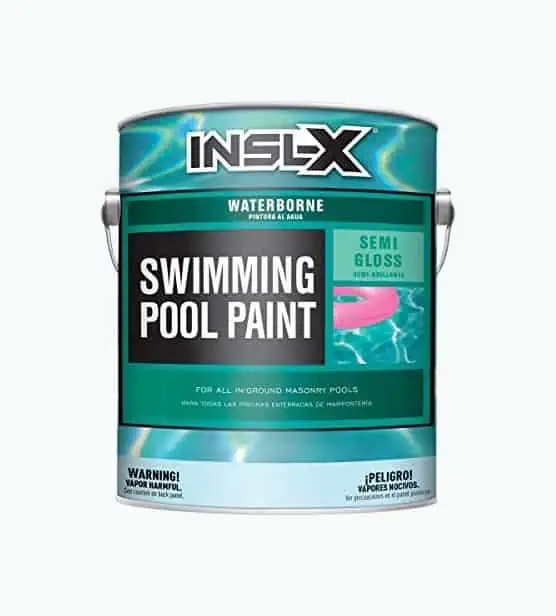
INSL-X Waterborne Semi-Gloss Pool Paint
Best Concrete Paint for Pool Decks
When you have a deck by the pool, resisting water and ponding is high on the agenda. This INSL cement paint is ideal for pools, bare concrete, unsealed surfaces, and other masonry. It comes in 5 colors, including aquamarine to white, and because it is a water-based product, it won’t harm the environment.
You get 300 to 400 square feet of coverage, so it should have enough spread to cope with your average-sized pool deck. Because this is actually a pool paint, you can cover your deck and pool, so the colors match.
It also withstands water submersion, so you know it can handle rainwater, and it even resists saltwater.
The negatives are that it takes an incredible amount of preparation work before you start painting, and 5 to 7 days to cure fully, so don’t expect your project to be completed in a hurry.
Pros
- Water submersible, including saltwater.
- An impressive 300 to 400 square feet of coverage.
- Suitable for most masonry and concrete surfaces.
- Comes in 5 colors.
Cons
- Requires a lot of prep work before paint is applied.
- Takes between 5 and 7 days to dry.
Product Specs
| Quantity | 1-gallon |
| Type | Acrylic |
| Uses | Exterior |
| Coverage | 400 sq ft |
| Drying time | 5 to 7 days |
| Price | $$$ |
Our Ratings
User Experience
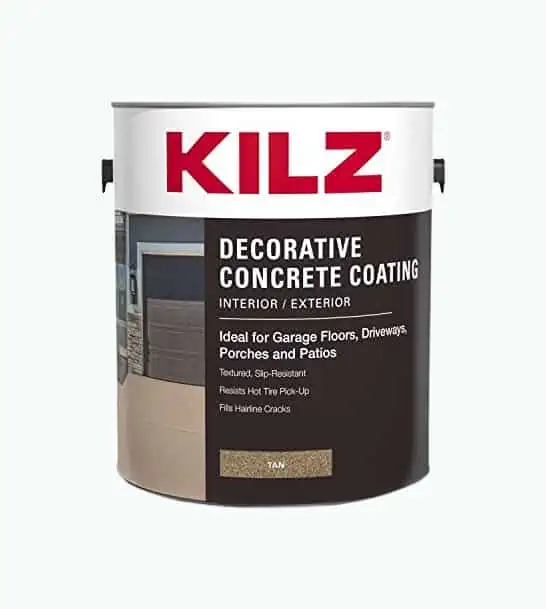
KILZ Slip-Resistant Decorative Concrete Paint
Best Concrete Paint for Driveways
This paint is specially formulated for hard traffic areas like driveways. It fills cracks up to 3mm and resists hot tires, dirt, and grease, so it is the perfect candidate for giving your driveway a new lease of life.
And if you have any leftovers, it is slip-resistant, making it ideal for pool decks and pathways. It dries ready for a recoat in 3 to 4 hours and cures over 24 hours. However, you shouldn’t attempt to drive over it for at least 72 hours.
You need to use a 0.25-inch roller to get this paint down, so that might slow you somewhat, and 1-gallon only covers about 50 square feet, so you get far less spread compared to other products.
Pros
- Ideal for hot tire surfaces like driveways.
- The non-slip texture is also ideal for pool decks and pathways.
- Recoats in just 3 to 4 hours.
- Fills 3mmm cracks and seals the surface of the concrete.
Cons
- Can only be applied with a roller, limiting application choices.
- Only covers 50 square feet, which is less than other products.
Product Specs
| Quantity | 1-gallon |
| Type | Latex |
| Uses | Exterior |
| Coverage | 50 sq ft |
| Drying time | 4 hours |
| Price | $$$$$ |
Our Ratings
Personal Perspective
| Product | Best | Quantity | Type | Uses | Coverage | Drying time | Price |
|---|---|---|---|---|---|---|---|
| KILZ Basement and Masonry Waterproofing Paint | Best Basement Floors | 1-gallon | Latex | Indoors & out | 125 sq ft | 4 hours | $$ |
| INSL-X Sure Step Acrylic Anti-Slip Paint | Best Anti-Slip | 1-gallon | Acrylic | Indoors & out | 120 sq ft | 8 hours | $$ |
| INSL-X Tough Shield Patio Paint | Best for Patios | 1-gallon | Acrylic | Indoors & out | 400 sq ft | Not stated | $$$ |
| KILZ 1-Part Epoxy Acrylic Garage Floor Paint | Best for Garages | 1-gallon | Acrylic | Indoors & out | 500 sq ft | 4 hours | $$$$ |
| INSL-X Waterborne Semi-Gloss Pool Paint | Best for Pool Decks | 1-gallon | Acrylic | Exterior | 400 sq ft | 5 – 7 days | $$$ |
| KILZ Slip-Resistant Decorative Concrete Paint | Best for Driveways | 1-gallon | Latex | Exterior | 50 sq ft | 4 hours | $$$$$ |
Types of Concrete Paint
There are two main types of concrete paint: acrylic and epoxy, but what are their differences, and is one better than the other?
Acrylic Latex Paint
Acrylic latex paint is a water-based option. It coats walls, floors, masonry, and steps, thanks to its ease of application. Water-based paints spread easily and cover every imperfection in the surface of the concrete. They are also better for the environment when you clean up because you can wash your brushes in soapy water.
However, acrylic latex paint is less durable, so you will need to repaint your surfaces every couple of years. The plus side is these paints cost less than the epoxy versions, and you can get non-slip options with small particles mixed through the formula for better grip on patios and pathways.
Epoxy
Epoxy paint is incredibly durable. It creates a hard seal on the surface of your concrete and can withstand everything you can throw at it.
It comes in various options, ranging from gloss to matte, and you can get paint with color flakes to give a high-end sheen. Epoxy paints are more expensive than water-based varieties, and they are more challenging to apply. You get epoxy resin and a hardener solution, which needs to be mixed before application.
This paint is not kind to the environment, thanks to the solvent-based formula, and it is a lot harder to paint with, but once you do, it dries rock-solid and lasts for years because it resists water and staining.
How To Choose the Best Concrete Paint
There is more to consider than just latex versus epoxy when choosing the best concrete paint. Here are some things that should be at the top of your priority list.

What Are You Painting?
How you intend to use the paint matters when making your selection. Some are better suited to indoor use, so read the label before purchasing. Also, some paints take to vertical surfaces better than others.
Epoxy paints are thick and heavy and don’t adhere that well to walls because they take so long to cure. You will find a water-based product more suitable. However, epoxies are better for hard floors.

What’s the Weather Like?
Weather resistance is another key area to consider. Do you live in a climate that gets extreme weather events, or are you lucky enough to get sun all year round?
Concrete surfaces experience every weather imaginable. They heat in the summer and freeze in the winter. Water erodes the surface of the concrete, leaving hairline cracks, and as the water freezes in the colder months, it expands.
The most weather-resistant concrete paints are the epoxy ones. They are typically oil or solvent-based and better suited to the elements. Water-based paints will fade and peel after a season or two.

Which Color Should You Choose?
There are lots of colors to choose from, so the ever-popular gray or slate has some competition. Do you go bright and cheerful, or are your tastes more traditional?
The point is, you can really cheer a space up with the right color selection. You can even color-match your concrete floor with your car.

What Finish Is the Best?
Epoxy paint gives a high-gloss finish. It really makes your concrete floor stand out. A glossy surface looks clean, is easier to keep clean, and reflects light to brighten the space. Matte finishes are more understated, so you might be better using them for the walls and stairs.
If you live somewhere cold, ice is an issue, so choose a non-slip surface on patios and pathways to reduce the risk of slips and falls. Even in milder climates, rain can make concrete slippery, especially for elderly relatives, so non-slip paint might be the best option.
If you opt for a glossy finish, just remember that while it is easier to clean, it also allows moisture to sit on the surface, which could become a trip hazard. If your concrete is slightly damp beneath the coat of paint, it will trap the moisture in and not allow the concrete to breathe.

How Long Will It Last?
If you want the most robust paint, choose epoxy. It sets hard and is almost indestructible. You get much more use from epoxy-based paints, but they are more expensive and a lot more hassle to apply.
Latex paints are better for walls and stairs, and they last about 2 years before they start to peel and flake. They don’t require mixing with hardener and can be applied using a brush, roller, or sprayer.
If you hate the idea of repainting your garage or patio every 2 years, choose epoxy. If you want the most straightforward application process and don’t mind the biennial maintenance program, latex paint is the one to choose.
Of course, there is also the issue of where the concrete is situated. Exterior concrete will need far more TLC than indoor spaces. You could probably extend the life of your latex paint indoors to between 3 and 5 years.
FAQs

Do I Need To Prime Concrete Before Painting?
If you want the best results and the longest lifespan for the paint, priming the concrete is a good idea. It seals the concrete surface, making it less porous, and helps the top coat of paint adhere better.
Some paints have a built-in primer, so it’s always a good idea to read the instructions before use.

Does Painting Concrete Make It Slippery?
It depends on the type of finish you use. High-gloss is the slippiest, especially in the wet. Epoxy dries hard and smooth, so when it rains, the water has no runoff. If moisture sits on the surface of your concrete, it creates a slip hazard.
You can buy textured paint with tiny particles mixed in the formula, so when you apply it, it dries with a non-slip coating.

How Long Must Concrete Paint Dry?
The recommended drying time is between 1 and 2 days. Epoxies take slightly longer because they have to cure, and they are a lot thicker than latex paints. However, latex paints require more than one layer, so you should leave 24 hours between coats to ensure you get the best adherence.

How Do You Keep Paint From Peeling Off Concrete?
The best way is to use a suitable primer and wait a minimum of 8 hours for it to dry before applying the first of the 2 topcoats. You should also ensure the floor is clean, free from all dust, and completely dry. If there is a hint of dampness, the paint will bubble and lift.