If you’re looking for a new faucet, you’re unlikely to have seen an AquaSource product at your local hardware store. It’s entirely possible that you won’t even have heard of the brand, but that doesn’t mean its faucets aren’t of high quality.
AquaSource faucets are an excellent option if you want a reliable, user-friendly faucet at an affordable price. Still, not every faucet will be suitable for your kitchen or bathroom, so you might need some help to narrow down your choices.
To learn more about AquaSource faucets, where you can buy them, and why you should consider adding one to your home, read on. We have also provided reviews of what we consider the best three AquaSource faucets available today.
- Americans With Disabilities Act compliant
- Lifetime warranty
- Easy to install for beginners
- ADA-compliant
- Ceramic cartridge valve
- Free from contaminants
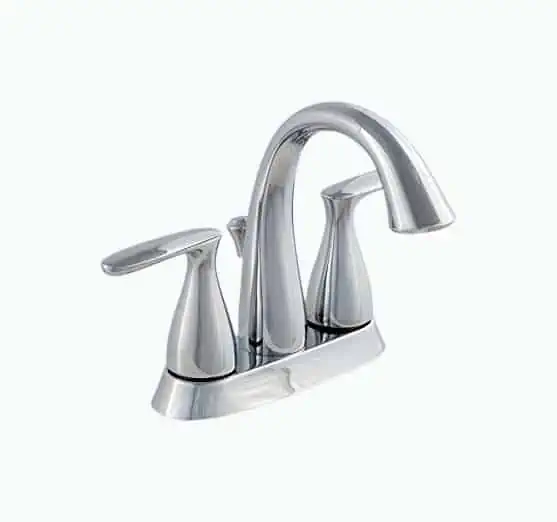
- Easy to use lever handles
- 1.2 GPM flow rate
- Meets federal lead guidelines
Review Methodology: At Sensible Digs, we pride ourselves on thorough research, hands-on experience, and data-driven analysis. We’ve put the best Aquasource faucets to the test, comparing their performance using a set of established criteria. This includes factors like design, durability, water efficiency, and ease of installation. Our professional team has evaluated these products from a user’s perspective, identifying key decision-making factors. We’ve tracked and measured their performance, providing you with clear, concise results. Our reviews are based on facts and real-life experiences, helping you understand what sets each product apart from its competitors. Trust our assessments and make an informed decision about the best Aquasource faucet for your home.
Best AquaSource Faucets of 2024
AquaSource is an excellent alternative to some of the more expensive high-end faucets on the market. After looking closely at the company’s products, we have chosen the best ones and included them in our list of AquaSource faucet reviews. This list contains both AquaSource kitchen faucets and AquaSource bathroom faucets.
AquaSource Chrome 1-Handle WaterSense Faucet
Most Affordable AquaSource Faucet
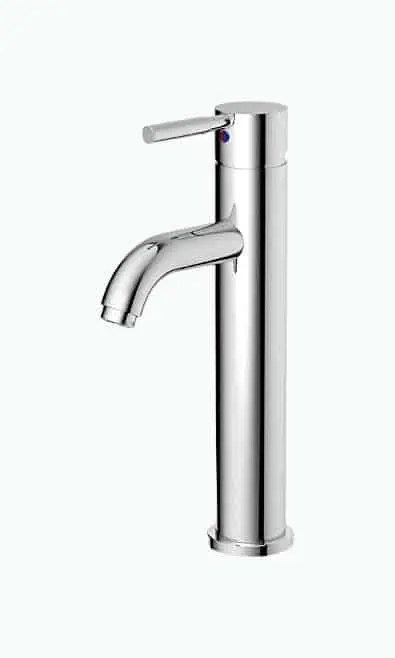
This one-handle WaterSense-approved faucet from AquaSource is solid proof that a less expensive faucet doesn’t have to feel cheap.
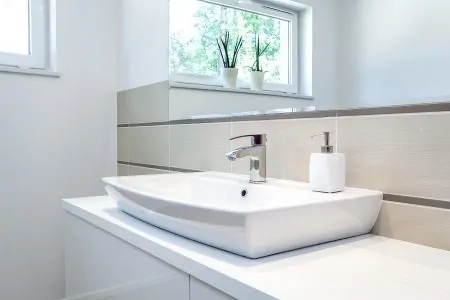
The sleek simplicity of its design makes the Grabill faucet ideal for vessel sinks in high-end modern bathrooms. It is also an excellent choice for one-hole sinks of other styles.
What We Like
Accessible Style
It isn’t overly difficult to find a faucet that is ADA compliant, but it can be challenging to find one that also looks good. The Grabill does both.
The easy one-handed operation and a free-standing design make it ideal for a vessel sink on an accessible bathroom countertop. It doesn’t compromise on looks, so you don’t end up with a bathroom that feels utilitarian.
Water-Saving Power
As a “Watersense Certified” faucet, the Grabill is up to 30% more efficient than a standard bathroom tap, and the ceramic valve guarantees a drip-free experience.
In addition, the flow rate of 1.2 GPM will save an average of 700 gallons of water per year compared to an older, standard bathroom faucet.
Ease of Installation
This is a straightforward bathroom faucet to install with its single-hole design, clear, detailed instructions, and the supply line and grid drain enclosed.
As long as you follow the instructions closely, this is an ideal plumbing job for a beginner.
What We Don't Like
Only Chrome
This faucet is only available in a polished chrome finish, which might not suit your chosen bathroom style.
Water, soap, and other bathroom residue tend to appear quickly on a polished chrome finish, so you could end up cleaning this faucet more than you expect.
Product Specs
| Finish | Polished chrome |
| Material | Metal |
| Flow rate | 1.2-GPM |
| Weight | 4 pounds |
Our Ratings
AquaSource Oil Rubbed Bronze Faucet
Best Water Dispenser AquaSource Faucet
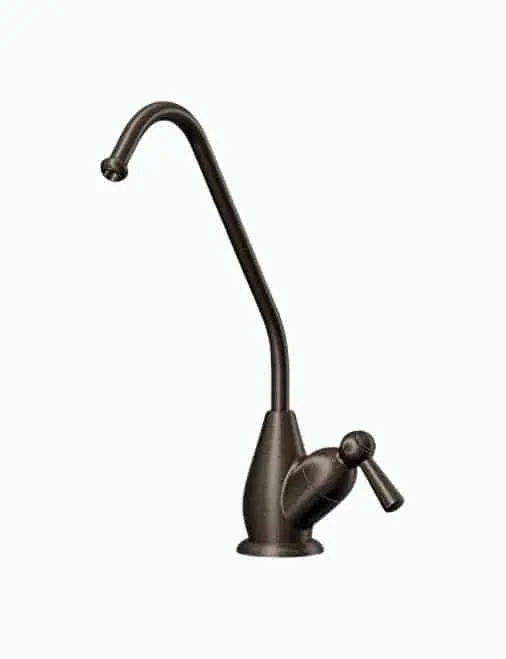
This popular faucet from AquaSource can bring a unique touch to your kitchen. It has a tall, narrow spout with an average reach, so it will fit most sinks. It has a single lever fitted on the side.
You can choose from several finishes such as oil-rubbed bronze, brushed nickel, and polished chrome. It also comes with a limited lifetime warranty.
What We Like
High Arc
The high arc gives the faucet a beautiful, sleek look. The water flows out in a narrow but powerful stream.
Thanks to the tall arc and shape, this faucet is ADA-compliant, so it’s easy and safe to operate for those with limited mobility.
Leak-Free
A ceramic cartridge valve helps to keep the handle operating smoothly while also keeping it drip and leak-free.
Free of Contaminants
Many homeowners worry about the amount of lead found in their drinking water. This faucet, however, meets the NSF’s low lead standards. It ensures your water is safe to drink.
What We Don't Like
Trouble With Reverse Osmosis Systems
Some customers reported problems when installing the faucet with an RO system.
AquaSource states that the faucet is compatible to work with a reverse osmosis (RO) system. RO systems treat the water and remove any contaminants. They use pressure to push water molecules through a membrane that filters any contaminants and flushes them out.
Product Specs
| Finish | Oil-rubbed bronze |
| Material | Metal |
| Flow rate | 2.2 GPM |
| Weight | 1.75 pounds |
Our Ratings
Personal Perspective
AquaSource Northridge Chrome Bathroom Faucet
Best Bathroom AquaSource Faucet
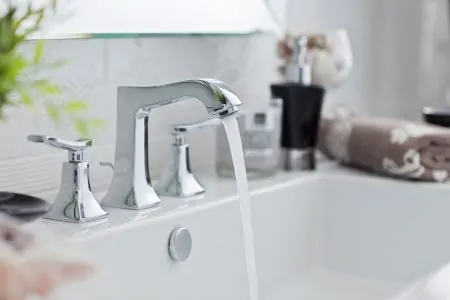
This faucet has a modern, minimalist style with its smooth arc and sharp handles. Each component sits on its own deck plate. Many customers praise the look of the spout and handles, saying they gave their bathroom a refreshed look.
It comes in a polished chrome finish that is easy to clean, and won’t show watermarks as easily as other AquaSource faucets.
The faucet is straightforward to install as it includes everything you need. It fits a three-hole, 8-inch configuration and you also receive a plastic pop-up drain with the same finish.
What We Like
ADA-Compliant and Easy to Use
The long spout reach provides a generous amount of space between it and the sink — an important feature for people with limited mobility. In addition, the two handles are large, easy to hold onto, and move with a simple forward rotation.
Water-Saving
More and more people are becoming aware of how important it is to conserve water. This also means it is important to choose a faucet that will help you do so.
This faucet is WaterSense labeled, which means it uses 20% less water without reducing its effectiveness. It has a flow rate of 1.2 GPM, which is standard for water-conserving bathroom faucets.
Free of Contaminants
Lead is a major concern for many homeowners across the United States, but this faucet meets the federal lead guidelines. It is free from any contaminants, and it will keep your water safe to drink.
What We Don't Like
Installation Isn’t Easy
Although AquaSource is often complimented for how easy it is to install its products, this one apparently misses the mark. Some customers said the instructions were confusing and difficult to read. It also doesn’t indicate that the washer hole needs to be aligned with the central spout.
Product Specs
| Finish | Chrome |
| Material | Not specified |
| Flow rate | 1.2 GPM |
| Weight | 2.88 pounds |
Our Ratings
Community Feedback
| Product | Award | Finish | Material | Flow rate | Weight |
|---|---|---|---|---|---|
| AquaSource Grabill Chrome | Most Affordable | Polished chrome | Metal | 1.2-GPM | 4 lbs |
| AquaSource Oil Rubbed | Water Dispenser | Oil-rubbed bronze | Metal | 2.2 GPM | 1.75 lbs |
| AquaSource Northridge | Bathroom | Chrome | Not specified | 1.2 GPM | 2.88 lbs |
Who Is AquaSource?
AquaSource is a discount homeware brand, sold almost exclusively by Lowe’s. Lowe’s acquires the products in bulk from several manufacturers, including:
- Long Tai Copper Corp: Established in Taiwan in 1981, Long Tai is one of the leading manufacturers of single and double-handled faucets. Long Tai prides itself on its high-quality products.
- Globe Union Industrial Corp: Based in Taichung, Taiwan, Globe Union is one of the largest plumbing product suppliers in the world. It has facilities in nine countries across Europe, Asia, and the Americas, but its products are sold in over 30 countries worldwide.
- Roddex Bath Hardware Co, Ltd: Founded in Shanghai in 1999, Roddex Bath Hardware Co. manufactures metal sanitary products for bathrooms and kitchens (1).
- American Standard Brands: For over 140 years, American Standard has been found in millions of U.S. homes. The company constantly raises standards by innovating new features and technologies (2).
Who Owns AquaSource?
AquaSource is sold by Lowe’s almost exclusively. As a result, many consumers believe the brand is owned by Lowe’s but this isn’t entirely accurate.
In 2008, LF, LLC trademarked AquaSource, indicating that they own the brand (3). Some quick research shows that LF, LLC also owns Lowe’s (4).
This means AquaSource is a Lowe’s-specific faucet brand, which is why it’s hard to find AquaSource products anywhere else.
Are AquaSource Faucets Any Good?
AquaSource is a discount brand, so you shouldn’t expect the same level of quality as Delta or Moen. That isn’t to say their products are of poor quality, as you will see in our reviews.
If you’re looking for a traditional faucet style within a specific price range, AquaSource could be the ideal choice.
This brand has an average rating of four stars on Amazon and Lowe’s, and most consumers were pleased with their purchases. Many buyers mention that installation is easy.
As AquaSource is a brand with multiple manufacturers, it is also easy to find replacement parts when needed.
A professional plumber is recommended when installing the faucets. The supply lines tend to be shorter than usual, which means they require extensions.
Some users have commented on the finishes of AquaSource faucets, particularly the glossy chrome. Specifically, reviews mention water spots after use, which require a wipe-down to clean. Chrome is already notorious for being high-maintenance, so keep this in mind when choosing a finish.
Where Can You Buy AquaSource?
The best place to find the full AquaSource catalog is Lowe’s, but you can also find a few models on Amazon. If you need replacement parts, you can take a look at Home Depot.
AquaSource Prices
Although AquaSource is considered a discount brand, there are still various prices within its range. Most kitchen faucets are sold for $150 or less but there are also multiple products available for less than $80 at Lowe’s.
If you choose to buy from another retailer such as Amazon, prices tend to vary more. It is essential to look for authorized dealers and not second-hand suppliers to ensure your faucets are properly protected. Prices here tend to start at less than $50 and can reach $200 for older models.
AquaSource faucets are very straightforward to maintain and don’t require much more than an occasional wipe-down. Repairing your faucet is also quite easy as replacement parts are readily available.
Warranty and Customer Service
All AquaSource faucets include a limited lifetime warranty, which guarantees the product will have no defects in material or craftsmanship. The warranty applies from the moment the product leaves the factory.
It’s important to note that intermediaries often sell this range. If you buy from one, you won’t be protected by the usual AquaSource faucet warranty if anything happens to your product.
Keep In Mind
Lowe’s Social Responsibility
LF, LLC has encouraged Lowe’s growth over the years. It started as a small hardware store in North Carolina. Since that time, it has grown into a major home improvement company. Today, more than 2,000 stores sell the AquaSource brand across North America.
Lowe’s is very active within each of its communities — sponsoring local events and donating to those in need (5). Lowe’s also prioritizes creating sustainable solutions for a better future.
The megastore focuses on stakeholder engagement within its organization. It aims to maintain a close relationship with customers and professional affiliates to address any issues, especially via its social media channels.
Lowe’s also conducts frequent employee surveys to ensure its ethical and conduct policies are being followed.
Types of AquaSource Faucets
AquaSource offers ample choice when it comes to kitchen and bathroom faucets. The brand offers single and double-handled models, as well as wall-mounts, pull-down, and pull-out styles.
Hi-Arc
Hi-arc faucets add an elegant style to any kitchen. Their narrow spouts give them a sleek look.
Being ADA-compliant (Americans with Disabilities Act) is hugely important and this type of faucet ticks that box thanks to the generous space it provides between the spout and the sink. The large single handle is easy to operate and provides a consistent temperature.
These faucets are available in multiple finishes such as brushed nickel, polished chrome, and oil-rubbed bronze.
Pros
- Elegant look.
- ADA-compliant.
- Available in multiple finishes.
Cons
- Not as efficient as other types.
Low-Arc
Low-arc faucets are more traditional, but they also look excellent in commercial-style kitchens. The smaller size is perfect for kitchens with limited space around the sink.
You won’t find much variety when it comes to the finish, so this might not be the right choice if you want something unique.
Some low-arc kitchen faucets include an extra feature: a side sprayer. Rather than the spout having two water settings, you receive an extra extendable hose that sits next to the faucet.
This type often features a PVD stainless steel finish that reduces water stains and helps the silver retain its shine.
Pros
- Suitable for smaller kitchens.
- Features a side sprayer.
- PVD finish.
Cons
- Few finish options.
Centerset
The centerset faucet style brings a timeless look to your bathroom and is a popular choice. They are available in a 4-inch double-handled configuration.
You should expect a flow rate of 1.2 gallons per minute, which meets the criteria set by WaterSense. They are also fitted with ceramic cartridges that keep them leak-free.
This range is ADA-compliant, meets the federal lead guidelines, and includes a limited lifetime warranty.
Pros
- WaterSense labeled by the EPA.
- Excellent flow rate.
- Ceramic cartridges.
Cons
- Limited finishes available.
FAQs

Is AquaSource a Good Brand for Faucets?
AquaSource isn’t considered one of the elite names in bathroom and kitchen faucets, but its products are very affordable and aren’t of poor quality. Perhaps the main reason it can be found in so many homes is that it is sold primarily by Lowe’s, which has more than 2,000 stores. It is a great option if you want to renovate a kitchen or bathroom without breaking the bank.

Who Makes AquaSource Faucets?
AquaSource is owned by LF, LLC, the company that also owns Lowe’s. However, its products are manufactured by several third-party manufacturers and purchased in bulk by AquaSource. These manufacturers include Long Tai Copper Corp and Globe Union Industrial Corp, both of which are Taiwanese. There is also Roddex, based in Shanghai, China, and American Standard Brands.

What Brand Is Compatible With AquaSource?
AquaSource faucets will work with any sink that has the appropriate configuration and number of holes. In terms of faucet parts, it is usually best to try to find replacement parts from the same company, in this case, AquaSource. However, there are other brands that are compatible with AquaSource, including Glacier Bay, which is owned by Home Depot. Your plumber or local retailer should be able to help you find a part that fits your faucet.

Which Is Better, Single or Double-Handle Aquasource Faucets?
Both single and double-handle faucets are made by Aquasource, and the choice between these two product types depends on what you need from a faucet.
Those who suffer from arthritis may find that single-handle faucets are more comfortable to use, while those who have double faucets are much less likely to inadvertently turn on extremely hot water. In the end, it’s all a personal choice.
The Verdict
Although AquaSource isn’t as high-end as some of the leading faucet brands, its products are still found in countless homes across the United States. These products are produced by several manufacturers, some of which are industry leaders.
If you are looking for a budget-friendly faucet for an inexpensive kitchen or bathroom renovation, the AquaSource catalog contains numerous excellent options. Still, you should keep in mind that you get what you pay for and you shouldn’t expect a faucet with the same reliability as the elite faucet brands.