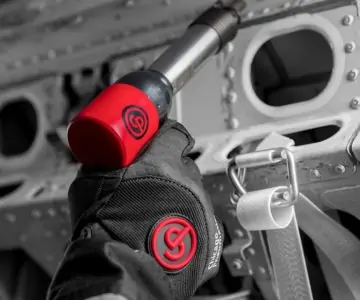
If you’ve never heard of an air hammer, you are in for a treat. An air hammer is a must-have tool for any DIY’er, especially if you like to turn your hands to anything and need a versatile and powerful device.
We run through the best air hammers to give you the facts.
- 1,800 BPM
- Positive trigger action
- 0.498-inch shank
- All-metal construction
- Instant trigger
- Doubles as a riveter
- 3,500 BPM
- 3 replacement chisels
- Heat-treated piston
- 2,200 BPM
- Quick-release feature
- Hardened steel barrel
No products found.
- Great entry-level hammer
- Built-in regulator
- Comes with 4 chisels
- 1-piece alloy barrel
- Variable trigger control
- Heat-treated piston
- Short barrel
- Aluminum body
- Speed regulating trigger
Review Methodology: At Sensible Digs, we take pride in providing you with thorough, hands-on analysis and professional evaluation of the best air hammers on the market. Our rigorous testing process includes benchmarking performance and comparing design attributes to determine what sets each product apart from its competitors. Our assessments are backed by concrete data and firsthand experience, ensuring that our findings are trustworthy. We rank each air hammer based on key decision-making factors such as power, durability, ease of use, and cost-efficiency. We also delve into the effect of the product’s design choices on the user experience. This allows us to provide you with an objective review that can guide you in choosing the right air hammer for your needs. Through our methodical approach, we aim to instill confidence in our readers that our recommendations are based on solid evidence and practical experience.
The Best Air Hammers of 2024
Air hammers come in all shapes and sizes. Plus, the prices vary enormously. We narrow down the best air hammers to our favorite 7 models.
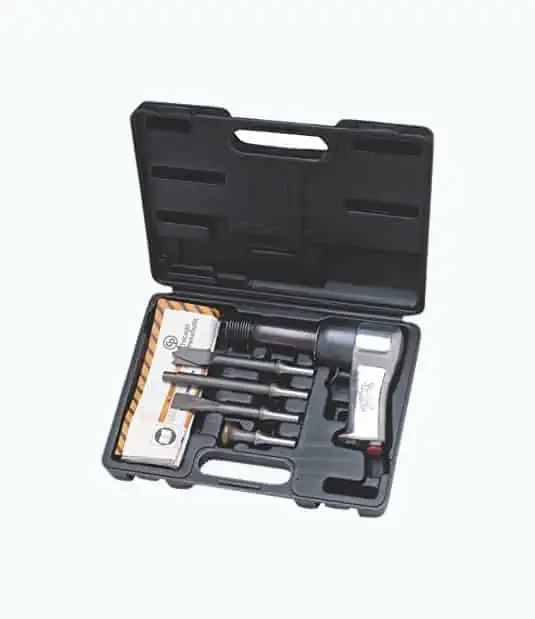
Chicago Pneumatic CP717K Super-Duty Air Hammer Kit
Best Air Hammer for Front End Work
This Chicago Pneumatic hammer chisel is the ideal tool to perform front-end work, deep cutting, and bolt riveting. It features a positive action trigger that delivers the power with an emphasis on control and speed.
It produces 1,800 blows per minute, has an ergonomic handle for comfort and enhanced grip, and is a heavy-duty tool. This air hammer will perform king pin bushing removal, bolt shearing, and install bulldozer walking beams.
It has a standard 0.498-inch shank, and it comes packed in a handy case along with 4 chisels and a spring-style retainer. The only dark cloud in the sky is the price. This tool is super-expensive, so it had better be good, or the price will seem outlandish.
Pros
- Comes with 4 chisels.
- 1,800 BPM.
- Positive trigger action.
- 0.498-inch shank.
Cons
- Super-expensive.
Product Specs
| Weight (pounds) | 5 |
| Dimensions (inches) | 10 x 3 x 13 |
| Accessories | 4 chisels |
| BPM | 1,800 |
| Price | $$$$ |
| Warranty | 2-year limited |
Our Ratings
User Experience
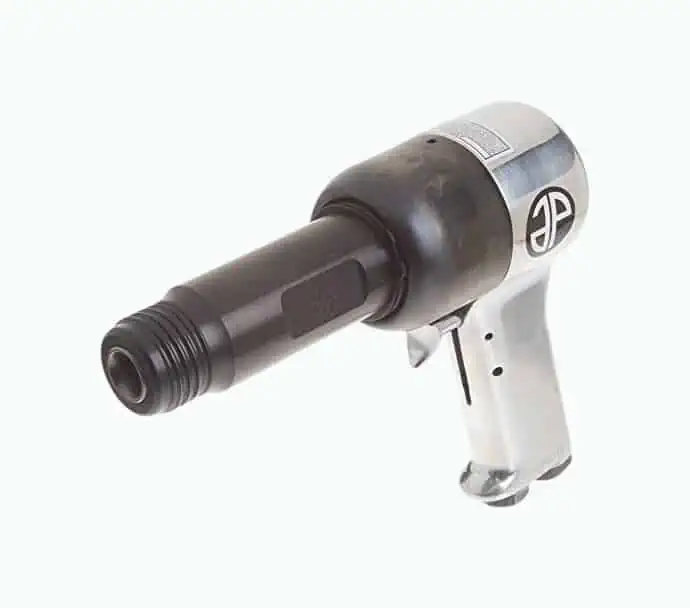
Astro Pneumatic 4980 Shank Super-Duty Air Hammer/Riveter
Best Heavy-Duty Air Hammer
This tool is not just an air hammer; it also doubles up as a riveter. This makes it a popular choice among professionals working on construction sites. The body is solid metal, enhancing its robust design and increasing its longevity. The handle is aluminum, while the barrel is steel.
It is a long barrel model, so it tackles heavy-duty tasks easier and delivers more power. It has an instantaneous trigger action, so you don’t have to wait for a full load of power. This saves time, although it does reduce the element of control.
The chisel action produces 1,800 BPM, and it comes with a retaining spring for easy attachment swapping.
Pros
- 1,800 BPM.
- All-metal construction.
- Long barrel.
- Instant trigger.
- Doubles as a riveter.
Cons
- No accessories.
Product Specs
| Weight (pounds) | 4.8 |
| Dimensions (inches) | 12 x 4.25 x 2.5 |
| Accessories | N/A |
| BPM | 1,800 |
| Price | $$$ |
| Warranty | 1-year |
Our Ratings
Personal Perspective
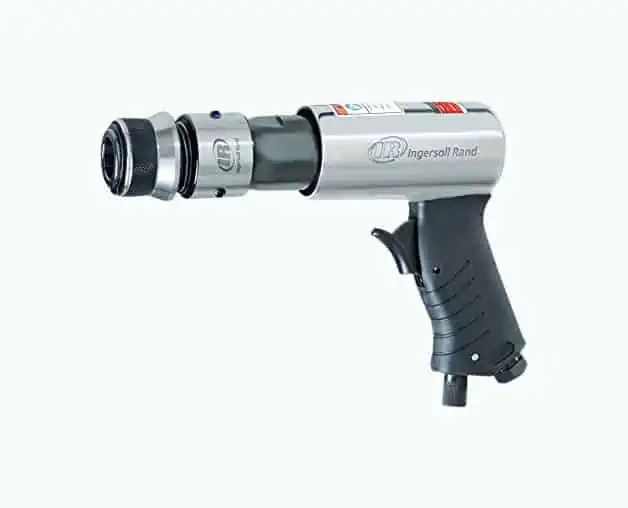
Ingersoll Rand Air Hammer 114GQC
Best Automotive Air Hammer
This Ingersoll Rand is a popular air hammer, outselling the competition on Amazon by a mile. The other great thing is the price. This is one of the most affordable air hammers you can buy. It delivers a medium-duty performance, making it ideal for the automotive industry.
It is comfortable to hold, thanks to the ergonomic design of the handle, and it delivers 3,500 BPM, using an average air consumption of 4 cubic feet per minute (CFM). The barrel is alloy steel, so it resists corrosion and the elements. It also makes it lighter.
This model has a heat-treated piston to increase its longevity and durability. It comes with 3 chisel attachments consisting of a tapered punch, a panel cutter, and a standard flat edge.
Pros
- 3,500 BPM.
- 3 replacement chisels.
- Heat-treated piston.
- All-metal barrel.
- Great price.
Cons
- Build quality issues.
Product Specs
| Weight (pounds) | 4.1 |
| Dimensions (inches) | 10.3 x 8.3 x 2.3 |
| Accessories | 3 chisels |
| BPM | 3,500 |
| Price | $$ |
| Warranty | 1-year limited |
Our Ratings
Community Feedback
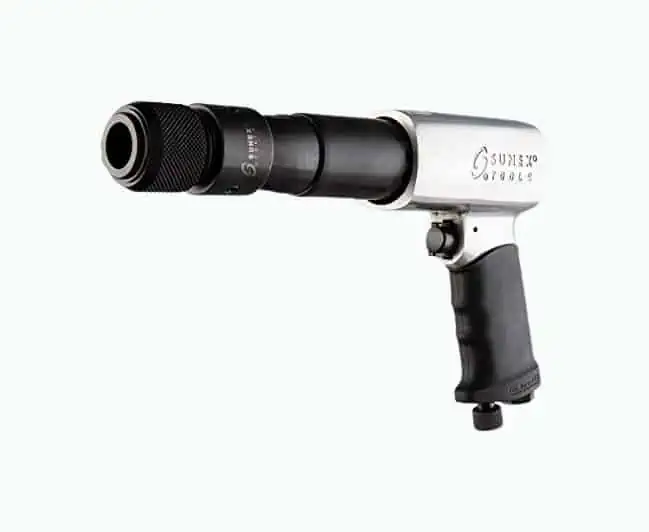
Sunex SX243 Hd 250-MM Long Barrel Air Hammer
Best Long Barrel Air Hammer
This Sunex combines lightweight design with producing the maximum power brilliantly. It has a long barrel, delivering power more effectively, making it an ideal air hammer for heavy-duty tasks.
The aluminum casing is what gives this hammer its robust yet lighter feel. Some elements within the hammer are steel for the sake of durability. The handle is ergonomic for comfort and grip, and the hammer action creates 2,200 BPM, making it a heavy-hitter.
It consumes an average of 4 CFM and is compatible with a 90 PSI air compressor, which is not an issue for modern compressors. It also has a quick-release feature to change chisels more efficiently and a regulator knob to control the speed better. This will please professionals because time is money.
Pros
- 2,200 BPM.
- Long barrel design.
- Quick-release feature.
- Lightweight.
- Hardened steel barrel.
Cons
- No accessories.
Product Specs
| Weight (pounds) | 6.7 |
| Dimensions (inches) | 10.5 x 7.5 x 2.5 |
| Accessories | N/A |
| BPM | 2,200 |
| Price | $$ |
| Warranty | 1-year |
Our Ratings
First-Hand Impression
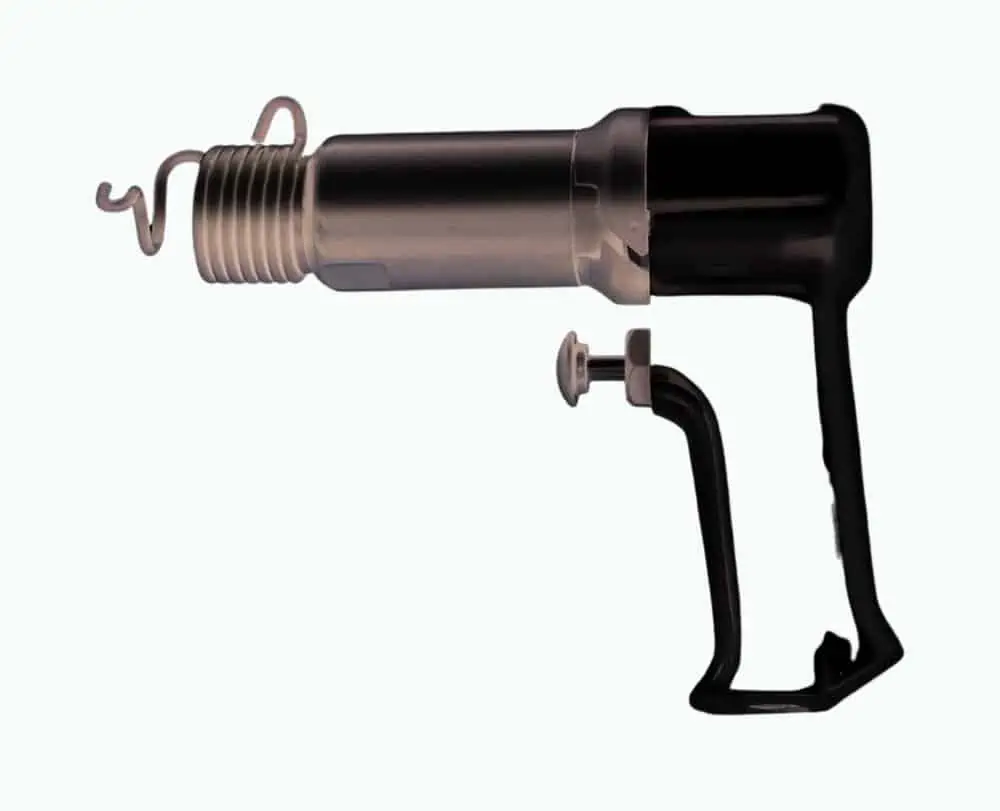
Dynamic Power Short Barrel Air Hammer
Best Budget Air Hammer
If you are shopping on a budget, this short-barreled air hammer could be the perfect choice. It costs a fraction of the rest included in the review, and best of all, you get 4 chisels and a retaining spring for quick attachment swapping.
This model is super-lightweight and comfortable to handle. The short barrel makes it an ideal candidate to get into tight spots, and the built-in regulator matches the speed to the job. It has an alloy-steel barrel and a heat-treated piston for increased durability and longevity.
As a budget air hammer, don’t expect this tool to be the best quality. The components are of inferior quality, drastically reducing the usable lifespan of this tool. But hey, you get what you pay for.
Pros
- Super-affordable.
- Great entry-level hammer.
- Lightweight.
- Built-in regulator.
- Heat-treated piston.
Cons
- Feels cheaply made.
- Prone to breaking.
Product Specs
| Weight (pounds) | 3.4 |
| Dimensions (inches) | 7.16 x 6.37 x 2.32 |
| Accessories | 4 chisels |
| BPM | Not stated |
| Price | $ |
| Warranty | Not stated |
Our Ratings
User Experience
Ingersoll Rand 121Q Super-Duty Air Hammer
Best Air Hammer for Concrete
If you are looking for an air hammer that breaks through concrete, most will do the job, but none as easy as this Ingersoll Rand model. It produces 3,000 BPM, making it a mighty air hammer for heavy-duty applications.
The robust 1-piece alloy barrel ensures that this air hammer will be around for years to come, and the heat-treated piston means it will last the distance, no matter how hard you drive this tool. It’s the reason why it is the best air hammer for breaking concrete.
It also has a built-in power regulator and variable trigger control, giving the user mastery of speed and power.
Pros
- Great brand name.
- 1-piece barrel.
- Lightweight.
- Built-in regulator.
- Heat-treated piston.
Cons
- Malfunctions are common.
- No attachments.
Product Specs
| Weight (pounds) | 3.5 |
| Dimensions (inches) | 15.8 x 2.8 x 7.3 |
| Accessories | N/A |
| BPM | 3,000 |
| Price | $$ |
| Warranty | 1-year |
Our Ratings
Personal Perspective
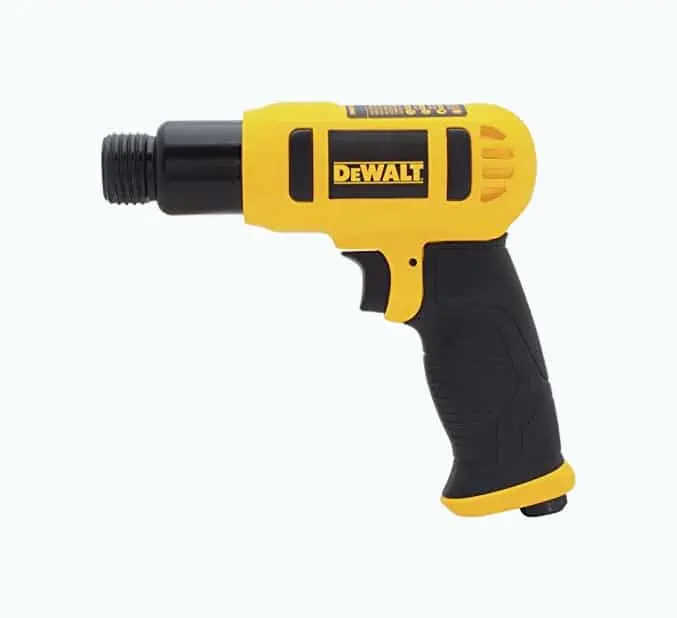
DeWALT Chisel Hammer DWM170785
Best Short Barrel Air Hammer
DeWALT is a well-known and respected name in the power tool world, so it comes as no surprise that we should include one in our air hammer review. What does come as a surprise is the price. This model could so easily have been the budget model winner.
It’s a short-barreled hammer, so it isn’t going to be the most potent tool to feature, but it still packs 2,600 BPM and has an average air consumption of 4.5 CFM. It also comes with a leading 3-year warranty, something the competition falls well short of doing.
The trigger is touch-control, helping you regulate the speed with ease. This allows you to build the power from a slower start and gives you added flexibility to adapt to different applications. It also has an aluminum body and a shock-absorbing rubber handle.
Pros
- Great brand name.
- Short barrel.
- Aluminum body.
- Speed regulating trigger.
- Great value for money.
Cons
- Built for lighter tasks.
- Lacks power.
Product Specs
| Weight (pounds) | 4.0 |
| Dimensions (inches) | 8.34 x 7.25 x 2.57 |
| Accessories | 3 chisels |
| BPM | 2,600 |
| Price | $ |
| Warranty | 3-year |
Our Ratings
Community Feedback
| Product | Best | Weight | Dimensions | Accessories | BPM | Warranty |
|---|---|---|---|---|---|---|
| Chicago Pneumatic Air Hammer | Front End Work | 5 lbs | 10 x 3 x 13″ | 4 chisels | 1,800 | 2-year limited |
| Astro Pneumatic Shank Air Hammer | Heavy-Duty | 4.8 lbs | 12 x 4.25 x 2.5″ | N/A | 1,800 | 1-year |
| Ingersoll Rand Air Hammer | Automotive | 4 lbs | 10.3 x 8.3 x 2.3″ | 3 chisels | 3,500 | 1-year limited |
| Sunex Long Barrel Air Hammer | Long Barrel | 6.7 lbs | 10.5 x 7.5 x 2.5″ | N/A | 2,200 | 1-year |
| Dynamic Power Air Hammer | Budget Pick | 3.4 lbs | 7.16 x 6.37 x 2.32″ | 4 chisels | N/A | N/A |
| Ingersoll Rand Air Hammer | Concrete | 4 lbs | 15.8 x 2.8 x 7.3″ | N/A | 3,000 | 1-year |
| DeWALT Chisel Hammer | Short Barrel | 4 lbs | 8.34 x 7.25 x 2.57″ | 3 chisels | 2,600 | 3-year |
What Is an Air Hammer?
An air hammer is a handheld tool that uses pneumatic power to carve into stone, break and shape metal and even wood. The strength comes from pressurized air that transfers energy through a series of repetitive strokes through the barrel.
These tools are so effective, thanks to the transfer of power from the pressurized air tank and the zero loss of PSI. An air hammer can cut through a steel pipe with ease when turned on full.
Air hammers are also useful to those in creative industries. Sculptors use them to chip away at marble and stone to create intricate shapes and designs.
How Do Air Hammers Work?
When the trigger is depressed, the air is supplied from the air compressor to a valve inside the hammer. Inside the barrel, there are pistons as well as two chambers located above and below the moving piston.
The pressurized air pushes the piston down, which moves the hammer action, known as the chisel extension, and this is what causes the chisel to strike the surface of your material.
The piston is forced back to its original position because of the air supply, and the whole process repeats in rapid succession.
What Can You Use an Air Hammer For?
Air hammers are ideal tools for heavy-duty industrial applications like removing old pipework and breaking up concrete. They are also found in fabrication settings where metal and alloys are cut and shaped.
The auto-industry uses them to loosen rusted or stripped bolts and nuts, and separate ball joints and shock absorber nuts, thanks to the vibration from the hammer action. In fact, air hammers are useful in any application that involves home renovations, dismantling machinery, car renovations, and even the arts, like sculptures.
How Do You Choose the Best Air Hammer?
If you’ve decided that an air hammer is the right tool, then you need to know what to look for when making your choice. Here are some simple elements to bear in mind.
Blows Per Minute (BPM)
You’ll hear this term a lot with air hammers and any other tools that have a percussive striking action. The blows per minute do exactly what they say. They are the number of times the piston pushes down to operate the hammer action of the chisel.
The BPM is the number of times this process occurs within a minute. The more BPM, the more powerful the machine, and the better it is at delivering that power. Each model caters to different tasks, and the BPM varies.
If you are a beginner, it might be a good idea to opt for a BPM somewhere in the medium to low range. 2,000 BPM is considered moderate, while 3,000 BPM is medium to heavy-duty. Getting a machine that’s too powerful can render it unusable in the hands of an inexperienced user.
A BPM of between 2,000 and 3,000 should have enough punch to cover 90 percent of all your tasks.

Trigger Control
How the power gets delivered depends on the type of trigger you have. Some offer instant power, and some allow you to control the compressor’s air delivery by graduating the supply based on the pressure you place on the trigger. This increases your control and stops the device from delivering too much power, which is hard to control.
Instant triggers release the full force of the air hammer the moment you press the trigger. While not suitable for all applications, construction workers and those operating within industrial settings appreciate this feature the most. They have little time to waste, waiting for the air hammer to reach capacity, and demand that instant speed.
For safety, a gradual increase of speed is better as it affords better control to the user.

Air Power
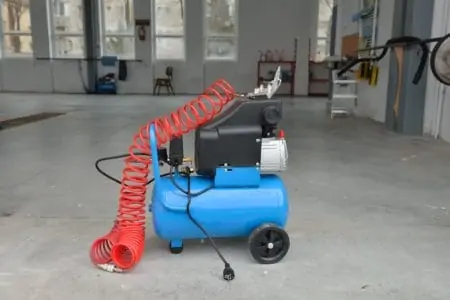
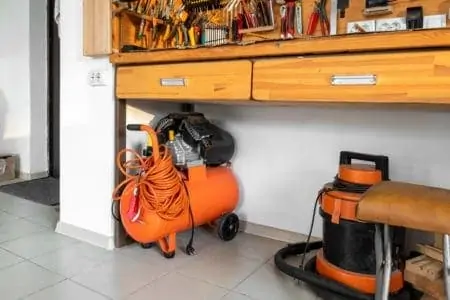
The impact of an air hammer comes from the compressor, which delivers a supply of compressed air. The hammer attaches to the compressor with an air hose. Be sure to check the PSI of the compressor and the hammer to make sure they are compatible. The last thing you want is an air hammer that struggles because the compressor is too weak.
While this is less of an issue with modern air compressors, built to match most tool standards, it is worth checking. An air compressor with a PSI of 100 will easily work with an air hammer with a PSI of 80. However, if the hammer has a PSI of 95 percent of the compressor’s maximum PSI, they are unlikely to match.
Barrel Size
A longer barrel delivers more significant amounts of force from the piston to the chisel. Imagine a handheld drill versus a pneumatic drill, and you’ll get the idea. Some of the heavy-duty models, designed for commercial use, have long barrels for this very reason.
This makes them powerful, but far less user-friendly or portable and less versatile. It also adds to the weight of the device. If you are looking for an all-around air hammer, don’t consider a model with a long barrel.
The most common is a medium-sized barrel. It will cover most of your tasks with ease. If you opt for a short barrel, expect the tool to be less potent, but the upside is it gets you into hard-to-reach places.
Does It Have a Chisel Set?
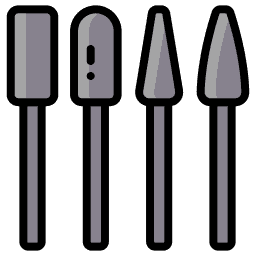
In the hands of an experienced operator, one chisel will cater to most tasks. However, if you want real versatility, getting a chisel set increases the applications. Chisel sets typically come in packs of 3 or 5, with different widths and surfaces.
Air Hammer Safety Tips
As with all tools, there are safe ways to use them. Here are a few hints and tips to keep you free from injuries.
Check the Compressor
Since all the power comes from the compressed air in the compressor, it is a good idea to make sure it isn’t empty. Waiting while the tank refills is a waste of time and could cost you money. Also, if you try the air hammer without the correct PSI, it could lead to damage to the tool and injury.
Choose the Right Chisel
Choosing the right attachment for the job is fundamental. Each chisel has a different width and surface, designed for each application. Also, make sure you have the right chisel for the material you are working with.
Mismatched attachments could lead to a poor end result and possible damage to the air hammer and the chisel.
Don’t Forget To Lubricate
Add machine oil to the base of the chisel as you insert it into the device. This helps to reduce any damage internally and preserves the chisel attachment.
Unattended Air Hammer
When leaving the air hammer unattended, shut off the air supply and make sure that you relieve the pressure when removing the air hose.
Take a Break
Using an air hammer is hard on your hands, wrists, and arms. To avoid fatigue, take regular breaks, and only work in short bursts.
Don’t Forget PPE
Using any type of power tool can be dangerous, especially if you don’t wear the correct protective equipment. You should put on goggles and ear defenders to protect you from possible flying debris and the noise of the air hammer. These tools are extremely loud!
Air Hammer FAQs

How Loud Is an Air Hammer?
The noise output of an air hammer starts at around 90 decibels, but some models (typically more powerful ones) can have up to 110 decibels.

How Big of a Compressor Do I Need for an Air Hammer?
Since air hammers need about 90 PSI to operate properly (of course, this depends on the size of the hammer), you need an air compressor with at least 4 CFM at 90 PSI. Note that more powerful air hammers may need up to 10 CFM air compressors to function properly.

What Oil Do You Use for Air Hammer?
Because air hammers are pneumatic tools, they need pneumatic tool oil. This type of oil has a mineral or a synthetic base. The low viscosity allows it to be atomized and carried through your air hammer using compressed air power.
Due to its composition, this oil isn’t sticky and doesn’t leave any unwanted residue.

Is an Air Chisel and Air Hammer the Same Thing?
An air chisel is just another name for an air hammer. Technically speaking, the two terms refer to the same tool. Chiseling is one of the many jobs that can benefit from using an air hammer, which also has several other applications.
You can swiftly and correctly carve out grooves to fit around curved surfaces with an air hammer and tap out rivets or pins that have been over-tightened.
Compared to grinding or using a power wire brush, the force of its blows makes it possible to remove rust, debris, or other things more quickly.

Who Makes the Strongest Air Hammer?
The Ingersoll Rand 114GQC is one of the most potent air hammers available – and that’s no surprise!
Developed by one of the most trusted brand names in power tools, this powerful little tool boasts 3,000 BPM and an all-metal barrel built to withstand even the most challenging jobs.
The hammer also comes with 3 spare chisels and a heat-treated piston designed to give you precise control on any project.
Hammer the Point Home
Air hammers are useful tools. Whether you are working on your car, stripping machinery on the farm, or producing the next great sculptural art piece, an air hammer is going to make your life easier.
They cut, strip, chisel, remove rivets, and chip away at stone, marble, and concrete. They are the ultimate all-rounder and a tool you should have in your arsenal.